stever_sl
ACCESS: Confidential
- Joined
- 31 August 2010
- Messages
- 182
- Reaction score
- 1,198
While poking around through bins of stuff collected in my 42-year aerospace career this morning, I uncovered a couple of stickers from the weird A/F-X competition where McDonnell Douglas had 2 separate teams working on 2 competing proposals with different sets of teammates. We were teamed with Vought on the one I was involved with. It was in the days when "Integrated Product Teams" were all the rage with management. We had IPTs for everything on that program, with comical results in some cases. I recall that there was an Outer Wing Panel IPT and an Inboard Wing Panel IPT with the separation line being at the wingfold (for the USN version). Usually there would be a single Wing Team but IPT was going to show us how to be more efficient and innovative and other buzzwords. Instead, each IPT did their own structural design independently, with the goal of carrying the local loads with the lightest possible structure. And when they were done, they'd come up with an outer wing having a different number of spars than the inner wing, so the wingfold ribs had no easy way to handle the carry-through bending and torsion loads. THAT took some fancy sorting-out.
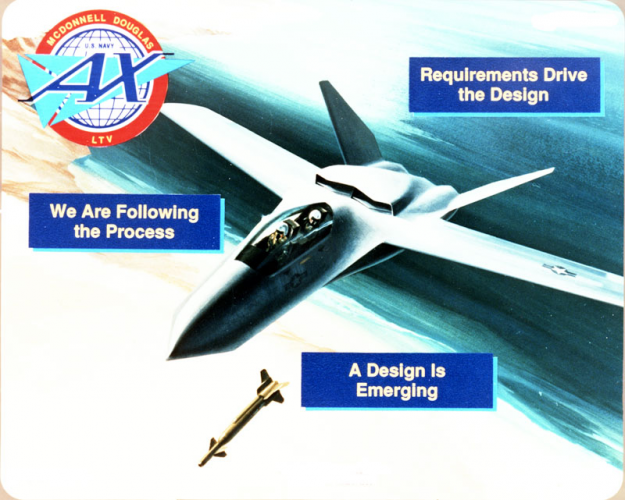
But the feature that caused the worst headaches involved something that's usually utterly benign, the inlet ducts. I've gone into this elsewhere but to recap, our top program manager was embracing yet another management fad called Management By Walking Around. He was making a tour of the design area and happened to notice that one of the most junior people had sketched a layout with the inlets on top of the fuselage instead of at the wing roots. He instantly seized on this as a way to make our design stand out visually from those that the competing teams would probably be producing. So that became our unchangeable design centerpiece. Only later did we realize that those inlets created all kinds of unsolvable practical problems, which again I've covered in some detail elsewhere. Suffice it to say that even if those problems had somehow been overcome, what resulted was a remarkably ugly airplane, so much so that when the whole program mercifully collapsed, our "clean sheet" A/F-X (as opposed to the "Son of A-12" that the other McDonnell Douglas-led team was working on) never made it into the real world in the form of articles or even photos. Various people have expressed curiosity about it, here and in other groups, but very little was available.
So when I found those stickers this morning, they made me take one more look with more creative search terms. And lo and behold, there it was, right here in this forum! So if anyone is interested, here it is! ("A Design Is Emerging" may be the ultimate in wishful thinking, out of all of the projects I supported in my career... )
)

But the feature that caused the worst headaches involved something that's usually utterly benign, the inlet ducts. I've gone into this elsewhere but to recap, our top program manager was embracing yet another management fad called Management By Walking Around. He was making a tour of the design area and happened to notice that one of the most junior people had sketched a layout with the inlets on top of the fuselage instead of at the wing roots. He instantly seized on this as a way to make our design stand out visually from those that the competing teams would probably be producing. So that became our unchangeable design centerpiece. Only later did we realize that those inlets created all kinds of unsolvable practical problems, which again I've covered in some detail elsewhere. Suffice it to say that even if those problems had somehow been overcome, what resulted was a remarkably ugly airplane, so much so that when the whole program mercifully collapsed, our "clean sheet" A/F-X (as opposed to the "Son of A-12" that the other McDonnell Douglas-led team was working on) never made it into the real world in the form of articles or even photos. Various people have expressed curiosity about it, here and in other groups, but very little was available.
So when I found those stickers this morning, they made me take one more look with more creative search terms. And lo and behold, there it was, right here in this forum! So if anyone is interested, here it is! ("A Design Is Emerging" may be the ultimate in wishful thinking, out of all of the projects I supported in my career...
)