- Joined
- 14 June 2006
- Messages
- 2,300
- Reaction score
- 699
Attachments
Last edited by a moderator:


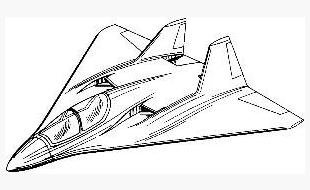


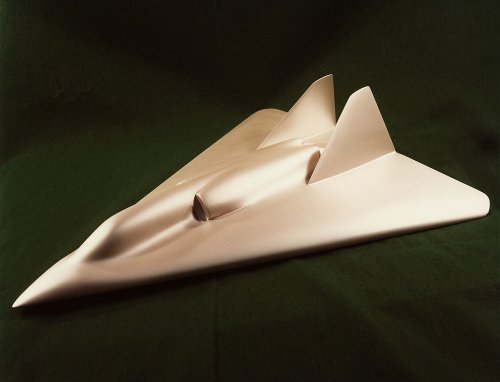
overscan said:Is it the McDonnell-Douglas XST?

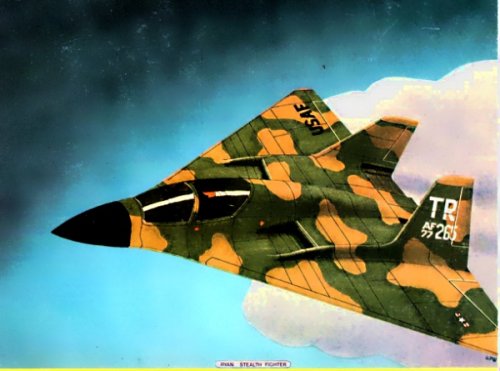
overscan said:What do you think?
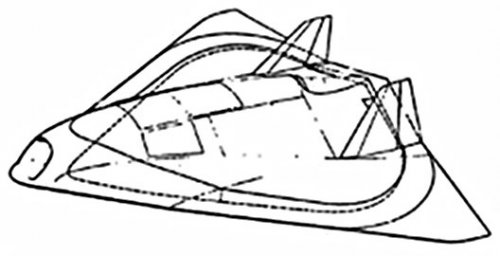
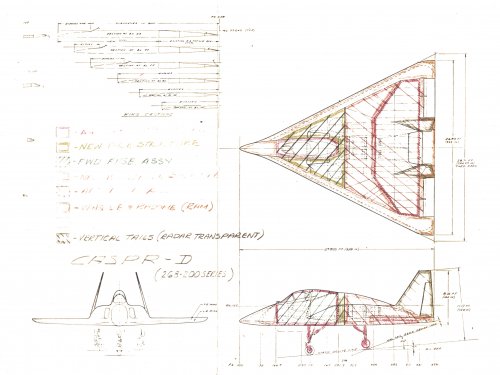
Scan is by Mark Nankivil, no info other than date of 1975.
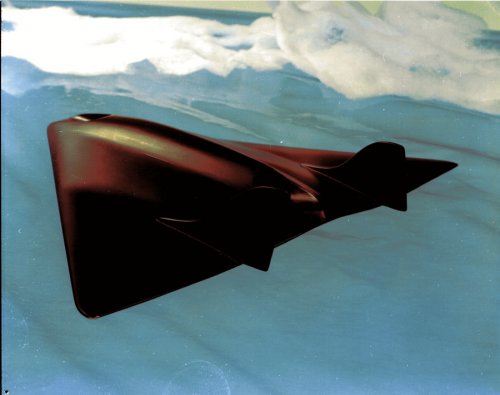
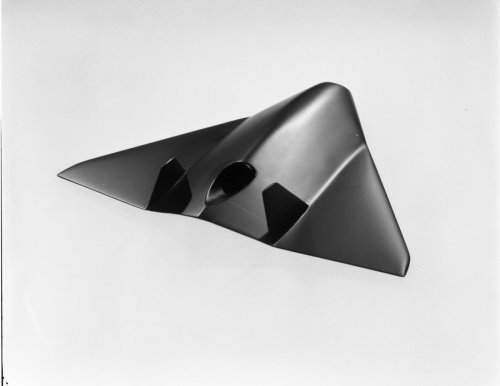
Model 268 is described in American Secret Projects as a low signature fighter designed to a DARPA contract in 1975.
McDonnell-Douglas were awarded a DARPA contract at the start of the XST project in 1975 along with Northrop.
Design matches basic XST parameters.
So, is this Model 268? Is it the McDonnell-Douglas XST?
overscan said:Should have noted: scan is from McDonnell-Douglas collection, so is presumed to be a MDC design.
Did Teledyne Ryan work with McDonnell-Douglas on the Quiet Aircraft?
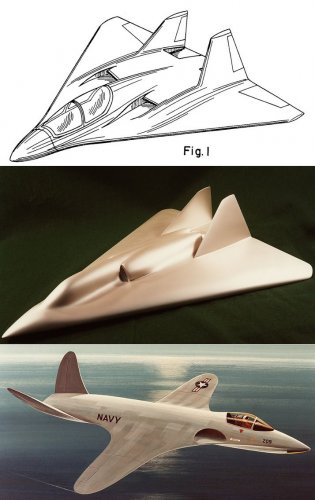

aim9xray said:Has anyone information that might tie in?

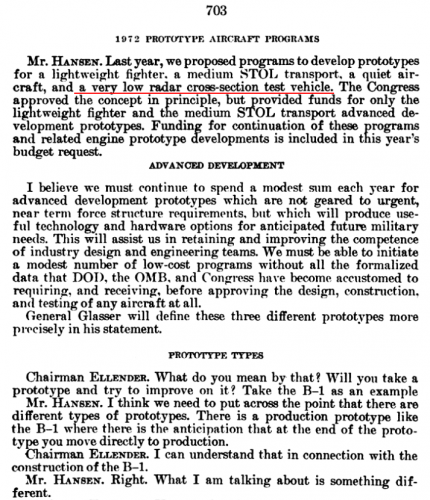
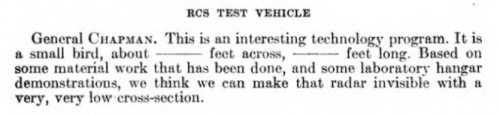
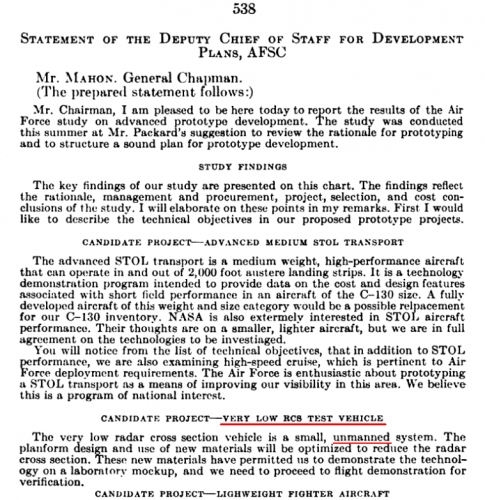
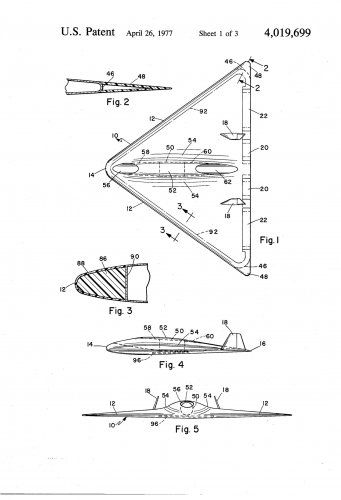
Accordingly, in 1971, a new Air Force prototyping study team recommended the development of a very low radar cross section test vehicle as part of a Department of Defense (DoD)-wide move toward advanced prototyping initiated by Deputy Secretary of Defense David Packard. The very low RCS test vehicle was proposed by Teledyne Ryan, and was one of six programs that the study team recommended from a field of 45 candidates, noting that
...the capability to achieve extremely low radar cross sections has been demonstrated by large scale, nonflying test models.... The capability to remain "invisible" to radar so radically changes the posture of most offensive and defensive systems that prototype testing to confirm this capability is warranted
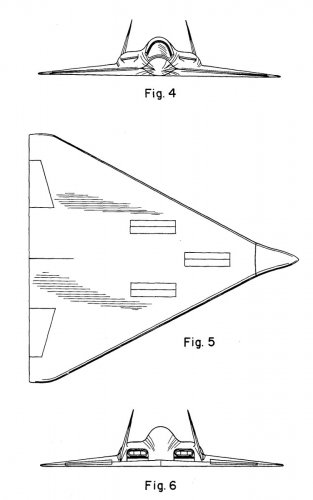
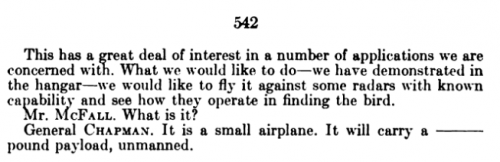
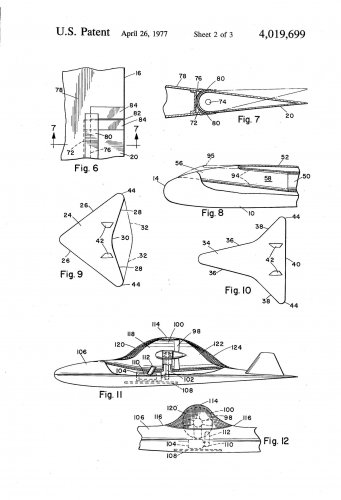
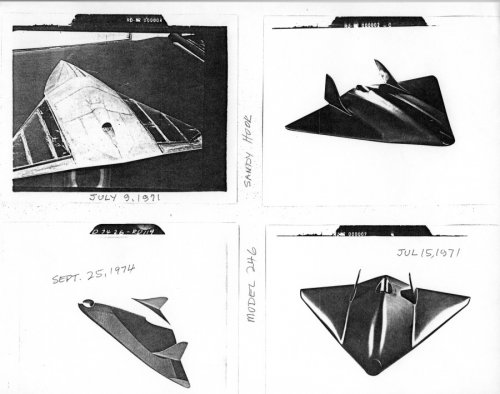
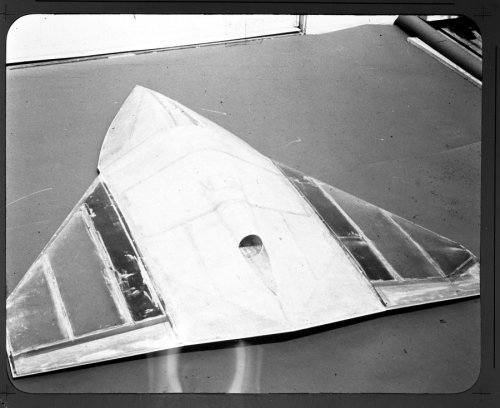
Teledyne Ryan proposed to build and flight test three unmanned aircraft. The proposed design was almost certainly similar to the delta-wing shape, illustrated in Fig. 5. Gross weight would be approximately 3000 lb. The aircraft would be subsonic but capable of very high altitude flight. Launch would be accomplished from a modified C-130 was recovery by the existing mid-air retrieval system (MARS) as used by their earlier AQM-91A Compass Arrow and other drones.
Teledyne Ryan Low RCS Vehicle Study (1973-1974 Design Study)
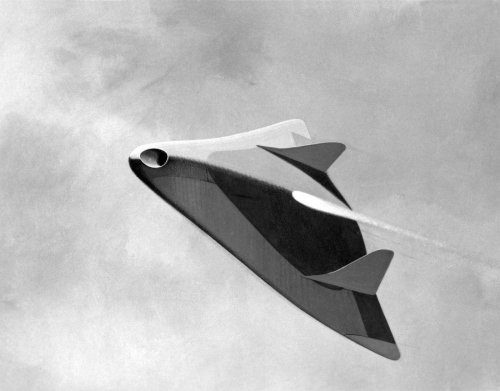
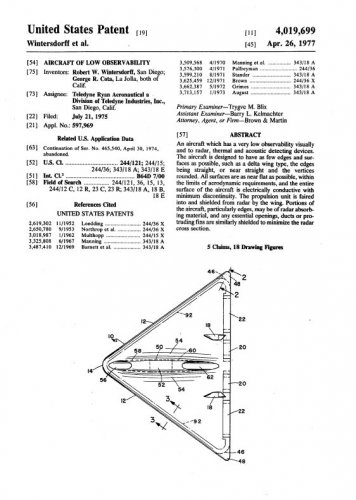
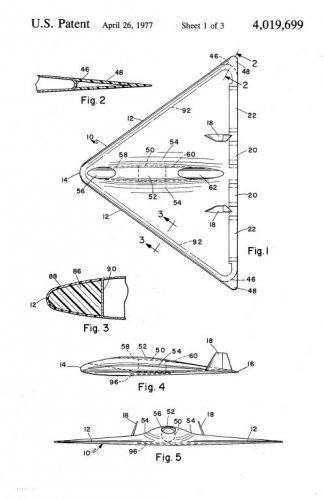
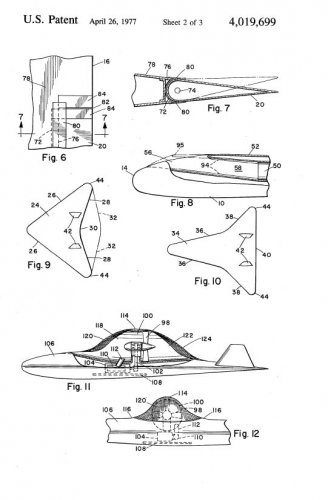
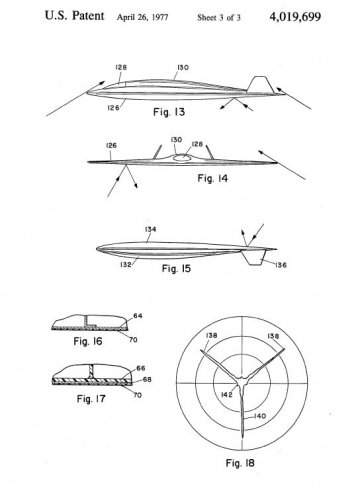
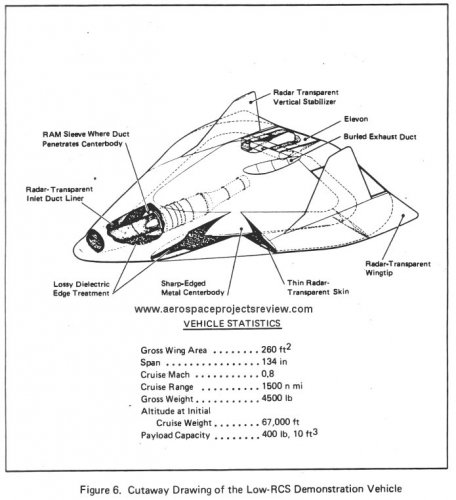
The Remotely Piloted Vehicle Special Projects Office at Wright-Patterson Air Force Base, Ohoi conducted studies and tests in conjunction with Teledyne Ryan and other companies of low RCS drones. Having learned from experience with the AQM-91A Compass Arrow that a conventional, wing-body-tail arrangement would not acheive very low signatures, Teledyne Ryan advanced to a more aggressive approach involving simpler planforms with fewer surfaces and edges. The Teledyne Ryan Low RCS Vehicle, illustrated in Fig. A11, was to consist of a small metal centerbody surrounded by a large amount of lossy dielectric material. The configuration was all-wing with a simple delta planform and inward-canted twin vertical tails. The engine and equipment were buried in the fairly thick wing root. Tail surfaces and other features were to be made of "radar-transparent" materials. Overall dimensions would be approximately 18 ft in overall length and 21 ft in wingspan.
Teledyne Ryan Mini-RPV (1974-1975)
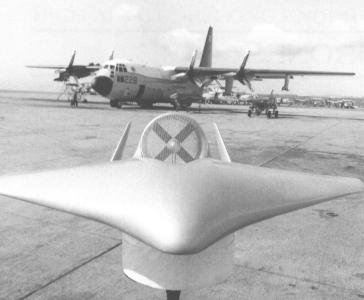
The 7.5-ft wingspan Teledyne Ryan Mini-RPV followed the same shaping approach as the Low RCS Vehicle, but it specifically avoided reliance on RAM. Several versions were proposed with variations in the tradeoff between radar treatment, countermeasures, and overall system cost. As shown in Fig. A12, it was powered by a ducted fan on the top side of the vehicle, and in some variants it was intended to use wire screens over both ends of the duct, as well as over the sensor package on the vehicle's underside. In RCS testing, Mini-RPV models met or exceeded signature goals that were based on achieving survivability through a combination of RCS reduction and countermeasures. Some Mini-RPVs were built and flown, although it is unknown wether any of these represented a low-RCS configuration or wether any in-flight RCS testing was ever performed.
Neither the Mini-RPV nor the Low RCS Vehicle achieved sufficiently low signatures to avoid detection completely while performing a useful military mission. However, they did provide what was perhaps the first credible indication that such a goal could be accomplished. Many radar systems did not perform at all well against these targets. The lesson was not wasted. Several of the people involved in these projects at the Air Force's RPV office later played key roles in formulating and managing the Have Blue program.
quellish said:The Mini-RPV is the Model 262. SDASM has posted quite a few images of it on Flickr:
https://www.flickr.com/search/?w=49487266@N07&q=Model 262
The Low RCS Vehicle Study paper mentions the Mini-RPV, and specifically that it did not incorporate the RAM edge treatments described in the paper because they were not available.
The Model 262 was built for the Navy's Shipboard Tactical Airborne RPV program. It was flight tested in 1976-1978(?).
In 1975 several tests were conducted at China Lake to explore RPV signatures using a BD-5 (N5390). The BD-5 acted as an RPV surrogate and flew through a dynamic RCS range set up at Randsburg Wash. You can seem some photos of this here:
http://www.chinalakealumni.org/1975/1975.htm
The Mini-RPV was later flown against the same dynamic range at Randsburg Wash to verify it's in-flight radar cross section.
quellish said:As this concerns the TR UAV programs that lead to the Model 268 XST (and, in fact, are what prompted the HAVE BLUE program itself), this topic seemed like the best place for it. If it is not I can remove my post.

Mark Nankivil said:Any thoughts on the meaning of CASPR-D? "Casper the Friendly Ghost" comes to mind....
Enjoy the Day! Mark

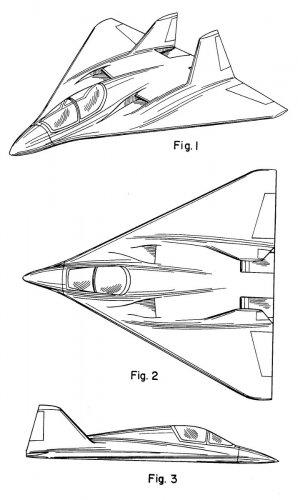
I'd say there are some [significant] differences between drawings and model, surely they are different iterations...PaulMM (Overscan) said:Yep, thats definitely a drawing of a Model 268 XST demonstrator. I understand the inlets better from this drawing than the model.
flateric said:I'd say there are some [significant] differences between drawings and model, surely they are different iterations...PaulMM (Overscan) said:Yep, thats definitely a drawing of a Model 268 XST demonstrator. I understand the inlets better from this drawing than the model.
Mark Nankivil said:Thanks Paul - works for me!
Enjoy the Day! Mark
 I wonder what the Northrop XST name was
 Mark Nankivil said:Any thoughts on the meaning of CASPR-D?