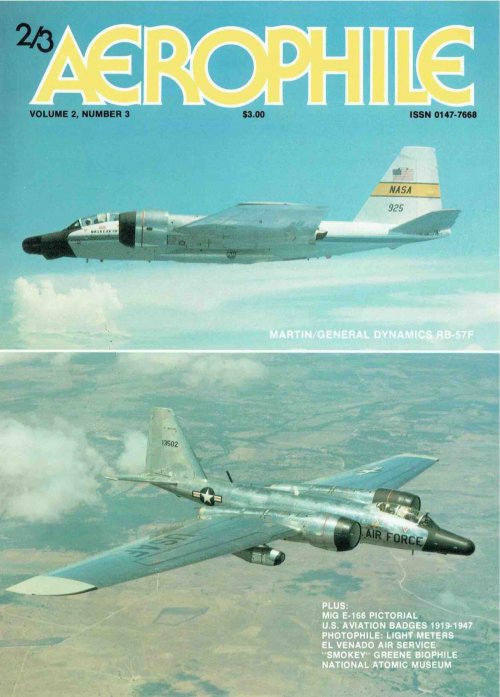
Martin RB-57F

Foo Fighter

Cum adolescunt hominem verum esse volo.
Senior Member
Joined
19 July 2016
Messages
4,816
Reaction score
4,276
How much commonality do these have with the standard Canberra/B-57? Apart from the lengthened wings.

 
RB-57F aircraft were converted by General Dynamics from RB-57A, B-57B and RB-57D aircraft.
Text from Profile 247 - 'The Martin B-57 Night Intruders & General Dynamics RB-57F' by David A. Anderton, Profile Publications.
[...]
modification - actually more of a complete rebuild - of 21 aircraft
[...]

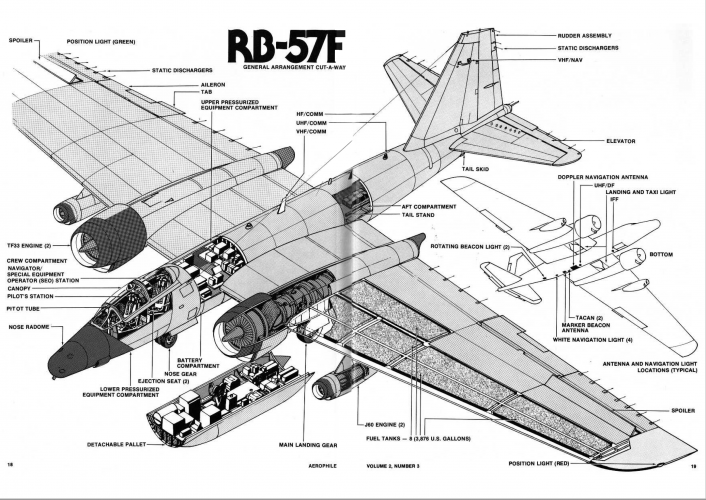
General Dynamics salvaged not much more than the fuselage centre and aft sections, the horizontal tail and the landing gear. Everything else - plus the cockpits of the RB/A aircraft - was new construction.
<edit>
According to 'General Dynamics Aircraft and their Predecessors' by John Wegg, Putnam, 1990, new serial numbers were issued because of the extent of the rebuild. Fuselage fuel tanks had to make way for additional electronic gear - all fuel was carried in the wings, outboard of the engines.
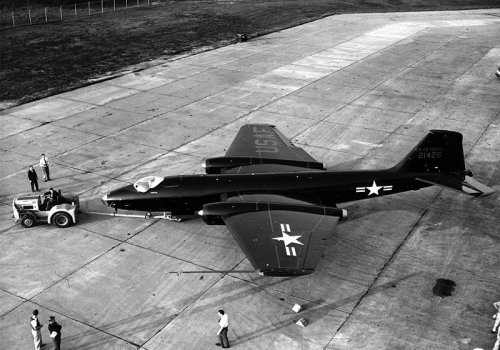
<edit2> The RB-57A had a single-piece bubble canopy, different from the B-57B/D canopy. Hence the need for new cockpit sections for the three F-aircraft converted/rebuilt from RB-57A aircraft.
Image from wiki
 

Attachments

  • Martin RB-57A.jpg
    Martin RB-57A.jpg
    104.1 KB · Views: 306
IIRC, the Squadron/Signal B-57 in Action book has a couple of photos of the rebuilding taking place
 
Speaking of:

https://www.youtube.com/watch?v=1v9qef5NtgA
 
(** PLEASE MOVE POST IF THERE IS A MORE APPROPRIATE TOPIC ALREADY CREATED **)

Posted by Jeff Quitney on YouTube is this film, "RB-57D Progress Report No. 2" (1956). The film includes RB-57D flight test footage, as well as structural test footage. The most interesting variety of the latter is footage of the "90% limit load proof test" on the aircraft's immense wings, which consisted of employees yanking on the wings up and down (beginning at the 2 minute 53 second mark). It is reminiscent of the "shake test" done on a boilerplate Saturn V/Apollo stack inside the Vehicle Assembly Building (VAB) in October 1966 (link).

YouTube - Jeff Quitney: "B-57 Canberra: 'RB-57D Progress Report No. 2' 1956 Martin Aircraft-USAF Reconnaissance Spy Plane"
https://www.youtube.com/watch?v=NII_IBplsdU
 
Ok, does somebody have the operational and maximum ceiling of that beast ? I've seen numbers ranging from 60 000 ft to 80 000 ft (!) - including: 62 000 ft, 68000 ft, 74 000 ft.

How high could it go, with the J-60-P9 ?
 
Ok, does somebody have the operational and maximum ceiling of that beast ? I've seen numbers ranging from 60 000 ft to 80 000 ft (!) - including: 62 000 ft, 68000 ft, 74 000 ft.

How high could it go, with the J-60-P9 ?
I've seen sources that said 125,000 feet years ago. I did read one account from an RB-57 pilot wherein he said that they'd see those values and chuckle because some of them were way overblown. ISTR him saying they gave U-2 pilots grief because, though they couldn't climb as high as the U-2s, the books said they could. :p
 
Ok, does somebody have the operational and maximum ceiling of that beast ? I've seen numbers ranging from 60 000 ft to 80 000 ft (!) - including: 62 000 ft, 68000 ft, 74 000 ft.

How high could it go, with the J-60-P9 ?
I've seen sources that said 125,000 feet years ago. I did read one account from an RB-57 pilot wherein he said that they'd see those values and chuckle because some of them were way overblown. ISTR him saying they gave U-2 pilots grief because, though they couldn't climb as high as the U-2s, the books said they could. :p

RB-57F pilot to U-2 pilot "I flew so high once, I landed on Uranus..." (runs for cover)
 
I read somewhere that the record in service was 70k' and change but am pretty sure that was a one off.
 
Last edited:
So with these RB-57Fs in type 1000 storage NASA has a relatively large number of airframes that could be restored to airworthy status if properly refurbished?
 
So with these RB-57Fs in type 1000 storage NASA has a relatively large number of airframes that could be restored to airworthy status if properly refurbished?
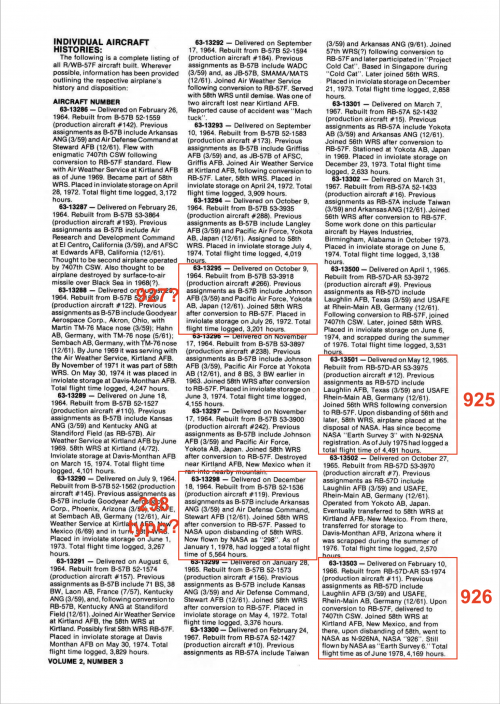
The airframe that crashed was only pulled out of Type 1000 a few years ago, so it's certainly possible. What we don't know is how many have been reduced to lower storage levels since the article was published. Some may have been further cannibalised to maintain the existing fleet, used in return to flight activities or otherwise written off. Periodically aircraft at the boneyard will have their status downgraded or written off as finances dictate or perceived utility falls.

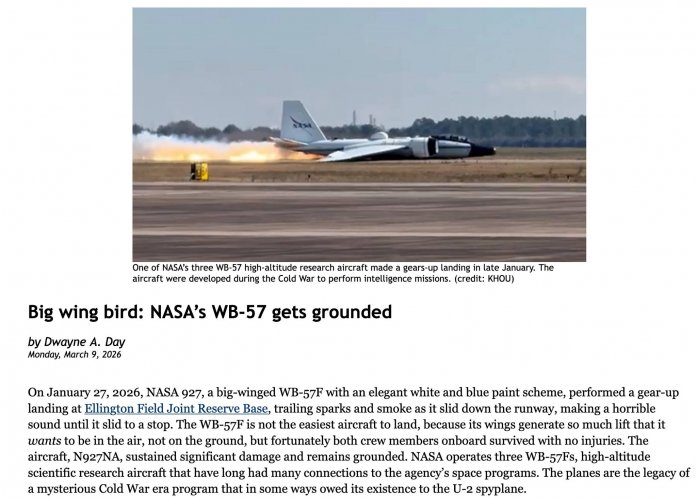
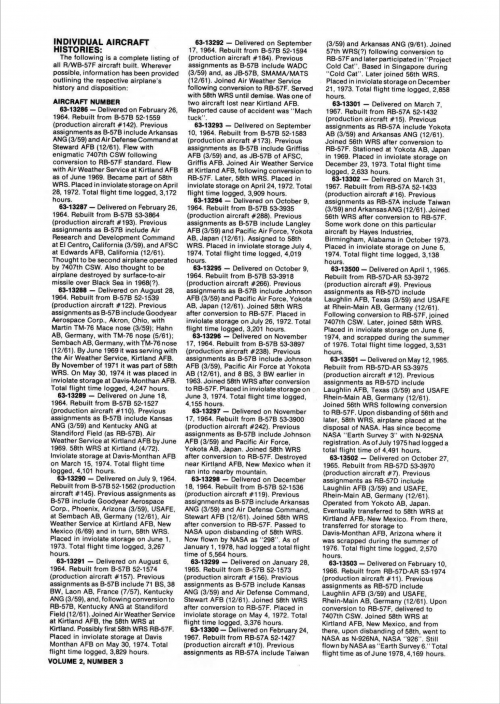
ETA - it's 63-13295 on the above article.
 
Last edited:
I'm working on an article about the WB for The Space Review. Last week at a meeting a NASA official who runs the Earth science program that owns the aircraft said that NASA flies them at 50,000 feet.

By the way, NASA just refers to them as WB-57s. Years ago I acquired a sticker for the program that labeled it the WB-57F, but then a year or so later they had dropped the "F." I've got the stickers around here somewhere. I'll take pictures and post them.

Does anybody know if they got the aircraft off the runway? I assume they did after a day or so, but have not seen any confirmation.
 
Does anybody know if they got the aircraft off the runway? I assume they did after a day or so, but have not seen any confirmation.
Usually doesn't take all that long to get the bird off the runway. Jacks under the lifting points, and force the landing gear down and locked. Tow it off the runway.

Then figure out what prevented the gear from coming down in the first place once the bird is back in the hangar.

Note that you can likely use the same jacks on that WB-57 as you can on a Cessna 172. It's cheap to overbuy your lifting gear, and the one time you need the full capacity of the lifting gear you've probably paid for it. What with the costs of leaving an airport closed while you send someone to go run to get sufficiently large jacks.

Granted that due to the fire in this case you've got a lot of wait time to make sure there's no reflash, so if by some nightmare that airfield doesn't have jacks strong enough to lift the plane in question you can send someone to go chase down a set from the neighboring airfield. But I bet they have ~40ton jacks at the airfield, nevermind the ~15ton jacks you'd need for an empty WB-57F.
 
I'm surprised they didn't lay down some fire-suppressant foam on the runway first before the WB-57F belly-landed.
 
I'm surprised they didn't lay down some fire-suppressant foam on the runway first before the WB-57F belly-landed.
I don't know if that is still done. IIRC it makes the slide a lot farther, which may not be a good idea.

Ignoring the whole "AFFF causes cancer" details.
 
As an example, here's Italian Airforce Tornado I-41 having a slide down RAF Cottesmore's runway (0.35s)

This was lifted, towed and in the hanger the same day (Slight delay as the crash kit was for Canberra's not tornados).

Sat in the hanger but was fully repaired and returned to flight (i think it took two year but that was partly politics, RAF base, Italian jets German crew)

View: https://www.youtube.com/watch?v=yDwEtzzLIGI
 
I'm surprised they didn't lay down some fire-suppressant foam on the runway first before the WB-57F belly-landed.
It is possible the crew did not know the gear was up when they landed on the runway.
 
One sidenote: around 2009 or 2010 I got to see the WBs up close. I was at JSC for work and emailed the head of the program, a former astronaut, and asked if I could come over to see them. He said sure, and then he walked me around one of them. I have a bunch of photos somewhere.

Anyway, one thing he told me was that they were running out of tires for the planes. I think he said that they called up Goodyear and in their warehouse, Goodyear still had the molds for the tires. The problem was that it would be expensive to set everything up to only make a few tires for the WB-57s. But the tires were the same diameter as the F-15 tires, and there are a million of those. So what they were doing was remanufacturing the wheel hubs on the WBs so that they could mount F-15 tires on them instead. It was expensive, but it was a one-time mod, and then they could use F-15 tires on the planes.
 
I don't know if that is still done. IIRC it makes the slide a lot farther, which may not be a good idea.

Ignoring the whole "AFFF causes cancer" details.

On whether or not to foam the runway prior to a bellylanding . This , from 'How to bellyland a Thunderchief' , 'Aeroplane Monthly' , October 1977 , page 515 :-

'Waite then asked if I wanted the runway foamed, and I replied “Negative.” My reasoning was this: foam would lengthen my ground slide and probably increase the damage to the aircraft. With a rnid—wing aircraft like the F-105, which had no fuel cells in the lower fuselage, the chance of fire was minimal except for the magnesium ventral fin on the rear fuselage (which, I must admit, I had forgotten}.
I was also influenced by aircraft I had seen after belly landings in foam. They were a mess, and virtually had to be disassembled for cleaning.'

( My bold )

cheers ,
Robin .
 
Okay, I'm still working on my article and trying to get something straight. The aircraft with the gear-up landing in January was 927.

926 and 928 are (or were, as of January) in maintenance.

927 is the one that started flying in 2011 after being in storage for a long time.

NASA has a decent website on its aircraft here:

https://www.nasa.gov/specials/jsc-aircraft-ops/wb57-history.html#top
https://www.nasa.gov/specials/jsc-aircraft-ops/assets/WB-57FBrochure.pdf

Something that was throwing me off is that 926 and 928 were flying for a long time, but there was no 927. When the last plane was refurbished and put into service, it was given the number 927.

Screenshot 2026-01-29 at 7.16.21&#8239;PM.png
 
I wonder if any of NASA's WB-57Fs ever participated in the DoD/DoEs atmospheric nuclear tests starting in 1956 with operation Redwing and ending in 1962 with operation Dominic?
 
I wonder if any of NASA's WB-57Fs ever participated in the DoD/DoEs atmospheric nuclear tests starting in 1956 with operation Redwing and ending in 1962 with operation Dominic?
It's possible. IIRC the first of the WB-57s NASA got were from the same squadrons that were involved in the tests.
 
I wonder if any of NASA's WB-57Fs ever participated in the DoD/DoEs atmospheric nuclear tests starting in 1956 with operation Redwing and ending in 1962 with operation Dominic?

The WB-57Fs were rebuilt B-57Bs starting in 1963.
 

Similar threads

Back
Top Bottom