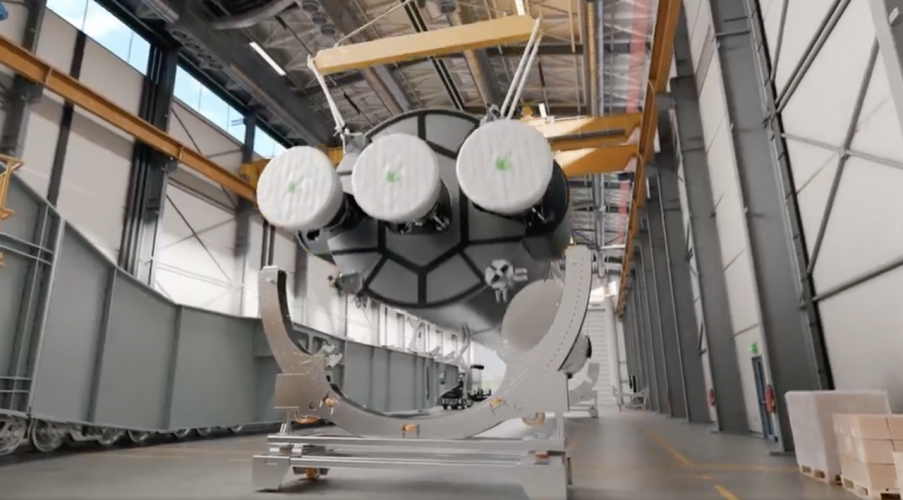
Every campaign begins at Pariacabo Port, where all Maia subsystems arrive aboard the Canopée vessel: first and second stage, interstage, Flight Control Bay, Colibri kick stage, Fairing, etc.
From there, the stages are transferred to the Guiana Space Center, to the
Maia Integration Building (MIB, former MIK), where
full horizontal integration of the launcher takes place on its mast-transporter-erector system.
Meanwhile,
the upper composite — including the adaptor, the fairing, and of course the satellites —
is assembled vertically. Using a dedicated handling system known as UPAM (Upper Part Assembly Mean), it is then tilted for seamless horizontal integration onto the launcher.
Once assembly is complete, the MIB doors open and the fully integrated launcher rolls out on rails to the launch pad, the
ELM2 (former Soyuz launch pad), approximately
1 km away.
At the pad, the mast-transporter-erector system raises Maia to the vertical position and provides all fluid and electrical connections with the launch table. At lift-off, it tilts by approximately 15°, triggering the automatic disconnection of all pad-to-launcher interfaces during the final countdown sequence.
A full launch campaign is designed to last 13 days, with
two parallel assembly lines supporting an ambitious cadence of up to 20 launches per year by the beginning of the next decade.
Rendez-vous in 2027, when MaiaSpace will perform its first orbital flight.
#GoMaia ! PS: Thanks to
Kevin Larat and
Void Media for this wonderful animation!