MaiaSpace Maia launcher

Andrew Parsonson
@AndrewParsonson
·
18m
Guiana Space Centre director Philippe Lier on the fate of the Soyuz equipment at the facility as MaiaSpace moves in and begins to adapt the launch pad for its Maia rocket.

"There are lots of nostalgic people here who wanted to keep everything that we dismantle, store it somewhere, turn it into a museum... I'm not of that mindset," Lier told AFP. Image credit: MaiaSpace

View: https://twitter.com/AndrewParsonson/status/2026748946433859941
 
Official delay to early 2027
https://outremers360.com/bassin-atl...tial-guyanais-un-nouveau-chapitre-pour-kourou
While the existing infrastructure is a major asset, some transformations are nonetheless necessary. “Everything specific to Soyuz will be dismantled before adapting the main structure, which is the most interesting part to reuse,” explains the director of space transportation.

This choice allows MaiaSpace to save valuable time. The company plans a first launch as early as the beginning of 2027. This work is already involving local companies. “This will generate activity in French Guiana, with local industries already involved in the project,” adds Carine Leveau.

“Building tomorrow’s successes on those of the past”

For Yohann Leroy, CEO of MaiaSpace, this day marks a key milestone. “It formalizes our intention to conduct all our launches from French Guiana,” he affirms. The executive emphasizes a pragmatic approach: “We are not looking to start from scratch.” “Benefiting from a pre-existing infrastructure saves us time, reduces our environmental footprint, and lowers costs.”

Approximately 80% of the Soyuz launch pad will be reused. Teams are already working on removing unnecessary equipment and constructing new ground facilities, including an erector mast and refueling systems.

A biomethane-powered launcher and a full order book

The future Maia launcher will be distinguished by its propulsion using liquid biomethane and liquid oxygen, a departure from the kerosene used by Soyuz. Even before its first flight, commercial success is already on the horizon. “More than 50% of our launch manifest is already secured,” says Yohann Leroy.

Among the signed contracts is a major agreement with Eutelsat for about ten launches intended to renew satellites in the OneWeb constellation. Other contracts have also been concluded with Exotrail and USpace, notably for a mission for the French Ministry of the Armed Forces.

Economic Benefits Expected for French Guiana

The establishment of MaiaSpace promises short- and long-term economic benefits. Three permanent employees are already based in French Guiana. Ultimately, the company anticipates approximately 70 direct jobs, with a target of around twenty launches per year at the beginning of the next decade.

"Our launcher is the precursor to the future family of reusable European launchers," concludes Yohann Leroy. This project could place French Guiana "in a leading technological position" for preparing future European launchers, even beyond Ariane 6.

https://la1ere.franceinfo.fr/undefi...cien-pas-de-tir-soyouz-en-guyane-1675251.htmlhttps://www.sciencesetavenir.fr/esp...a-casse-la-fin-de-l-ere-russe-a-kourou_191055
The task seems monumental when you see the tons of Russian machinery that make up the heart of the launch pad, destined for the scrap heap, as well as the gantry that sheltered the Soyuz rockets from the elements and is useless for the Maia launcher, which will be assembled horizontally and placed on the launch pad at the last minute, completely bare. Doubts about meeting the maiden flight date of late 2026 arise when you visit the surprisingly empty integration building. [This article was published before the delay]

But, according to MaiaSpace, this image hides months of invisible effort: filling the site with equipment for the new launcher, already ordered, takes less time than clearing it out. Only the rails and lifting platforms in the integration building have been kept by MaiaSpace, along with the lightning rods surrounding the launch table. "When we took over the site, everything was left in place. We filled a few dumpsters," says Maxime Tranier, MaiaSpace's technical coordinator.
 
As a German aerospace engineer who once used to professionally work on conceptual ESA FESTIP RLV concepts for a while, seeing the current utterly pathetic state of ESA reusable launch "capability" makes me intensely grateful that I bailed to the USA when I got a chance - 0 regrets...
 
Last edited:
MaiaSpace Linkedin [Mar 10]

The common bulkhead must withstand the pressure and temperature differential between the oxygen and methane tanks. To validate the design, MaiaSpace teams carried out a series of tests, applying various pressure differentials while replacing the liquid propellants with water.

To complete the campaign, the teams decided to push the structure all the way to failure in order to identify its true limits.

The result?

The structure performed far better than expected. This allows us to reduce design margins on the tanks, ultimately improving the launcher’s overall performance.

A notable side effect: the welds held so well that the performance actually validated at the final rupture came as a surprise to everyone watching the test - as you can easily see on the face on the video below
 
As a German aerospace engineer who once used to professionally work on conceptual ESA FESTIP RLV concepts for a while, seeing the current utterly pathetic state of ESA reusable launch "capability" makes me intensely grateful that I bailed to the USA when I got a chance - 0 regrets...
You are right ESA reusable launcher will never go anywhere , ESA is losing the space race , Europe si losing most of the challenge for the futur sadly.
 
Great animation here —> https://www.linkedin.com/posts/maiaspace_maia-maia-gomaia-activity-7444760538682798083-qlsJ

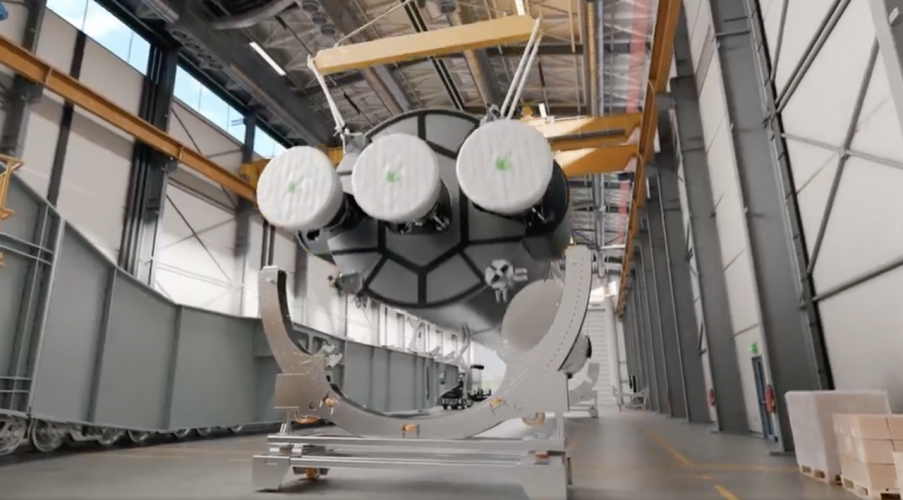
Every campaign begins at Pariacabo Port, where all Maia subsystems arrive aboard the Canopée vessel: first and second stage, interstage, Flight Control Bay, Colibri kick stage, Fairing, etc.

From there, the stages are transferred to the Guiana Space Center, to the Maia Integration Building (MIB, former MIK), where full horizontal integration of the launcher takes place on its mast-transporter-erector system.

Meanwhile, the upper composite — including the adaptor, the fairing, and of course the satellites — is assembled vertically. Using a dedicated handling system known as UPAM (Upper Part Assembly Mean), it is then tilted for seamless horizontal integration onto the launcher.

Once assembly is complete, the MIB doors open and the fully integrated launcher rolls out on rails to the launch pad, the ELM2 (former Soyuz launch pad), approximately 1 km away.

At the pad, the mast-transporter-erector system raises Maia to the vertical position and provides all fluid and electrical connections with the launch table. At lift-off, it tilts by approximately 15°, triggering the automatic disconnection of all pad-to-launcher interfaces during the final countdown sequence.

A full launch campaign is designed to last 13 days, with two parallel assembly lines supporting an ambitious cadence of up to 20 launches per year by the beginning of the next decade.

Rendez-vous in 2027, when MaiaSpace will perform its first orbital flight.

#GoMaia ! PS: Thanks to Kevin Larat and Void Media for this wonderful animation!

I’m noticing for the first time that the 3 first-stage engines are aligned … I would have expected them to be arranged in a triangular layout. I assume because only the central engine will be used for landing?

I also recall that a version with four Prometheus engines is already being considered, so i wonder what the engine arrangement will look like on that one.

image.png
 
Last edited:
3 engines aligned is better for lift soaring (all the engines contribute positively regarding the position of the lift vector). They could simply have discovered it.
 
https://europeanspaceflight.com/loft-orbital-books-multiple-launches-aboard-maiaspace-rockets/

US-based satellite operator Loft Orbital has signed a multi-launch agreement with ArianeGroup subsidiary MaiaSpace. Although the announcement provided few details, it did share that the first flight was expected in 2028.

In an 8 July press release, MaiaSpace explained that the multi-launch agreement “consolidates its launch manifest,” adding that the company has now sold more than half of all capacity for its first three years of operation.
 
The 4 engine version of Maia is expected to deliver up to 8 tons to LEO, or 1 ton in its reusable configuration.

Despite doubling the rocket's performance, the additional 4th Prometheus engine should increase the launch-cost by only ~1 million €

MaiaSpace says it is a two-year development program, contingent on market demand.

https://europeanspaceflight.com/mai...ts-rockets-performance-with-one-extra-engine/
 
https://www.maia-space.com/news/410/

MAIASPACE EXPANDS ITS LAUNCH ECOSYSTEM WITH A NEW COMMERCIAL CONTRACT WITH RIDE!​

  • MaiaSpace has signed a commercial contract with RIDE!, strengthening its commercial ecosystem ahead of Maia's inaugural orbital flight.
  • The agreement enables compatible auxiliary payloads flight alongside MaiaSpace primary missions whenever mission requirements allow.
  • The contract marks MaiaSpace's fifth commercial contract in the past 15 months, reflecting MaiaSpace’s continued development of its go-to-market strategy and growing launch ecosystem.
 
- !

Every test campaign at MaiaSpace is an . Not only about the vehicle itself, but also about the operations that will ultimately

Over the past months, the second prototype at scale of ’ . This prototype notably features a complete set of avionics, valves, & fluid system equipment, and the test - more complex than previous campaigns - was supported in Vernon.

The campaign confirmed the structural behaviour of the upper stage during pressurization and functional performances under cryogenic operations. Dedicated tests on the high-pressure helium vessels also provided valuable data on their behaviour under cryogenic conditions.

, , validating operational capabilities and strengthening the coordination that will carry us through the next stages of the programme. We tested the avionics, implemented the control-command system and operated with a ground architecture representative of the one that will ultimately support launch campaigns in Sinnamary.

All lights are green for : the firing test of this second stage, ahead of combined operations in French Guiana.


Video in link
https://www.linkedin.com/posts/maiaspace_𝗡𝗲𝘄-𝘂𝗽𝗽𝗲𝗿-𝘀𝘁𝗮𝗴𝗲-𝘃𝗮𝗹𝗶𝗱𝗮-activity-7500201782954946560-pniJ
 

Similar threads

Back
Top Bottom