
You are using an out of date browser. It may not display this or other websites correctly.
You should upgrade or use an alternative browser.
You should upgrade or use an alternative browser.
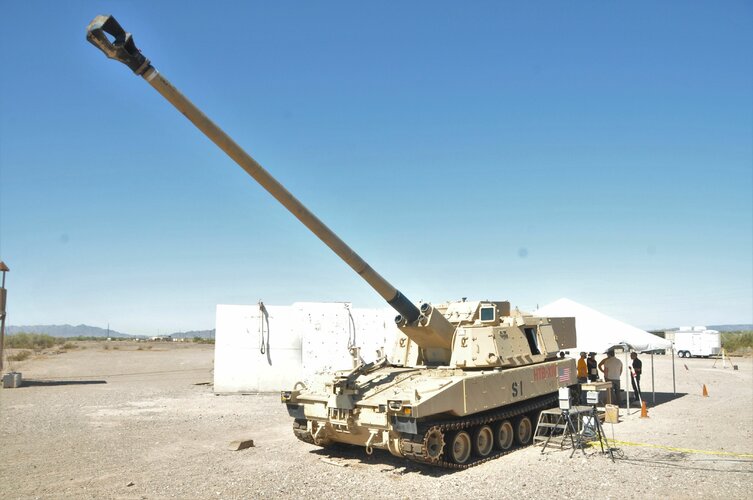
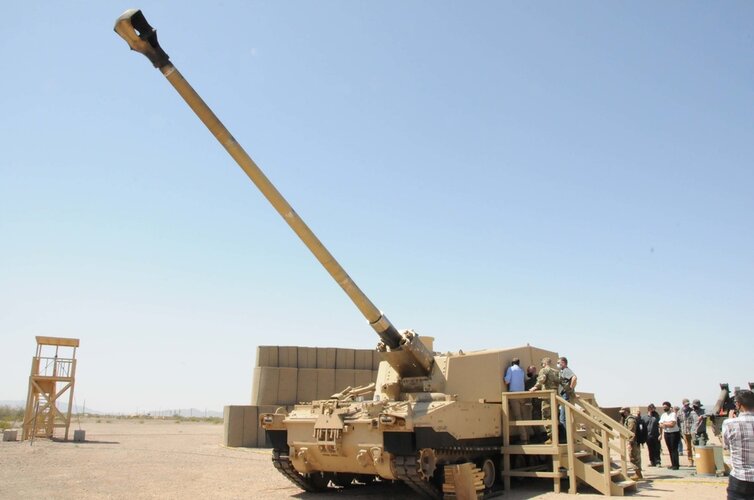
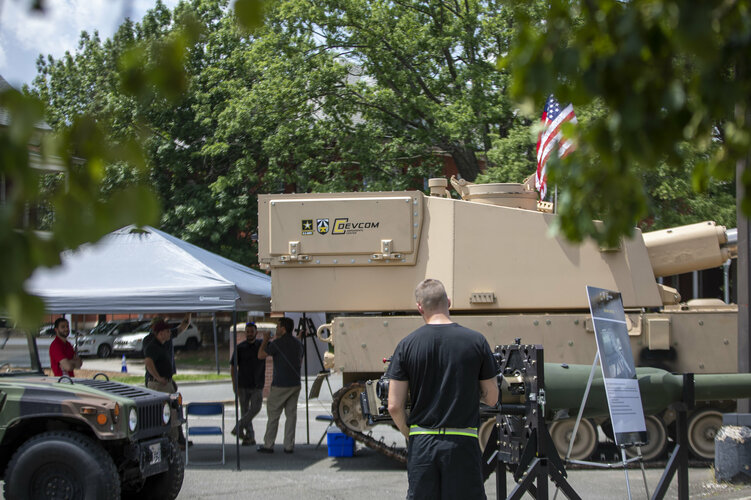
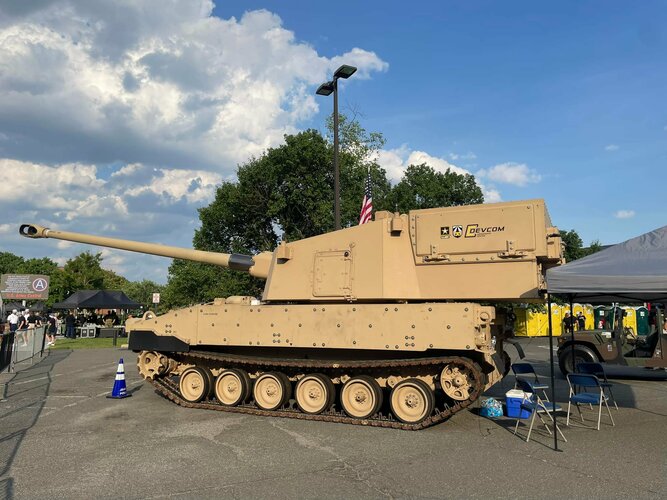
M109A6 test bed for XM907 ERCA
- Thread starter seruriermarshal
- Start date
aonestudio
I really should change my personal text
- Joined
- 11 March 2018
- Messages
- 3,381
- Reaction score
- 9,230
seruriermarshal
ACCESS: Top Secret
- Joined
- 4 May 2008
- Messages
- 1,180
- Reaction score
- 587
4-27 FA 'Iron Thunder' battalion has been named the operational test unit for ERCA
View: https://www.facebook.com/169476853095761/posts/4420909157952488/
View: https://www.facebook.com/169476853095761/posts/4420909157952488/

W
What about final chassis ? 6 or 7 wheels per track ?Le bataillon 4-27 FA 'Iron Thunder' a été nommé unité de test opérationnel pour l'ERCA
Voir : https://www.facebook.com/169476853095761/posts/4420909157952488/
jsport
what do you know about surfing Major? you're from-
- Joined
- 27 July 2011
- Messages
- 8,639
- Reaction score
- 6,937
aonestudio
I really should change my personal text
- Joined
- 11 March 2018
- Messages
- 3,381
- Reaction score
- 9,230
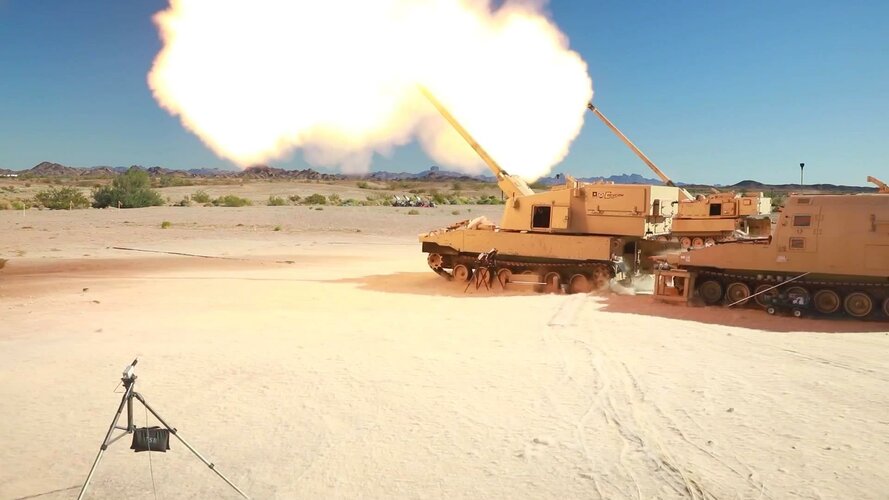
The Extended Range Cannon Artillery 31-round autoloader’s speed and capabilities were demonstrated during a test March 30, 2021, at Yuma Proving Ground, Ariz.
View: https://www.youtube.com/watch?v=d5l4mK1pLKA
seruriermarshal
ACCESS: Top Secret
- Joined
- 4 May 2008
- Messages
- 1,180
- Reaction score
- 587
US Army Team Blasts to Record Velocities from Extended Range Cannon Artillery (ERCA) Test Bed
The Extended Range Cannon Artillery (ERCA) weapon system has made headlines in recent years for its ability — as its name states, to fire at an extended range. Yet in early August the weapon system made history by firing at the highest velocity on record with this program at Yuma Proving Ground (YPG). While shooting far distances is desirable and part of the Army’s modernization strategy, firing at a high-velocity is also a vital element to eliminating threats through Multi Domain Transformation, in this case, increasing the range, speed, and convergence of cutting edge technologies. In general, artillery systems can be more cost efficient compared to using missiles and rockets. An artillery round can potentially complete the same mission at a fraction of the cost.
“We want to get this projectile in the air and to its target as fast as possible because the targets are getting faster. “We come up with different configurations of the propelling charge, and we fire it in the ballistic simulator and we study the video. We see the transport phenomenon, we get an idea of the temperature, speed of ignition, the turbulence and we conceptualize how we can control the burning. Our goal is to have uniform burning to minimize pressure waves which damage the gun and projectile.,” explains Paul Henderson, lead hypervelocity propulsion engineer with the Combat Capabilities Development Command-Armament Center (DEVCOM-AC).
The effort of designing and building the propelling charge for this high-velocity test. The YPG Ammunition Plant personnel constructed the propelling charge specific to this project based on historical data collected from the DEVCOM-AC team. The team determined that they needed to see what happens to the propellant in the gun during ignition. Since the charge is inside the gun chamber when fired and unable to be observed visually, the team developed a ballistic simulator (BSIM) to aid propulsion development and emplaced it at YPG. The BSIM tube is transparent and bursts at a low pressure, but the few milliseconds of video data before it bursts are critical to the design of the propelling charge.
All this work is for a propelling charge design with a predictable and optimized pressure profile to enhance the projectiles performance, a key factor to achieve this is a design that approaches uniform ignition. The ignitor, which is part of the ignition system, is behind the propelling charge, which sits behind the projectile. The force of the propellant gas on the projectile is what causes the round to shoot out of the cannon, when optimized breakthroughs in projectile velocity are achieved. During test fires, the YPG team collects data such as high-speed video, pressure, and muzzle velocity. The projectile team monitors the projectiles then compares the data collected at the test site against the data of the model.
https://militaryleak.com/2021/11/11...xtended-range-cannon-artillery-erca-test-bed/
The Extended Range Cannon Artillery (ERCA) weapon system has made headlines in recent years for its ability — as its name states, to fire at an extended range. Yet in early August the weapon system made history by firing at the highest velocity on record with this program at Yuma Proving Ground (YPG). While shooting far distances is desirable and part of the Army’s modernization strategy, firing at a high-velocity is also a vital element to eliminating threats through Multi Domain Transformation, in this case, increasing the range, speed, and convergence of cutting edge technologies. In general, artillery systems can be more cost efficient compared to using missiles and rockets. An artillery round can potentially complete the same mission at a fraction of the cost.
“We want to get this projectile in the air and to its target as fast as possible because the targets are getting faster. “We come up with different configurations of the propelling charge, and we fire it in the ballistic simulator and we study the video. We see the transport phenomenon, we get an idea of the temperature, speed of ignition, the turbulence and we conceptualize how we can control the burning. Our goal is to have uniform burning to minimize pressure waves which damage the gun and projectile.,” explains Paul Henderson, lead hypervelocity propulsion engineer with the Combat Capabilities Development Command-Armament Center (DEVCOM-AC).
The effort of designing and building the propelling charge for this high-velocity test. The YPG Ammunition Plant personnel constructed the propelling charge specific to this project based on historical data collected from the DEVCOM-AC team. The team determined that they needed to see what happens to the propellant in the gun during ignition. Since the charge is inside the gun chamber when fired and unable to be observed visually, the team developed a ballistic simulator (BSIM) to aid propulsion development and emplaced it at YPG. The BSIM tube is transparent and bursts at a low pressure, but the few milliseconds of video data before it bursts are critical to the design of the propelling charge.
All this work is for a propelling charge design with a predictable and optimized pressure profile to enhance the projectiles performance, a key factor to achieve this is a design that approaches uniform ignition. The ignitor, which is part of the ignition system, is behind the propelling charge, which sits behind the projectile. The force of the propellant gas on the projectile is what causes the round to shoot out of the cannon, when optimized breakthroughs in projectile velocity are achieved. During test fires, the YPG team collects data such as high-speed video, pressure, and muzzle velocity. The projectile team monitors the projectiles then compares the data collected at the test site against the data of the model.
https://militaryleak.com/2021/11/11...xtended-range-cannon-artillery-erca-test-bed/
seruriermarshal
ACCESS: Top Secret
- Joined
- 4 May 2008
- Messages
- 1,180
- Reaction score
- 587
Australia ?Watching the exhaust from the fume extractors is pretty amazing. Outside of Yuma, I bet there's almost no place to test it.
aonestudio
I really should change my personal text
- Joined
- 11 March 2018
- Messages
- 3,381
- Reaction score
- 9,230
Autonomous Mobility Extended Range Cannon Artillery (AMERCA) video demonstrating remote crew station, teleoperation, and waypoint navigation.
View: https://www.youtube.com/watch?v=lvt1j4MrBGQ
https://www.dvidshub.net/video/822439/amerca-video
https://www.dvidshub.net/video/822439/amerca-video
- Joined
- 5 May 2007
- Messages
- 2,020
- Reaction score
- 4,288
Amazed they didn't shoehorn 'Improved' in, it's contrived enough already....Really getting over the top with the acronyms on that one...

- Joined
- 3 June 2011
- Messages
- 21,000
- Reaction score
- 19,297
Whenever I see a contrived acronym I think, "somebody needs to be fired". Obviously they don't have enough to do.Amazed they didn't shoehorn 'Improved' in, it's contrived enough already....Really getting over the top with the acronyms on that one...
aonestudio
I really should change my personal text
- Joined
- 11 March 2018
- Messages
- 3,381
- Reaction score
- 9,230

Kat Tsun
eeeeeeeeeeeeeee
- Joined
- 16 June 2013
- Messages
- 1,887
- Reaction score
- 2,669
Amazed they didn't shoehorn 'Improved' in, it's contrived enough already....Really getting over the top with the acronyms on that one...
ERICA will be the XM1299A1.
Autonomous Mobility, Enhanced Reloading/Integrated Command-Control Carrier, Armored (AMERICCCA). Drives itself and automatically reloads its attending guns while sending them fire missions with robotic turret direction from orbital LEO/SATCOM targeting network. The three C's help emphasize its importance and need to be equally emphasized when saying it out loud. The only purpose of the crew is to make sure that the proper SATCOM channels are hooked up on the radios.
MERKA (Modular Enhanced Reaction Kinetic Artillery) is the railgun ERCA for the far future.
DOD really just needs to go back to having badass acronyms like Cobra SMASH (Southeast Asia Multi-Sensor Armament Subsystem for HueyCobra), SEALORDS (Southeast Asia Lakes, Ocean, River, Delta Strategy), and MiDAS (Missile Detection Alert System). Maybe then Delta Force can start wearing blue jeans and sewing their own tactical webbing again because they can't just buy the latest Crye Elite(R) Operator(TM) Series Supreme Chungus Tactical Overlord Pants with Mesh Cooling Pockets and Cellphone Clip (EOSSCTOPwMCPaCC isn't even a cool acronym?) with their GSA account.
The good old days when entire COCOMs were named contrived yet badass things like STRIKE.
Flexes the creativity muscles when trying to fit something that sounds reasonable inside a single word.
Last edited:
jsport
what do you know about surfing Major? you're from-
- Joined
- 27 July 2011
- Messages
- 8,639
- Reaction score
- 6,937
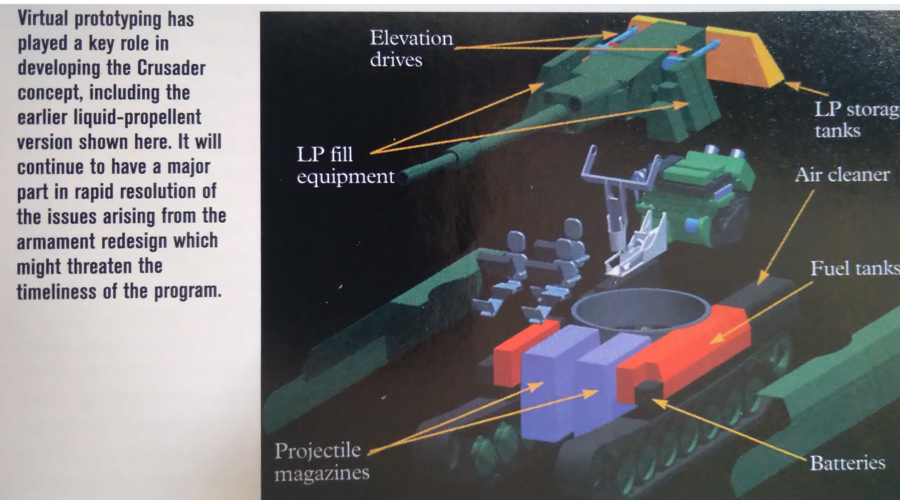
Crusader charts new course, Janes IDR 8/96 pg 52
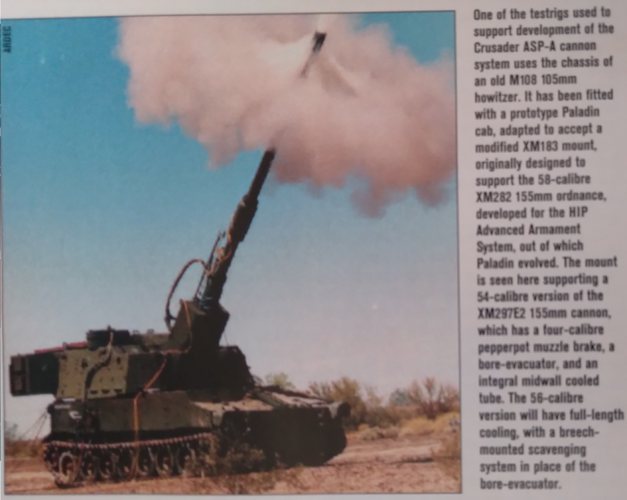
The 56-caliber XM297E2 is the first gun to have full length cooling, asleeve filled with a coolant mix of ethly glycol and water covering the greater part of the tube. This should minimize barrel droop, and a muzzle reference system therefore ought not be needed. Nonetheless, one will be fitted for the duration of the dem/val phase. A variety of complementary techniques and equipment is planned to be used to compensate for on and off carriage ballistic errors. In addition to the automated position/navigation and pointing system, elements of the "extended-range accuracy suite" planned to be added to production vehicels inculde a muzzle velocity management/prediction system, and a projectile tracking and meteorological extraction system.
The maximum rate-of-fire requirement for the KOPPs (key operational performance parameters) is 10-12 rds/min, which has to be sustained for 3-5mins.
M-109 w/ RLPG
M-108 w/ full length cooling, with a breech mounted scavenging system in place of the bore evacuator

The 56-caliber XM297E2 is the first gun to have full length cooling, asleeve filled with a coolant mix of ethly glycol and water covering the greater part of the tube. This should minimize barrel droop, and a muzzle reference system therefore ought not be needed. Nonetheless, one will be fitted for the duration of the dem/val phase. A variety of complementary techniques and equipment is planned to be used to compensate for on and off carriage ballistic errors. In addition to the automated position/navigation and pointing system, elements of the "extended-range accuracy suite" planned to be added to production vehicels inculde a muzzle velocity management/prediction system, and a projectile tracking and meteorological extraction system.
The maximum rate-of-fire requirement for the KOPPs (key operational performance parameters) is 10-12 rds/min, which has to be sustained for 3-5mins.
M-109 w/ RLPG
M-108 w/ full length cooling, with a breech mounted scavenging system in place of the bore evacuator
I always wondered how exactly US counts those "records"? From their own testing of specific type of tech, for their testing of whole type of tech, for world-wide disclosed results of those testings?.. For example with what recent AIM-120 shot was compared? And with what this velocity record was?
Kat Tsun
eeeeeeeeeeeeeee
- Joined
- 16 June 2013
- Messages
- 1,887
- Reaction score
- 2,669
Someone probably had a Jane's pocket guide of artillery cannon and looked at the velocities. Or they're comparing the velocities with the program's own records. Which means it's the fastest shot only ERCA has ever done.

bring_it_on
I really should change my personal text
- Joined
- 4 July 2013
- Messages
- 4,225
- Reaction score
- 5,772
For example with what recent AIM-120 shot was compared?
Simple answer to that would be that it was the longest ranged shot that they had done at any one of their instrumented test ranges. That's the only ballpark they could use. There isn't a global database or a world-record collection that they can reference and compare to.

donnage99
ACCESS: Top Secret
- Joined
- 16 June 2008
- Messages
- 1,586
- Reaction score
- 1,640
cannon artillery seems low effort enough to me to believe they didn't really spend much time on it. keep them. for now.Whenever I see a contrived acronym I think, "somebody needs to be fired". Obviously they don't have enough to do.Amazed they didn't shoehorn 'Improved' in, it's contrived enough already....Really getting over the top with the acronyms on that one...
- Joined
- 3 June 2011
- Messages
- 21,000
- Reaction score
- 19,297
Well, if we're talking SAMs BOMARC blew them all out of the water.I feel like it would behoove them to use that language when they make those kinds of annoucements. I assume one of the Russian anti AWACs missiles was tested at near full range at least once.
aonestudio
I really should change my personal text
- Joined
- 11 March 2018
- Messages
- 3,381
- Reaction score
- 9,230
View: https://twitter.com/ypg_az/status/1564253028944818181
View: https://twitter.com/armyfutures/status/1558078480033669120
View: https://twitter.com/armyfutures/status/1558078480033669120
ERCA’s rate of fire increase under development at YPG
As the Army’s Futures Command continues its modernization efforts with long range precision fires (LRPF), its cross functional teams along with U.S. Army Yuma Proving Ground (YPG) are working to develop new capabilities to increase the Extended Range Cannon Artillery’s (ERCA) rate of fire from an outsider’s perspective.
ERCA possesses the capability to fire twice as far as any currently fielded U.S. cannon artillery and its ongoing development to increase its rate of fire, always has room to enhance developmental outcomes. That is exactly what the Long Range Precision Fires Cross Functional Team (CFT) and the U.S. Army Application Lab (AAL) hopes to achieve.
Starting in October 2020, fifteen private companies brought their perspective to the table in efforts to potentially increase ERCA’s rate of fire while decreasing the physical load on the Soldier. “We help shape their problems and solicit solutions for problems,” he said. “It’ll help shape how the Army fights.” As the Army sought outsider perspectives, only five of the companies were selected to continue with their capabilities testing and were sent to the proving ground to get a firsthand look at their potential enhancements. “We are about halfway through a two-year sprint to improve rate of fire for the ERCA system,” said CPT Mark Toups of the Army’s LRPF C F T.
The initial ERCA prototypes, designed by DEVCOM Armament Center at Picatinny Arsenal, are currently being tested at YPG. “Our chance to touch and feel the ERCA equipment is here at YPG because they (YTC Test Crews) are testing it, shooting it, and the selected companies are looking at how can we shoot the system faster,” Kehler noted. “These companies have a new eye, are new to the Army, new to artillery, but they also know engineering and how can we take this process and optimize it and look at it from a different lens,” said LRPF portfolio manager Walker Williams. Walker serves as the liaison between industry and Army for the AAL.
The current rounds used for ERCA are large and can weigh more than 100 pounds. “Loading those can result in fatigue or back injuries,” Williams explained. “During our last soldier touchpoint, a soldier dropped it on his foot and broke his foot,” Williams explained. “So, we can assist the soldier in optimizing that fire mission process, while leaving the soldier to do what he does best.”
From July 26 to July 27 those companies selected took to YPG to engage in equipment and inert munitions, data collection and discussions. “YPG is at the tip of the spear when it comes to real-time data, videos, access to vehicles and testing crews,” said Williams. “These companies will be delivering an increased rate of fire to ERCA, if all goes planned.” Once the selection process is finalized, those enhancements will be presented to the Army’s senior leaders in fiscal year 2023, according to Toups. And from there that will decide whether they are fielded to the war fighter.“With these capabilities of increasing the rate of fire and increasing the lethality of this system, it is extremely important for the fielding of these capabilities in the future,” Walker said.
Last edited:
jsport
what do you know about surfing Major? you're from-
- Joined
- 27 July 2011
- Messages
- 8,639
- Reaction score
- 6,937
- The XM1299 ERCA is the next artillery platform for the United States Army. Designed by BAE Systems, the ERCA is the next step in modernizing the nation’s Field Artillery capabilities against peer adversaries. Still in the prototype stage, the ERCA boasts a longer tube, improved breech, and an autoloader, mounted on the existing M109A7 chassis.1 The ERCA has demonstrated its ability to fire a round over 65 km to within one meter of a target.2 This outclasses the M209A7 and M777A2 Howitzers by more than twice their range. The autoloader is templated to fire 10 rounds a minute sustained, once again eclipsing any cannon artillery in the arsenal. With its improved range and rate-of- fire, the ERCA shows exceptional potential on paper. However, it is a revolutionary platform of which no current unit or Soldier has experience.
- Saturating the enemy artillery and air defense in indirect Fire is a must to ensure the enemies’ total annihilation.
- While enemy armored forces enjoyed relative safety from indirect Fires in the past, the Bonus MK II Round penetrates armor with a roughly one-for-one round per tank ratio.
- Once the force-on-force portion of NTC 20-10 began, the DIVARTY staff confronted several challenges with the ERCA. First was the initial volume of Fires requested from 1ID was significantly greater than anticipated. Instead of firing around fifty missions adayasinDGIIandIII,the ERCA was firing over a hundred missions a day split between counterfire, deliberate, dynamic, and Suppression of Enemy Air Defense (SEAD) Fires.
- The 1ID’s Battalions fought a tough close-fight with enemy indirect Fire systems with significant counterfire. The Division’s GS Battalions, however, fired with little to no fear of repercussions.
- Ammo resupply with the volume of Fires required a daily resupply with forecasting out to 96 hours. We exercised “just in time inventory” at the beginning of the rotation as we adjusted our consumption tables to account for the higher volume of Fires.
- Additionally, maintenance became an issue with the volume of firing for the ERCA. The tube life for the XM 907 is currently templated at 700 rounds with the supercharge propellant firing at max range. 5Additionally, if the tube temperature reached 350 degrees, then the tube required a mandatory 24 hour period to cool down. The ERCA response cell simulated these constraints by rotating firing batteries and managing their Battalion Fire orders. Despite this management, there were times ERCA sections were down for maintenance for 24 hours to account for tube wear and temperature.
- The ERCA battalion consistently provided suppression of enemy air defense for these missions. ERCA’s munition flexibility allowed for specific rounds per target type as well as last- minute “audible” changes to targets. Having the capability to range up to 70 km to suppress or destroy air defense enabled the CAB to not only expand its attack distance but expand its target SEAD targets to allow for a more comprehensive suppression. Though the DIVARTY staff does not recommend it due to ammunition and planning requirements, the ERCA regularly suppressed or destroyed over a dozen targets for SEAD near simultaneously.
- The last challenge of the ERCA was in its fight against the enemy’s armor. Of course, the Bonus MK II Round was the key to this challenge, which arguably provided the greatest advantage of the ERCA. While the Bonus MK II Round was reputed to be a revolution, 1ID had yet to utilize this round; simulation or otherwise. This combination of extended range up to 50 km and anti-tank munitions changed the course of the battle.
- This was in anticipation of the roughly 200 (T-90) MS Main Battle Tanks consolidating to attack through the southern mobility corridor. The 1ID quickly identified the force and its supporting air defense assets. Then, the 1ID cleared all air in the south and sent DIVARTY a single Fire mission targeting this enemy Brigade Tactical Group. The DIVARTY Fire Control Officer directed the ERCA to fire twelve battalion volleys of the Bonus MK II Round. The ensuing Fire mission destroyed 135 T-90s in minutes thus effectively ending the enemy’s counterattack and ensuring the initiative remained with 1ID. The ERCA would subsequently destroy the remainder of the T-90s in piecemeal Fire missions using that munition.
- Of note was the pairing of the AN/TPQ-Q53 RADAR and the ERCA, which could fire out to the RADAR’s maximum sensing range. The enemy medium and light indirect Fires were focused on the close fight with the BCTs and RCS and chose to prioritize those formations over the GS Battalions. Therefore, the DIVARTY’s Counterfire became a game of “whack-a-mole,” trying to destroy the dispersed medium artillery as quickly as possible to support the BCTs in the close fight. The medium artillery was lower on priority on the High Payoff Target List, but VII Corps shaping effects had been effective at destroying the enemy long-range artillery.
- The XM1299 ERCA dominated the battlefield during NTC Rotation 20-10. Positioned just behind Maneuver forces to fire forward, the ERCA had ample range in which to Fire missions, providing extraordinary responsiveness when Division acquired targets. The very nature of cannon artillery enables munition flexibility, as the round only needs to be on hand and not pre-loaded. This platform destroyed tanks, artillery, electronic warfare assets, and air defense with lethal efficiency. Furthermore, the ERCA can easily assist in the close fight for GS relationships when needed; the platform will not need to relocate to range. The fundamentals of the cannon propellant allow for flexibility on short or longer ranges.
- The ERCA is capable of firing roughly 70 km, but that would ostensibly require a full load of supercharges. The wear from such a propellant load will rapidly degrade a tube if combined with the ability to shoot far and with an autoloader. ERCA units will need to be able to rapidly replace tubes due to excessive wear. They may need to even have the Forward Support Companies (FSC) carry them to switch out as quickly as possible, which would need to be a priority training objective for those FSC Commanders.
- Is the XM1299 ERCA capable of direct Fire on encroaching enemies? Though it is preferable to avoid the situation, direct Fire has saved countless Artillerymen.
- ERCA provides a “10x” capability through a combination of an increased range, increased rate of fire, increased lethality, increased reliability and a greater survivability.
CPT Sutton was the Fire Control Officer for 1ID DIVARTY during the NTC Rotation 20-10 and was in the position for five months at the time. Currently, he serves as the Battery Commander for Delta, 1-5th FA “Hamilton’s Own.”
MAJ Jeffery A. Wollenman was the 1ID DIVARTY Brigade Operations Officer during its recent deployment to NTC 20-10 and WFX 21-3. MAJ Wollenman is currently serving as the executive officer for the 1st Battalion, 7th Field Artillery Regiment in 2nd Brigade, 1st Infantry Division.
https://en.wikipedia.org/wiki/Field_Artillery_(magazine)
aonestudio
I really should change my personal text
- Joined
- 11 March 2018
- Messages
- 3,381
- Reaction score
- 9,230
https://www.rheinmetall.com/en/rheinmetall_ag/press/news/latest_news/index_34304.php
01 Sep 2022
Rheinmetall brings new L58 Extended Range Charge technology to the U.S. Army
Rheinmetall will supply its latest artillery propellant charge technology to the U.S. Army. American Rheinmetall Munitions Inc., located in Stafford, VA is on contract to prototype an artillery extended range charge (ERC) for firing munitions out of a L58 length 155mm artillery cannon. This ERC increases ranges achieved from U.S. Army 155mm munitions by approximately 10% over any other artillery propellant currently fielded today. It builds upon a successful cooperative R&D effort with the U.S. Army for L39 and L52 versions of the 155mm ERC. American Rheinmetall Munitions’ charge is particularly exceptional because it can achieve the 10% range performance increase over the entirety of the operational temperature profile including in ambient scenarios.
- The XM1299 ERCA is the next artillery platform for the United States Army. Designed by BAE Systems, the ERCA is the next step in modernizing the nation’s Field Artillery capabilities against peer adversaries. Still in the prototype stage, the ERCA boasts a longer tube, improved breech, and an autoloader, mounted on the existing M109A7 chassis.1 The ERCA has demonstrated its ability to fire a round over 65 km to within one meter of a target.2 This outclasses the M209A7 and M777A2 Howitzers by more than twice their range. The autoloader is templated to fire 10 rounds a minute sustained, once again eclipsing any cannon artillery in the arsenal. With its improved range and rate-of- fire, the ERCA shows exceptional potential on paper. However, it is a revolutionary platform of which no current unit or Soldier has experience.
- Saturating the enemy artillery and air defense in indirect Fire is a must to ensure the enemies’ total annihilation.
- While enemy armored forces enjoyed relative safety from indirect Fires in the past, the Bonus MK II Round penetrates armor with a roughly one-for-one round per tank ratio.
- Once the force-on-force portion of NTC 20-10 began, the DIVARTY staff confronted several challenges with the ERCA. First was the initial volume of Fires requested from 1ID was significantly greater than anticipated. Instead of firing around fifty missions adayasinDGIIandIII,the ERCA was firing over a hundred missions a day split between counterfire, deliberate, dynamic, and Suppression of Enemy Air Defense (SEAD) Fires.
- The 1ID’s Battalions fought a tough close-fight with enemy indirect Fire systems with significant counterfire. The Division’s GS Battalions, however, fired with little to no fear of repercussions.
- Ammo resupply with the volume of Fires required a daily resupply with forecasting out to 96 hours. We exercised “just in time inventory” at the beginning of the rotation as we adjusted our consumption tables to account for the higher volume of Fires.
- Additionally, maintenance became an issue with the volume of firing for the ERCA. The tube life for the XM 907 is currently templated at 700 rounds with the supercharge propellant firing at max range. 5Additionally, if the tube temperature reached 350 degrees, then the tube required a mandatory 24 hour period to cool down. The ERCA response cell simulated these constraints by rotating firing batteries and managing their Battalion Fire orders. Despite this management, there were times ERCA sections were down for maintenance for 24 hours to account for tube wear and temperature.
- The ERCA battalion consistently provided suppression of enemy air defense for these missions. ERCA’s munition flexibility allowed for specific rounds per target type as well as last- minute “audible” changes to targets. Having the capability to range up to 70 km to suppress or destroy air defense enabled the CAB to not only expand its attack distance but expand its target SEAD targets to allow for a more comprehensive suppression. Though the DIVARTY staff does not recommend it due to ammunition and planning requirements, the ERCA regularly suppressed or destroyed over a dozen targets for SEAD near simultaneously.
- The last challenge of the ERCA was in its fight against the enemy’s armor. Of course, the Bonus MK II Round was the key to this challenge, which arguably provided the greatest advantage of the ERCA. While the Bonus MK II Round was reputed to be a revolution, 1ID had yet to utilize this round; simulation or otherwise. This combination of extended range up to 50 km and anti-tank munitions changed the course of the battle.
- This was in anticipation of the roughly 200 (T-90) MS Main Battle Tanks consolidating to attack through the southern mobility corridor. The 1ID quickly identified the force and its supporting air defense assets. Then, the 1ID cleared all air in the south and sent DIVARTY a single Fire mission targeting this enemy Brigade Tactical Group. The DIVARTY Fire Control Officer directed the ERCA to fire twelve battalion volleys of the Bonus MK II Round. The ensuing Fire mission destroyed 135 T-90s in minutes thus effectively ending the enemy’s counterattack and ensuring the initiative remained with 1ID. The ERCA would subsequently destroy the remainder of the T-90s in piecemeal Fire missions using that munition.
- Of note was the pairing of the AN/TPQ-Q53 RADAR and the ERCA, which could fire out to the RADAR’s maximum sensing range. The enemy medium and light indirect Fires were focused on the close fight with the BCTs and RCS and chose to prioritize those formations over the GS Battalions. Therefore, the DIVARTY’s Counterfire became a game of “whack-a-mole,” trying to destroy the dispersed medium artillery as quickly as possible to support the BCTs in the close fight. The medium artillery was lower on priority on the High Payoff Target List, but VII Corps shaping effects had been effective at destroying the enemy long-range artillery.
- The XM1299 ERCA dominated the battlefield during NTC Rotation 20-10. Positioned just behind Maneuver forces to fire forward, the ERCA had ample range in which to Fire missions, providing extraordinary responsiveness when Division acquired targets. The very nature of cannon artillery enables munition flexibility, as the round only needs to be on hand and not pre-loaded. This platform destroyed tanks, artillery, electronic warfare assets, and air defense with lethal efficiency. Furthermore, the ERCA can easily assist in the close fight for GS relationships when needed; the platform will not need to relocate to range. The fundamentals of the cannon propellant allow for flexibility on short or longer ranges.
- The ERCA is capable of firing roughly 70 km, but that would ostensibly require a full load of supercharges. The wear from such a propellant load will rapidly degrade a tube if combined with the ability to shoot far and with an autoloader. ERCA units will need to be able to rapidly replace tubes due to excessive wear. They may need to even have the Forward Support Companies (FSC) carry them to switch out as quickly as possible, which would need to be a priority training objective for those FSC Commanders.
- Is the XM1299 ERCA capable of direct Fire on encroaching enemies? Though it is preferable to avoid the situation, direct Fire has saved countless Artillerymen.
- ERCA provides a “10x” capability through a combination of an increased range, increased rate of fire, increased lethality, increased reliability and a greater survivability.
CPT Sutton was the Fire Control Officer for 1ID DIVARTY during the NTC Rotation 20-10 and was in the position for five months at the time. Currently, he serves as the Battery Commander for Delta, 1-5th FA “Hamilton’s Own.”
MAJ Jeffery A. Wollenman was the 1ID DIVARTY Brigade Operations Officer during its recent deployment to NTC 20-10 and WFX 21-3. MAJ Wollenman is currently serving as the executive officer for the 1st Battalion, 7th Field Artillery Regiment in 2nd Brigade, 1st Infantry Division.
https://en.wikipedia.org/wiki/Field_Artillery_(magazine)
I didn’t realize the US used/had BONUS rounds. Also I would have thought a standard round with a GPS kit would work against a static armored vehicle, though that would take a lot of planning and individual fire missions compared to spamming self seeking rounds.
There are no mention of any guided rounds being used in the exercise…did this exercise assume only unguided ordnance was available (outside BONUS)?
Is there a link to the original article?
jsport
what do you know about surfing Major? you're from-
- Joined
- 27 July 2011
- Messages
- 8,639
- Reaction score
- 6,937
https://www.fieldartillery.org/Error/RestrictedPage?ReturnUrl=~/news/artillery-journal
looks like it is locked to non members, and..am not.
looks like it is locked to non members, and..am not.
aonestudio
I really should change my personal text
- Joined
- 11 March 2018
- Messages
- 3,381
- Reaction score
- 9,230
- Joined
- 21 May 2006
- Messages
- 3,262
- Reaction score
- 2,887
Firefinder
ACCESS: Top Secret
- Joined
- 5 October 2019
- Messages
- 1,262
- Reaction score
- 2,388
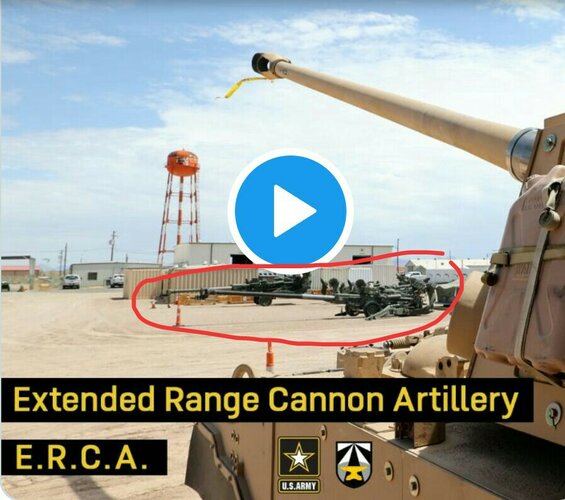
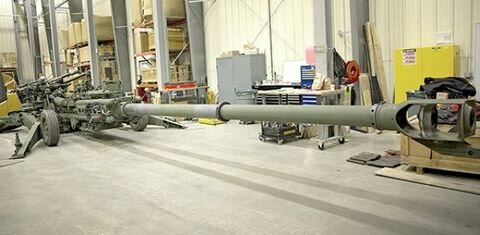
That the long barrel M777 they toyed with.Sorry to distract from the main topic, but the gun in the foreground, with it's extremely long barrel has me intrigued
Regards
Pioneer
Forgot the exact model program but its basically a M777 with a 52 caliber barrel instead of the 39 one.
Attachments
Last edited:
- Joined
- 21 May 2006
- Messages
- 3,262
- Reaction score
- 2,887
Great snapping buttocksThat the long barrel M777 they toyed with.Sorry to distract from the main topic, but the gun in the foreground, with it's extremely long barrel has me intrigued
Regards
Pioneer
Forgot the exact model program but its basically a M777 with a 52 caliber barrel instead of the 39 one.

Thanks Forefinder, I appreciate your time and effort in answering my enquiry.
Regards
Pioneer
Firefinder
ACCESS: Top Secret
- Joined
- 5 October 2019
- Messages
- 1,262
- Reaction score
- 2,388
No problem.Great snapping buttocksThat the long barrel M777 they toyed with.Sorry to distract from the main topic, but the gun in the foreground, with it's extremely long barrel has me intrigued
Regards
Pioneer
Forgot the exact model program but its basically a M777 with a 52 caliber barrel instead of the 39 one.
Thanks Forefinder, I appreciate your time and effort in answering my enquiry.
Regards
Pioneer
If I recal correctly.
The long barrel added like half a ton or so to the weight and bout 20km to the range.
With there being 2 models, the standard and the folding, which I think I posted.
The Standard being the well standard model with a one piece 52 caliber.
The folding one had a TWO PIECE barrel that you could fold up to move. Which makes sense since a 52 cal barrel make a M777 nearly 30 foot long compare to the 39's 18 foot. You can see the reasoning,but I dont think it went anywhere.
Similar threads
-
-
 South African artillery/cannon/guns - prototypes, projects, concepts etc.
- Started by Graugrun
- Replies: 151
-
French artillery projects (cannons, howitzers, mortars, munitions)
- Started by Elan Vital
- Replies: 27
-
WW1 period (~1900-1920s) experimental and small-known artillery (field, siege, AA)
- Started by Bottleship
- Replies: 61
-
