
You are using an out of date browser. It may not display this or other websites correctly.
You should upgrade or use an alternative browser.
You should upgrade or use an alternative browser.
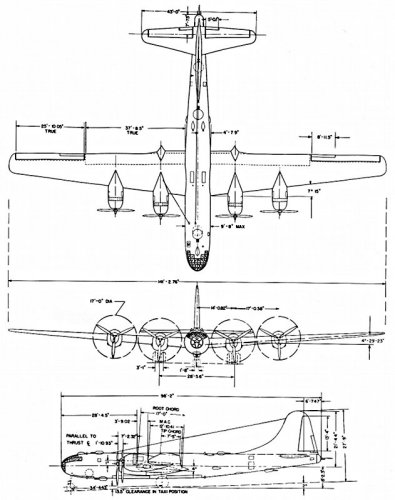
Looking for Boeing XB-29 and XB-39 Drawings
- Thread starter luftsturm
- Start date

sferrin said:http://tinyurl.com/nxt9jd
http://tinyurl.com/muobas
BWAHHHHHHHH!!!!!!

- Joined
- 27 December 2005
- Messages
- 19,230
- Reaction score
- 35,694
Forum rules:
* Always be polite, especially to new users, even if they ask questions you find irritating. Nobody was born an expert.
The above response from sferrin would be appropriate if the google searches actually found the images in question.
I checked my B-29 Warbirdtech, it has a 3 view drawing of the YB-29 but not XB-29.
* Always be polite, especially to new users, even if they ask questions you find irritating. Nobody was born an expert.
The above response from sferrin would be appropriate if the google searches actually found the images in question.
I checked my B-29 Warbirdtech, it has a 3 view drawing of the YB-29 but not XB-29.
- Joined
- 27 December 2005
- Messages
- 19,230
- Reaction score
- 35,694
J
joncarrfarrelly
Guest
The Air Force Museum website datasheet page on the XB-29 has three photos of the XB-29s:
http://www.nationalmuseum.af.mil/factsheets/factsheet_media.asp?fsID=2574
On one of the photos you can see that there is a plug or filler plate where the turret should be.
http://www.nationalmuseum.af.mil/shared/media/photodb/photos/060711-F-1234S-020.jpg
I don't think you are going to find a drawing of the XB-29 that doesn't show turrets, the simplest thing to do would
be to take a B-29 drawing and erase the turrets.
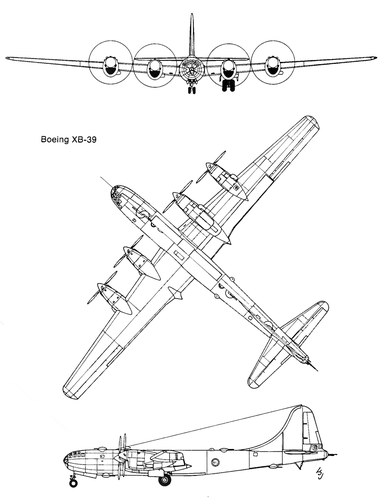
U.S. Bombers by Lloyd S. Jones has XB-39 drawings.
Jones U.S.Fighters and U.S. Bombers are commonly available
on the used book market (often available for as little as five dollars US).
While neither is perfect or the be-all-end-all in terms of accuracy they are useful
general references.
Jon
http://www.nationalmuseum.af.mil/factsheets/factsheet_media.asp?fsID=2574
On one of the photos you can see that there is a plug or filler plate where the turret should be.
http://www.nationalmuseum.af.mil/shared/media/photodb/photos/060711-F-1234S-020.jpg
I don't think you are going to find a drawing of the XB-29 that doesn't show turrets, the simplest thing to do would
be to take a B-29 drawing and erase the turrets.
U.S. Bombers by Lloyd S. Jones has XB-39 drawings.
Jones U.S.Fighters and U.S. Bombers are commonly available
on the used book market (often available for as little as five dollars US).
While neither is perfect or the be-all-end-all in terms of accuracy they are useful
general references.
Jon
Or find a drawing of Enola Gay or Bock's Car or maybe a post WWII B-29. A KB-29 would do except for the K mods, maybe.
joncarrfarrelly said:The Air Force Museum website datasheet page on the XB-29 has three photos of the XB-29s:
http://www.nationalmuseum.af.mil/factsheets/factsheet_media.asp?fsID=2574
On one of the photos you can see that there is a plug or filler plate where the turret should be.
http://www.nationalmuseum.af.mil/shared/media/photodb/photos/060711-F-1234S-020.jpg
I don't think you are going to find a drawing of the XB-29 that doesn't show turrets, the simplest thing to do would
be to take a B-29 drawing and erase the turrets.
U.S. Bombers by Lloyd S. Jones has XB-39 drawings.
Jones U.S.Fighters and U.S. Bombers are commonly available
on the used book market (often available for as little as five dollars US).
While neither is perfect or the be-all-end-all in terms of accuracy they are useful
general references.
Jon

Steve Pace
Aviation History Writer
- Joined
- 6 January 2013
- Messages
- 2,266
- Reaction score
- 271
Steve Pace
Aviation History Writer
- Joined
- 6 January 2013
- Messages
- 2,266
- Reaction score
- 271

- Joined
- 22 January 2006
- Messages
- 4,436
- Reaction score
- 2,801
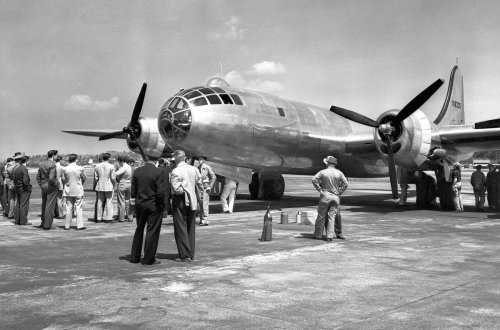
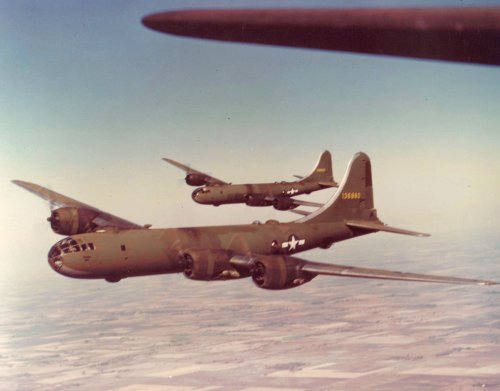
Not what you asked for but cool anyway.
I agree and thank you very much for posting it.
Off-topic: in my opinion a nice source of inspiration for what-iff artists. Don't know why but that B-29 look very "European Front" to me.

blackkite
Don't laugh, don't cry, don't even curse, but.....
- Joined
- 31 May 2007
- Messages
- 9,515
- Reaction score
- 9,661
When I compared with B-29 and RENZAN, I surprised very much that B-29's MTOW is twice as RENZAN.
B-29/RENZAN
Engine:R3350 2,200HP in take off/Homare 24 Ru engine 2,000HP in take off (both engine turbo charged)
Wing area:161.27m2/112m2
Wing span:43.1m/32.54m
over all length:30.2m/22.94m
MTOW:61.2ton/32.15ton
Max speed:574km/h/593km/h
Range:5,200km with 4.5ton bomb/3,945~7,463km
Honestly speaking,I don't want to think about B-29, but it was a really outstanding plane.
B-29/RENZAN
Engine:R3350 2,200HP in take off/Homare 24 Ru engine 2,000HP in take off (both engine turbo charged)
Wing area:161.27m2/112m2
Wing span:43.1m/32.54m
over all length:30.2m/22.94m
MTOW:61.2ton/32.15ton
Max speed:574km/h/593km/h
Range:5,200km with 4.5ton bomb/3,945~7,463km
Honestly speaking,I don't want to think about B-29, but it was a really outstanding plane.
Steve Pace
Aviation History Writer
- Joined
- 6 January 2013
- Messages
- 2,266
- Reaction score
- 271
pometablava said:Not what you asked for but cool anyway.
I agree and thank you very much for posting it.
Off-topic: in my opinion a nice source of inspiration for what-iff artists. Don't know why but that B-29 look very "European Front" to me.
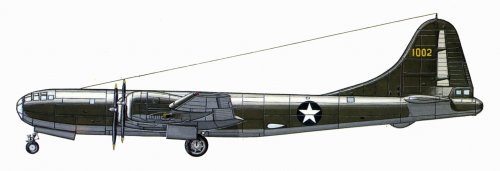
Must be the early-on olive drab paint scheme that was not used on full production B-29s.
blackkite
Don't laugh, don't cry, don't even curse, but.....
- Joined
- 31 May 2007
- Messages
- 9,515
- Reaction score
- 9,661
Attachments
blackkite
Don't laugh, don't cry, don't even curse, but.....
- Joined
- 31 May 2007
- Messages
- 9,515
- Reaction score
- 9,661
Hi! Good pictures.
http://nhungdoicanh.blogspot.com/2013/04/boeing-xb-39-superfortress.html
http://nhungdoicanh.blogspot.com/2013/04/boeing-xb-39-superfortress.html

snark
But Dad, don't we EAT the antelopes?
- Joined
- 2 December 2007
- Messages
- 111
- Reaction score
- 90
Thanks, Blackkite-san! Great site... Harry

- Joined
- 19 July 2016
- Messages
- 4,816
- Reaction score
- 4,276
Thank you, Sir. Great link.

Tonton-42
ACCESS: Secret
- Joined
- 10 May 2014
- Messages
- 405
- Reaction score
- 798
I have been a fan of B-29 and its derivatives for many years (more than 5 decades!). Unfortunately we have to note the considerable lack of technical material concerning the machine! Most of the 3 views are false, especially in the front compartment and in its perfectly symmetrical shape in both planes, except for the bomber’s bubble, which has a flat lens for the Norden viewfinder. If it helps I tried to solve the problem in my own way to draw a shot of a 1/14 flying semi-model.Forum rules:
* Always be polite, especially to new users, even if they ask questions you find irritating. Nobody was born an expert.
The above response from sferrin would be appropriate if the google searches actually found the images in question.
I checked my B-29 Warbirdtech, it has a 3 view drawing of the YB-29 but not XB-29.
https://www.secretprojects.co.uk/threads/b-29-model.29241/

- Joined
- 26 May 2006
- Messages
- 38,285
- Reaction score
- 20,424
From old site on the Net,
in the autumn of 1943, as the first production B-29 "Superfortress" heavy strategic bomber began to enter service with USAAF training bomber units, Boeing began intensive work on modernizing the aircraft. One of the new components to be tested was the Allison V-3420 high-output 24-cylinder engine, whose design had begun at the request of the US Army Air Corps back in 1937. This engine was essentially a combination of two V-1710 12-cylinder in-line engines. It had a common crankcase and two crankshafts, driving the propeller shaft via a gearbox.
To test the new engine, the first YB-29-BW test aircraft (serial number 41-36954) was transferred to General Motors Corporation's Power-plant Development Division, whose engineers designed, built, and installed the entire new powerplant system on the airframe. The bomber, bearing the military designation XB-39-GM and nicknamed Spirit of Lincoln , underwent a series of flight tests, demonstrating that despite an increase in empty weight of nearly 3 tons compared to a standard B-29A or B-29B, the aircraft with the new engines had significantly improved performance while maintaining its combat capabilities.
However, despite its improved performance and lack of any side effects, the XB-39 failed to replace the B-29 bombers on the production line and remained in production with only a single prototype. The reasons were likely fourfold, and they are easy to surmise. The B-29, equipped with Wright R-3350 engines, had sufficient performance to meet the Air Force's current expectations. Furthermore, significant expenditures had already been made preparing for mass production of both the airframe and the engines. Furthermore, the USAAF urgently required ever-increasing numbers of bombers, and such a radical powerplant change (with the simultaneous lack of mass production of the V-3420 engines) was bound to adversely affect production rates. Finally, the XB-39's performance was not sufficiently superior to the B-29 to justify further massive expenditures.
The XB-39 was undoubtedly one of the best heavy bombers developed during World War II, but it remained in prototype form. After the war, the B-29 underwent a powerplant upgrade. After replacing the engines with 28-cylinder quadruple-radial Pratt & Whitney R-4360 "Wasp Major" engines, the XB-44 was developed, which was later put into series production under the designation B-29D, and ultimately B-50.
in the autumn of 1943, as the first production B-29 "Superfortress" heavy strategic bomber began to enter service with USAAF training bomber units, Boeing began intensive work on modernizing the aircraft. One of the new components to be tested was the Allison V-3420 high-output 24-cylinder engine, whose design had begun at the request of the US Army Air Corps back in 1937. This engine was essentially a combination of two V-1710 12-cylinder in-line engines. It had a common crankcase and two crankshafts, driving the propeller shaft via a gearbox.
To test the new engine, the first YB-29-BW test aircraft (serial number 41-36954) was transferred to General Motors Corporation's Power-plant Development Division, whose engineers designed, built, and installed the entire new powerplant system on the airframe. The bomber, bearing the military designation XB-39-GM and nicknamed Spirit of Lincoln , underwent a series of flight tests, demonstrating that despite an increase in empty weight of nearly 3 tons compared to a standard B-29A or B-29B, the aircraft with the new engines had significantly improved performance while maintaining its combat capabilities.
However, despite its improved performance and lack of any side effects, the XB-39 failed to replace the B-29 bombers on the production line and remained in production with only a single prototype. The reasons were likely fourfold, and they are easy to surmise. The B-29, equipped with Wright R-3350 engines, had sufficient performance to meet the Air Force's current expectations. Furthermore, significant expenditures had already been made preparing for mass production of both the airframe and the engines. Furthermore, the USAAF urgently required ever-increasing numbers of bombers, and such a radical powerplant change (with the simultaneous lack of mass production of the V-3420 engines) was bound to adversely affect production rates. Finally, the XB-39's performance was not sufficiently superior to the B-29 to justify further massive expenditures.
The XB-39 was undoubtedly one of the best heavy bombers developed during World War II, but it remained in prototype form. After the war, the B-29 underwent a powerplant upgrade. After replacing the engines with 28-cylinder quadruple-radial Pratt & Whitney R-4360 "Wasp Major" engines, the XB-44 was developed, which was later put into series production under the designation B-29D, and ultimately B-50.
Similar threads
-
 Boeing B-29 Pre-Projects and Development
- Started by hesham
- Replies: 15
-

-
-
Martin XB-907/XB-10 original prototype drawings
- Started by ACResearcher
- Replies: 1
-
