Agree with all of this. Even the 'corruption is diplomacy and welcome to the family' part.I think that recent events have established Saudi Arabia to be, effectively, a regional defense partner. It’s become obvious that MBS’ number one goal at this point is regional stability, and he’s fallen back on the US and its proxies to provide it even as China and Russia have aligned with Iran. Meanwhile, Turkey is still playing man-in-the-middle. I think that if the question is “would they sell secret access to the F-35”, it seems unlikely that MBS would at this point, but plausible that Erdogan might.
(The corruption aspect helps too, but for MBS and Trumpworld that’s basically just another form of diplomacy, where being included on a scheme is like marrying into the family.)

You are using an out of date browser. It may not display this or other websites correctly.
You should upgrade or use an alternative browser.
You should upgrade or use an alternative browser.
Lockheed Martin F-35 Lightning II Joint Strike Fighter (JSF)
- Thread starter Triton
- Start date

- Joined
- 29 November 2010
- Messages
- 2,308
- Reaction score
- 5,299
Ainen
I really should change my personal text
- Joined
- 25 August 2011
- Messages
- 2,884
- Reaction score
- 4,991
So, canopy and bay door. UPS forgot just slats and ailerons to make sure China gets to study all main types of RAM on F-35.
- Joined
- 29 November 2010
- Messages
- 2,308
- Reaction score
- 5,299
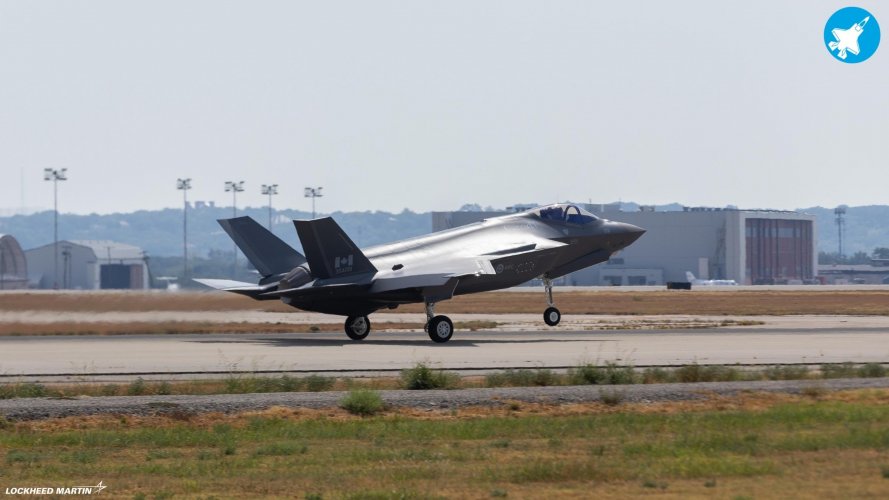
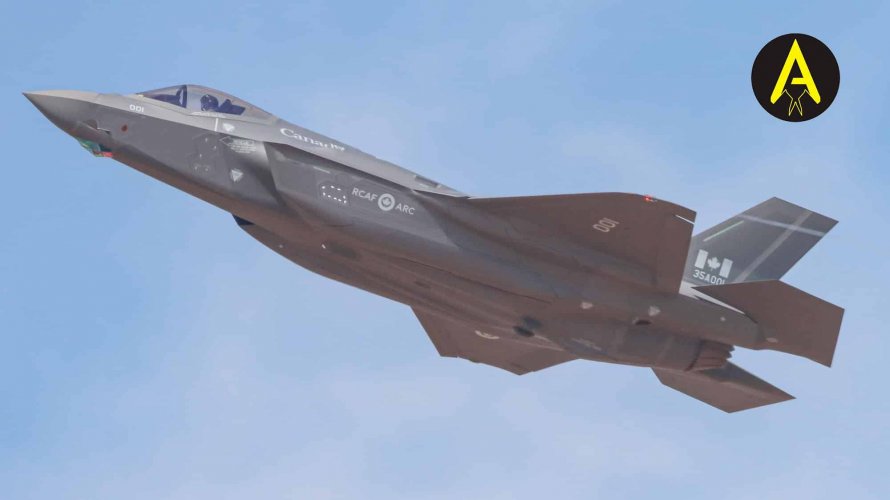
Another picture
from here
https://theaviationist.com/2026/09/23/canadas-first-f-35-conducts-maiden-flight/
from here
https://theaviationist.com/2026/09/23/canadas-first-f-35-conducts-maiden-flight/
Attachments

In_A_Dream
ACCESS: Top Secret
- Joined
- 3 June 2019
- Messages
- 788
- Reaction score
- 932
So, canopy and bay door. UPS forgot just slats and ailerons to make sure China gets to study all main types of RAM on F-35.
Is there anything left of the F-35 program that hasn't been plundered over the last few decades?
Well, not even the US can get their hands on the new AN/APG-85 yet, so I guess there’s that.Is there anything left of the F-35 program that hasn't been plundered over the last few decades?
View: https://www.youtube.com/watch?v=yoenQiitK7w
So, canopy and bay door. UPS forgot just slats and ailerons to make sure China gets to study all main types of RAM on F-35.
There needs to be a criminal investigation into this diversion (Which I strongly suspect is no accident).

Seriously? What a ridiculous comment.Is there anything left of the F-35 program that hasn't been plundered over the last few decades?
In_A_Dream
ACCESS: Top Secret
- Joined
- 3 June 2019
- Messages
- 788
- Reaction score
- 932
Seriously? What a ridiculous comment.
IYKYK.
IYKYK.
What does that acronym mean, please?
- Joined
- 29 November 2010
- Messages
- 2,308
- Reaction score
- 5,299
as this is an aviation forum. Dream's acronym likely refers to GTX's favorite aircraft companies, Ilyushin Yak KAI Yakovlev Kamov.What does that acronym mean, please?
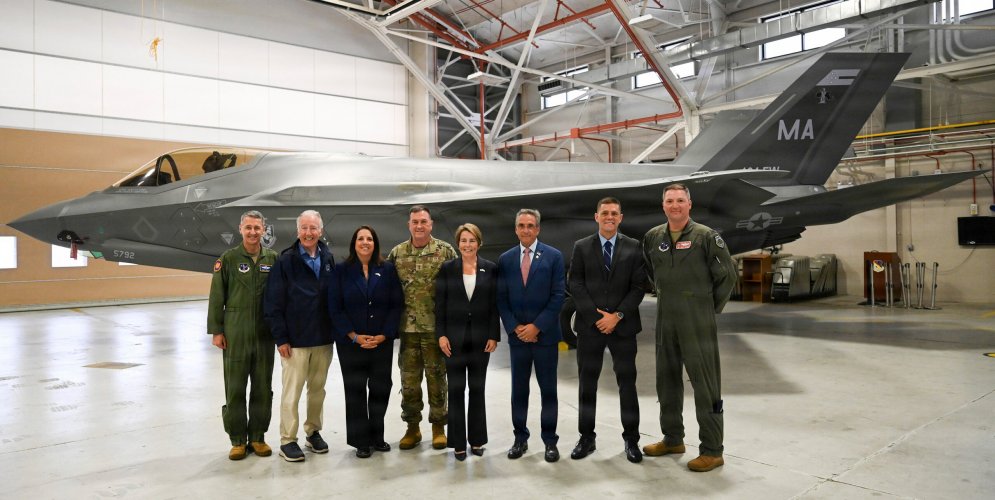
anyways back to F-35 news, did not see this posted yet,,
Massachusetts air national guard gets their first F-35s
Attachments
Scott Kenny
ACCESS: USAP
- Joined
- 15 May 2023
- Messages
- 19,688
- Reaction score
- 28,179
If You Know, You Know.What does that acronym mean, please?

wtna7
ACCESS: Confidential
- Joined
- 18 September 2025
- Messages
- 135
- Reaction score
- 372

EmoBirb
ACCESS: Top Secret
- Joined
- 18 January 2025
- Messages
- 2,729
- Reaction score
- 6,987
The JSF is a decades old program, produced in the thousands, exported all over the world and used in active conflicts.
Anyone that's surprised that other countries (adversaries and allies) compiled massive amounts of intel on it, from construction to material science and performance parameters is very naive. And it's definitely something the AF and LM know as well. That's why aircraft don't remain stagnant over their lifetime.
Anyone that's surprised that other countries (adversaries and allies) compiled massive amounts of intel on it, from construction to material science and performance parameters is very naive. And it's definitely something the AF and LM know as well. That's why aircraft don't remain stagnant over their lifetime.

snne
ACCESS: Top Secret
- Joined
- 3 July 2022
- Messages
- 2,435
- Reaction score
- 8,936
Just to point out the obvious while adding to your comment:Anyone that's surprised that other countries (adversaries and allies) compiled massive amounts of intel on it, from construction to material science and performance parameters is very naive. And it's definitely something the AF and LM know as well. That's why aircraft don't remain stagnant over their lifetime.
View: https://x.com/Planesandstuffe/status/2103061265421582651?s=20
View: https://x.com/stray_helium/status/2103026712426787172?s=20
View: https://x.com/Tas1Bora/status/2102892735024009693?s=20
Last edited:

- Joined
- 3 June 2011
- Messages
- 21,000
- Reaction score
- 19,290
But not without merit.Seriously? What a ridiculous comment.
snne
ACCESS: Top Secret
- Joined
- 3 July 2022
- Messages
- 2,435
- Reaction score
- 8,936
Again, the TF-X program was initiated back in 2010 with a planned 250-aircraft order, at a time when Turkey was still part of the F-35 program (i.e., in addition to the planned 116 F-35s in total). Even today, when the TurAF and Erdogan talk about procuring F-35s, it's because they were always intended to complement Kaan -- this has never been an "either/or" type of situation...I'm conflicted on these bans. as @bring_it_on said, we at a point where we either lose these markets completely or live with the fact that we can't control how these countries buy their weapons.
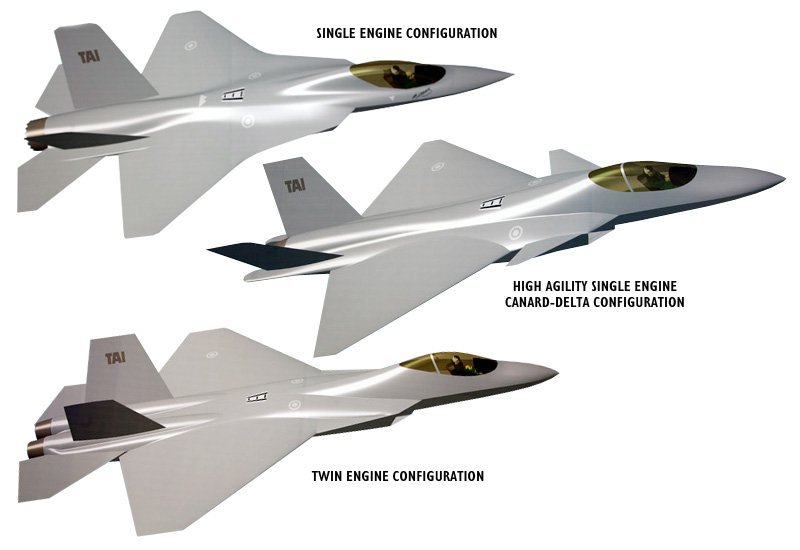
Before 2017-18 (i.e., F110 engine selection & Turkey's removal from the F-35 project), the TF-X (later named Kaan) was envisioned to be more of an J-35/KF-21-class aircraft, not the F-22/Su-57/J-20-class aircraft that it ended up being in order to cover both aircraft's originally intended roles in the force structure...
Honestly, I've had to repeat the exact same points so many times in this thread that I'm getting tired of writing here. I might as well just turn off notifications for this thread altogether...
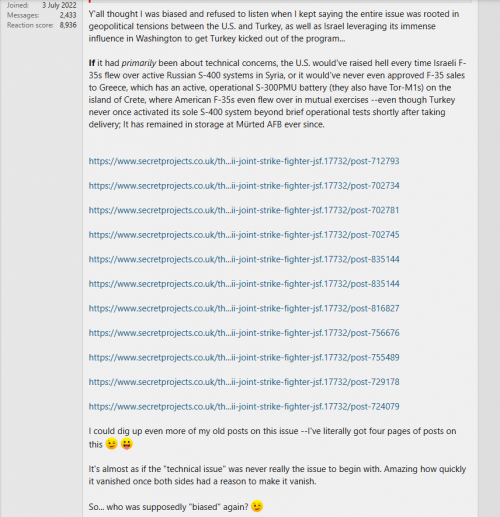
Check it for yourself if you don't believe me:
https://www.secretprojects.co.uk/search/2191760/?t=post&c[thread]=17732&c[users]=snne&o=date
Welp, Turkey only needs the F-35 for three particular reasons:
- NATO interoperability: The F-16s will eventually have to be retired and, even with a comprehensive MLU, they won't remain competitive into the 2030s. What modern aircraft fulfills NATO interoperability requirements better than the F-35?
- Nuclear sharing: Same reason. The F-16s will have to be retired by ~2040, and Turkey will eventually need a replacement. Kaan won't be certified to carry B61s.
- Test & Evaluation: Kaan won't reach IOC immediately, the earliest deliveries won't even begin until 2029 and its initial focus will primarily be A2A. There are six Turkish F-35s already in storage that could be delivered soon (in about two years), and this is where they come in. Incidentally, countries that pose a threat to Turkey are also in the F-35 club, so another benefit is gaining first-hand experience with the platform and preparing accordingly.
Turkey is a major UAV powerhouse, whose first LO platforms are set to enter service this year, but that experience still won't come anywhere close to operating a manned LO deep-strike fleet built around a mature design. Supplementing those six already-built aircraft with new orders won't result in additional deliveries before at least 2032, but they would still provide highly valuable operational experience.
As such, there's a reason why the military is only interested in around 40 aircraft at most --most of the planned ~500-strong combat fleet will be made up of indigenous aircraft, and you simply don't need any more than 40 F-35s for those three reasons.
I don't think re-admission into the programme is possible. All Turkish workshare (except for the engine parts) has already been redistributed to other partner nations or new customers, most notably Germany. Rejoining would also require the approval of all partner nations, which certainly won't be easy... Still... you never know.
@JS23 I see you're not too bad at parroting the exact same narratives CNN/Fox News spoon-fed you 8 years ago... Truly impressive geopolitical analysis from 10000km away, all from the comfort of a screen!
Attachments
Oh no, whatever will we do.Honestly, I've had to repeat the exact same points so many times in this thread that I'm getting tired of writing here. I might as well just turn off notifications for this thread altogether...
snne
ACCESS: Top Secret
- Joined
- 3 July 2022
- Messages
- 2,435
- Reaction score
- 8,936
+++
A while ago, I listened to someone who was affiliated with the Turkish MIC/engine industry as recently as the early 2010s (still is?), who said that while Turkish industry was hit pretty hard when they lost their estimated $10-14B in total income from the project, the absolute majority of those companies are now far too busy with either commercial aviation supply-chain orders or developing and producing equipment for the Turkish service, thanks to the sheer jump in capability they've achieved since then.
He gave Aselsan as a particularly good example -- some of the optics people there whom he knew personally had contributed to F-35's EOTS production back in the day. According to him, if you went back to those same people today and asked them about getting involved in the F-35 program again, they'd probably greet you with a mouthful of quite creative slurs... They're apparently too damn busy just keeping up with their own delivery schedules these days...
A while ago, I listened to someone who was affiliated with the Turkish MIC/engine industry as recently as the early 2010s (still is?), who said that while Turkish industry was hit pretty hard when they lost their estimated $10-14B in total income from the project, the absolute majority of those companies are now far too busy with either commercial aviation supply-chain orders or developing and producing equipment for the Turkish service, thanks to the sheer jump in capability they've achieved since then.
He gave Aselsan as a particularly good example -- some of the optics people there whom he knew personally had contributed to F-35's EOTS production back in the day. According to him, if you went back to those same people today and asked them about getting involved in the F-35 program again, they'd probably greet you with a mouthful of quite creative slurs... They're apparently too damn busy just keeping up with their own delivery schedules these days...
Last edited:
Similar threads
-
Lockheed Martin F-16 Fighting Falcon News and Developments
- Started by seruriermarshal
- Replies: 898
-

-

-
 Lockheed JSF evolution: ASTOVL, SSF, CALF, JAST
- Started by Antonio
- Replies: 176
-
 USAF/USN 6th Gen Fighters - F/A-XX, F-X, NGAD, PCA, ASFS News & Analysis [2008- 2025]
- Started by Matej
- Replies: 10K