Well in that case I would think that Chile would replace both the F-5 and F-16 fleets sooner with the F-35 after Belgium. After all the USAF sent down F-35s to Chile recently on exercise.
 
Well in that case I would think that Chile would replace both the F-5 and F-16 fleets sooner with the F-35 after Belgium. After all the USAF sent down F-35s to Chile recently on exercise.
It was for the FIDAE air show and on its way there it was refueled by a KC-135 of the Chilean Air Force and flew over Santiago accompanied by F-16s. This, along with the fact that the Chilean government is already looking for replacements for the F-5 and Peru's purchase of F-16 Block 16s, has fueled this speculation.
 
https://www.airandspaceforces.com/g...kZzAkdDE3ODEyNzM5NDUkajYwJGwwJGgyMDE2Njc5OTM2

https://www.gao.gov/assets/gao-26-108113.pdf

Full GAO report and also summary from air and space forces mag. This is a multi-faceted issue. Of the roughly 500 F-35A in US service, 20 percent were delivered with the TR-3 upgrade but aren't fully combat capable yet. That accounts for part of the major hit in mission capable rates. On top of that, you have older F-35A undergoing upgrades. The spares problem has been a constant headache and it's probably safe to say that the global spares pool model has been a failure. Obviously the fully mission capable rate is troubling, but context is important. The F-35's deployed in combat have been reliable when given the spares priority.
https://www.defensenews.com/industr...n-4-f-35s-is-fully-mission-capable-gao-finds/
 
https://aviationweek.com/defense/bu...s-delivered-marines-so-far-without-new-radars

Lockheed Martin has delivered six F-35Bs to the U.S. Marine Corps without radars due to ongoing delays with a powerful new upgrade, the head of the F-35 Joint Program Office (JPO) told lawmakers on June 23.

The Marine Corps chose to wait for the arrival of the Northrop Grumman APG-85 active electronically scanned array (AESA) radar rather than accept F-35Bs equipped with the existing radar, Lt. Gen. Gregory Masiello said during a Senate Armed Services Committee hearing.
But Masiello said that the PTMS upgrade will not be required or available at the time that the APG-85 is ready to be installed on the six F-35Bs that the Marine Corps has received so far without radars. An initial version of the PTMS with incremental improvement will arrive by fiscal 2031, Masiello said, with the full capability arriving a few years later. But the APG-85 will be ready before fiscal 2031.
 
Well they're TR-3 jets so they aren't combat capable anyway. Speaking of, it's been a year now since it was reported that Lockheed believes they've finished with the TR-3 software but as far as I know they're still not deemed combat capable. The software situation on these jets is pretty opaque and I'd love more insight on what's going on but from what we can see it's pretty bad and doesn't look to be improving.
 
This is the german FCAS.... with so many content from Airbus....
No, that's the Jagdbomber of the near future. The fifth generation stealth fighter is only supplementing a national sixth generation design. This fleet make-up can also be seen in the UK and Italy, which also boast the F-35 on top of developing an indigenous next generation fighter.

After all, any serious force should have acquired or developed at least some stealth fighters by now.

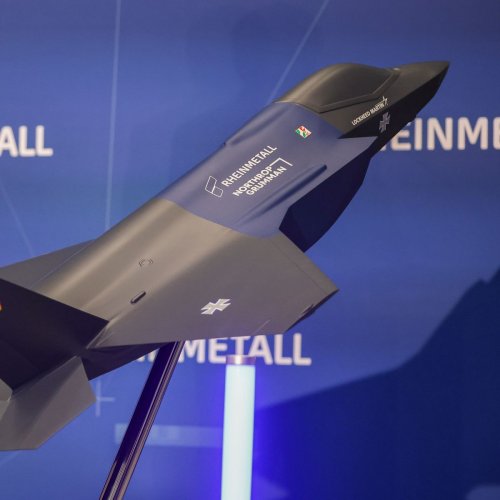
Furthermore, the F-35 has German participation, Rheinmetall will construct pieces of the fuselage in Weeze. A pretty good deal on top of a capable strike fighter. Industrial participation will ultimately benefit the German aviation industry at large. And I'd argue that the center fuselage of such a jet is quite the substantial involvement.

1d84345e-512f-4e66-ab06-b3eef645f56b_w1200_r1_fpx75_fpy47.jpg
 
Last edited:
And once again:

https://www.reuters.com/world/middl...-turkey-can-get-f-35-fighter-jets-2026-06-24/

What is notable here is the push at the highest level.
This whole deal has become so tiresome over the years that the current consensus -- from PhDs to observers -- is basically: "If it works out, great. If not, so be it (gelirse Ekim'e, gelmezse s*kime)".

I think all of my posts in this thread perfectly encapsulate everything about this complex geopolitical mess.
https://www.secretprojects.co.uk/search/1997380/?t=post&c[thread]=17732&c[users]=snne&o=relevance

That said, I hope everyone understands that, from a non-biased perspective, the US (and Europe as well) needs Turkey operating F-35s just as much as Turkey needs them in the immediate term... The problem is that there are still huge obstacles in the way, namely congressional lobbying, Israel not wanting a strong and stable power in the region, and the individual geopolitical views of key decision-makers in Washington.
 
Last edited:
Furthermore, the F-35 has German participation, Rheinmetall will construct pieces of the fuselage in Weeze. A pretty good deal on top of a capable strike fighter. Industrial participation will ultimately benefit the German aviation industry at large. And I'd argue that the center fuselage of such a jet is quite the substantial involvement.
So nothing essential. just some crumbs.

With Eurofighter they alredy built center of frame. Are they capable of producing something else? long is the road for mastering a whole jet, not to sepak onf engine.
 
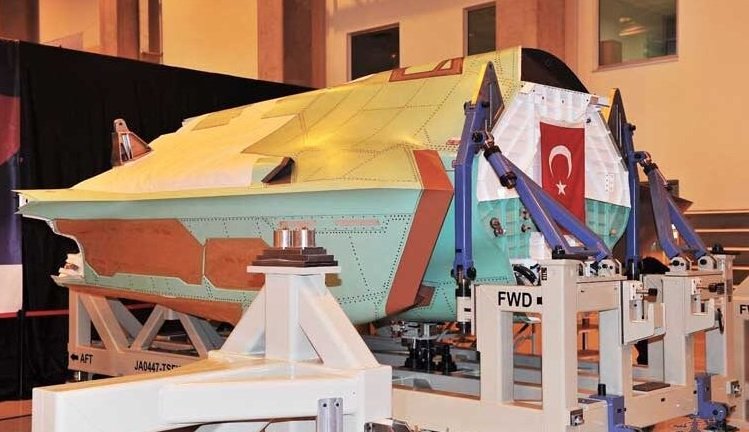
I wouldn't say that manufacturing the center fuselage for a stealth strike fighter is "just some crumbs". It's a major participation in the supply line of the type and provides valuable experience in the construction of low observable aircraft.
What is important is not to built, accordind to drawings not made by you, so without the stealth know how.
As said, Germany is far from having the skill to study a complete stealth fighter. Only a subcontractor (in the jet industry).
 
What is important is not to built, accordind to drawings not made by you, so without the stealth know how.
As said, Germany is far from having the skill to study a complete stealth fighter. Only a subcontractor (in the jet industry).
The only country more qualified in that realm within Europe is the UK. BAE has a comfortable lead in that regard, while the likes of Airbus and Rheinmetall have valuable experience in that realm. Leaving TAI out for a moment.
 
The only country more qualified in that realm within Europe is the UK. BAE has a comfortable lead in that regard, while the likes of Airbus and Rheinmetall have valuable experience in that realm. Leaving TAI out for a moment.
any one that can produce a central frame of a modern jet (ie with composite) can produce a stealth one ! you just have to follow the right shapes studied to be stealth.
BAe probably can study that. probably.
Germany not so far. As said, in this industry, they are just subcontractor.
 
BAe had experience of designing stealth aircraft with the Future Offensive Air System (Other wise FOAS) back in the nineties.
 
any one that can produce a central frame of a modern jet (ie with composite) can produce a stealth one ! you just have to follow the right shapes studied to be stealth.
BAe probably can study that. probably.
Germany not so far. As said, in this industry, they are just subcontractor.
It's certainly not as easy as you portray it, otherwise it would be much more common. And while stealth aircraft have been somewhat democratized, in that more and more countries have been able to develop and field them, the design and construction is only one portion. Operation and maintenance is another, something USAF personelle repeatedly pointed out, similarly to how USAF, PLAAF and VKS sources state that the deployment of low observable aircraft required rethinking their doctrine and how they approach their own operations.

This can only be learned by real world deployment. Something that in Europe only applies to the UK, Germany and Italy. Countries that operate low observable aircraft (all three are F-35 customers), train with US forces on the type and have the industrial and financial capacity to develop their own upcoming stealth aircraft.

Industrial participation and genuinely operating, using and maintaining the F-35 offers a whole new dimension of familiarity with low observable combat aviation. Meaning that the Luftwaffe can introduce their input based on their experience they're going to gather with the F-35, something the MoD and Airbus/Rheinmetall/MTU/Hensoldt etc. can then consider in their choices to deliver something that benefits from real world validation.

The F-35 is through and through a win for the German military and in many ways a valuable opportunity for German industry. Missing out on the opportunities offered by the JSF means having to build the experience in construction, maintenance, operation and doctrine from scratch with a first time national low observable aircraft. When the F-35 can already offer a low risk head start. And in case of the Luftwaffe it was the perfect replacement for the Tornado anyway, it was a win/win.

 
It's certainly not as easy as you portray it, otherwise it would be much more common. And while stealth aircraft have been somewhat democratized, in that more and more countries have been able to develop and field them, the design and construction is only one portion. Operation and maintenance is another, something USAF personelle repeatedly pointed out, similarly to how USAF, PLAAF and VKS sources state that the deployment of low observable aircraft required rethinking their doctrine and how they approach their own operations.

This can only be learned by real world deployment. Something that in Europe only applies to the UK, Germany and Italy. Countries that operate low observable aircraft (all three are F-35 customers), train with US forces on the type and have the industrial and financial capacity to develop their own upcoming stealth aircraft.

Industrial participation and genuinely operating, using and maintaining the F-35 offers a whole new dimension of familiarity with low observable combat aviation. Meaning that the Luftwaffe can introduce their input based on their experience they're going to gather with the F-35, something the MoD and Airbus/Rheinmetall/MTU/Hensoldt etc. can then consider in their choices to deliver something that benefits from real world validation.

The F-35 is through and through a win for the German military and in many ways a valuable opportunity for German industry. Missing out on the opportunities offered by the JSF means having to build the experience in construction, maintenance, operation and doctrine from scratch with a first time national low observable aircraft. When the F-35 can already offer a low risk head start. And in case of the Luftwaffe it was the perfect replacement for the Tornado anyway, it was a win/win.
I generally agree with you on its advantages (of which there are indeed many - including "seamless" interoperability with other F-35 operators and NATO nuclear sharing), but there are also huge downsides to operating the F-35 -- namely its outrageous lifetime costs and poor readiness rates. What good is a stealth fighter if I can't get it in the air when I actually need it?

It also comes with a great deal of geopolitical, economic, and technological strings attached, to the point that some desperate prospective customers have opted to look elsewhere. Then there's the well-known risk that comes with operating American (or European!) equipment in general: maintenance support and the supply of spare parts can be cut off the moment a political dispute arises, or simply because Washington changes its mind about you -- which, these days, tends to happen every four years...
 
Last edited:
The only country more qualified in that realm within Europe is the UK. BAE has a comfortable lead in that regard, while the likes of Airbus and Rheinmetall have valuable experience in that realm. Leaving TAI out for a moment.
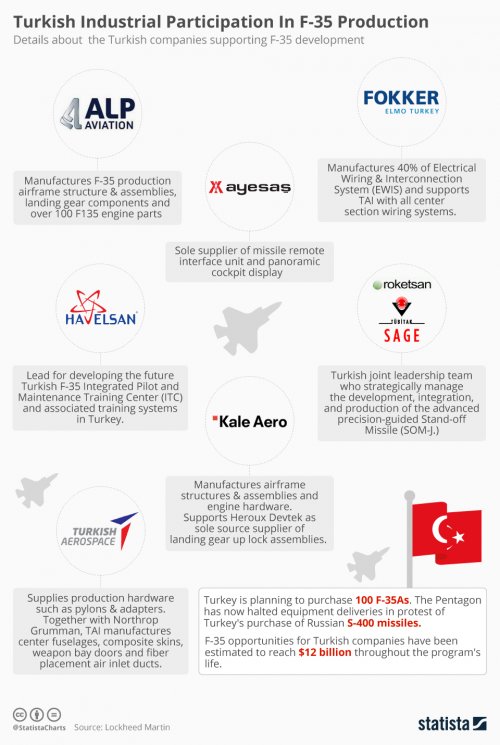
To tie this into your later comment about the advantages of experiencing such an ecosystem: without Turkish military and industrial participation in the JSF as a prominent Tier 3 partner until 2018 (and industrially until 2022 23), I genuinely don't think the Kaan would have become what it is today. Turkey would still have developed an advanced aerospace and engine industry over time, but integrating all of those technologies, disciplines, and lessons into a single package is what truly distinguishes a 5th-generation fighter (or beyond) from a conventional aircraft with a broadly LO shape.

Without all that experience, I'm not convinced the Kaan would've evolved into anything much beyond a modern "F-15 reimagination" with stealth shaping (or SuperBug → KF-21, remember the original concepts?). Beyond the industrial expertise accumulated through the program, perhaps its greatest contribution was giving the traditionally conservative TurAF Command an entirely new operational vision for future air warfare centered around low-observable combat aviation and network-centric operations. In short, Turkey didn't have to start from zero and learn how to build a competitive stealth fighter from scratch like everyone else.

And the benefits didn't stop with the Kaan, either; they propagated throughout an entire ecosystem... Projects such as Baykar's fighter-like UCAV and TAI's flying-wing UCAV have also benefited -- directly or indirectly -- from the technologies, systems, and industrial know-how that grew out of the Kaan's subsystem development, itself heavily shaped by Turkey's military and industrial participation in the JSF program.
 

Attachments

  • 17557.jpeg
    17557.jpeg
    371.8 KB · Views: 45
  • F-35-Center-Fuselage-TAI.jpg
    F-35-Center-Fuselage-TAI.jpg
    113.7 KB · Views: 44
Last edited:
https://news.usni.org/2026/07/01/testimony-on-the-f-35-aircraft-program

I had the opportunity a couple of
years ago to fly an F-16 against an F-35, and it was
informative, to say the least.· Could not see it on radar,
even when I'm looking right at it, which was impressive.
Had a crappy first turn so I was able to gun them up after a
9G turn in an F-16.· And then I've also had the opportunity
to fly the simulator down in Pax River against J-20s and the
F-35.
 
He seems to be making a strong case that, at least in the simulator, the F-35 is the only aircraft that gives one a fighting chance in contested environments. Which in turn doesn't bode well for legacy platforms and makes the need for the F-35 even more clear.
And then I've also had the opportunity to fly the simulator down in Pax River against J-20s and the F-35. Impressive capability. Nothing like when I was flying in the Navy. This airplane is going to, you know, have a major role in any future conflict and especially in like a contested environment.
 
You didn't understood me.
To study a stealth frame is hard. To produce it is not more complexe than any other frame.
The germans have no demonstrated skill in study, but in production.
because we underestimated the thoughtlessness of your comment. there are more than dozen layers of stealth treatment of different materials stacking on top of each other. and they are not unison throughout the aircraft. Because different curves, bumps. panels, cavities interact differently with radar waves, and different frequencies in turn interact differently against these surfaces as well. calculation of which stealth technique, be it radar absorbent materials, radar absorbent structures, to applied local to each part of the aircraft become exponentially complex when so many different factors interact with each other.

the end product is an extremely complex machine with various layers and localized features to manage RCS, infrared signature, etc. that a non stealth aircraft simply doesn't bother with.
 
You didn't understood me.
To study a stealth frame is hard. To produce it is not more complexe than any other frame.
The germans have no demonstrated skill in study, but in production.
Airbus and German industry in general has several studies concerning low observable aviation under their belt, I don't think I have to mention that Germany was right there behind the US during the cold war when it comes to such studies. We never had Tacit Blue or Have Blue, as flyable demonstrators. But we had Lampyridae and TDEFS, valuable studies nonetheless. And these days there are studies like LOUT, DLR FFD, Airbus' Wingman studies as well as the work that went into the optimization and improvement of existing platforms. Now things like participation in the wider JSF framework, Airbus having a relation with Kratos concerning the XQ-58 or General Atomics Aerotec Systems GmbHs involvement in trying to make the FQ-42 more suitable for European customers, add further expertise to the wider German aerospace sector. It's a decent balance of past, current and future development studies on an indigenous basis while gaining industrial expertise through cooperation with American partners. And who better to learn from than the Americans in that regard?
 
Airbus and German industry in general has several studies concerning low observable aviation under their belt, I don't think I have to mention that Germany was right there behind the US during the cold war when it comes to such studies. We never had Tacit Blue or Have Blue, as flyable demonstrators. But we had Lampyridae and TDEFS, valuable studies nonetheless.
Problem is, these things tend to matter significantly only when they're reaching operational status. Or, at least a prototype, which worked in reality (even if on artisanship and individual treatment).
Otherwise, it's studies. Idk, Antonov had internal fighter studies. Maybe even stealth ones.
 
Problem is, these things tend to matter significantly only when they're reaching operational status.
I wouldn't say so. On this forum alone you can find various advanced studies that never had an associated demonstrator produced but still hold significant value on their own. One of the more recently relevant examples being the Northrop DP-21 aka the Christmas Tree Fighter. NATF-23 is another study/proposal that never left the drawing board yet had substantial relevance for Northrop Grumman as a company. The BAE Replica was also not a flying prototype, yet BAE deemed it crucial.
 

Similar threads

Back
Top Bottom