Sandboxx has a new video out about the recent F-35A that got a near miss hit from an Iranian MANPADS and survived:


After an American F-15E Strike Eagle and an A-10 Thunderbolt II were both downed over Iran on the same day a few weeks ago, I thought it was worth looking back at the reports of an F-35 seemingly tanking a direct hit from an Iranian missile, but staying airborne and operational, allowing its injured pilot to make it back to friendly airpsace to conduct an emergency landing, where he was then treated for shrapnel wounds. And it turns out... that is exactly what this advanced jet was built to do.​
 
https://aviationweek.com/defense/bu...on-wants-major-f-35-plus-block-4-acceleration
Included in the breakout of the reconciliation request is $324 million to accelerate the purchase of 200 Block 4 upgrade kits. This, the Pentagon says, will accelerate installations on the aircraft and shift the first fleet delivery to 2030 from 2031. The major Block 4 upgrade package has long been delayed, with the Joint Program Office shifting its requirements and fielding plan to try to bring it on more quickly. The Government Accountability Office in September 2025 announced the 2031 date, a five-year delay from the original timeline.
 
Last edited:
The Pentagon in its budget request says it can speed up fielding of the F-35's Block 4 by a year, to 2030, as it increases spending on the program. This is reliant on reconciliation approval
20251229_210729.jpg https://aviationweek.com/defense/budget-policy-operations/pentagon-wants-major-f-35-plus-block-4-acceleration
 
UK F-35 Review Sets Timeline For Spear 3 Integration

The UK Defense Ministry expects to field the MBDA Spear 3 mini cruise missile on the Lockheed Martin F-35 Joint Strike Fighter starting in fiscal year 2028-29.

After months of review, the ministry has now completed what it calls a “review note,” Luke Pollard, minister for defense readiness and industry, told British lawmakers.

“Fielding this critical F-35 war-fighting capability is targeted within the joint program from financial year 2028-29; spiral capability upgrades across the program life cycle will occur thereafter,” Pollard said, suggesting a partial integration at first.
 
25 more F-35I for Israel:

Currently, Israel has 48 F-35I jets, following an initial order of 50. Another 25 F-35s were ordered in 2023, which are expected to be delivered starting in 2028. Israel ordered 25 F-15IA jets in 2024, and the first are expected to be delivered starting in 2031.
[...]
The aircraft will eventually bring the Israeli Air Force’s F-35i fleet to 100 and F-15IA — the Israeli variant of the advanced F-15EX — fleet to 50 in the coming years.


https://www.timesofisrael.com/liveb...e-squadrons-of-f-35i-and-f-15ia-fighter-jets/
 
What are the chances that the next purchase for Israel are going to be a small number of the F-35B STOVL variant? Would make sense really than more F-35As.
 
What are the chances that the next purchase for Israel are going to be a small number of the F-35B STOVL variant? Would make sense really than more F-35As.
Why would they want a more expensive variant with less range, smaller payload and higher maintenance? Unless they have a small carrier hidden somewhere?
 
What are the chances that the next purchase for Israel are going to be a small number of the F-35B STOVL variant? Would make sense really than more F-35As.
Before Oct 7th 2023, Israel did look at the F-35B as a "nice to have" capability, similar to the V-22 it eventually abandoned.
Iran and its proxies (primarily Hezbollah) were considered capable enough to temporarily shut down Israeli aviation for the critical first days. The F-35B was supposed to fix that.
But the doom prophecy was ultimately invalidated in this war.
I am actually surprised that Israel never had an aircraft carrier, just a thought that I had Manuducati.
Geographically it makes no sense. 3,000km of narrow seas between port and an ocean. And the closest parking spot near Iran would bring it to within more range than a direct Israel-Iran flight.
A much better solution is long range aviation.
 
Before Oct 7th 2023, Israel did look at the F-35B as a "nice to have" capability, similar to the V-22 it eventually abandoned.
Iran and its proxies (primarily Hezbollah) were considered capable enough to temporarily shut down Israeli aviation for the critical first days. The F-35B was supposed to fix that.
But the doom prophecy was ultimately invalidated in this war.
I’m still waiting for someone to seriously propose land-based F-35Cs with cat-and-trap bunker hangars built like WWII submarine pens.
 
The Marine Corps does have F35C and they usually have them land based unless moving and deployed onto carriers.
 
Because not every country has a lot of convenient highway tunnels under mountains?
You misunderstand me. What advantage do you see of a land based F-35C over a standard F-35A? I ask since no air force seems to see it. The only reason the USMC has a small number (140 planned) of F-35Cs is to be able to operate them off USN carriers as a replacement of their classic Hornets.
 
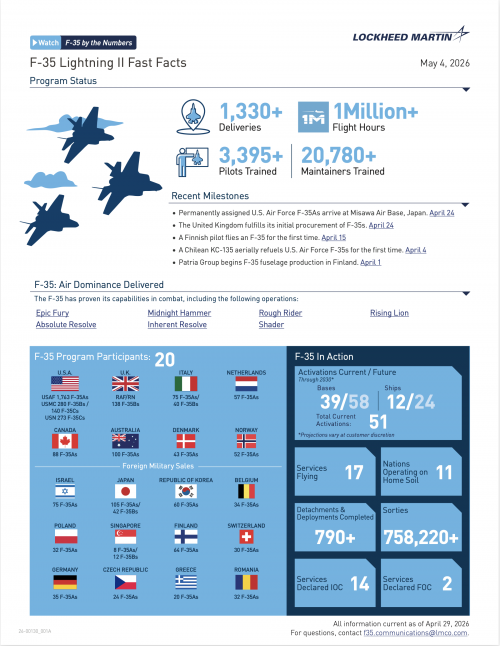
Thanks @GTX. Sortie generation per aircraft appears to be going down... 128,900 F-35 sorties in the last 12 months vs. 122.400 sorties in the preceding 12mo period from May 2024-May 2025. That's only a 5% sortie increase despite the fleet size having increased by 15%!

Translated into flight hours that's roughly 165 flight hours/aircraft/year, assuming an average sortie duration of 1.6hrs / 1h35min (using the historical average sortie data from recent years), down from 180 hrs/year in 2023 and 2024.
 
Last edited:
You misunderstand me. What advantage do you see of a land based F-35C over a standard F-35A? I ask since no air force seems to see it. The only reason the USMC has a small number (140 planned) of F-35Cs is to be able to operate them off USN carriers as a replacement of their classic Hornets.
I'm sorry, to clarify, based on the interest in flying F-35As off of improvised highway runways and shelter them in highway tunnels, my logic was that the ultimate solution to the vulnerability of hangars and runways is to build a fully hardened installation, and use short-takeoff aircraft so that you can make due with either a short stretch of surviving runway or a takeoff/landing area that's fully enclosed. The F-35B has been the go-to for that, and seems to have been seeing some renewed interest based on that, but it's pretty compromised in range and payload, and you don't necessarily need the full vertical lift capability. Instead, you could use land-based CATOBAR (which some seem to have been experimenting with lately) to launch and recover the longer-ranged and more capable F-35Cs from within a fully enclosed facility, and your only window of vulnerability would be when the doors are open for flight operations.
 
Thanks @GTX. Sortie generation per aircraft appear to be going down... 128,900 F-35 sorties in the last 12 months vs. 122.400 sorties in the preceding 12mo period from May 2024-May 2025. That's only a 5% sortie increase despite the fleet size having increased by 15%!

Translated into flight hours that's roughly 165 flight hours/aircraft/year, assuming an average sortie duration of 1.6hrs / 1h35min (using the historical average sortie data from recent years), down from 180 hrs/year in 2023 and 2024.
Too broad a data set to make determinations such as that. Multiple air forces operating it with different priorities, stages of OC etc etc.
 
flying F-35As off of improvised highway runways and shelter them in highway tunnels

Instead, you could use land-based CATOBAR (which some seem to have been experimenting with lately) to launch and recover the longer-ranged and more capable F-35Cs from within a fully enclosed facility, and your only window of vulnerability would be when the doors are open for flight operations.

You are talking about a very specific scenario(s) (one being highway tunnels and the other being fully enclosed facilities) which I doubt many, if any, air forces would be willing to consider. You also have to remember that in the case of hardened facilities these are also capable of being targeted or at least the doors are with precision weapons etc. land based catapult equipment is also somethign that isn't a small undertaking top operate and sustain.

Finally, you claim that the F-35C is longer ranged. I presume you are talking about in comparison to the F-35B because the F-35A and -35C are similar ranged with the latter being heavier. This alone is a reason why air forces using land based operations will go for the A model over the C every time.
 
To add to what GTX said, you can also operate the F-35A from such installations if present. Because quite frankly, when you're already carving a small airbase into a mountain, it's not impossible to have proper runway length. Certainly it would be easier than to install a catapult assisted take off and arrested landing setup in confined space.

I also get the fascination with the concept, as did many during the height of the cold war, after all similar installations existed in the Alpes. And today Iran uses a similar approach for drone and missile launches. But large militaries, especially ones that operate the F-35 are largely not interested in such a concept. Because the cost of construction and having such a suitable location in the first place are enormous. Dispersed operations on roads are generally well received as a concept because you don't have to commit to massive changes or entirely new projects with regards to infrastructure. One is taking advantage of already existing and abundant infrastructure, the other is a highly specialized and far more resilient kind of military structure, purpose build. Which is why ultimately there's no demand for land based F-35Cs, because the concept that would make it necessary would also be able to operate the F-35A and because no customer country is looking to construct mountain imbedded WWIII air bases just now.
 
Actual F-35C range in a non-USN profile is unknown. But safe to assume it has longer legs than the F-35A.
The question is how much more. Probably not enough to justify the increased cost and lower performance.
 
Too broad a data set to make determinations such as that. Multiple air forces operating it with different priorities, stages of OC etc etc.

Not sure if you're questioning the math around average fleet activity or just saying that we shouldn't draw any conclusions from it?

For what it's worth the F-35 fleet mix hasn't changed much in the last few years, roughly 65% US / 35% foreign. So there's no obvious reason why year-over-year aggregate sortie number trends would be impacted by the operator mix. What we do know is that overall fleet availability has been challenging (partly due to spare parts constraints) and that part of the F-35 fleet has been parked and isn't contributing to sortie generation numbers (whether early LRIP training aircraft in storage or recent TR-3 models waiting for software clearance). The drop in sortie generation per aircraft could well be linked to that.
 
Actual F-35C range in a non-USN profile is unknown. But safe to assume it has longer legs than the F-35A.
The question is how much more. Probably not enough to justify the increased cost and lower performance.
I mean, it is another 1500lbs of internal fuel.
 
I mean, it is another 1500lbs of internal fuel.
It's more complicated than that. The F-35C has an ~18% empty weight penalty but carries only 8% more fuel, so its fuel fraction is actually worse than the F-35A. On the other hand it has 60% more effective wing area, so its lift-to-drag ratio should be improved despite the weight penalty. In theory the net result should still be an increase in range but you need some detailed math to estimate the actual benefit.
 
BTW, taking the last point further, one needs to keep things in context re the F-35 range by comparing to the main types it is replacing:
Not sure if you're questioning the math around average fleet activity or just saying that we shouldn't draw any conclusions from it?
I was talking about drawing any conclusions. There is a lot of other information that would influence anything in this area.
 
Actual F-35C range in a non-USN profile is unknown. But safe to assume it has longer legs than the F-35A.
The question is how much more. Probably not enough to justify the increased cost and lower performance.
Why make that assumption when the range is already reported as the same
 
Why make that assumption when the range is already reported as the same

Is it?
F-35A A/G combat radius, USAF profile: 669 nm
F-35C A/G combat radius, USN profile: 670 nm
Note the USN profile includes more reserve fuel.
For the F-35A, we also know the radius is 732 nm in an optimised A/G profile. No similar numbers are available for the F-35C afaik.
But I think it's pretty safe to assume it could use the reserve fuel needed for carrier ops to increase range in an optimised profile.
 
Is it?
F-35A A/G combat radius, USAF profile: 669 nm
F-35C A/G combat radius, USN profile: 670 nm
Note the USN profile includes more reserve fuel.
For the F-35A, we also know the radius is 732 nm in an optimised A/G profile. No similar numbers are available for the F-35C afaik.
But I think it's pretty safe to assume it could use the reserve fuel needed for carrier ops to increase range in an optimised profile.
I agree that a Cee operating the same profile as an A from a land based field is likely to have a longer range. I doubt it is significantly longer, perhaps between 50 to 75nm at best.

The question is whether what you gain on range is worth what you lose in other areas. I've already mentioned the reduced G of the Cee but also consider the acceleration of the Cee compared to the A. The difference is SIGNIFICANT!!! Then add additional mechanical complexity of the Cee compare to the A, the 10 times larger user base of the A and what that will do to parts and support and by extension overall long term affordability and finally the cost of a Cee over an A which is going to be at least 10% more per airframe. That cost reduction potentially provides for more aircraft over a buy of 20 aircraft or more. IMO with those factors the pendulum swings heavily in favour of operating A models land based over a Cee.

The only things that potentially benefit a Cee acquisition is if the user needs, like really needs, land based arrested landing and potentially that last drop of range given no tanker fleet. I can't see anything else that would make an operator chose the Cee over an A.
 
Cruise Altitude? 6th Gen will fly higher. The C might get here some interesting advantages to trade against its A cousin.
 
I agree that a Cee operating the same profile as an A from a land based field is likely to have a longer range. I doubt it is significantly longer, perhaps between 50 to 75nm at best.

The question is whether what you gain on range is worth what you lose in other areas. I've already mentioned the reduced G of the Cee but also consider the acceleration of the Cee compared to the A. The difference is SIGNIFICANT!!! Then add additional mechanical complexity of the Cee compare to the A, the 10 times larger user base of the A and what that will do to parts and support and by extension overall long term affordability and finally the cost of a Cee over an A which is going to be at least 10% more per airframe. That cost reduction potentially provides for more aircraft over a buy of 20 aircraft or more. IMO with those factors the pendulum swings heavily in favour of operating A models land based over a Cee.

The only things that potentially benefit a Cee acquisition is if the user needs, like really needs, land based arrested landing and potentially that last drop of range given no tanker fleet. I can't see anything else that would make an operator chose the Cee over an A.
Considering also the fact that the C version costs around 20$ millions apiece more compared with the A, while it lacks an internal cannon and has reduced maneuverability (7.5G instead of 9G) a slight advantage in range would not compensate the other disadvantages. For each 6 F-35C you get another supplementary F-35 in your fleet if you opt for the A version. Or get the money for a landing strip lenght extention.

If you don`t have aircraft carriers you just could not justify the sum of all the disadvantages which the -C version has.
 
Last edited:
The question is whether what you gain on range is worth what you lose in other areas.

No IMHO, CATOBAR carrier operators are the only potential customers for the F-35C.
Btw. the acceleration of the C but also the B is so bad they have been described as essentially subsonic aircraft with supersonic dash capability. Something like the A-7F. :p

For each 6 F-35C you get another supplementary F-35 in your fleet if you opt for the A version. Or get the money for a landing strip lenght extention.

Or for every 12 or so F-35A you get a KC-46. :D
 
No IMHO, CATOBAR carrier operators are the only potential customers for the F-35C.
You're probably right, though IIRC all USN airframes have a lower G limit due to constantly hitting the carrier at 700fpm descent rate no flare. So it could be possible for a "never flown off a carrier" Charlie to regain the 9-gee limit of the Alpha if the engineer's math agrees.


Or for every 12 or so F-35A you get a KC-46. :D
That's probably a better selling point.
 
No IMHO, CATOBAR carrier operators are the only potential customers for the F-35C.

If the bean-counters in HM's treasury hadn't been so tight-fisted I have no doubt that the RN's QE-class CVs would be equipped for CATOBAR operations and the they'd be equipped with F-35Cs (That could happen yet but it would take an expensive refit).

Or for every 12 or so F-35A you get a KC-46. :D

"Buy 12 F-35As and get a KC-46 for free";):D.
 

Similar threads

Back
Top Bottom