
You are using an out of date browser. It may not display this or other websites correctly.
You should upgrade or use an alternative browser.
You should upgrade or use an alternative browser.
Lockheed Martin F-35 Lightning II Joint Strike Fighter (JSF)
- Thread starter Triton
- Start date
yeetmahboi
ACCESS: Top Secret
- Joined
- 6 April 2022
- Messages
- 1,025
- Reaction score
- 1,434
So why wasn't the APG-85 designed to fit into a common, or minimally modified mounting, and instead pursued this complication?

- Joined
- 3 June 2006
- Messages
- 3,538
- Reaction score
- 6,215
Hey folks , today on February 7th, 2026, the first F-35B for the Japan Air Self-Defense Force (JASDF) was officially unveiled at Nyūtabaru Air Base.
Source (Japanese, X fka Twitter): View: https://x.com/i/status/2020076273188651303
Source (Japanese, X fka Twitter): View: https://x.com/i/status/2020076273188651303
The mount is not the problem, the problem is the late delivery and subsequent blown out testing and integration of the APG-85. If a common mounting was available would the US Govt or NG pay for both radars and retrofit the APG-85 at a later date? That would be expensive for either party and contractually I doubt NG would have agreed and the US Govt paying for both wouldn't pass the pub test.So why wasn't the APG-85 designed to fit into a common, or minimally modified mounting, and instead pursued this complication?

bring_it_on
I really should change my personal text
- Joined
- 4 July 2013
- Messages
- 4,203
- Reaction score
- 5,730
The APG-85 was built around a requirement that the USAF led in terms of definition and future capability needs. Getting the sensor integrated on the F-35 from a space / configuration stand point is not a or ' the challenge'. Lockheed designed that working with Northrop Grumman and the program office. That works is done. Why the AF specified performance requirement that necessitated anything other than minimally mod drop in should be easy to understand - It's effectively the MLU for the F-35 with another radar unlikely for the next couple of decades if ever.So why wasn't the APG-85 designed to fit into a common, or minimally modified mounting, and instead pursued this complication?
Northrop and JPO could have paid for the changes LM specified to be able to add either radars to keep up with production / deliveries but that's not for Lockheed to decide. Same for ordering APG-81s as backup to mitigate any future APG-85 delays. Hundreds of APG-85's have been ordered so the Defense Daily claim of Lot 20 deliveries needs to be substantiated with evidence.
As has been mentioned before, the APG-85, unlike the APG-81, is GFE for the F-35 so those decisions are between JPO and Northrop Grumman. Lockheed's job is to accept the GFE, mount it on the aircraft and deliver the aircraft along with TR-3 and block 4 software development.
Last edited:
siegecrossbow
I really should change my personal text
- Joined
- 12 March 2012
- Messages
- 843
- Reaction score
- 2,903
Radar-less F-35s have been able to fly, as long as they are accompanied by other F-35s, data linked and equipped with the APG-81, the source said.
That’s one way to test loyal wingman tech…

- Joined
- 23 August 2011
- Messages
- 2,555
- Reaction score
- 8,428
What's the name of a popular US concrete brand? Can we call it that...(though Tornado F.2.s stand in was in fact steel...and I suspect might be more shortlived than this issue...),
But....this sounds like a Tranche 1 Typhoon situation......
AN/APG-85 appears to be, at least for the present time, a US only system....
But it also now appears to not be backwards compatible for upgrade on any earlier production aircraft, regardless of user, so no upgrade at a later date,
A mounting capable of handling AN/APG-81 AND AN/APG-85 won't be available for at least 2 years and is new production only, not retrofittable (so Lot 20 or Lot 21 production cut in). And thats if power and cooling, and other Block IV necessary items arrive in that timeframe....
With Block IV upgrades and costing for previous production aircraft still not available, or even on the horizon, is F-35 moving towards a scenario where the first 1,000 aircraft are effectively non-upgradeable? It's 2026....and I can't see this suddenly being resolved any time soon...
Last edited:
bring_it_on
I really should change my personal text
- Joined
- 4 July 2013
- Messages
- 4,203
- Reaction score
- 5,730
With Block IV upgrades and costing for previous production aircraft still not available, or even on the horizon, is F-35 moving towards a scenario where the first 1,000 aircraft are effectively non-upgradeable? It's 2026....and I can't see this suddenly being resolved any time soon...
There are TR-3 jets out there with AN/APG-81 radars. Including US jets. They will be getting block 4 enhancements via software upgrades as they are developed. Potentially other upgrades as well. Over time, one would expect plans to be presented to TR-2 operators of getting TR-3 upgrades. Will they be 'MLU' like plans of getting upgraded radars (with necessary changes), those additional EW arrays being cut in next year etc etc. is TBD. But they have done those sort of extensive mods on legacy jets so can't rule it out (F-15 RMP for example).
Having a fragmented fleet in terms of radar is not something unique to the F-35. Typhoon's are still flying around with MSCAN radars which I believe still equips > 80% of the fleet? France also operates several dozen Rafale fighters with the legacy PESA radars and the same for USAF's non AESA equipped F-16's and even some early build Super Hornets. There are a couple of paths Northrop Grumman and Lockheed could take with this. They could either offer enhancements to APG-81 for FMS users and US TR-2 fleet or develop a path to getting APG-85 on these jets via a more extensive depot based upgrade process that would hopefully add other enhancements too like PTMS and EW.
I think the radar upgrade discussion will be had once operators of TR-2 jets determine what they want to do vis-a-vis TR-3 upgrades in the future. I think that would be the highest priority given about 1,000 or between a third and a half of all F-35's produced over the program's production run would have been delivered with TR-2 HW.
You don't need those elements for AN/APG-85 at baseline. You would absolutely need these things for maximizing your performance across the radar, EW and other sub-systems but the radars in testing presently are meant to perform within the power and thermal footprint available on current aircraft.And thats if power and cooling, and other Block IV necessary items arrive in that timeframe....
Last edited:
What's the name of a popular US concrete brand?
Top US Cement companies:
Industry structure
In 2017, the top producers of portland cement in the US were:[2]
In 2017, the top 5 companies produced 59 percent of US portland cement; the top 10 companies produced 79 percent.
- 1 - Holcim (now LafargeHolcim)
- 2 - CEMEX
- 3 - Heidelberg Materials (formerly Lehigh Hanson Inc.)
- 4 - Buzzi Unicem
- 5 - Ash Grove Cement Company (to be acquired by CRH plc in early 2018)
- 6 - Argos USA Corp.
- 7 - Eagle Minerals Inc.
- 8 - CalPortland Co.
- 9 - Martin Marietta Materials, Inc.
- 10 - GCC of America, Inc.
The biggest cement company in the US is Baker Concrete Construction.
Can we call it that...(though Tornado F.2.s stand in was in fact steel...and I suspect might be more shortlived than this issue...),
In the 1980s when the Tornado F Mk-2 first flew and its' AI24 radar wasn't available concrete ballast was installed in the nose to main proper aircraft CoG, the Tornado flight-crews referred to the ballast derisively as "Blue Circle"
 .
.- Joined
- 23 August 2011
- Messages
- 2,555
- Reaction score
- 8,428
In the 1980s when the Tornado F Mk-2 first flew and its' AI24 radar wasn't available concrete ballast was installed in the nose to main proper aircraft CoG, the Tornado flight-crews referred to the ballast derisively as "Blue Circle"
The concrete is an old wives tale. It was a steel insert. Apparently it was only individual aircraft that had their radar sent to Ferranti for upgrades, then returned and refitted pretty quickly. The story appears to have got more complex as time went on.

Deltafan
ACCESS: Top Secret
- Joined
- 8 May 2006
- Messages
- 1,784
- Reaction score
- 2,767
Canada discreetly puts money down on 14 additional F-35s
https://www.cbc.ca/news/politics/canada-f35-purchase-components-9.7081240
Canada discreetly puts money down on 14 additional F-35s
https://www.cbc.ca/news/politics/canada-f35-purchase-components-9.7081240
Point to note for those hoping Canada will buy the Gripen

- Joined
- 28 January 2008
- Messages
- 1,646
- Reaction score
- 4,211
That's the new AESA Phase Plate Radar Upgrade for Some Probability of Intercept. Re-configurable variation by changing the number of phastronic plates for variable frequencies. I asked what are the frequency changes and the engineer stated every other day if his back holds up.
- Joined
- 3 June 2006
- Messages
- 3,538
- Reaction score
- 6,215
Good to see that “Fat Amy” is hitting the weights to shed a few pounds.Does i count as gen 5 or gen 2,5 with the weight kit?
[...]
Suspect the fleet was always going to grow anyway, there is no way they would attempt to operate only 16 jets. The key decision point will be whether they go past around 40 which is close to half their intended commitment and a fleet size where they can reliably deploy a subset for operations.Point to note for those hoping Canada will buy the Gripen
Are, F-35s pumping iron, this seems to be the appropriate song for this
:WatcherZero
ACCESS: Top Secret
- Joined
- 22 May 2023
- Messages
- 1,146
- Reaction score
- 2,974
When aircraft get designed by Naval designers who want to trim the ballast.
https://www.dvidshub.net/image/8647335/388-lss-trains-with-marines-during-aircraft-recovery-exercise
Original, uncropped pictures with context from the link above.
Thanks. So it’s S/N AF12-5052, an early F-35A (delivered 2015) that was deemed irreparable after a fire and now serves as an instructional airframe at Hill AFB. So nothing amiss ;-)Original, uncropped pictures with context from the link above.
https://www.f-16.net/index.php?module= AircraftDB&func=display_airframe&id=6209&actype=F-35
Yes the planes from the next three production lots that will be rolling of the production line for at least two years with concrete block instead of the radar are going to look cooler.
* in any case non ''combat coded'' lineup in F35 production is really going to be impressive , larger than most of worlds airforces.
* in any case non ''combat coded'' lineup in F35 production is really going to be impressive , larger than most of worlds airforces.
Last edited:

EmoBirb
ACCESS: Top Secret
- Joined
- 18 January 2025
- Messages
- 2,694
- Reaction score
- 6,920
Shouldn't it get cheaper year after year?
Much to do with initial low balling to get the deal trough ,you would need to court martial and jail the AF brass and involved politicains as much as LM ,as they were the co conspirators . Subsequently whole project cost snowballed by some 50% but ,by that time the customer has no choice but to throw more money into the pit.Shouldn't it get cheaper year after year?
- Joined
- 23 August 2011
- Messages
- 2,555
- Reaction score
- 8,428
Shouldn't it get cheaper year after year?
Obviously this isn't the cost per flight hour....
But its noteworthy that a few years ago LM made a big song and dance about a company 'effort' called '25 by 25'....the aim was to get CPFH for F-35A to 25k per hour by 2025....
All I'll say is that it is now 2026....and LM haven't mentioned '25 by 25' for 5 years....you could bet your house on them mentioning it regularly if they'd come close....
bring_it_on
I really should change my personal text
- Joined
- 4 July 2013
- Messages
- 4,203
- Reaction score
- 5,730
But its noteworthy that a few years ago LM made a big song and dance about a company 'effort' called '25 by 25'....the aim was to get CPFH for F-35A to 25k per hour by 2025....
The 25 by 25 goal (which was a program office stretch goal and not something LM came up with on its own) needed the entire F-35 enterprise to work on their respective cost reduction elements, and not just the airframe prime contractor. LM cannot achieve anything like that by itself given other stakeholders also control O&S cost and investments aimed at reducing it. This O&S cost share has been explained by program and industry officials on numerous occasions in public testimony and hearings. There are even articles covering it.
But Lockheed’s plan for addressing concerns about the F-35A’s hourly operating costs includes a major limitation. As the airframe supplier, Lockheed directly controls only 39% of the F-35A’s hourly operating cost, a company official says. By contrast, the Air Force controls about 47% of the cost. The F135 engine supplier, Pratt & Whitney, is responsible for the remaining 14%.
In absolute terms, the Air Force’s share of the $33,000 cost per flight hour comes out to $15,510. Lockheed’s share is $12,870, leaving Pratt with $4,620 of the total bill.
By using a variety of tools, including an emerging supply-side performance-based logistics deal and the opening of repair depots, Lockheed believes it has a solid plan to reduce the airframe portion of the cost per flight hour by 40% by the end of fiscal 2025.
Since the company’s cost-saving plan applies only to its $12,870 share of the overall hourly cost, a 40% reduction would cut the F-35A’s hourly cost attributable to the airframe by only $5,148, lowering Lockheed’s share of the overall total to $7,722.
Lockheed’s plan would reduce the cost per flight hour of the F-35A to $27,852, which is still $2,852 higher than the company’s commitment.
To hit the $25,000 target by the end of fiscal 2025, Lockheed needs help from the Air Force and Pratt, which account for $20,130 of the $33,000 hourly cost. Fortunately, neither would be required to match Lockheed’s plan to cut its share of the cost by 40% over the next 4.5 years—the Air Force and Pratt would need to reduce their costs by only 14.2% each. LINK
I don't think we have FY'25 end data yet from any government reporting source for CBO or other analysts to plot CPFY for the AF in constant dollars so we will have to wait to see where they actually stood at the end of fiscal year 2025. Basically, an updated version of this (from CBO) -
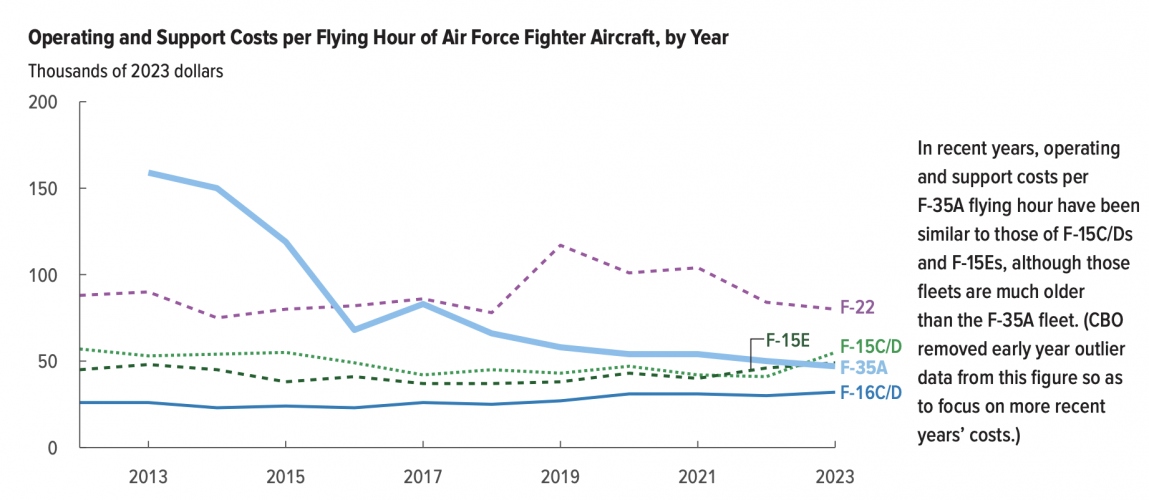
siegecrossbow
I really should change my personal text
- Joined
- 12 March 2012
- Messages
- 843
- Reaction score
- 2,903
Does i count as gen 5 or gen 2,5 with the weight kit?
Apparently Lockheed-Martin just proposes to deliver F-35s with no radars to the USAF for the next three production lots over the next two years .
View attachment 801763View attachment 801763
This was an aircraft that got totaled during an accident and is now being used as a ground based training aid. Obviously you can’t lug around gym weights in a flying aircraft.
is now being used as a ground based training aid
So it would be now a GF-35A?
So, a fake news campaign (radar and CPFH surfaced simultaneously*)? Interesting.
*It is obvious that sending a package of only 4 aircraft for a penetrating mission instead of 24 and loosing 30% of them at best, costs less, wherever CPFH those would have in a realistic world...
*It is obvious that sending a package of only 4 aircraft for a penetrating mission instead of 24 and loosing 30% of them at best, costs less, wherever CPFH those would have in a realistic world...

Forest Green
ACCESS: USAP
- Joined
- 11 June 2019
- Messages
- 14,512
- Reaction score
- 31,558
WatcherZero
ACCESS: Top Secret
- Joined
- 22 May 2023
- Messages
- 1,146
- Reaction score
- 2,974
LOL, the statement seems to boil down to "We are procuring radars as part of the F-35 programme, but we cant tell you whether the aircraft are being delivered with radars installed or not as that has now been classified" (where the engine/airframe/radar deliveries weren't previously)
bring_it_on
I really should change my personal text
- Joined
- 4 July 2013
- Messages
- 4,203
- Reaction score
- 5,730
but we cant tell you whether the aircraft are being delivered with radars installed
From the article:
“USAF F-35A lot 17 aircraft are delivering with APG-81 radars,” an Air Force spokesperson told TWZ today in an unprompted statement.
Lot 17 is the current lot delivering aircraft. I think they conclude deliveries in the late summer / early fall of this year. It was claimed by Defense Daily that the AF and possible other services had been accepting aircraft without radars since June of 2025. This shows that this was not the case, at least for the Air Force.
WatcherZero
ACCESS: Top Secret
- Joined
- 22 May 2023
- Messages
- 1,146
- Reaction score
- 2,974
They are delivering with APG-81 radars but a bulkhead that only takes an APG-85 radar as a dual configuration bulkhead has not been developed. So essentially being delivered with an unfitted spare radar. The statement doesn't conflict with those reports.
My personal somewhat uninformed opinion is that the between the new Block 4 and the F35 that was delivered initially, there is basically no commonality in terms of electronic systems (and possibly, likely others), it's like a brand new plane in the shape of the old one. I would even risk the assumption that one could pick some midpoint in the timeline and even that would hold true both between said midpoint and the initial version, and the midpoint and Block 4.
Which means LM managed to cram 2-3 generations of almost complete redesign (which might've been more costly and time consuming than going for a clean sheet one), into a plane that basically looks the same.
At this point, the F-35 is only called the F-35 to save LM from the loss of face of writing the whole thing off, and appease international partners.
This kind of makes me think there was a missed opportunity to declare another competition, and allow some other competitor to at least bid against the F35 design, and see if they can address the basic shortcomings of the program, which afaict arelack of cooling and power, and internal volume - in a different airframe.
I'm sure the mandated level of capability would be much easier and cheaper to achieve if those things were available.
Which means LM managed to cram 2-3 generations of almost complete redesign (which might've been more costly and time consuming than going for a clean sheet one), into a plane that basically looks the same.
At this point, the F-35 is only called the F-35 to save LM from the loss of face of writing the whole thing off, and appease international partners.
This kind of makes me think there was a missed opportunity to declare another competition, and allow some other competitor to at least bid against the F35 design, and see if they can address the basic shortcomings of the program, which afaict arelack of cooling and power, and internal volume - in a different airframe.
I'm sure the mandated level of capability would be much easier and cheaper to achieve if those things were available.
Forest Green
ACCESS: USAP
- Joined
- 11 June 2019
- Messages
- 14,512
- Reaction score
- 31,558
Belgium wants additional F-35 jets to be ‘as European as possible,’ says defense minister
https://breakingdefense.com/2026/02...s-european-as-possible-says-defense-minister/
- Joined
- 3 June 2011
- Messages
- 20,910
- Reaction score
- 19,107
I guess the same could be said of the F-14Ds, eh? They got new engines, new radars, completely new displays, got rid of the glove vanes, etc. etc.My personal somewhat uninformed opinion is that the between the new Block 4 and the F35 that was delivered initially, there is basically no commonality in terms of electronic systems (and possibly, likely others), it's like a brand new plane in the shape of the old one. I would even risk the assumption that one could pick some midpoint in the timeline and even that would hold true both between said midpoint and the initial version, and the midpoint and Block 4.
Which means LM managed to cram 2-3 generations of almost complete redesign (which might've been more costly and time consuming than going for a clean sheet one), into a plane that basically looks the same.
At this point, the F-35 is only called the F-35 to save LM from the loss of face of writing the whole thing off, and appease international partners.
Similar threads
-
Lockheed Martin F-16 Fighting Falcon News and Developments
- Started by seruriermarshal
- Replies: 886
-

-

-
 Lockheed JSF evolution: ASTOVL, SSF, CALF, JAST
- Started by Antonio
- Replies: 176
-
 USAF/USN 6th Gen Fighters - F/A-XX, F-X, NGAD, PCA, ASFS News & Analysis [2008- 2025]
- Started by Matej
- Replies: 10K