Lockheed "Classified Aero Program"

Flyaway

ACCESS: USAP
Senior Member
Joined
21 January 2015
Messages
14,349
Reaction score
22,767
Hasn’t it previously been rumoured that it’s this aircraft they keep losing money on during development.

In a news release, Lockheed attributed the reach-forward losses on the aeronautics project to continued design, integration, and test challenges that “had a greater impact on schedule and costs than previously estimated.” The company completed a comprehensive review of the program in the second quarter and made “significant changes to its processes and testing approach,” which in turn resulted in additional cost and schedule delays.

Taiclet said changes to the program included assigning experts from across the company to improve its performance under a new risk identification and corrective action plan.


“This is a highly classified program that can only be described as [a] game-changing capability for our joint US and international customers, and therefore it is critical that it be successfully fielded,” he said. “With our enhanced oversight of this program and rapid incorporation of lessons learned, we expect to continue to reduce risk over the next few years as we move through the key milestones of this very advanced system.”


Lockheed previously booked a $555 million loss on the same classified aerospace program in the fourth quarter of 2024. At the time, the company cited a recent review of the program, which had found that it would have to spend more money on engineering and integration activities in order to meet upcoming milestones.
 
Lockheed Martin have booked a $950m loss in the last quarter on a Black Project aeronautics project due to setbacks in design, integration, testing and performance. Anyone got an idea what possible aircraft program? Thats a significant write down for a quarter and led to an 8% fall in the companies share price (Edit: now up to a 10.9% fall in share price).

Wonder if that was the same program they booked a 555 million overrun in 2024 per here ?
 
I listened to the call twice. The first two question of Q&A were LOL funny. Whatever program is kicking up these charges, it ain’t F/A-XX. Maybe HACM or a UAV.

EDIT: as several smart people have pointed out it cannot be HACM and has to be an AV, by segment definition (see post below)
 
Last edited:
They knew the car was sideways sometime late last year, brought in new oversight (so the B team was tasked on this initially!?!) aka some grey beards, totally rebaselined timelines due to some technical and/or scientific and mentioned the customer would work them financially. Plus new CFO prolly wants to clear the decks or call out the problem spots- this was clearly one of them.

It was a crazy ass earnings call, with almost noncredible comments from mgmt in places. Highly recommend.
 
CEOs comments lead me to believe that it is something that goes very fast or very far or very high or is very hard to “see” or some combination of those attributes. Or it could be a boat.
If it is, a program generating a $1.5B loss is a very large program. That's not $1.5B in expenses, that's the deficit between expenses and revenues. What the hell are they cooking up.

If it is the same program as the 2024 overrun it is a fixed-price incentive fee contract which you would think wouldn't lend itself well to something with a lot of low TRL to be developed.
 
Lockheed has a history of bidding low to win contracts, then escalating costs afterward, once the customer has formally committed to their contract. JSF is a good example of just how far this can go, where not only did the costs skyrocket, but originally mandated performance requirements had to be reduced as well.
 
Lockheed has a history of bidding low to win contracts, then escalating costs afterward, once the customer has formally committed to their contract. JSF is a good example of just how far this can go, where not only did the costs skyrocket, but originally mandated performance requirements had to be reduced as well.
Not just bidding low, promising capability they haven't developed. That goes back to at least the P-38. Given that history, and with the exception of the F-104 bribes, I haven't a clue how they've kept getting contracts.
If this is the same classified program that is using the previously discussed landing gear, then its not a boat or missile.
What previously discussed landing gear? Got a link?
 
So Lockheed has a contract towards a flight demonstrator/prototype of some kind and ok, they have hardware already, unless the loss would not be this huge. They lost 1.5B$ + 500M$ (see link above from Ozair) + small money from the years before and they expect this to go on until 2028 ? Let's be generous, 10B$ loss till first flight and formal acceptance. Still they expect to make profit from this plane afterwards. The higher the price per unit, the higher the margin. B-21 is 700M$ and 100 will be build ? I doubt that Northrop makes 100M$ per plane. And I doubt the US will need 100 suborbital bombers or mach 15 spy planes. Means an ever higher price per unit, even beyond B-2 territory. Must be quite a thing, like a flying nuclear sub. Or the numbers are utter nonsense.
 
Given that history, and with the exception of the F-104 bribes, I haven't a clue how they've kept getting contracts.
I’ve occasionally wondered this myself, but in fairness to them, they were very often on the cutting edge of technology/performance that (usually) the Air Force very much wanted, so if the AF didn’t respect or even understand how much work it would take to bring their dreams to reality, it’s kinda on them, too, when the projects go long and over budget. Also, although no one on earth gets excited for C-130s and P-3s and EC-121s, Lockheed made a ton of those with seemingly reasonable development cycles. And we haven’t even touched on the U-2 and the Blackbird and the F-117.

So, in summary, I guess Libya is a land of contrasts.
 
For clarity and from the most recent LM 10-K

Aeronautics is engaged in the research, design, development, manufacture, integration, sustainment, support and upgrade of advanced military aircraft, including combat and air mobility aircraft, unmanned air vehicles and related technologies. Aeronautics also has contracts with the U.S. Government for various classified programs.

MFC provides air and missile defense systems; tactical missiles and precision strike weapon systems; logistics; fire control systems; mission operations support, readiness, engineering support and integration services; ground vehicles; and energy management solutions. MFC also has contracts with the U.S. Government for various classified programs.

Comments & answers re “Highly classified program at LM Aeronautics” as discussed on the latest quarterly call.

[JT] Turning to the Classified Program at Aeronautics, our mission at Skunk Works pushes the boundaries of science and technology to deliver highly advanced solutions that provide our customers a step-function advantage over potential adver*saries. This particular progr%am team discovered new insights in the quarter that required us to adjust our expected future costs on that program and then recognize the charge for doing so. I acknowledge the losses on this Classified Program are significant. Again, we are taking these charg!es very seriously and have initiated changes in program team management and assigned experts across the company to improve the performance and oversight of this program under a comprehensive risk identification and corrective action plan. This is a highly Classified Program that can only be described as game-changing capability for our joint US and international customers#. And therefore, it is critical that it be successfully fielded. With our enhanced oversight of this program and rapid incorporation of lessons learned, we expe^ct to continue to reduce risk over the next few years as we move through the key milestones of this very advanced system.

First, the Aeronautics Classified Program. As Jim mentioned, the process, control and resource changes we implemented following the fourth quarter of 2024, along with additional performance data on the program resulted in new insights that led us to recognize an incremental $950 million of reach-forward loss in the second quarter. To provide more detail, we have experienced desigzn, integration and test challenges as well as other performance issues on this program. Those challenges and performance issues continued into 2025 and had a greater impact on scheduling costs than previously estimated. As a result, we performed a comprehensive review of the design, integration, test and other processes to achieve the technical requirements of the program.

Based on this review and ongoing discussions with the customer and teammates, we made a significant change to our processes and testing approach, resulting in a significant update to the program's schedule and cost estimates. Based on this, we believe that recognizing this incremental charge is a prudent continuation of the comprehensive cor@rective actions and risk mitigation approach we implemented at the start of the year, which continues to demonstrate solid progress. Our continued investment in this program reflects our ongoing confidence in its criticality for national security and we remain excited about the future prospects for this solution.

with Evan's succession as the CFO role earlier this year and evidence of further program performance issues beginning to reemerge early in 2025, we've reconstituted the program review team for Classified Aeronautics program. So we had a different team, wider expexrtise from across the company and a higher-level scrut -- higher-level management as part of the scrutiny of the program. So we -- once we put that team together, having added additional expertise, as I said from across the company, we reassess the newly evident trends of cost increases and reevaluated all the program assumptions to the most detailed level of depth, a level below what had been done previously. Once these assumptions and they were long-standing assumptions were rebaselined to the then current performance, the additional reach-forward charge was calculated based on numerous future years of fixed price contract commitments.

Unfortunately, due to the nature of the clasxsification, we can't say how many years that is. But it is, I'll say it is not unlimited.

In addition, given the critical importance and customer support for these three particular programs, we will be and I will be actually further engaging their respective customers on opportunities to restructure these program contracts to moderate the currently identified and other potential risks while meeting the national security objectives of those customers.

And finally, I want to reiterate the policy that was put in place at Lockheed Martin five years ago, that there are no longer any must win programs. We will continue to ensure that every bid price proposal and contract structure does not introduce outsized or unbounded future risk as we're seeing on these three programs. Evan, do you want to add anything to that? [ES] continued transparency [is] what allowed us to signal in May that we were experiencing cost challenges and to have better insight as the continued program moved forward. And note at that same time, we signal cowst confidence in the MFC classified program and that we have the same established discipline there.

[ES] With the respect to MFC classified program. This is a program I'm very familiar with and that I worked personally in my last role. So it also has a reach-forward charge that we disclosed in the fourth quarter of last year. We've continued to monitor this very closely, similar to how we're monitoring the Aero Classified Program. And we've signaled throughout this quarter and continue to signal now sthat we've got confidence with how we're positioned with that program. Also a very important program for the Warfighter that we're anxious to deliver with strong customer advocacy. Jim, anything you'd add?

[JT] Yeah, I'd say the MFC program and I mentioned this before, the next Air Force pilot. This is again another game-changing capability for the US, really essential. And even on the margins, I think there is some upside in the future because those margins were affected by some of these one-time write-offs, although there were some plus-ups, the write-offs obviously were way higher. So there could be upside. We're not doing guidance for 2026 here, but there's -- there could be opportunity, especially in MFC.
 
Didn't NATO have access to Blackbird intel?

So it's possible that "Son of Blackbird" could have joint US and international customers.

I'm personally thinking more like "Son of D-21", however. unmanned, high speed recon drone. Might only be Mach 4.5 instead of M6.0
 
Didn't NATO have access to Blackbird intel?

So it's possible that "Son of Blackbird" could have joint US and international customers.

I'm personally thinking more like "Son of D-21", however. unmanned, high speed recon drone. Might only be Mach 4.5 instead of M6.0
That would probably be customer to the intel instead of customer to the aircraft itself...? So they probably count as customers of the CIA rather than customers of Lockheed... Would it be possible that this "capability" is not a new aircraft, but a classified upgrade to an existing aircraft (integrating high energy laser onto the F-35, just as an example). That would technically be under the aeronautics department, have a hefty total cost that matches up with the losses, and a low enough unit cost such that an international customer can buy a few sets with their black budgets...
 
seems like the least complex explanation is that LM is working on a strike system centered on at least one uncrewed aircraft, for multiple branches of the US and some international partners.

I should say “multirole including strike” instead of strike
 
Last edited:
That would probably be customer to the intel instead of customer to the aircraft itself...? So they probably count as customers of the CIA rather than customers of Lockheed... Would it be possible that this "capability" is not a new aircraft, but a classified upgrade to an existing aircraft (integrating high energy laser onto the F-35, just as an example). That would technically be under the aeronautics department, have a hefty total cost that matches up with the losses, and a low enough unit cost such that an international customer can buy a few sets with their black budgets...
No the most probable case. Safran is not building the F-35 landing gear. If that was all about an upgrade/modification of the program, another contractor won´t have to be brought in.
Here we can only think about something with significantly different landing parameters like higher landing speed and mass (SAFRAN is Messier-Bugatti-Dowty, )
 
No the most probable case. Safran is not building the F-35 landing gear. If that was all about an upgrade/modification of the program, another contractor won´t have to be brought in.
Here we can only think about something with significantly different landing parameters like higher landing speed and mass (SAFRAN is Messier-Bugatti-Dowty, )
That would be based on the assumption that the landing gear belongs to this program, which may or may not be the case…?

My doubt with an entirely new airframe is that the magnitude of the loss indicates a much larger total program expenditure (probably in the tens of billions), which would indicate either a very high per unit cost (limits options of international customers, few countries can throw billions of dollars in total secrecy for a couple of airframes) or a very large number of airframes (which would leave much less money to the game-changing capabilities due to the shear number of airframes being built, assuming it is not a huge $100B+ program)…
 
Last edited:
That would probably be customer to the intel instead of customer to the aircraft itself...? So they probably count as customers of the CIA rather than customers of Lockheed...
Unless multiple countries would want to own high speed recon drones.


Would it be possible that this "capability" is not a new aircraft, but a classified upgrade to an existing aircraft (integrating high energy laser onto the F-35, just as an example). That would technically be under the aeronautics department, have a hefty total cost that matches up with the losses, and a low enough unit cost such that an international customer can buy a few sets with their black budgets...
Possible? maybe.

Still feels more like a high speed recon drone to me, though.
 
That would probably be customer to the intel instead of customer to the aircraft itself...? So they probably count as customers of the CIA rather than customers of Lockheed... Would it be possible that this "capability" is not a new aircraft, but a classified upgrade to an existing aircraft (integrating high energy laser onto the F-35, just as an example). That would technically be under the aeronautics department, have a hefty total cost that matches up with the losses, and a low enough unit cost such that an international customer can buy a few sets with their black budgets...

Integrating a HEL into the B.52 :cool::cool:
 
"As Jim mentioned, the process, control and resource changes we implemented following the fourth quarter of 2024, along with additional performance data on the program resulted in new insights that led us to recognize an incremental $950 million of reach-forward loss in the second quarter. To provide more detail, we have experienced desigzn, integration and test challenges as well as other performance issues on this program. Those challenges and performance issues continued into 2025 and had a greater impact on scheduling costs than previously estimated. As a result, we performed a comprehensive review of the design, integration, test and other processes to achieve the technical requirements of the program."

That sounds awfully like software problems they know are going to be an ongoing issue.

F-35 TR3 rides again?
 
seems like the least complex explanation is that LM is working on a strike system centered on at least one uncrewed aircraft, for multiple branches of the US and some international partners.
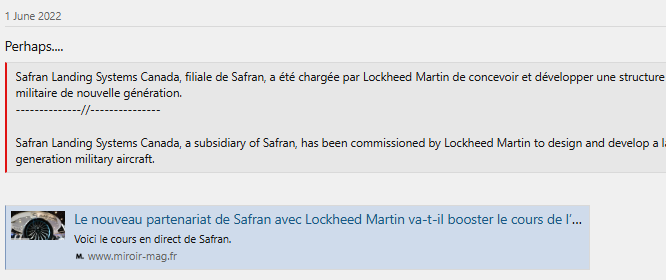
I vote for a hig speed strike UAV system, they speak about a game changer and it is highly classified , a loss of 1.6 billion is not on a little project. Something they can't talk about before years , in work since 2018 with a mysterious Safran landing gear.....May be this is related to the mysterious budget of 600 millions for USAF and 500 millions for Navy on a strike aircraft.
 
Last edited:
I believe with almost nothing to justify it that a long range low observable that both USN and USAF can operate (or variants) is being developed. I also believe a long range high speed strike ac should be developed as well. This program could be either, but I feel right now a common airframe that can be used by lots of aviation branches is more valuable. Affordable but still capable mass over exquisite capability that is unaffordable.
 

Similar threads

Back
Top Bottom