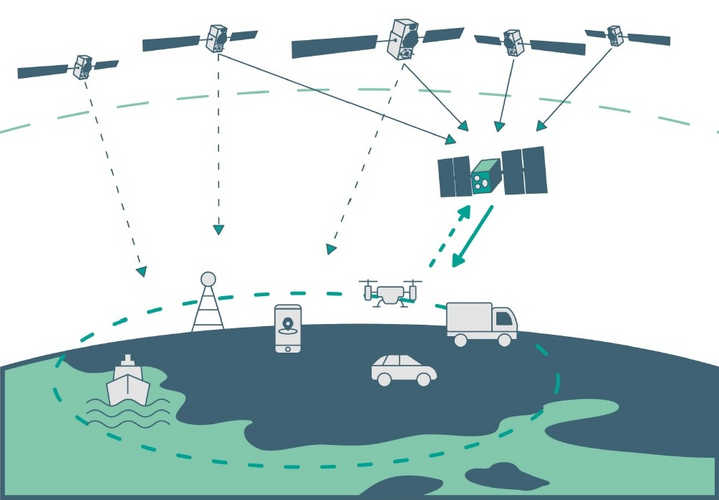
LEO-PNT satellite system (ESA)

Grey Havoc

ACCESS: USAP
Joined
9 October 2009
Messages
24,500
Reaction score
18,175
https://spacewatch.global/2022/10/esa-plans-to-demonstrate-low-earth-orbiting-pnt-satellites/ 1667766424873.png
LEO-PNT. Credit: ESA

Edinburgh, 28 October 2022. – The European Space Agency’s (ESA) Navigation Directorate is planning an in-orbit demonstration with new low Earth orbit (LEO) navigation satellites supplementing Europe’s 23 Galileo satellites. The LEO-PNT satellites will investigate a new multi-layer satellite navigation system-of-systems approach to deliver seamless Positioning, Navigation and Timing (PNT). ESA states that the technology could enable much more accurate, robust and available-to-all services.

Standard GNSS (Global Navigation Satellite Systems) approach is reaching its limits due to growing positioning requirements. These are demanded by various industries such as autonomous vehicles, ships, drones, robotics, Smart Cities and the industrial Internet of Things. As LEO-PNT satellites will be closer to Earth, there will be less of a distance to cover. Thus, the signals will be more powerful and able to overcome interference, reaching previously unreachable places as well.

The novel navigation techniques and a wider range of signal bands will allow for more rapid movements and greater penetration in difficult environments. Each satellite will be less than 70 kg in mass, compared to current Galileo satellites, which are around 700 kg. ESA is targeting three years from the signing of the contracts to the first satellites in orbit.

LEO-PNT is part of ESA’s Directorate of Navigation’s FutureNAV programme, which is up for decision at ESA’s next Ministerial Conference in November.
 
Celeste IOD-2 separating from Electron [Mar. 30]

View of Celeste IOD-2 separating from the Rocket Lab's Electron launcher.

Celeste will play a pioneering role in elevating the future of Europe’s satellite navigation capabilities. As Europe’s first initiative for satellite navigation in low Earth orbit (LEO), the mission will be testing next-generation technologies and add new frequency bands for satellite navigation.

ESA’s Celeste broadcasts first navigation signal from low Earth orbit [Apr. 10, updated Apr. 17]

The European Space Agency has achieved a European first with Celeste IOD-1, successfully transmitting a navigation signal from low Earth orbit, following the launch of the mission’s first satellites on March 28.

Update (17/04): On 17 April, Celeste IOD-2 transmitted its first navigation signal.

On the morning of Wednesday, 8 April, ESA and industrial teams gathered at ESA’s Navigation Lab at ESTEC received the very first navigation signal from the Celeste mission.

This is a historic first in the world of European PNT. Sent from Celeste IOD-1, the signal is the first dual-frequency navigation message in the L- and S-band, the first sent from a European satellite in low-Earth orbit. A transmission from the Celeste IOD-2 satellite will follow in the coming days.

Navigation signals sent from low Earth orbit benefit from more strength, new dynamics and additional ranging geometry. This makes them valuable to complement existing medium Earth orbit systems and improve overall resilience, robustness, availability, and timeliness, especially in demanding environments like deep urban areas.

“Seeing Celeste achieve its first milestone, only days after launch, is a moment we will look on in the years to come. This is a first step in a mission aiming to demonstrate how a satellite navigation constellation in low Earth orbit can further address current and future user needs, complementing Europe’s current Galileo system in medium Earth orbit," explains Roberto Prieto-Cerdeira, ESA's Celeste programme manager.

This first achievement comes as part of the satellites’ commissioning and in-orbit testing phase. Early April, days after their launch on March 28, the satellites completed their launch and early operations phase and were formally declared fit for life in orbit. The satellites are now ongoing checks to verify all vital subsystems, from propulsion to attitude and orbit control, are ready.

These signal transmissions are also contributing to bringing into use the required frequency filings in L- and S-bands for future operational European LEO-PNT missions, together with meeting other regulatory and compatibility commitments in accordance with International Telecommunication Union regulations.
 

Similar threads

Back
Top Bottom