Late 70s RN fleet carrier design?

Rule of cool

ACCESS: Top Secret
Joined
16 January 2024
Messages
3,567
Reaction score
4,520
I think the RN's 1952-53 and CVA01 designs are pretty well known around this site. They fall pretty much into when the RN needed a new fleet carrier, so if the British built a 52 carrier from the early/mid 50s and CVA01 from 1966 to keep a 3 carrier force they'd need to lay down a new fleet carrier in the late 70s.

Assuming the RN bought the Buccaneer and some sort of Phantom in the 60s what would a late 70s British fleet carrier, a follow-on from the CVA01 look like? How big would/could it be? What short of engines and how many shafts would it have? Would it have bigger cats than the CVA01s BS6s, and how many would it have? How big could/would the CAG be?
 
The plan....let's be generous, was originally 4 new CV of what became CVA-01 design.
This shrunk and by cancellation was still expected to be two such vessels.

So the simplest answer is CVA-02 or ideally CVA-03.
All were expected to complete in the 70's and succeed the 40's and 50's vessels.
Obviously budgetary and strategic considerations changed this.

The most obvious change would be Seawolf instead of Seacat.
Internally magazine and maintenance for Martel for Buccaneer, the expensive recon pod for the F4.
CVA-03 might be delayed for keeping Eagle in service but an early 80's succession would be expected.

So this vessel might be modified for GWS.31 with Type 1030 and Internally facilities for Skyflash, Sea Eagle and later ALARM.

Now IF......if CVA-01 design on service entry is deemed inadequate and CVA-02 modified doesn't fix those issues. Then a new design maybe forthcoming.
 
If they have a couple of years of operating CVA-01 under their belt, I would assume there would be modifications to the design based on what worked and what didn't work on CVA-01. It would most likely be very similar to CVA-01 to save on scarce design resources, but not identical.
 
By the mid-late 70s not only would the RN have a few years operating CVA01 they'd have considerable experience with big Olympus GTs which might provide an option for propulsion.

IIRC in the CVA01 design process the CVA01 became a 53,000t, 3-shaft ship because having 4 shafts and 58,000t didn't provide enough tactical benefits to justify the cost. Perhaps a decade later, with the Spey coming into service 4 shafts and 58,000t might become better value for money. Indeed by then the British might be able to build a 60,000t carrier.
 
70's is the period of the troubled RB.211 three shaft turbofan development. That led to RR being taken into state hands to save them.

But.....that engine is the basis of the MT30 now used on CVF. Arguably such marinisation could have occurred earlier, once the engine was in production.

But the 70's is also another peak point for nuclear, and the UK nuclear industry was really expanded by this time. So if the money had been there, CVN becomes quite plausible too and aligns with then French ambitions.
 
Assuming the RN bought the Buccaneer and some sort of Phantom in the 60s what would a late 70s British fleet carrier, a follow-on from the CVA01 look like?

Purely technically, I'd say the CVA series is quite adequate for Phantom/1154 + Buccaneer complement and aside from electronic/weapon system upgrades there would be no major difference between, say, CVA-01 and CVA-04. And with proper care they are good till '00.

The project bridging the gap between the CVA and the CVF, though, may be something that is built around Typhoon + Tornado, with planning starting in late 70's and first ship being completed toward mid-late 80s. Could be nuclear, because why not.
 
Do we really need yet another RN carrier what-if thread? There must be about 20 of these now.

They tend to go the same way; that Britain can't afford it, or follow the plan, or build the medium carrier, or the VTOL aircraft works or whatever. I'm interested in the technology of a plain-Jane, big but RN (not USN) sized fleet/strike/attack carrier using late 70s tech.

I must admit I hadn't thought of nuclear propulsion, I was thinking if GTs are suitable for a ship 55-60,000t. However in the mid-late 60s Britain's civilian nuclear programme went through a significant change and perhaps that might change the numbers for a nuclear powered carrier by the late 70s.

Another thing I'm interested in is the 'steel is cheap, air is free' mantra that I think is linked to GT propulsion, given the CVA01 was designed to politically imposed limits.

It looks as if the timing is wrong for Spey GTs, IIUC the Type 22 HMS Brave had ~22,000shp SM1A and was laid down in 1982. However the SM1A appears to be a straight swap for the Olympus and used in a COGOG arrangement. The later SM3C 19,000shp Speys, used in a COGAG arrangement didn't get used until Batch 3 Type 22s laid down from 1983. It looks as if a late 70s British fleet carrier would use Olympus GTs (f it went that way), but by the late 70s the Olympus was a mature type used in a lot of other RN ships so that's not a bad thing.
 
With nuclear propulsion, I totally agree with the decision not to have CVA01 have nuclear propulsion. Even the vastly better funded USN didn't follow the Enterprise with a repeat CVN because of the cost and when JFK was to be built with newer more efficient A3W reactors the USN couldn't justify the costs enough to Mac, even though Mac was open to a CVAN if it was justfied. However by 1968 the USN was able to justify CVANs and had an even more advanced and efficient reactor, which means that by the mid 70s the door would be open to the RN to look as nuclear propulsion for the special case of a big aircraft carrier.

However in the mid 60s the British made decisions around their civilian nuclear programme that totally butchered it, choosing the AGR as the next generation civilian reactor on false pretenses. The result was that by the mid 70s the civilian nuclear programme with AGRs were wildly over budget and late building and other aspects of the programme such as the breeder reactors proving they were no longer required. I think that this debacle would not endear nuclear propulsion to the RN, despite it's merits as a method of carrier propulsion, especially given North Sea oil would make the economics of conventional propulsion particularly good at the time.
 
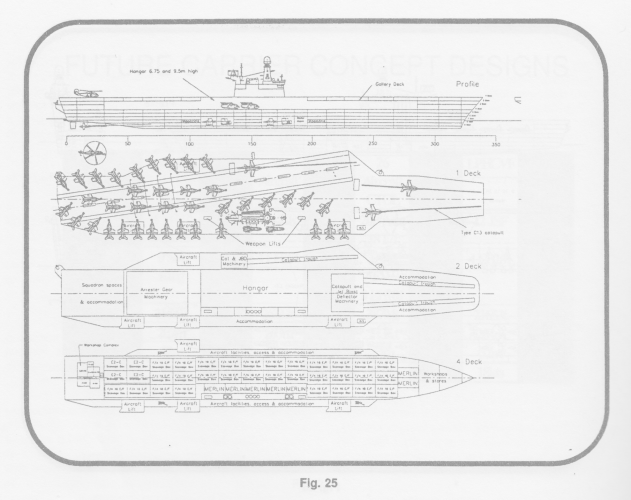
The easiest way to approximate would probably be taking some of the very, very preliminary and early projects of the CVF program and downgrading them to appropriate tech level. At least they reveal the feverish dreams thinking of the naval command about what they would want given enough resources.

Something like this one, replacing F/A-18 with Typhoons -

1758369677506.png

(the image is from one of the CVF threads here, I just can't remember which one)

3 catapults, 4 lifts, 40 aircraft in hangar, long and narrow hull indicating desire for high speed.
 
Last edited:
As far as gas turbines, CVA-01 was a three-shaft steam ship that developed 135,000 shp. In the late 70s the RN would have access to the Olympus TM3 turbine, with anywhere from 25,000-28,000 shp. In a six-engine COGAG format, that's anywhere from 150,000-168,000 shp, a perfectly respectable number for a ship that size.
 
As far as gas turbines, CVA-01 was a three-shaft steam ship that developed 135,000 shp. In the late 70s the RN would have access to the Olympus TM3 turbine, with anywhere from 25,000-28,000 shp. In a six-engine COGAG format, that's anywhere from 150,000-168,000 shp, a perfectly respectable number for a ship that size.

That would appear to be plenty of power to increase the displacement from CVA01 ~54,000t to 58-60,000t without the extra cost of a 4th shaft. Given the Invincible class had 2 Olympus GTs per shaft I assume it's OK for a much bigger ship.
 
As far as gas turbines, CVA-01 was a three-shaft steam ship that developed 135,000 shp. In the late 70s the RN would have access to the Olympus TM3 turbine, with anywhere from 25,000-28,000 shp. In a six-engine COGAG format, that's anywhere from 150,000-168,000 shp, a perfectly respectable number for a ship that size.
I think a COSAG arrangement might make more sense.

You could keep the centerline shaft as is (45,000shp steam driven) and install 25,000shp Olympus GTs + 15,000hp steam turbines on the side shafts. These would be similar to HMS Bristol’s COSAG arrangement but with uprated Olympus GTs, for a total of 125,000 shp.

The 60-40 split between steam and GTs would allow the best of both worlds - steam having a lower fuel consumption for cruising and being needed anyway for the catapults, and GTs saving weight and providing the quick boost needed for launch & recovery cycles.

The centerline shaft could also be COSAG but I’d worry about the extra trunking of adding a 3rd GT.
 
I think a COSAG arrangement might make more sense.

You could keep the centerline shaft as is (45,000shp steam driven) and install 25,000shp Olympus GTs + 15,000hp steam turbines on the side shafts. These would be similar to HMS Bristol’s COSAG arrangement but with uprated Olympus GTs, for a total of 125,000 shp.

The 60-40 split between steam and GTs would allow the best of both worlds - steam having a lower fuel consumption for cruising and being needed anyway for the catapults, and GTs saving weight and providing the quick boost needed for launch & recovery cycles.

The centerline shaft could also be COSAG but I’d worry about the extra trunking of adding a 3rd GT.
COSAG certainly makes sense but I'm not a fan of this arrangement, mostly due to the power reduction. CVA-01 was already iffy in the power department, this would compound the issue.
 
My objection to steam would be the on-board maintenance burden, which is a major contributor to a steam ship's ~65% availability. In contrast IIUC the Olympus GTs in the Invincibles could be removed via shafts into the hangar, facilitating repair by replacement. Repair by replacement enabled a jump in availability to 75-80% as well as breaking the ever declining intervals of boiler firebox re-linings which drove high costs in the later years of a ships life that led to the financial-political pressure to retire ships early.
 
They tend to go the same way; that Britain can't afford it, or follow the plan, or build the medium carrier, or the VTOL aircraft works or whatever. I'm interested in the technology of a plain-Jane, big but RN (not USN) sized fleet/strike/attack carrier using late 70s tech.
Ok, I will nibble.

From your OP it looks like the RN has a 1952 carrier, presumably refitted and updated for Phantom in the early 1970s and CVA-01 was built and commissioned sometime around 1973. And that what you're looking for is a replacement for HMS Eagle or Ark Royal (whichever got the Phantom recent in this scenario) to enter service by 1978-80.

CVA-01 is the logical starting point. Some factors I have thought of:
1. Size still matters. CVA-01 was ultimately designed for cross-decking USN F-111Bs and doubtless in this scenario where the RN has cat n trap carriers, there will still be a desire to cross-deck F-14A Tomcats on occasion. Presumably the RN in this scenario is likely to buy E-2 Hawkeyes. So it still needs a relatively large deck.
Whatever aircraft the FAA is looking to buy to replace Phantom/Bucc (or even if it runs them on into the 90s), the fuel and stores needs will be no less. So the basic hull is likely to still be the smallest practical carrier.

2. The Alaskan Highway. Operational use of CVA-01 will determine whether it is a valuable feature or one of those ideas that seemed good on paper but less so in operation. If dropped, that supposes some basic redesign of the ship, moving the island outboard.

3. Powerplant. The options are tricky. The Invincibles had four Olympus TM3B for 97,000shp, with a maximum total continuous power of 94,000shp to two shafts, so a six-turbine three-shaft layout should produce 141,000shp, which should be plenty. Endurance might suffer given you need to feed two extra Olympus. The donkey boilers would need to be pretty hefty to provide enough steam, they could also run turbo-generators so reducing the need for diesel generation (the Invincible had eight diesel generators). But we're talking multiple fuel types now, oil, diesel, plus aviation fuel for the Olympus and the aircraft. Saving on weight compared with steam propulsion might fully compensate.
Also need to think about trunking and exhausts. Six Olympus need a lot of air and expel a lot, I think you'd need two funnels plus you need to vent the donkey boilers. Invincible's island is a massive two funnel affair, this perhaps further reinforces the need to abandon the Alaskan Highway and move the island outboard to avoid the trunking intruding on the hangar space. But a massive outboard island needs balancing and that is not as easy with the parallel deck of CVA-01, whether that influences a shift to a return to the classic angled deck is another question to ponder.
Nuclear. Not beyond the realms of technical possibility, but I'm not sure a pair of PWR1 would be up to it. Plus we're talking massive costs and how to build it? Barrow building those sections of hull and shipping them to Scotland? Plus it probably means sacrificing a couple of SSNs in the building programme. It seems a step too far.

4. Catapults & arrester gear. Updated BS.6 and DAAG should suffice. Might even get an export bonus with France choosing the AU BS.6A for Charles de Gaulle.

5. STOVL. The real conundrum is ASTOVL. Putting aside the whole P.1154 debacle, HSA and BAC and BAe never lost sight of ASTOVL and neither did the RAF. The 1970s were rife with STOVL designs. Of course no Harrier successor is likely to enter service much before the early 1980s, but its not inconceivable that with the RN looking to replace its Phantoms and Buccs that a joint RAF-RN supersonic ASTOVL programme isn't launched in the late 1970s. If so all bets are off and the CV-3 could well turn out to be a CVS with ski-jump. Perhaps something not unlike the CVF we know today but single island, twin-funnel, COGAG, ski-jump bows.
It's interesting that CVF is 30ft shorter in hull length and 6ft beamier in the hull compared with CVA-01. The flight deck is much larger of course with overhangs etc. CVA's hangar was 162ft longer but 31ft narrower and 5-15ft lower. They are pretty evenly matched with similar airgroup size and avgas capacity.

 
It's interesting that CVF is 30ft shorter in hull length and 6ft beamier in the hull compared with CVA-01.
The CVF final design is a shortened option, IIRC. The preliminary options tended to be long and narrow.

The alaskan highway is also featured on all angled deck options of the early CVF studies (although it seems it was mostly intended for helicopter parking)

The deck configuration mostly depends on the choice of aircraft. The same studies feature Typhoons, F/A-18 and JSF.

In late 70s/early 80s this removes the JSF and adds the Tornado, with purchase options for F-14 and F/A-18, or would require to speed up the development of the Typhoon.

Flying Tornado, F-14 and continuing operating Buccaneers requires catapults. F/A-18 and Typhoons can (probably) work with ski jump launch and arrested landing.

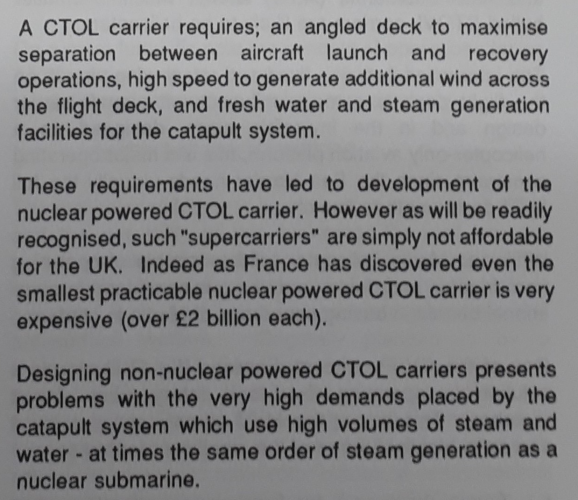
Concerning propulsion, the primary choice for conventional aircraft versions (absent costs restrictions) was nuclear

1758370011313.png


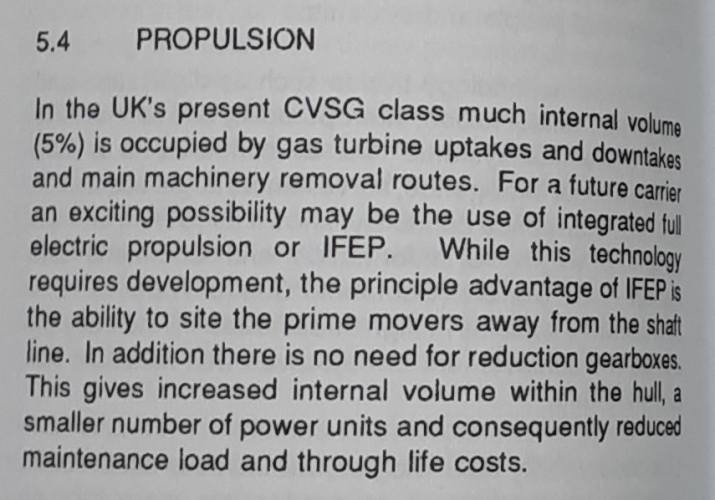
and with electric transmission

1758370118932.png
 
Last edited:
But we're talking multiple fuel types now, oil, diesel, plus aviation fuel for the Olympus and the aircraft.
Most likely the RN will make like the USN and design the diesels and donkey boiler to run on jet fuel. It would be easier than fitting all those different fuel types, especially now that avgas has finally been eliminated from the fuel mix.

There's also the potential for using hot gas turbine exhaust to generate the steam, as is often done in gas turbine electrical plants.

It's interesting that CVF is 30ft shorter in hull length and 6ft beamier in the hull compared with CVA-01.
It's not actually shorter. The oft-cited 963-foot overall length of CVA-01 counts the bridle horn; the actual hull and flight deck are pretty close in length to CVA-01, though I don't remember the exact numbers off the type of my head.
 
From your OP it looks like the RN has a 1952 carrier, presumably refitted and updated for Phantom in the early 1970s and CVA-01 was built and commissioned sometime around 1973. And that what you're looking for is a replacement for HMS Eagle or Ark Royal (whichever got the Phantom recent in this scenario) to enter service by 1978-80.

More or less. I started with an arbitrary 5 yeas between completion of the 52-53 carrier and start of CVA01 and added that 5 years to the 1973 completion of CVA01, which more or less lines up with the longer life span estimates of the Eagle.

CVA-01 is the logical starting point. Some factors I have thought of:
1. Size still matters. CVA-01 was ultimately designed for cross-decking USN F-111Bs and doubtless in this scenario where the RN has cat n trap carriers, there will still be a desire to cross-deck F-14A Tomcats on occasion. Presumably the RN in this scenario is likely to buy E-2 Hawkeyes. So it still needs a relatively large deck.
Whatever aircraft the FAA is looking to buy to replace Phantom/Bucc (or even if it runs them on into the 90s), the fuel and stores needs will be no less. So the basic hull is likely to still be the smallest practical carrier.

The RN would have two ~55,000t carriers and a large number of aircraft suited to these ships, so won't be going small to save money or anything. While the Eagle and likely the 52 carrier would struggle to cross deck an F14 I'd think the CVA01 would manage it as would the 1978 carrier.

Due to a lack of options I'd think the RN would be looking at Hornets in the late 80s. What is the minimum requirement for E2s?

2. The Alaskan Highway. Operational use of CVA-01 will determine whether it is a valuable feature or one of those ideas that seemed good on paper but less so in operation. If dropped, that supposes some basic redesign of the ship, moving the island outboard.

I agree, although I still think the island would be big due to British ideas on full width gallery decks and the exhaust requirements of GT propulsion.
3. Powerplant. The options are tricky. The Invincibles had four Olympus TM3B for 97,000shp, with a maximum total continuous power of 94,000shp to two shafts, so a six-turbine three-shaft layout should produce 141,000shp, which should be plenty. Endurance might suffer given you need to feed two extra Olympus. The donkey boilers would need to be pretty hefty to provide enough steam, they could also run turbo-generators so reducing the need for diesel generation (the Invincible had eight diesel generators). But we're talking multiple fuel types now, oil, diesel, plus aviation fuel for the Olympus and the aircraft. Saving on weight compared with steam propulsion might fully compensate.
Also need to think about trunking and exhausts. Six Olympus need a lot of air and expel a lot, I think you'd need two funnels plus you need to vent the donkey boilers. Invincible's island is a massive two funnel affair, this perhaps further reinforces the need to abandon the Alaskan Highway and move the island outboard to avoid the trunking intruding on the hangar space. But a massive outboard island needs balancing and that is not as easy with the parallel deck of CVA-01, whether that influences a shift to a return to the classic angled deck is another question to ponder.

I imagine the great heat of the GTs would be used to generate steam and as you say run turbo generators for power, like a combined cycle gas power plant. I'd imagined a slightly bigger ship than CVA01, 58kt instead of 54kt, but GTs (assuming they're a suitable power option for a ship of this size) would free up a lot of weight, which is always helpful for ship designers.

Nuclear. Not beyond the realms of technical possibility, but I'm not sure a pair of PWR1 would be up to it. Plus we're talking massive costs and how to build it? Barrow building those sections of hull and shipping them to Scotland? Plus it probably means sacrificing a couple of SSNs in the building programme. It seems a step too far.

I'd think nuclear would only be on the table if the British civilian programme had chosen the SGHWR in the mid-late 60s instead of the AGR and therefore had a much smoother transition to 2nd generation reactors. I think by the mid 70s nuclear in Britain in general wasn't looking very good. Britain would need specialized reactors for a carrier rather than scaling up the PWR1, which drives up the already massive cost. Having GTs in a ship this big would already be considered innovative.


5. STOVL. The real conundrum is ASTOVL. Putting aside the whole P.1154 debacle, HSA and BAC and BAe never lost sight of ASTOVL and neither did the RAF. The 1970s were rife with STOVL designs. Of course no Harrier successor is likely to enter service much before the early 1980s, but its not inconceivable that with the RN looking to replace its Phantoms and Buccs that a joint RAF-RN supersonic ASTOVL programme isn't launched in the late 1970s. If so all bets are off and the CV-3 could well turn out to be a CVS with ski-jump. Perhaps something not unlike the CVF we know today but single island, twin-funnel, COGAG, ski-jump bows.
It's interesting that CVF is 30ft shorter in hull length and 6ft beamier in the hull compared with CVA-01. The flight deck is much larger of course with overhangs etc. CVA's hangar was 162ft longer but 31ft narrower and 5-15ft lower. They are pretty evenly matched with similar airgroup size and avgas capacity.

The RN wouldn't be in the market for a new carrier aircraft in the late 70s, the Buccaneer and Phantom would be ripe for mid life updates and the USN would be well underway with the Hornet. I doubt they'd go down any STOVL route hoping an aircraft would appear.
 
There's also the potential for using hot gas turbine exhaust to generate the steam, as is often done in gas turbine electrical plants.

The beauty of this system is that the faster the ship need to go the more GTs rev up and create more heat to make ever more steam. Such a ship would be in the unusual position for a non nuclear carrier of being able to run at top speed while providing maximum steam for the catapults.
 
The RN wouldn't be in the market for a new carrier aircraft in the late 70s, the Buccaneer and Phantom would be ripe for mid life updates and the USN would be well underway with the Hornet. I doubt they'd go down any STOVL route hoping an aircraft would appear.

The Bucc and Phantom flew until the early 90s, with the Phantom being axed early due to the Cold War ending. Timing is tight for a navalised Typhoon or Rafale.
 
TBH the RN would probably have to buy Hornets as an interim solution, that in true procurement fashion becomes a very permanent interim solution.
 
The Bucc and Phantom flew until the early 90s, with the Phantom being axed early due to the Cold War ending. Timing is tight for a navalised Typhoon or Rafale.

The USN flew the last 2 sqns of F4S on carriers until 1986, although most were replaced by F14s by the early 80s. The A6E and A7E lasted on carriers into the 90s although they were built well into the 70s whereas the RN sqns converted to the S2 Buccaneer by 1966. Much like the USN F4 and A7 I'd think the RNs F4s and Buccaneers would be very tired by the mid-late 80s and need replacing then and not years later.
 
It's not actually shorter. The oft-cited 963-foot overall length of CVA-01 counts the bridle horn; the actual hull and flight deck are pretty close in length to CVA-01, though I don't remember the exact numbers off the type of my head.
You are correct, the actual length length is pretty much identical.
CVA-01: 963ft 3in (292.6m) overall, including catapult bridle; 925ft (281.9m) overall hull; 890ft (271.2m) waterline
CVF: 932ft (284m) overall; not sure I've seen accurate waterline length measurements but from plans I calculate it to be 890ft (not counting the bulb) which exactly matches CVA-01.

Beam:
CVA-01: 122ft (37.2m) hull; 231ft 4in (70.5m) overall
CVF: 128ft (39m) hull; 240ft (73m) overall

Flightdeck:
CVA-01: 890ft (271.2m) x 189ft (57.6m)
CVF: 918ft 6in (280m) x 229ft 6in (70m)

Hangar:
CVA-01: 670ft (204.2m) x 80ft (24.3m) x 18ft (5.49m)
CVF: 508ft 6in (155m) x 111ft 6in (34m) x 22ft 11in to 33ft (7-10m)
 
On Buccaneers built.
Forty-six built between 1973 and 1977, plus three for weapons trials work.
Had RN carrier remained in operational planning beyond the early 70's. Then we can envision a new S.3 variant put into production from the mid-to-late 70's. Likely using a lot of Tornado avionics.
Production line could have remained open for much longer.
Temptation there to either move to uprated Spey development or replace with a RB.199 variant.


It all would depend on the bigger picture.
 
You are correct, the actual length length is pretty much identical.
CVA-01: 963ft 3in (292.6m) overall, including catapult bridle; 925ft (281.9m) overall hull; 890ft (271.2m) waterline
CVF: 932ft (284m) overall; not sure I've seen accurate waterline length measurements but from plans I calculate it to be 890ft (not counting the bulb) which exactly matches CVA-01.

Beam:
CVA-01: 122ft (37.2m) hull; 231ft 4in (70.5m) overall
CVF: 128ft (39m) hull; 240ft (73m) overall

Flightdeck:
CVA-01: 890ft (271.2m) x 189ft (57.6m)
CVF: 918ft 6in (280m) x 229ft 6in (70m)

Hangar:
CVA-01: 670ft (204.2m) x 80ft (24.3m) x 18ft (5.49m)
CVF: 508ft 6in (155m) x 111ft 6in (34m) x 22ft 11in to 33ft (7-10m)

On this basis a late 70s carrier will have these dimensions, nothing bigger. Although it might have a fuller hull form than CVA01 like how the Nimitz class bulked up over its production life.
 
On this basis a late 70s carrier will have these dimensions, nothing bigger. Although it might have a fuller hull form than CVA01 like how the Nimitz class bulked up over its production life.
The CVF final design is a shortened option, IIRC. The preliminary options tended to be long and narrow.

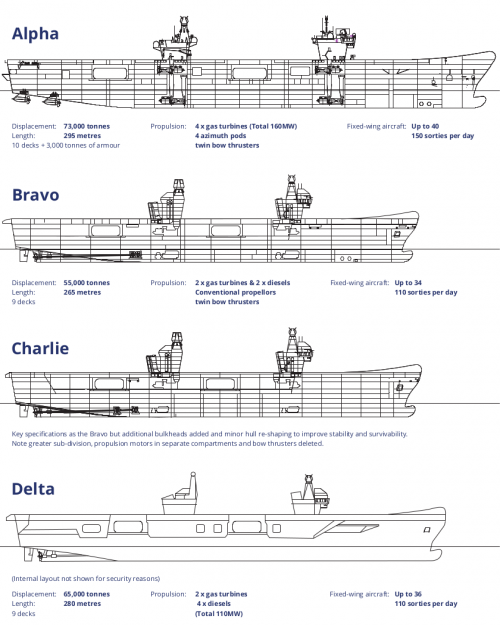
QE (Delta) was a compromise from dimensions point of view, the Alpha variant of the CVF was larger and had different propulsion arrangement. It was, of course, scaled down for economical reasons, but if we don't factor the defense cuts too much, the 1990-92 CATOBAR project I cited above had 340-350m length overall.

1758505659876.png
 
Last edited:
When did Britain get infrastructure and facilities to handle 295m-73,000t carriers?

It's not that you can't build a new dock, if (as it is supposed) enough money is allocated. Could create jobs even, support local industry, etc.

My point is that in both historical cases (1990 and 2000 studies) the proposed ship was larger than CVA-01, and it was considered by the designers as sufficiently realistic to offer it as an option, even within known historical economic constraints.

They do, probably, represent the ceiling of what was considered possible at the respective design time.

(I updated the plan above, showing the correct variant for final QE, which is larger than Bravo, but still smaller than Alpha)
 
Last edited:
Australia considered CVA01 and an Essex class in 1965 and the RN considered a Forrestal sized ship as well as the many beloved medium carriers during the CVA01 process. Organisations consider all sorts of things in order to establish a left and right of arc, that doesn't mean they ever thought they'd get them, or even wanted them.
 
Commercial facilities existed that could take such carriers and military ones were planned.

There was a substantial expansion plan for Devonport that would have added 4 drydocks capable of handling 1,000ft long carriers. Land was acquired during the WWII.

The 1952 ship being limited to military drydocks wasn't allowed to grow into the ideal 75,000ton 1000ft long beast the RN wanted.

CVA-01 studies examined upto 1005ft long 68,000ton ship.

And you can see CVF went upto similar figures.

Once CVA-01 would have been built it's just a matter of time before one of the new drydocks for it was built, rather than rely on the civilian sector.
IMO, it would be likely that they would build one that could take a larger carrier. Probably upto Enterprise or Nimitz size in order to be available in an emergency for the USN.
 
Once CVA-01 would have been built it's just a matter of time before one of the new drydocks for it was built, rather than rely on the civilian sector.
IMO, it would be likely that they would build one that could take a larger carrier. Probably upto Enterprise or Nimitz size in order to be available in an emergency for the USN.

In this scenario by the time CVA01 is started the RN has the 55,000t '1952' carrier and the 50,000t rebuilt Eagle, so I suspect the mmentum is there to build a big naval drydock which would be well and truly finished by the mid 70s.

The Inchgreen dry dock at Greenock was completed in 1964 (1,000ft x 145ft at the gate - 304.8m x 44.2).

1965-68 saw construction of a new dry dock at the Harland and Wolff yard in Belfast (335m x 50m x 12m)

So the limiting factor ceases to be building and support infrastructure and becomes acquisition and sustainment cost, crewing numbers and Air Wing size. We get back to 3 shafts being cheaper to buy and run than 4, the RN only at most 4 Buccaneer and 4 fighter (Sea Vixen) sqns and the manpower limits of the 70s and 80s.

I'd still like a somewhat bigger ship than CVA01, but it's size does have a powerful logic behind it when looking at the big picture.
 
Shaft wise we know that more shp is achievable, as the US proved.
So getting 70,000shp per shaft delivers 210,000shp sufficient for a 70,000ton vessel to over 30kts.
 
Brown mentions several times (in development of Type 42, IIRC) that the desired max speed of the fleet ships was around 34 knots, and it was always cut to around 31. But the admirals wanted, and at times even demanded 34.

the RN only at most 4 Buccaneer and 4 fighter (Sea Vixen) sqns and the manpower limits of the 70s and 80s.
Depends on state of the budget and inter-service rivalry, but you can always put RAF jets on the carrier, if you can't increase the number of fleet air arm squadrons for whatever political reasons. But consider that the political situation is very different, since you already have 2 or 3 CVA carriers with full complements, plus backup and shore squadrons, etc. And I still advocate for carrier-based Tornados for 80's.

Or - there is always an option to purchase the whole package - F/A-18+E-2C+Vikings, with weapons and electronics, from the States and concentrate on the platforms only.
 
I think the issue becomes how much power does Britain have to put into such shafts and propellers?
The Invincibles had four Olympus TM3B for 97,000shp, with a maximum total continuous power of 94,000shp to two shafts,

However, it appears that the TM3B Olympus could put out 28,000shp so likely sustain ~27,000shp giving ~162,000shp sustain on 3 shafts. This should be enough to allow the basic CVA01 design a bit of margin for bulking up within reason.
 
Back
Top Bottom