Kellner-Béchereau projects

Tophe

ACCESS: Top Secret
Joined
18 February 2006
Messages
1,156
Reaction score
174
Website
www.kristofmeunier.fr
In the Trait d’Union #138, this is a mystery.
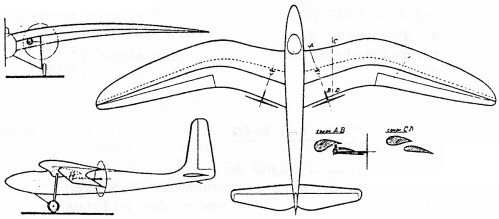
After the very classical Kellner-Bechereau E60 trainer (1st flight March 1940) is another 3-view drawing of twin-pusher with a weird wing. Nothing in the text there explains what this is. The only explanation I found could be a text 3 pages before in the introduction: "Béchereau designed a glider with a weird shape, a double crescent wing for a fighter project. From this glider project, Béchereau designed a motor-glider with two 7hp engines and the first drawer wing". The date seems between 1932 and 1936.
 

Attachments

  • r_Tu138.JPG
    r_Tu138.JPG
    27.7 KB · Views: 859
Tophe said:
In the Trait d’Union #138, this is a mystery.
After the very classical Kellner-Bechereau E60 trainer (1st flight March 1940) is another 3-view drawing of twin-pusher with a weird wing. Nothing in the text there explains what this is. The only explanation I found could be a text 3 pages before in the introduction: "Béchereau designed a glider with a weird shape, a double crescent wing for a fighter project. From this glider project, Béchereau designed a motor-glider with two 7hp engines and the first drawer wing". The date seems between 1932 and 1936.


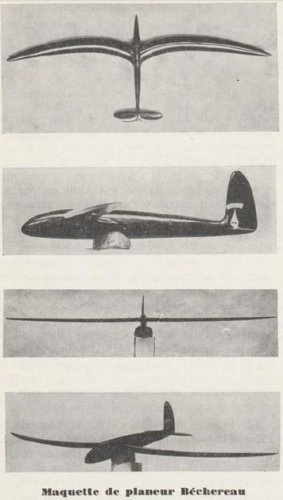
And here is the Bechereau glider and motor -glider strange concept of wing,from
L'Aerophile;


http://gallica.bnf.fr/ark:/12148/bpt6k65536639/f16.image.r=l%27a%C3%A9rophile.langFR
 

Attachments

  • Bechereau.JPG
    Bechereau.JPG
    26.1 KB · Views: 149
Hi,


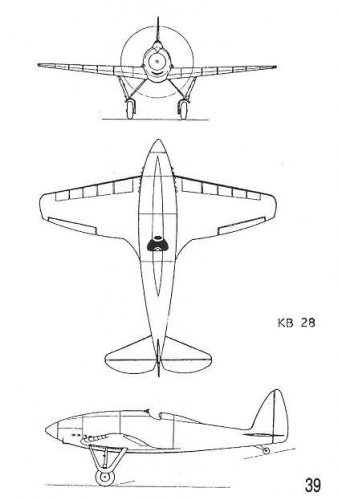
in the competition of 1930 C.1 for single seat fighter,about 31 or 32 entries submitted
to it,Kellner-Bechereau KB-29 was single seat fighter project,intended to this contest,
developed from KB-28 racer aircraft,powered by one 450 hp Delage 12 Gvis engine,
who can imagine its drawing,specially it was based on KB-28.
 

Attachments

  • KB-28.JPG
    KB-28.JPG
    24.8 KB · Views: 404
Once again , we need dependable sources to do further searchwork Hesham...
 
lark said:
Once again , we need dependable sources to do further searchwork Hesham...


OK my dear Lark,


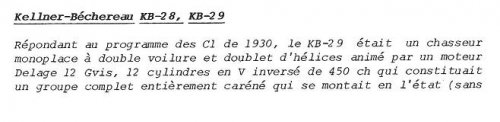
the source is; Trait d'Union issue 138.
 
Ah..good Hesham. Can you show us the piece of text
concerning the KB-29 if possible ?
 
OK my dear Lark,


here it's.
 

Attachments

  • 29-1.JPG
    29-1.JPG
    21.8 KB · Views: 318
  • 29-2.JPG
    29-2.JPG
    14.8 KB · Views: 302
Hi,


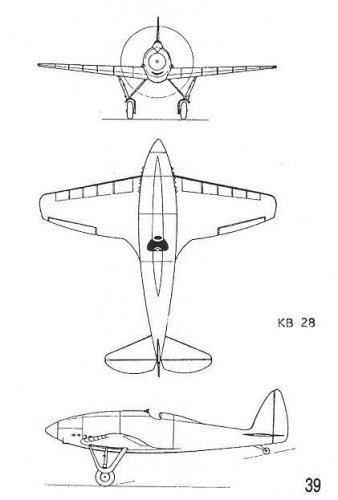
the kellner-Bechereau KB-30 was a single seat fighter project,intended for
1934 C.1 competition,and it was derivative of KB-28 racer aircraft,powered
by one 500 hp Hispano-Suiza 12 engine,never beyond a tunnel model,also
can anyone imagine its configuartion,it was based on KB-28.


TU magazine issue 138
 

Attachments

  • KB-28.JPG
    KB-28.JPG
    24.8 KB · Views: 248
Interesting. This gives more insight in the work of KB...
 
Hi,


We know the designer Bechereau and his company SRAP,which created the T.7 light transport
aircraft;
http://www.aviafrance.com/s-r-a-p-t-7-aviation-france-9048.htm


The company also designed the SRAP T.11,a twin engined derivative aircraft project,and
could accommodated 11 passenger,power by two 230 hp Salmson 9 Ab engines.
 
Hi,


I understand from this paragraph on TU magazine,that,Mr. Bechereau designer created
a fighter from Mignet Pou de Ciel,is that right ?.
 

Attachments

  • Bechereau.png
    Bechereau.png
    66.3 KB · Views: 123
hesham said:
I understand from this paragraph on TU magazine,that,Mr. Bechereau designer created
a fighter from Mignet Pou de Ciel,is that right ?.

Not quite created "from" the Pou but rather inspired by the same general lines, yes.
 
Are we talking about the Kellner-Béchereau E-60? I know of no Béchereau design that employed the Formule Mignet and I think it unlikely that he would do so. In terms of size, one might say that the Pou de Ciel could have 'inspired' the E-60 - but that does seem to stretch a point. Furthermore, the E-60 was a fighter trainer, rather than a fighter, and didn't fly until some five years after the date mentioned in the TU extract posted by Hesham.

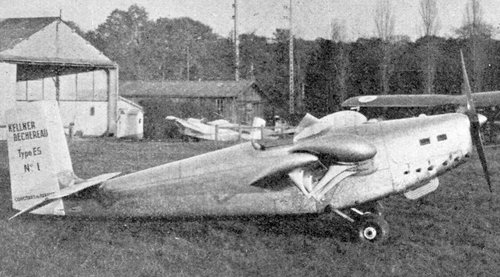
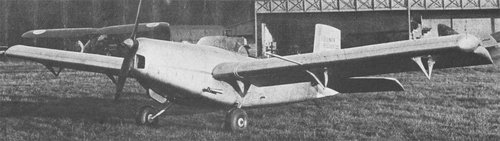
It's certainly fair to say that after forming his company with Georges Kellner, Louis Béchereau designed and Kellner-Béchereau produced some rather unorthodox aeroplanes, such as the E-5 (q.v. http://www.the-blueprints.com/fr/blueprints/modernplanes/modern-jk/18389/view/kellner-bechereau_e-5/), and in a company document currently being offered for sale (q.v. http://www.priceminister.com/offer/buy/449283153/dossier-confidentiel-avions-kellner-bechereau-type-e-c-4-e1-de-kellner-bechereau.html) apparently there's mention of a type EC4 or C4E or CE4 (to none of which can I find any other reference). So whilst I know one should never say never, I remain rather sceptical about there having been - even if only on paper - a Béchereau Formule Mignet Chasseur.
 
My dear Avion,


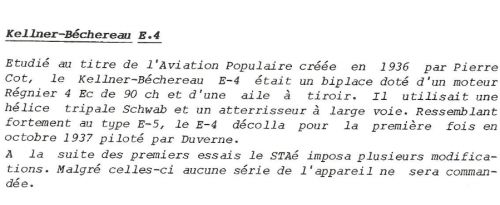
here is a more info about E.4 from TU magazine issue 138.
 

Attachments

  • E.4.png
    E.4.png
    154.4 KB · Views: 734
Thank you, Hesham. The E.4 is relatively well known and it may be to this, in addition to the E.1, that the document for sale refers. But the document apparently refers to the second type, with which it deals, as the EC4/C4E/CE4. However this may be something of a 'red herring'. But I'm not prepared to fork out 99 € to find out!
 
OK my dear Avion,


and here is a small Info about EC.4 from A-Z magazine.
 

Attachments

  • EC.4.png
    EC.4.png
    419.2 KB · Views: 746
Thank you, again, Hesham. However to get back to the point - having spent some time on this enjoyable tangent - there's still no evidence that Louis Béchereau did come up with a fighter aeroplane design that was inspired by the Pou de Ciel, which I would deduce to mean that it employed the Formule Mignet, beyond the oblique reference in TU.
 
Mignet connections aside, the spit-wing approach of the KB E-5 is intriguing. If anyone can point me to any contemporary articles, flight test reports or other info, I'd be very grateful.
 
My dear Cluttonfred,


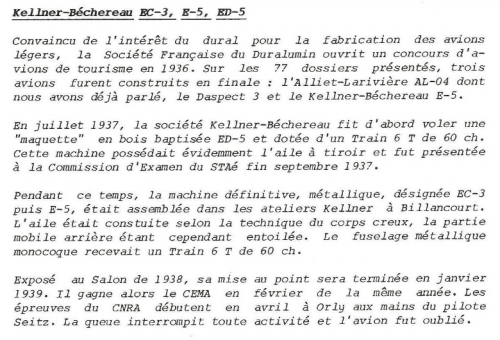
here is all I have about E-5 & ED-5.
 

Attachments

  • Bechereau.png
    Bechereau.png
    289.1 KB · Views: 601
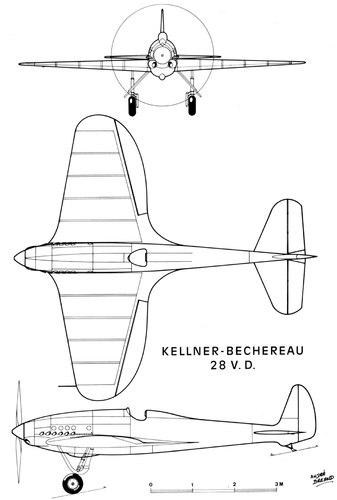
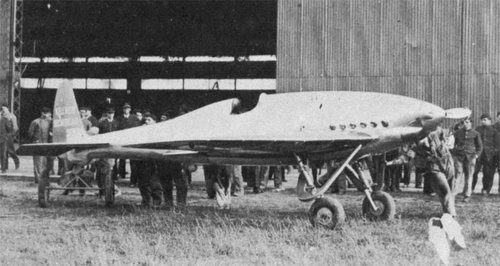
Hi! Kellner-Bechereau 28V.D.
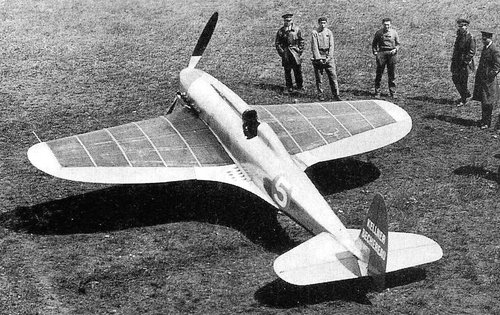
Kellner-Bechereau 28 V.D. (or Kellner-Bechereau KB-28) is a racing aircraft designed to compete in the popular French Cup Deutsch de la Meurthe. The racers with a volume of no more than 8 litres flew on a 1000km route and passed it twice with an intermediate landing of 90 minutes. Who won - that well done and the owner of four million francs.

The fast-paced aircraft made its maiden flight on May 12, 1933, and the last, during the qualifying competitions - On May 14, 1933.

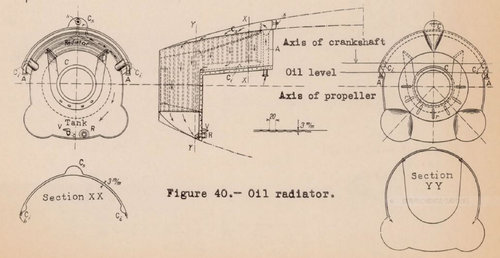
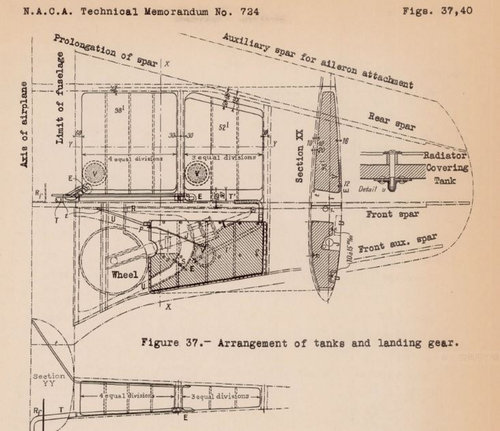
The oil system on Kellner-Bechereau 28 V.D. was very cleverly arranged - the oil tank and radiator were one device. In this case, the oil tank in outlines coincides with the hood of the engine and makes up part of it.

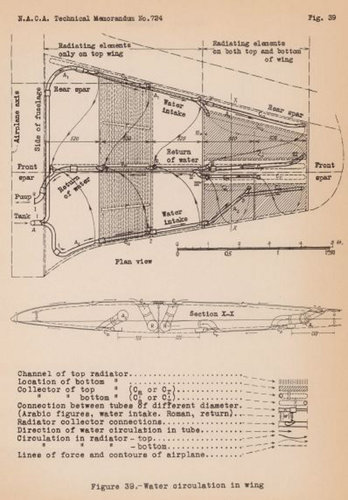
The Delage 12CEDirs engine cooling system is also a steam vaporizer for a reason. The steam cooling radiators were located in the wing. The pair of these radiators, which was blinded by the pilot Maurice Vernhol, caused the plane to land roughly and then destroy it.

The Retinwin with the ratier's modiving braked the engine too much, and on the day of the accident the pitch was reduced by about five divisions. The pilot abruptly opened the throttle, and the number of revs increased sharply to 4,400 rpm instead of 4,000 rpm. Perhaps the excess power caused the rupture of some connections or blockage of the pipe.

The pilot suffered only minor injuries during the accident, but the plane did not recover. The aircraft has been the subject of rigorous research in the wind tunnel, and its unusual appearance in the plan is undoubtedly very suitable for high-speed flights. Without any changes, this aircraft could get a 650-horsepower engine for which it was actually designed.

Two combat fighter projects were carried out on the basis of racing 28KB. First for the famous competition 1930C1: KB-29 with aircraft engine Delage 12 Gvis with a capacity of 450hp Competition as famously won by Dewoitine D.500. And the second for the equally famous 1934 C.1 - KB-30 with the engine Hispano-Suiza 12 in 500hp. The winner of this requirement was Morane-Saulnier MS-405.
kb28-1.gif kb28-2.jpg kb28-5.jpg
SKIN COOLER.JPG OIL COOLER.JPG
 
Last edited:
Thanks a lot for the NACA file ! :D

Oh! I don't know. Please show me the truth my dear Deltafan-san!!:)
Alas, I don't know this 650 hp engine either ... It was a question.

I have a very old article (one page...) of the Fana de l'aviation on the KB 28V.D. Michel Marrand wrote that the 8 Liter Deutsch cup Delage engine was a derivative of a 12 Liter Delage engine (one prototype) that was foreseen for 450 hp. This 450 hp engine was foreseen for a cancelled KB light fighter (Nothing more on this KB light fighter). In the Docavia Les chasseurs français 1918-1940, it is said too that the 12 L Delage engine of a KB light fighter project had 450 hp.

In the Docavia Les moteurs à piston aéronautiques français, it is said that this 12 L Delage engine was foreseen for 500 hp.

In another old article of Le Fana (2 pages), Robert J. Roux wrote that the KB 28 VD "was intended to receive several types of engines up to 650 hp"

At the time of the KB 28 VD, the most popular French in line engine of 650 hp was the Hispano Suiza 12N, with a weight (469 kgs) close of the total weight of the 12 L Delage engine (440 kgs)
 
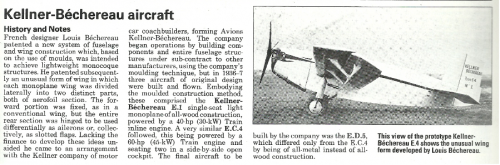
Hi! E-1.
French designer Louis Bechereau has patented a new wing and fuselage design, manufactured as opposed to the traditional casting for that period.

He also received a patent for a wing of an unusual shape, consisting of two parts. The front was fixed as a traditional wing, and the rear part was attached to the front on the hinges. Elements of the back of the wing might deviate differentially like alerons or synchronously like flaps.

In the absence of the proper amount of money, the inventor was unable to implement his ideas on his own and had to turn to the firm "Kellner" that supplied the aircraft body. The result was the formation of Avions Kellner-Bechereau.

The new company started its activity with the production (by casting technology) of aircraft parts and fuselage for other aircraft manufacturers. But in 1936-1937 the company was able to build and test three aircraft of the original design.

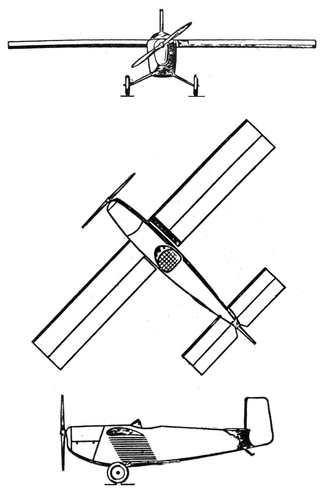
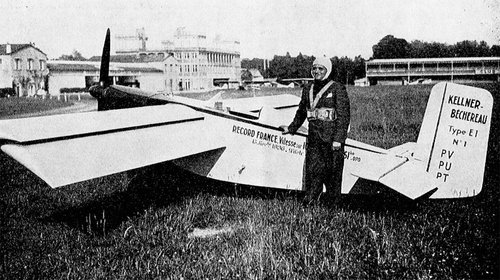
Casting techniques were used to make components of the single-seat Kellner-Bechereau E-1 light monoplane. It was a single-seater wooden midplane equipped with a 40 hp Train 4T engine.

The aircraft took off in November 1934 and served as the base for the creation of two-seater aircraft - wooden E-4 (EC-4) and all-metal E-5 (ED-5).
e1-1.gif
e1-3.jpg
 
Last edited:
Hi! E-5.
Kellner-Béchereau E.C.4
An enlarged E.1 powered by a 6-cylinder Train 6T delivering 40 kW (54 hp)
Kellner-Béchereau E.D.5
Outwardly identical to the E.C.4 but constructed of Duralumin
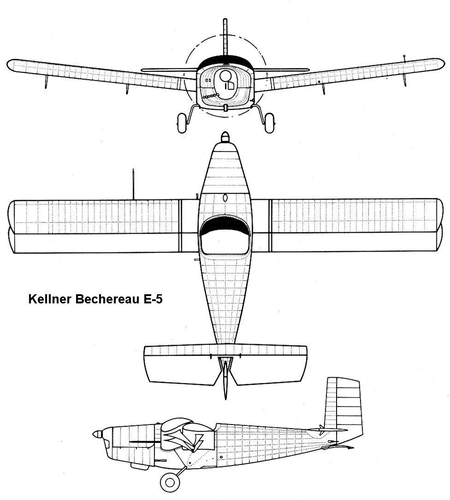
Like the E.1, the EC.4 was a wooden aircraft with spruce frames and plywood covering. It was a mid-wing cantilever monoplane with straight, thick section, constant chord wings of quite high aspect ratio (9.45). The lateral division was at about 65% chord, with the rear part joined to the front with conspicuous V-shaped faired underwing hinges. In normal flight the two parts were close together and the rear sections acted both as lifting surface and, differentially, ailerons but they could also be lowered together as slotted flaps, moving rearwards as well as down to produce a slot between fore and aft parts.

The Kellner-Béchereau designs were not ordered for the Aviation Populaire programme, the Air Ministry preferring the Caudron C.270 and the Salmson Cri-Cri which were both bought in large numbers. Instead, Kellner-Béchereau, along with other manufacturers, built the Cri-Cri under licence.

e5-1.gif e5-3.jpg e5-1.jpg
 
Last edited:
What an interesting arrangement of the two-part wing in the Kellner-Becherau E-5. Is there any report on flying characteristics of this configuration?
 
Salmson Cri-Cri.
salmsond6-3.jpg
 
What an interesting arrangement of the two-part wing in the Kellner-Becherau E-5. Is there any report on flying characteristics of this configuration?
Unfortunately I can't find any report about your interest still now.
 
Blackkite,you mixed some subjects here;

what was the relationship between Salmson Cri-Cri and Kellner-Bechereau ?,the company just built it under
licence,and it was not from it's products,and why sent a Caudron C.270 here ?!.
 
What an interesting arrangement of the two-part wing in the Kellner-Becherau E-5. Is there any report on flying characteristics of this configuration?
I think that the merits and demerits of this double wing(advanced biplane?) are as follows.
Merits
1. Good STOL performance.
2. Low stall speed.
3. High wing efficiency.(High aspect ratio)
Demerits
1. Expensive
2. Heavy weight
3. Large drag

How about control performance? So the conclusion is.........?
 
Last edited:
What an interesting arrangement of the two-part wing in the Kellner-Becherau E-5. Is there any report on flying characteristics of this configuration?
It was called Aile-tiroir, ie drawer-wing. The idea was not only to change the camber, but also to significantly extend the wing's area and change the aspect ratio for different phases of the flight.
 
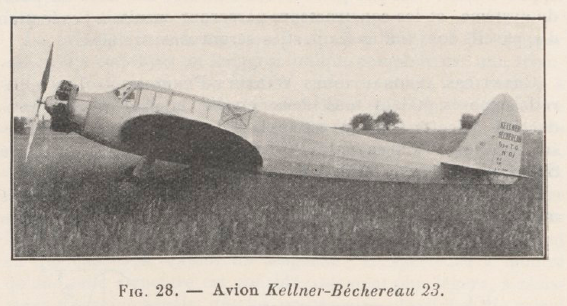
From TU 138,

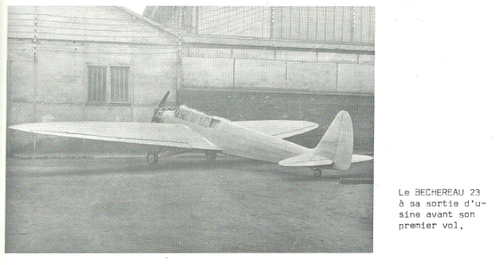
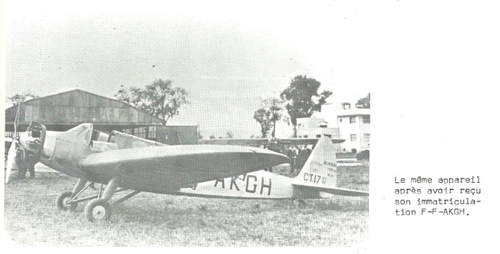
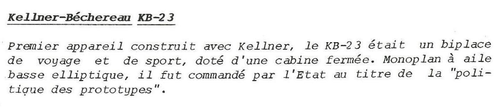
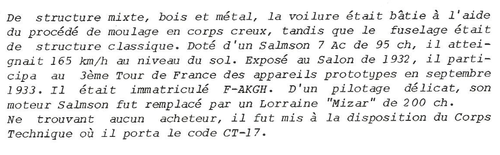
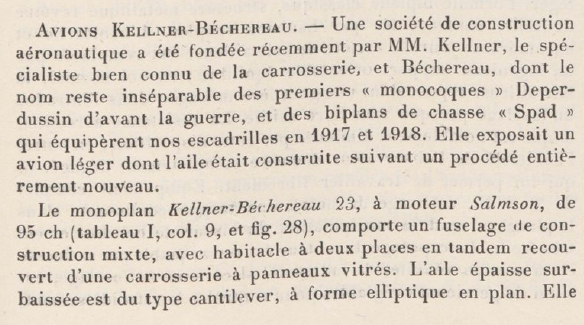
here is a Kellner-Bechereau KB-23,a two-seat low-wing light sporting monoplane.
 

Attachments

  • 1.png
    1.png
    373.1 KB · Views: 69
  • 2.png
    2.png
    306.2 KB · Views: 66
  • 3.png
    3.png
    92.3 KB · Views: 52
  • 4.png
    4.png
    156.7 KB · Views: 55
#5 includes a photo of a test pilot standing beside a prototype. What kind of harness is he wearing?
It sort looks like a ripcord protruding from his left elbow.
Without leg straps, what keeps in the harness?
 
Thanks for the info. The disadvantages will probably have outweighed the merits, no manufacturer has applied this system as far as I know.
 
Cost, including increased maintenance outflows, would seem likely to me to have been a major factor.
 
From, Le_Génie_civil___revue_[...]_bpt6k64883746
 

Attachments

  • 23-1.png
    23-1.png
    220.3 KB · Views: 58
  • 23-2.png
    23-2.png
    294.6 KB · Views: 46
  • 23-3.png
    23-3.png
    83.8 KB · Views: 43
In lightweight fighter contest,I forget to mention a Kellner-Bechereau fighter project of 1935/36.
As far as I know, this Kellner-Béchereau project was designed for the previous C1 program: the MT-CPT4 (4 editions 1934-1935).
 

Similar threads

Back
Top Bottom