PX-L
Source: Wikipedia (2023/08/11 01:40 UTC)
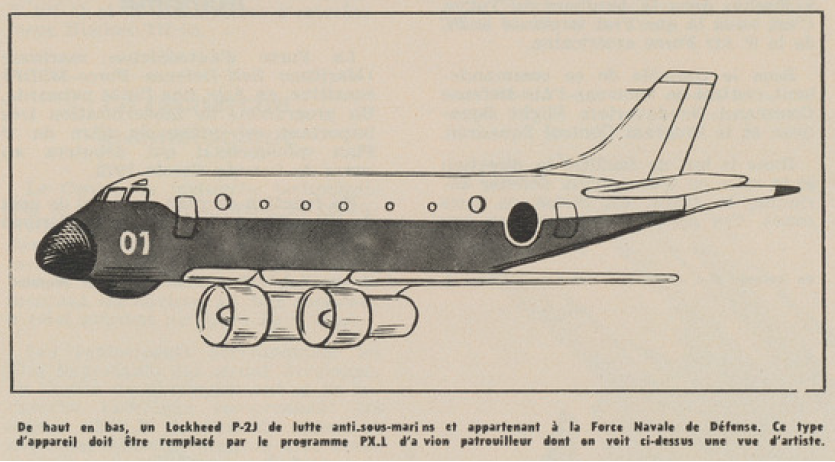
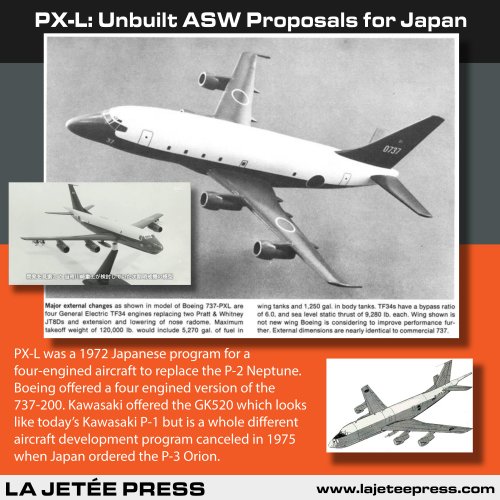
The PX-L is a planned anti-submarine patrol aircraft for the Japan Maritime Self-Defense Force. This article describes the P-2J successor project. Kawasaki Heavy Industries initially developed the aircraft domestically as the GK520, but ultimately licensed production of the Lockheed P-3C Orion was selected.
History
Development History
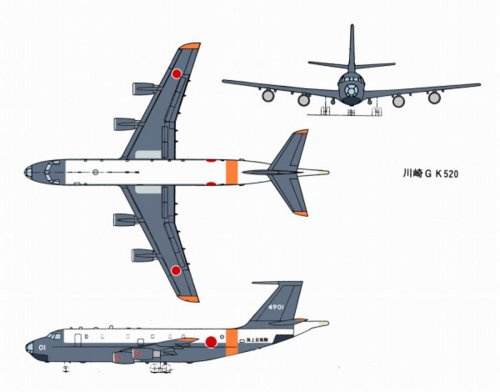
In early 1967, just before the decision was made to mass-produce the P-2J, Kawasaki Heavy Industries, responsible for its development and production, began its own research and development of a P-2J successor, internally named the "GK520." The Maritime Staff Office also began basic studies around 1968, and the Third Defense Program called for the necessary research and development to begin in fiscal year 1970, with the aim of starting development of a next-generation anti-submarine aircraft (PX-L) in fiscal year 1972 or later. However, while the initial budget request was for a research plan for a small patrol aircraft to replace the coastal S2F-1, the plan shifted to a larger patrol aircraft to replace the P-2J within two years of its approval, resulting in distrust from the Ministry of Finance. The U.S. Navy had begun development of a groundbreaking anti-submarine warfare system for patrol aircraft (the A-NEW system) since 1962. The JMSDF, hoping to incorporate this system into its domestically developed anti-submarine aircraft, requested materials from the U.S. Military Advisory Group - Japan (MAAG-J) in 1968, but received a response in April 1969 stating that the request would be rejected at this time. Also in 1968, a survey team was dispatched to Europe and the United States to study anti-submarine patrol aircraft and their onboard equipment. Based on the results of these studies, the JMSDF recognized the need to conduct research into measures for independently developing the next-generation anti-submarine aircraft, including onboard equipment.
The Defense Agency resolved to begin domestic development of the next-generation anti-submarine aircraft in fiscal year 1971 and included a budget for basic design. However, the Ministry of Finance raised doubts about the high cost and necessity of the project, as well as pointed out an insufficient evaluation of the research results. As a result, only approximately 300 million yen was approved as a technical research contract, out of a total request of approximately 1.89 billion yen (of which approximately 760 million yen was allocated from fiscal year 1971 expenditures), and basic design work did not begin. However, since the technical research funding was approved, in September 1971, Kawasaki Heavy Industries was commissioned to carry out technical research on planning and design, research and testing, and to investigate the outlook for mass-produced aircraft pricing.
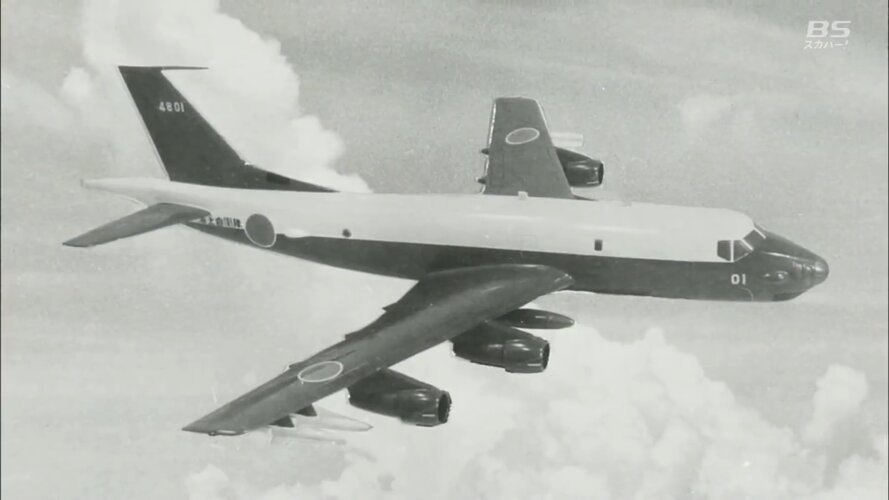
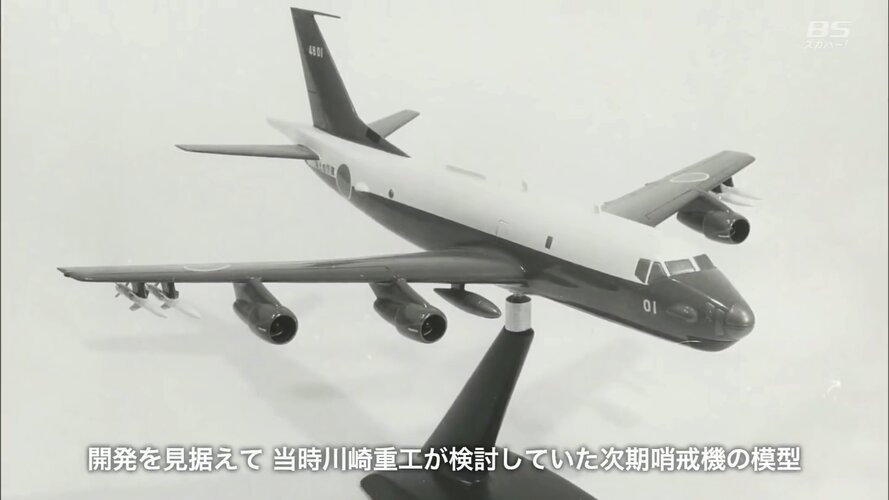
The Defense Agency had planned to complete the basic design in 1972, build a full-scale model in 1973, and two prototypes in 1974, with completion scheduled for the summer of 1978. However, Kawasaki had already nearly completed the basic design in 1970 and produced a full-scale model in 1971. The PX-L was expected to be in service from the late 1980s to 2000.
Scrapbook and Decision to Introduce the P-3C
The Defense Agency had aimed to begin basic design of the PX-L in fiscal year 1972, but due to the pending Fourth Defense Program and YX Program, the lack of justification for PX-L development, and the need for further review of the results of the technical research contract, funding was again allocated only for the technical research contract.
Due to these repeated postponements, the Maritime Staff Office hoped that full-scale development of the PX-L would begin with the Fourth Defense Program, which was scheduled for approval that same year.[2] However, at a National Defense Council meeting on October 9, 1972, the day before the Fourth Defense Program was approved by the Cabinet, the issue of domestically producing next-generation anti-submarine and early warning aircraft was scrapped.[Note 2] It was decided to establish an expert committee within the National Defense Council Secretariat to continue the study. The Fourth Defense Program's main plan included only research and development of electronic devices. Of the approximately 120 fixed-wing anti-submarine aircraft owned by the JMSDF at the time, the P2V-7s were scheduled to reach the end of their service lives in 1981, and the S2F-1s by 1983. The P-2J fleet was also estimated to gradually decline after peaking at 80 in 1975. To replace these losses and maintain a minimum fixed-wing anti-submarine force, the next generation of anti-submarine aircraft needed to be deployed to the fleet by 1980 or 1981 at the latest. Given this short time frame, the JMSDF hoped for an early conclusion from the expert panel, but the first meeting was held in August 1973.[3] However, after requesting documents from the United States in preparation for the meeting, the JMSDF received word in July 1973 that P-3Cs equipped with the A-NEW system were available for release to Japan.[3] In September of that year, a P-3C demonstration flight was conducted at Marine Corps Air Station Iwakuni. A delegation including the Air Wing Commander and field personnel had the opportunity to board and experience the system and were deeply impressed by its performance.
In December 1974, the Expert Committee submitted its report, which expressed doubts about the domestically produced plan due to its cost and feasibility. While it mentioned the possibility of introducing a foreign aircraft, it was ambiguous and encouraged further consideration.[3] Given the looming deadline, the Maritime Staff Office concluded that a domestically produced aircraft would no longer be viable. From May to June 1975, the Deputy Director of the Defense Department dispatched a P-3C to the United States to conduct a field survey. In parallel with this, in addition to the previously considered domestic development and modification of existing aircraft, a compromise plan to equip a domestically produced aircraft with American-made systems was also considered. Regarding the compromise proposal, Canada was developing the CP-140, which combined the P-3C airframe with the S-3A system, and there was hope that a similar approach might be possible in Japan. However, the United States stated that it would only release the P-3C system as a set with the airframe, and although it was possible to release the S-3A system separately, it was significantly inferior to the P-3C system.
After considering these options, at a meeting of the Defense Agency on August 24, 1977, it was decided that 45 P-3Cs would be acquired through license production by the end of fiscal year 1987, and that the cost of purchasing the P-3C would be included in the fiscal year 1978 budget request. These details were approved at the National Defense Council meeting in December, and the decision was made to introduce the P-3C.
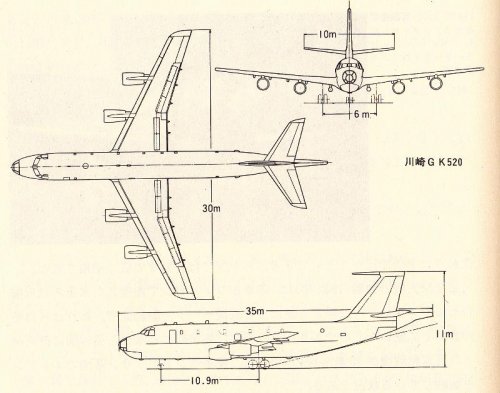
Design (GK520)
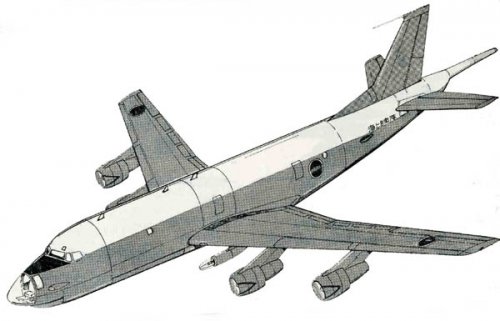
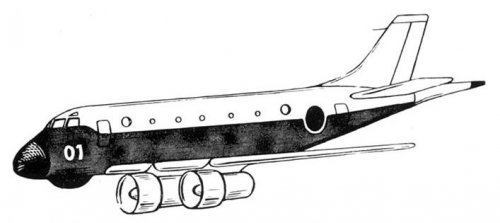
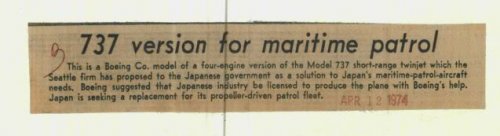
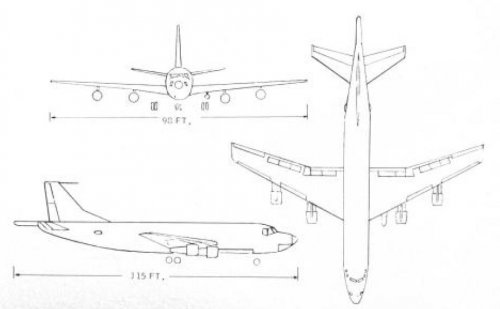
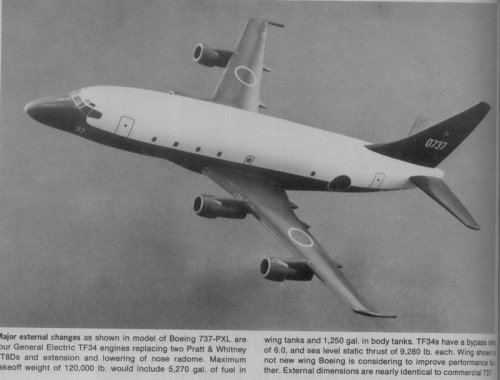
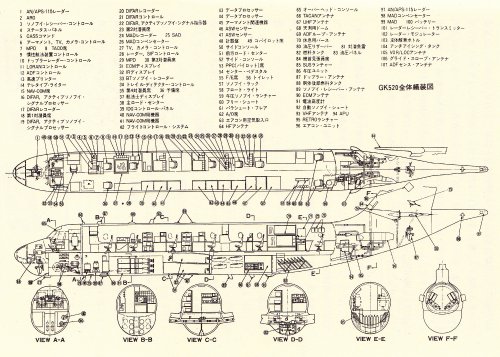
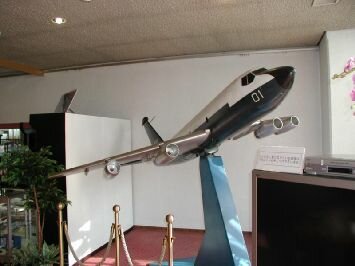
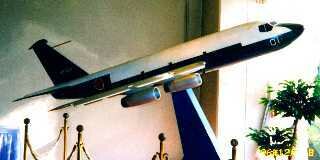
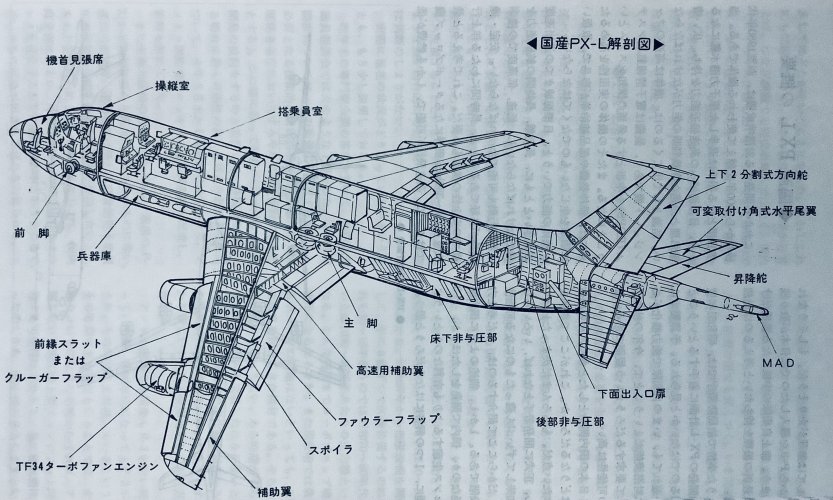
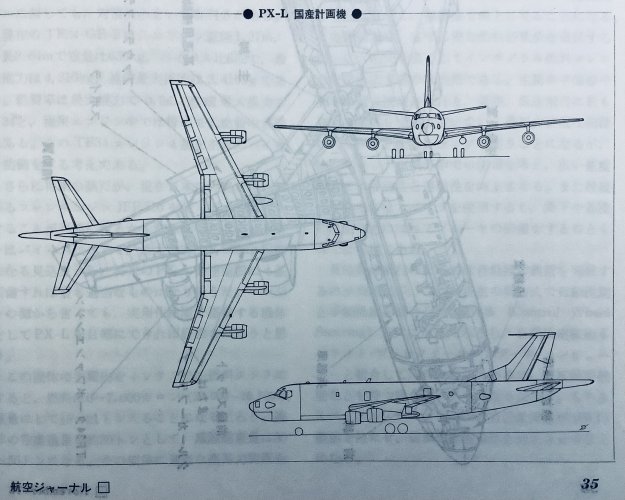
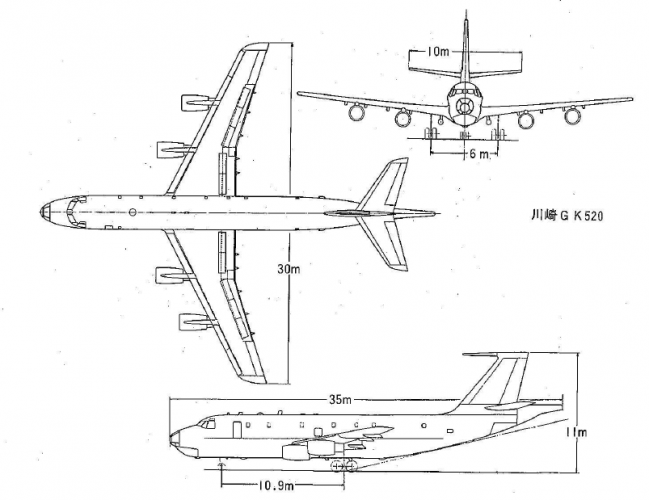
The GK520 was a low-wing, four-engine aircraft powered by turbofan engines. As of October 1972, detailed design and structural strength testing were underway. At the time, Japan lacked turbofan engine technology, and reliability was prioritized, leading to plans for a Rolls-Royce[8] or General Electric engine. Development of detection equipment and an information processing system was also considered a priority.
In 1965, a U.S. Naval Weapons Laboratory staff member inspecting Kawasaki reported that P-3A tactical compartment crews, who had sideways seating, were prone to hemorrhoids. Therefore, the GK520's tactical compartment seating was forward-facing, similar to the P-3C.
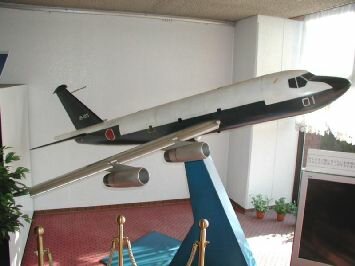
A scale model was on display in the lobby of the Central Plaza Hotel in Kakamigahara City, Gifu Prefecture, but was removed during renovations.
Performance and Specifications (Planned Values)
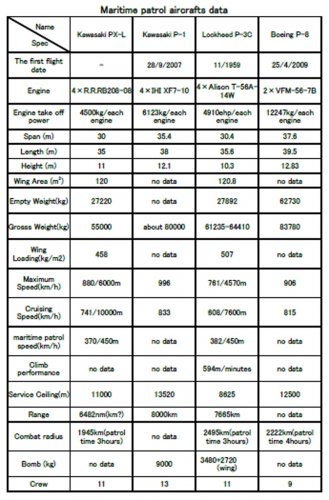
Specifications
• Crew: 11
• Length: 35.0 m (114.8 ft)
• Height: 11.0 m (36.1 ft)
• Wingspan:
• Wing Area: 120.0 m
• Empty Weight: 27,220 kg (60,010 lb)
• Operating Weight: 55,000 kg (121,000 lb)
• Powerplant: Rolls-Royce RB208-08[Note 3] turbofan engines, 4,500 kgf (9,900 lbf) x 4
Performance
• Maximum Speed: 880 km/h (480 kn)
• Cruising Speed: 741 km/h (400 kn)
• Range: 6,482 km (3,500 nmi)
• Service ceiling: 11,000 m (36,000 ft)
Armament
• Anti-submarine torpedoes x 10
• Avionics
o AN/APS-115 radar
o Sonobuoys
o Magnetic detector
o Radio detector