Kawasaki Ki-119 Experimental Fighter-Bomber

blackkite

Don't laugh, don't cry, don't even curse, but.....
Joined
31 May 2007
Messages
9,515
Reaction score
9,661
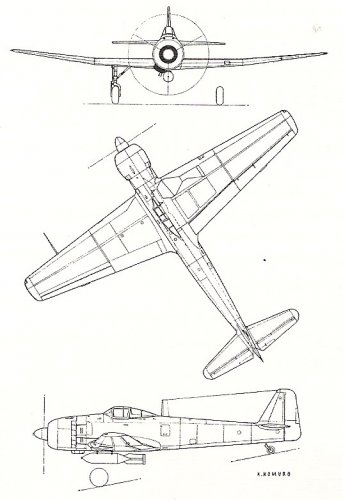
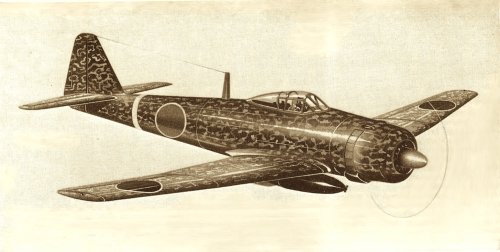
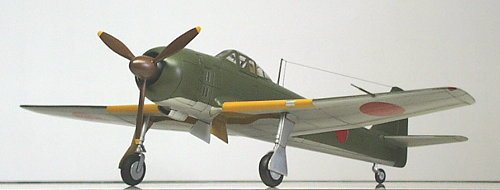
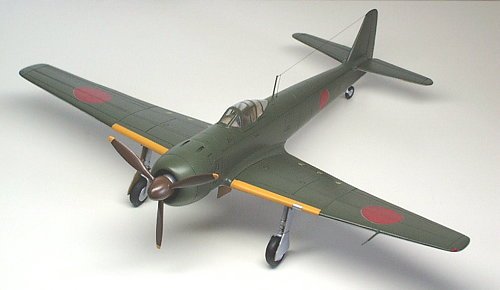
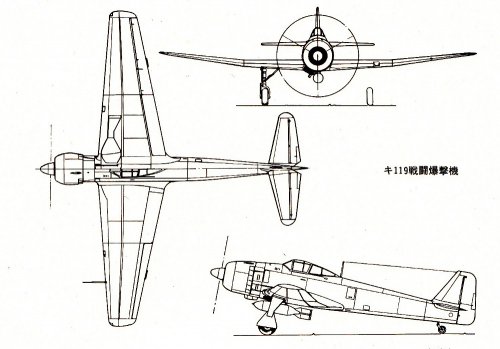
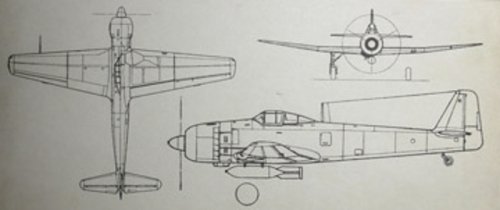
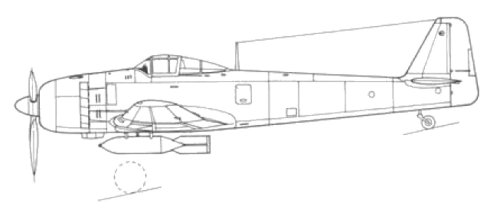
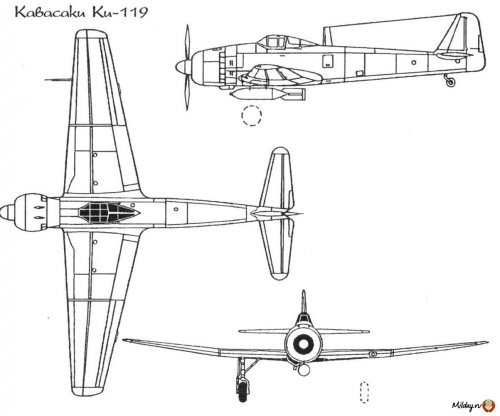
Hi! Kawasaki Ki-119 fighter bomber. Enlarged design from Ki-100.
IJA ordered Kawasaki to manufacture prototype of Ki-119 in March 1945, not completed until the end of the war.
It was the first Japanese fighter bomber to attack ships by dive bombing or torpedo. After ship attack, fighting with enemy fighter and return to the base. Chief designer was Takeo Doi(土井武夫,Ki-61,YS-11 designer).
Engine:HA104,radial air cooling 18 cylinder,2,000hp(take off)
Wing span:14.0m, Length:11.85m, Height:4.5m, Wing Area:31.9m2, Empty weight:3,670kg, MTOW:5,980kg, Wing Loading:187.4kg/m2,
Max speed:580km/h(6,000m), Service Ceiling:10,500m, Range:600-1200km, Armament:20mm cannon×2, Bomb:800kg.
Source:All the Experimental Aircraft in Japanese Army, KANTOSHA, Tokyo.
 

Attachments

  • Kawasaki-Ki-119.jpg
    Kawasaki-Ki-119.jpg
    87.9 KB · Views: 862
A little but this is of course a very original Japanese design,very advanced indeed!
Its a pitty that this design too doesn't make it to operational status,I believe they have only build a mock up of this very promosing design.
 
Nick Millman's Aviation of Japan website is great blog and if any here are not visiting regularly you should be, if you have any interest at all in Japanese aviation.
 
Hi!

http://www.geocities.co.jp/MotorCity-Rally/6275/Mokei/ki119/ki119.html

Ki-119 specification
Span : 14.000 m
Length : 11.850 m
Height : 4.500 m
Wing area : 31.90 m2
Empty weight : 3,670 kg
Gross weight : 5,980 kg
Engine Mitsubishi "Ha 104" air cooling double row radial type 18 cylinder
2,000hp (take off power)
Propeller Fixed-speed variable pitch 3 blades 3.60 m in diameter
Maximum speed : 580 km/h
6-minute and 6-second to altitude of 6,000 m
Service ceiling : 10,500 m
Range : 1,200 km
Armaments : 20 mm cannon x2
Bomb :
A 800kg bomb or 800 kg torpedoe
Crew member One person
Note : Detail design and full scale mockup examination finished before the end of the war. The aircraft incompleted.
 

Attachments

  • ki119_3.jpg
    ki119_3.jpg
    17.8 KB · Views: 217
  • ki119_2.jpg
    ki119_2.jpg
    16.8 KB · Views: 562
  • ki119_1.jpg
    ki119_1.jpg
    20.3 KB · Views: 622
  • Ki-119.jpg
    Ki-119.jpg
    517.6 KB · Views: 737
  • Ki-119_3_side_view.jpg
    Ki-119_3_side_view.jpg
    120.1 KB · Views: 839
  • Kawasaki_Ki-119.jpg
    Kawasaki_Ki-119.jpg
    63.2 KB · Views: 865
Thanks for this, blackkite! This was a true beauty and might have given a few headaches to Americans if built...
 
Thanks my dear Star for your attention.
The Imperial Japanese army ordered development of a fighter-bomber to the Kawasaki airplane in March, 1945 (Showa 20).
As a mission of the fighter-bomber, a bomb is hunged under the body, attack enemy's naval fleet first, and fight with an enemy's fighter after that.
Kawasaki started development by having made the Takeo Doi engineer into the chief, and completed the full-scale mock-up in June 1945.
The shown design conditions
- Have intensity required for diving speed 800km/h and an air battle in single seat form.
- An engine is using Ha 104 under practical use.
- Make a cruising range 600km with 800kg bomb, 1200km with special equipments.
- Armaments at its minimum were two or more 20mm cannons.
- From the necessity for rapid mass production, avoid forge parts as much as possible on parts, and strive for reduction of machine parts.
- Maintenance be simple.
The planned fighter-bomber was a single-engine plane of a huge form called about 14 m in full width, about 12 m in full length, and the weight of about 6 tons, and appearance was the touch which made 5 shiki fighters large-sized.
The body was made into all the metal and this aircraft was for simplification / substitution of the 4 shiki heavy bomber by which conversion production was being carried out in Kawasaki.
As for the engine, same Ha 104 (HA 42-11) as 4 shiki heavy bomber 1 type was planned at the beginning.
When a 4 shiki heavy bomber succeeded in performance gain, it considered equipping same Ha 214 as 4 shiki heavy bomber 2 type.
In addition, this fighter-bomber was attaining shortening of the development period by diverting the design of the existing body.
Moreover, this fighter-bomber was also taking facilitation of maintenance into consideration for the improvement in an operating ratio.
The nose of an airplane was equipped with 2 20-mm cannons.
Although it took immediately for manufacture of an experimental model after mock-up examination, since the war situation had been tight, work did not progress. In the original schedule, the trial production of No. 1 was due to be completed in September, Showa 20.
 

Attachments

  • Mitsubishi_Ki-67-2.jpg
    Mitsubishi_Ki-67-2.jpg
    322.9 KB · Views: 221
blackkite,

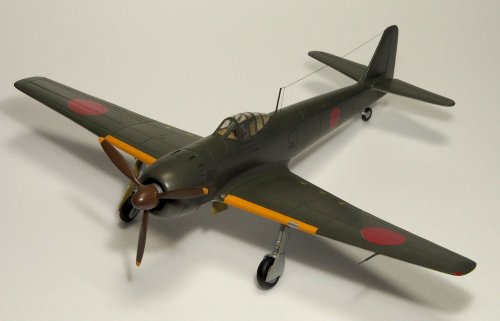
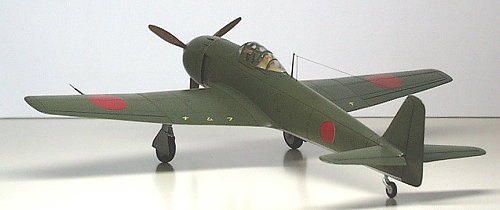
That's a nicely done Raccoon Models rendering of the Ki-119.

Do you know if there's a 1/72nd version of the beast?
 
Hi!
http://www.unicraft.biz/bigph2/ki119-arnold.htm
 

Attachments

  • ki119-01.jpg
    ki119-01.jpg
    15 KB · Views: 238
Ki-119 was a large fighter bomber.
 

Attachments

  • Ki-119 and Reppu.jpg
    Ki-119 and Reppu.jpg
    52.6 KB · Views: 237
  • Ki-119 Tsurugi Ta Go and Shusui kai.jpg
    Ki-119 Tsurugi Ta Go and Shusui kai.jpg
    16.2 KB · Views: 263
Hi,

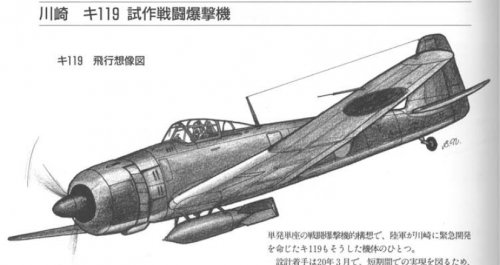
the Ki-119 artist drawing;

The Xplanes of Imperial Japanese Army & Navy 1924-1945
 

Attachments

  • Ki-119.png
    Ki-119.png
    196.4 KB · Views: 330
Several random posts merged into existing topic.
 
From old site on the Net,

in early 1945, the Japanese Army Air Force Command (Rikugun Koku Hombu) identified an urgent need for a new type of light, fast bomber aircraft, intended to attack American invasion forces in the event of their expected landing on the Japanese home islands. The aircraft was to be as simple as possible in design to facilitate production and operation, and to have good flight characteristics (especially during takeoff and landing), making it suitable for even less-trained pilots. The aircraft was required to have an operational radius of at least 600 km, with a payload of 800 kg of bombs and an armament of two 20 mm cannons.

Because the required operational radius was significantly smaller than for previously designed bombers (operations at great distances from home bases were not anticipated), the Koku Hombu opted for a single, high-powered engine and a single-man crew. The aircraft's good performance also meant it could be used as an escort fighter for other bombers or special attack aircraft (Kamikaze). An order for the development of such an aircraft—designated the Army Experimental Light Bomber —was placed with Kawasaki in March 1945.

The new aircraft's design was developed in less than three months by a design team led by Takeo Doi and Jun Kitano. It was a cantilever, low-wing monoplane of metal construction with a trapezoidal wing of high aspect ratio and lifting area. The widely spaced main landing gear utilized long-stroke shock absorbers from the twin-engine Ki-102 heavy fighter. The fuselage design was somewhat reminiscent of that of the single-engine Ki-100 fighter. Much of the aircraft's equipment was also sourced from that aircraft. The cockpit was located above the wing, near the front of the fuselage. An 18-cylinder Mitsubishi Ha-104 (or Army Type 4) radial engine was selected for power, driving a three-blade propeller (the prototype was intended to use a four-blade propeller). The entire aircraft's design was adapted for production in small, dispersed workshops, with final assembly to be carried out in an ad hoc underground factory in Misunami.

In its light bomber version, the aircraft—designated Ki-119 for the time being —was intended to carry a single 800 kg bomb on an external mounting under the fuselage. For dive-bombing missions, two 250 kg bombs each could be attached under the wings. Two additional fuel tanks, each with a capacity of 600 liters, could also be attached to the same under-wing mountings, increasing the aircraft's combat radius to 1,200 km. Two 20 mm Ho-5 cannons were located in the forward fuselage above the engine. Two additional cannons of the same type were to be mounted in the wings of the proposed escort fighter version.

The prototype's first flight was initially planned for September 1945, but during a June 1945 raid by American bombers on the Kawasaki plant in Kagamigahara, almost all of the Ki-119's technical documentation was destroyed. The need to recreate this documentation postponed the planned prototype's first flight until November 1945. However, in mid-August 1945, Japan declared an armistice, and further work on the Ki-119 was halted. Only a 1:1 scale wooden mock-up of the aircraft was built.

 
Back
Top Bottom