
You are using an out of date browser. It may not display this or other websites correctly.
You should upgrade or use an alternative browser.
You should upgrade or use an alternative browser.
Kaiserliche Marine - Imperial German Navy Ship Plans/Discussion
- Thread starter _Sarcasticat_
- Start date

_Sarcasticat_
Die Katze.
- Joined
- 16 April 2020
- Messages
- 366
- Reaction score
- 396
Quick update.
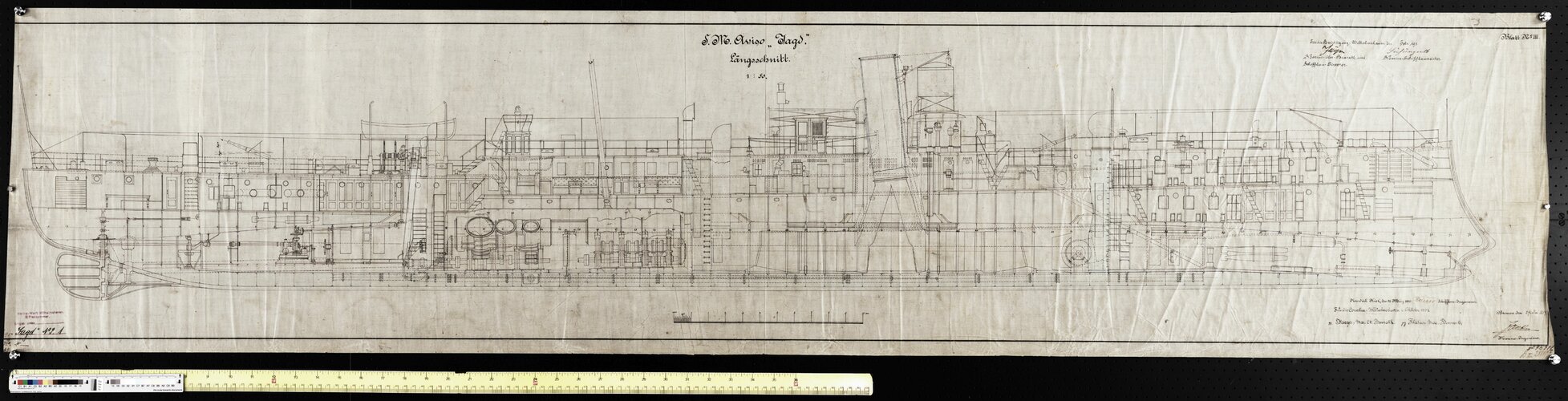
I recalled that I had downloaded a bunch of WWI Kaiserliche Marine ship plans. Not too much is available, but it's there. This not the most recent plans, but what was available a few months ago that I had on-hand. They have now been uploaded.
They include plans for:
- Mackensen-class Battlecruiser
- Scharnhorst-class Armored Cruiser
- Yorck-class Armored Cruiser
- Bayern-class Battleship
- Coln-class Light Cruiser
- Derfflinger-class Battlecruiser
- Ersatz Yorck-class Battlecruiser
- Konig-class Battleships
- Konigsberg-class Light Cruiser
- Madgeburg-class Light Cruiser
- Konig-class Battleships
- Moltke-class Battlecruiser
And a few others.
I recalled that I had downloaded a bunch of WWI Kaiserliche Marine ship plans. Not too much is available, but it's there. This not the most recent plans, but what was available a few months ago that I had on-hand. They have now been uploaded.
They include plans for:
- Mackensen-class Battlecruiser
- Scharnhorst-class Armored Cruiser
- Yorck-class Armored Cruiser
- Bayern-class Battleship
- Coln-class Light Cruiser
- Derfflinger-class Battlecruiser
- Ersatz Yorck-class Battlecruiser
- Konig-class Battleships
- Konigsberg-class Light Cruiser
- Madgeburg-class Light Cruiser
- Konig-class Battleships
- Moltke-class Battlecruiser
And a few others.
Last edited:
Both Bayern half-sisters Sachsen and Württemberg have also been digitalized, you can at least see their machinery layout, armor deck, turrets, upper deck etc, though i haven't able to find their diesel engines on the hull yet to compares with Baden and Bayern.
The suppose schlachtschiff "O" is schlachtschiff "G" hull btw given the plan name.Schlachtschiff O
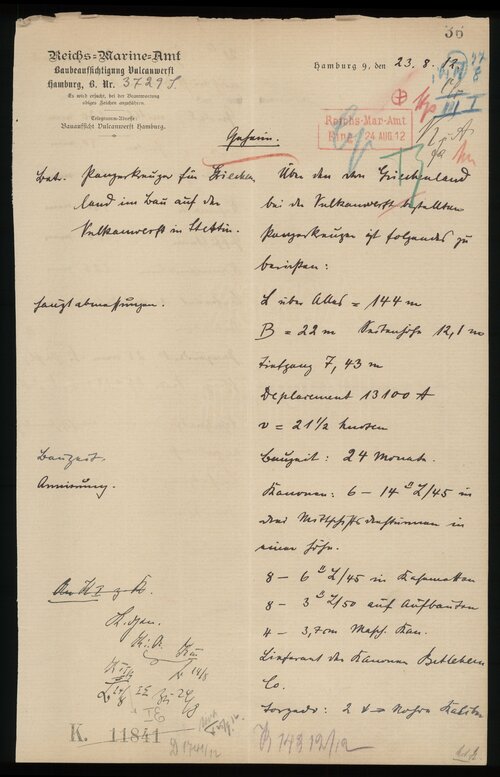
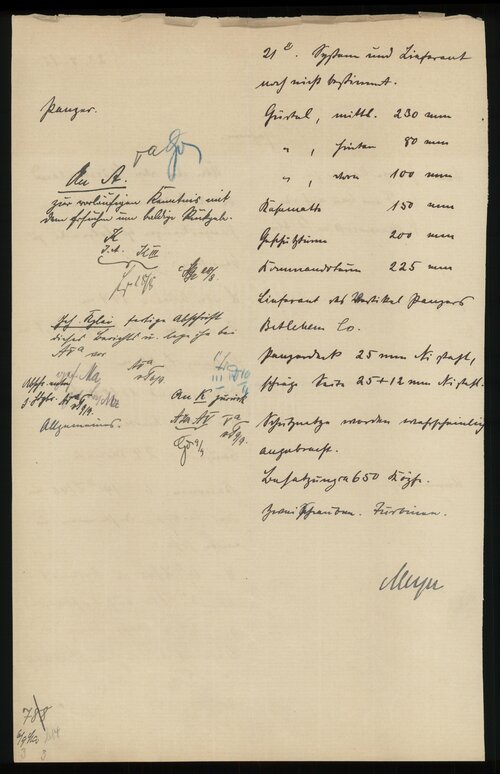
From "German export designs from private shipyards", here's probably the characteristics of pre-design battleship Salamis, if anyone can decrypt the rest i will very appreciated, according to other texts German call them "panzerkreuzer" (Armored cruiser equivalent term to British "battlecruiser").
Attachments
Last edited:
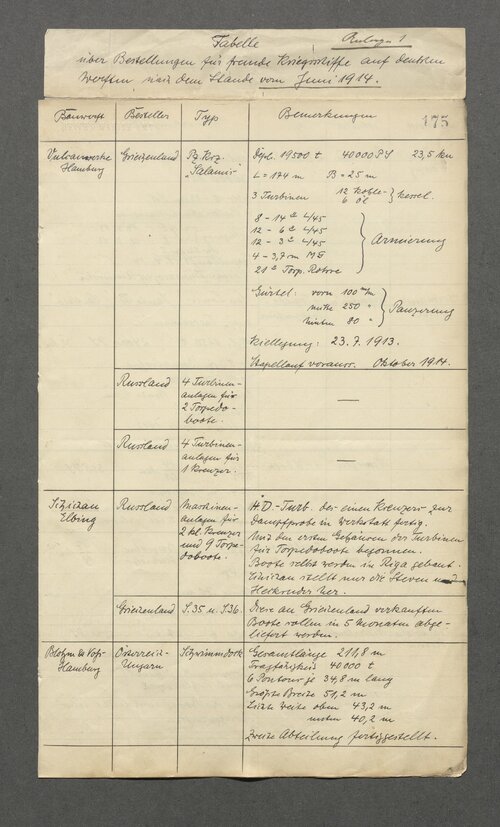

Country in the lists ranging from Greece (finalized Salamis), Russia (AG Vulcan built two light cruisers, with their engines and machinery), Austro-Hungarian? (looks like a 40000t floating dock), Argentina (4 large torpedo boats), Norway, Dutch (4 small torpedo boats), Japan (no clue, but it mentioned diesel, possibly diesel engines).
Roodbaard1958!
ACCESS: Confidential
- Joined
- 26 December 2019
- Messages
- 113
- Reaction score
- 154
Alexi, what is the exact source for both scans? The four torpedoboats mentioned to be built by the Vulkanwerft, Stettin on account of the Netherlands were never delivered. In Dutch service they would become the Z1-4. Instead all four were commissioned in the German navy as V105-108 and three survived the First World War. V10 became Polish Mazur, V106 handed over to Brazil and sold to England, broken up in 1920?, V107 sunk after hitting a mine on 8 May 1915 and V108 became Polish Kaszub. The Dutch shipyards Nederlandsche Scheepsbouw Mij, Amsterdam laid down in 1915 built as replacement the Z1-4.View attachment 731534View attachment 731535
Country in the lists ranging from Greece (finalized Salamis), Russia (AG Vulcan built two light cruisers, with their engines and machinery), Austro-Hungarian? (looks like a 40000t floating dock), Argentina (4 large torpedo boats), Norway, Dutch (4 small torpedo boats), Japan (no clue, but it mentioned diesel, possibly diesel engines).
Last edited:
Roodbaard1958!
ACCESS: Confidential
- Joined
- 26 December 2019
- Messages
- 113
- Reaction score
- 154
From "German export designs from private shipyards", here's probably the characteristics of pre-design battleship Salamis, if anyone can decrypt the rest i will very appreciated, according to other texts German call them "panzerkreuzer" (Armored cruiser equivalent term to British "battlecruise
Alexi what is the correct source for both scan?From "German export designs from private shipyards", here's probably the characteristics of pre-design battleship Salamis, if anyone can decrypt the rest i will very appreciated, according to other texts German call them "panzerkreuzer" (Armored cruiser equivalent term to British "battlecruiser").
The text is dealing with the Salamis called a panzerkreuzer.
Lenght over all 144 metres.
Beam 22 metres,
Depth in hold (?) 12,1 metres
Draught 7,43 metres
displacement 13,100 tons
sped 21.5 knots
Building time 24 months
3x2-14cm L/45 (turrets)
8-6 cm L/45 casemates
8-3cm L/50 on aufbauten, rough translation of aufbau=construction
4-3,7cm
Bethelem Co delivered guns?
Remaing text I did not read no time, is dealing with the armour belt =fore 100-center 230-aft 80mm
casemates 150mm
gun turrets 200 mm
conning tower 225 mm
armour delivered by Bethlehem Co?
Last edited:
RM 3/1097 (the scan numbers attached in the image, pg 341 and 342 for the export tables) and thank you for the decryption.Alexi what is the correct source for both scans

00-PureEvil-00
ACCESS: Confidential
- Joined
- 5 September 2021
- Messages
- 69
- Reaction score
- 144
@Roodbaard1958!
P.S. How the hell does one quote/reply to a post which is entirely a quote itself?... Maybe my browser is too old, but normal quoting just doesn't work for me.
These calibers are in inches, not centimetres. So, that will be 3×2 356-mm/45, 8× 152-mm/50, and 8× 76-mm/50. The only caliber given in centimetres is the last one, 3,7-cm — these are, most likely, saluting guns.3x2-14cm L/45 (turrets)
8-6 cm L/45 casemates
8-3cm L/50 on aufbauten, rough translation of aufbau=construction
P.S. How the hell does one quote/reply to a post which is entirely a quote itself?... Maybe my browser is too old, but normal quoting just doesn't work for me.
_Sarcasticat_
Die Katze.
- Joined
- 16 April 2020
- Messages
- 366
- Reaction score
- 396
Well done. As memory serves, measurements done on German plans are also in Imperial. Weird, as I had thought they'd converted entirely to metric decades before.@Roodbaard1958!
These calibers are in inches, not centimetres. So, that will be 3×2 356-mm/45, 8× 152-mm/50, and 8× 76-mm/50. The only caliber given in centimetres is the last one, 3,7-cm — these are, most likely, saluting guns.
P.S. How the hell does one quote/reply to a post which is entirely a quote itself?... Maybe my browser is too old, but normal quoting just doesn't work for me.
I just use the Reply function. I suspect that would work?
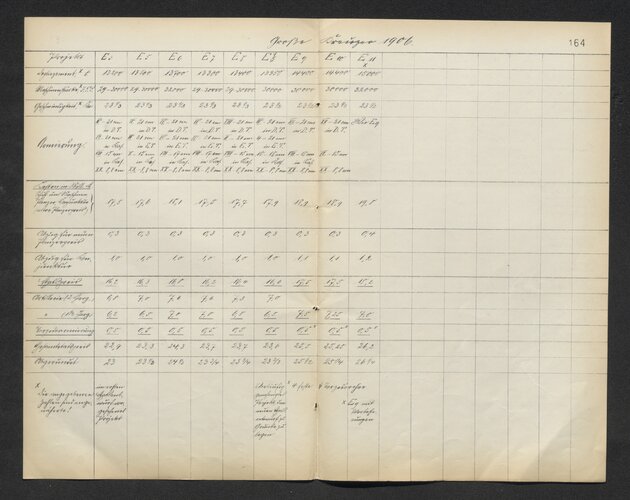
Data tables of armored cruiser "E" or "Grosse Kreuzer 1906" (aka SMS Blücher), there's some interesting bit about her preliminaries from other pages but i can't read since most these are hand writing, note "D.T" mean double turret and "E.T" mean single turret.

Note both E6 and E7 have 17cm gun secondaries.
Note both E6 and E7 have 17cm gun secondaries.
Last edited:
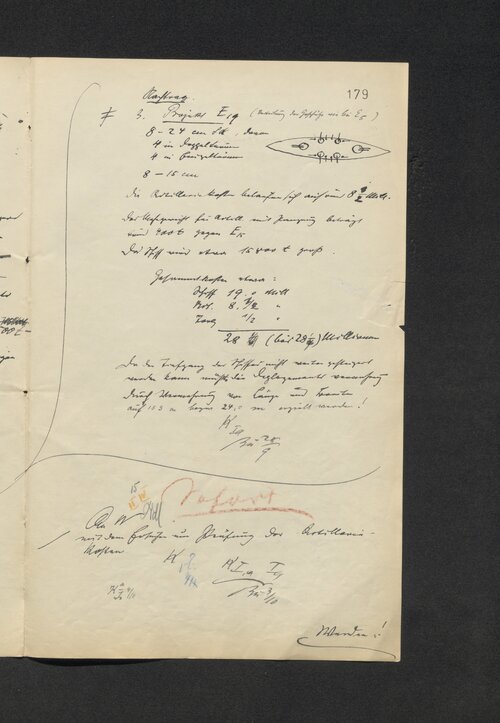
thanksFrom Erich Gröner "Die deutschen Kriegsschiffe 1815-1945" vol.1 :
Roodbaard1958!
ACCESS: Confidential
- Joined
- 26 December 2019
- Messages
- 113
- Reaction score
- 154
Alexi, what is the corrrect source for this scan?Data tables of armored cruiser "E" or "Grosse Kreuzer 1906" (aka SMS Blücher), there's some interesting bit about her preliminaries from other pages but i can't read since most these are hand writing, note "D.T" mean double turret and "E.T" mean single turret.
View attachment 732799
Note both E6 and E7 have 17cm gun secondaries.
RM 3-357 page 0331 and 0361, the scans numbers should be in the file image when you hover/click on it.Alexi, what is the corrrect source for this scan?
Roodbaard1958!
ACCESS: Confidential
- Joined
- 26 December 2019
- Messages
- 113
- Reaction score
- 154
Thx!RM 3-357 pagina 0331 en 0361, de scannummers zouden in de bestandsafbeelding moeten staan als u erop zweeft/klikt.
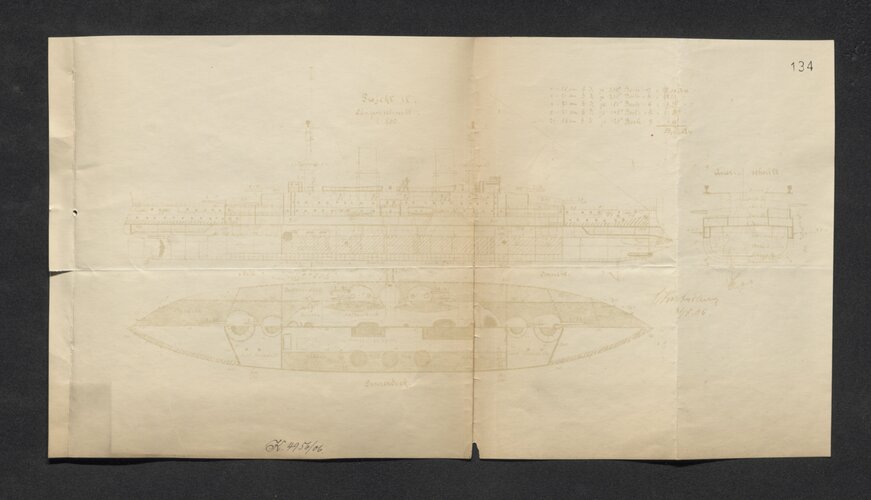
Unrelated, I found a couple of improved Deustchland-class pre-dreadnought plans from RM 3 some months ago but never post here, these are the part of 1906 naval programs presumably. There are no data on hull dimensions (except Projekt IX haven't read it yet), only design requirements at 16000 tons and top speed of 19 knots. Total of 10 projects (Projekt I - X), they only have above/top view of the hull plans sadly. Here's the all-big gun projects, the rest are mixed caliber with 28cm, 24cm, 21cm, 19cm and 17cm types.
"Projekt I" - 6x28cm/L40 (3x2), 8x17cm and 24x8.8cm in casemate.
"Projekt II" - 6x28cm/L40 (2x2, 2x1), 4x21cm (4x1) and 24x8.8cm in deck mounts and casemate.
"Projekt III" - 10x28cm/L40 (2x2, 2x1 in turrets and 4x1 in casemate) and 24x8.8cm in deck mounts and casemate.
"Projekt VI" - 12x28cm/L40 (4x2 in turrets, 4x1 in casemate) and 24x8.8cm in deck mounts and casemate.
One notable mixed caliber pre-dreadnought type was "Projekt IX" have 2x2 28cm but armed to the teeth with 16x21cm in twin turrets!one can be describe as "German Lord Nelson".
"Projekt I" - 6x28cm/L40 (3x2), 8x17cm and 24x8.8cm in casemate.
"Projekt II" - 6x28cm/L40 (2x2, 2x1), 4x21cm (4x1) and 24x8.8cm in deck mounts and casemate.
"Projekt III" - 10x28cm/L40 (2x2, 2x1 in turrets and 4x1 in casemate) and 24x8.8cm in deck mounts and casemate.
"Projekt VI" - 12x28cm/L40 (4x2 in turrets, 4x1 in casemate) and 24x8.8cm in deck mounts and casemate.
One notable mixed caliber pre-dreadnought type was "Projekt IX" have 2x2 28cm but armed to the teeth with 16x21cm in twin turrets!one can be describe as "German Lord Nelson".
Attachments
Last edited:
Hi, Alexi,Unrelated, I found a couple of improved Deustchland-class pre-dreadnought plans from RM 3 some months ago but never post here, these are the part of 1906 naval programs presumably. There are no data on hull dimensions (except Projekt IX haven't read it yet), only design requirements at 16000 tons and top speed of 19 knots. Total of 10 projects (Projekt I - X), they only have above/top view of the hull plans sadly. Here's the all-big gun projects, the rest are mixed caliber with 28cm, 24cm, 21cm, 19cm and 17cm types.
"Projekt I" - 6x28cm/L40 (3x2), 8x17cm and 24x8.8cm in casemate.
"Projekt II" - 6x28cm/L40 (2x2, 2x1), 4x21cm (4x1) and 24x8.8cm in deck mounts and casemate.
"Projekt III" - 10x28cm/L40 (2x2, 2x1 in turrets and 4x1 in casemate) and 24x8.8cm in deck mounts and casemate.
"Projekt VI" - 12x28cm/L40 (4x2 in turrets, 4x1 in casemate) and 24x8.8cm in deck mounts and casemate.
One notable mixed caliber pre-dreadnought type was "Projekt IX" have 2x2 28cm but armed to the teeth with 16x21cm in twin turrets!one can be describe as "German Lord Nelson".
Can you provide the exact document number? According to your description, these designs do not seem to belong to any "official design history" - neither the research of D.Nottelmann or A.Grießmer, nor the Kurrent font files that have been digitized. When the discussion about rises to 16,000 tons displacement, the turret used in the design is no longer an old design (L/40, although L/45 was still called Drh.L. C/01 at the time). Judging from the more "Italian" secondary armament of P.IX, it is possible that it was a study directed by Wilhelm II.
I hope I can provide some help.View attachment 731534View attachment 731535
Country in the lists ranging from Greece (finalized Salamis), Russia (AG Vulcan built two light cruisers, with their engines and machinery), Austro-Hungarian? (looks like a 40000t floating dock), Argentina (4 large torpedo boats), Norway, Dutch (4 small torpedo boats), Japan (no clue, but it mentioned diesel, possibly diesel engines).
1. In this table, Vulcan built for Russia the turbine equipments (Turbinenanlagen) for two torpedo boats and a cruiser, not the ships themselves - the latter later gave rise to the proposal to build a new mine cruiser (i.e. SMS Brummer); Schichau's shipyard in Danzig was responsible for two new small cruisers (the future Pillau class), and its shipyard in Elbing was responsible for their machinery equipment;
2. To be precise, what was built for Argentina was a torpedo boat destroyer (Torpedozerstörer), which may not be the same as the "official" large torpedo boat in terms of reference relationship;
3. What Vulcan built for Japan was a DC adjustable transformer (Unisteuerbaren Transformator für Dieselmaschine eines Zerstörers) for the diesel machine (probably generator) of a destroyer, not built a diesel engine; this destroyer was built in Yarrow (der bei Yarrow im Bau ist).
I'm currently writing about Tirpitz Fleet Law and the Wilhelm II Fast battleship race, and I'll try to help you out when I have some free time.

- Joined
- 22 January 2006
- Messages
- 4,436
- Reaction score
- 2,801
No. It would be a good idea.Are there any threads on the forum or other sites discussing Germany's unfinished naval program in WWI like this thread?


- Joined
- 6 September 2006
- Messages
- 5,316
- Reaction score
- 11,545
This thread has been split out from KM Ship Plans Discussion
Other related sections are:
KM Naval Armament Plans and Discussion
Link to _Sarcasticat_ file store on this topic:
https://drive.google.com/drive/folders/1TvB_4n7bAEFCNdy5kOFPAruCxWLS9HXW
Other related sections are:
KM Naval Armament Plans and Discussion
Link to _Sarcasticat_ file store on this topic:
https://drive.google.com/drive/folders/1TvB_4n7bAEFCNdy5kOFPAruCxWLS9HXW

Pirate Pete
ACCESS: Secret
- Joined
- 25 July 2007
- Messages
- 408
- Reaction score
- 736
Some pages from a book I copied from some years ago in my then local Reference Library:
Deutsche Grosskampshiffe 1915-1918, Sonderausgabe: Die Entwicklung der Typenfrage im Ersten Weltkrieg. Mit Schiffstypen-Darstellungen. By Friedrich Forstmeier and Siegfried Breyer.
Apologies for relatively poor quality but it was in the days before Scanners and it was a 'wet paper' type photocopier/xerox machine.
Deutsche Grosskampshiffe 1915-1918, Sonderausgabe: Die Entwicklung der Typenfrage im Ersten Weltkrieg. Mit Schiffstypen-Darstellungen. By Friedrich Forstmeier and Siegfried Breyer.
Apologies for relatively poor quality but it was in the days before Scanners and it was a 'wet paper' type photocopier/xerox machine.
Attachments
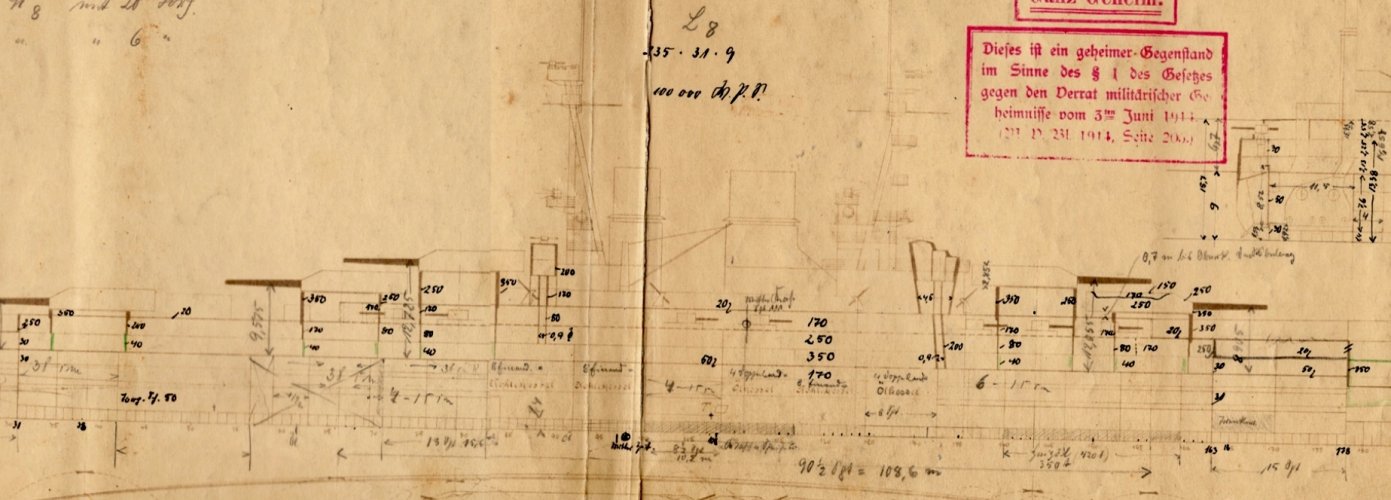
Very interesting sir, do you have the rest? since not many of them have been scanned on invenio yet. Also mirrored tripod mast? i remember one of the GK-series (Grossekreuzer) have them and there are specs under "L8". (235m in length, 31m beam and 9m draft, 100k horsepower?) also different turrets placement compare to L2 and L21a.Greetings. Perhaps this document will be of interest to the community.
Last edited:
"L 8" is the only mention of the project, without the title of the document.Very interesting sir, do you have the rest? since not many of them have been scanned on invenio yet. Also mirrored tripod mast? i remember one of the GK-series (Grossekreuzer) have them and there are specs under "L8". (235m in length, 31m beam and 9m draft, 100k horsepower?) also different turrets placement compare to L2 and L21a.
It's likely one of the missing links between L1-3 series and L20-24a series, i recalled there are mentions of some 1916 battleship designs with either 10 or 12 guns (mixed with twin and quad) to match Q.E-class, hope this document will be scanned at one point, it provided studies of German late-war capital ships with three-gun turrets and quadruple turrets.


Alexi, I assume that the fully scanned document will someday be posted for review if the owner deems it possible.It's likely one of the missing links between L1-3 series and L20-24a series, i recalled there are mentions of some 1916 battleship designs with either 10 or 12 guns (mixed with twin and quad) to match Q.E-class, hope this document will be scanned at one point, it provided studies of German late-war capital ships with three-gun turrets and quadruple turrets.
View attachment 772233

Vepr157
I like submarines
- Joined
- 20 December 2015
- Messages
- 171
- Reaction score
- 463
Is there a mechanism whereby you can request that the Bundesarchiv digitize a particular drawing that they have a catalog listing for? At the U.S. National Archives you can email them and they'll accommodate the request if they can (although often they say that the paper is too fragile to scan).
airborne24
ACCESS: Restricted
- Joined
- 22 March 2020
- Messages
- 10
- Reaction score
- 15
Does anyone have any information (such weight, range, etc) regarding the 75 cm torpedo that was being developed by Junkers that was mentioned in Friedman's Naval Weapons of World War I?
Last edited:
Scott Kenny
ACCESS: USAP
- Joined
- 15 May 2023
- Messages
- 19,668
- Reaction score
- 28,151
IIRC the forum turned off nested quoting a year or two ago.P.S. How the hell does one quote/reply to a post which is entirely a quote itself?... Maybe my browser is too old, but normal quoting just doesn't work for me.
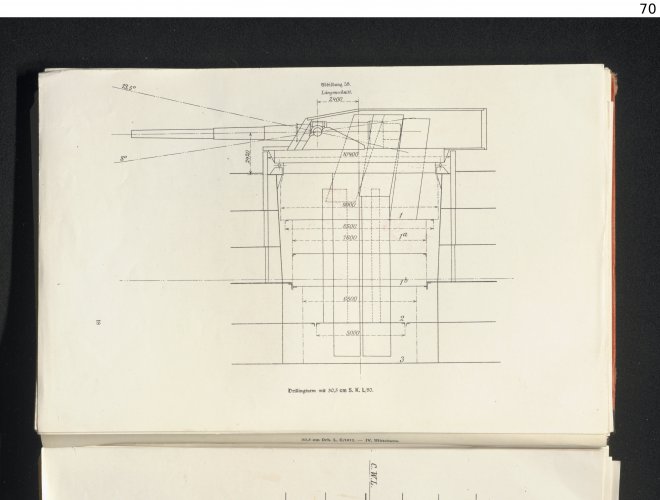
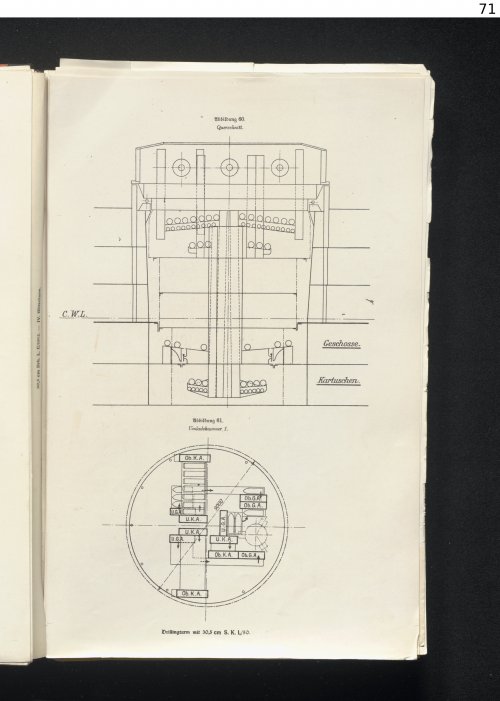
Hello, i have found two sketches of Krupp designed 30.5cm/L50 triple turret, they're inspired from Austro-Hungarian triple 30.5cm but have wider barbatte diameter (10.4m versus 9.6m on A-H triple turret) and more complicated loading systems.
The source is document RM 6/3339 titled " Entwicklung unserer Marineartillerie".


The source is document RM 6/3339 titled " Entwicklung unserer Marineartillerie".
Last edited:
The next document RM 6/3342 caught my attentions, here are what appear to be some of the turret plans of quadruple 38cm/L45, the only visible Krupp designed quad-turret i know so far was the quadruple 35cm turret for Dutch export battleship, there were several attempts to developing triple and quadruple turrets incoporate into future battleships to save weight during late war 1917-18, there is also a data table for 42cm gun as well in single (why?), twin, triple and quadruple turret.

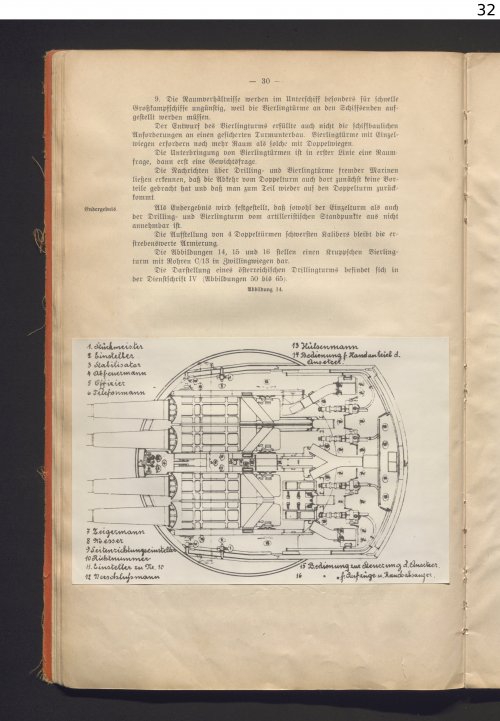
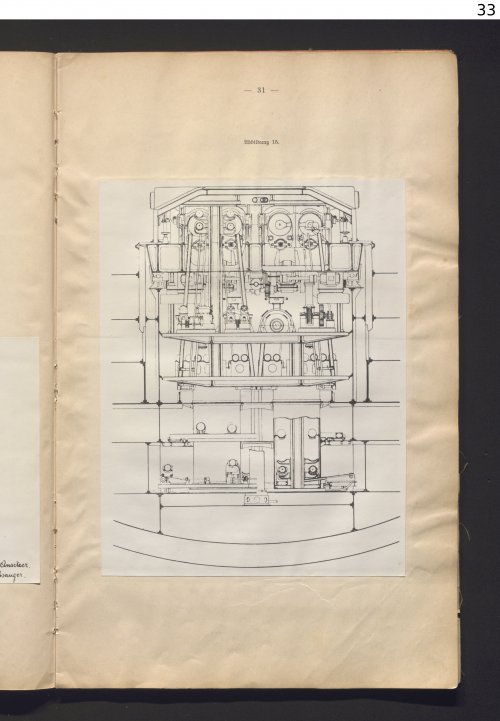
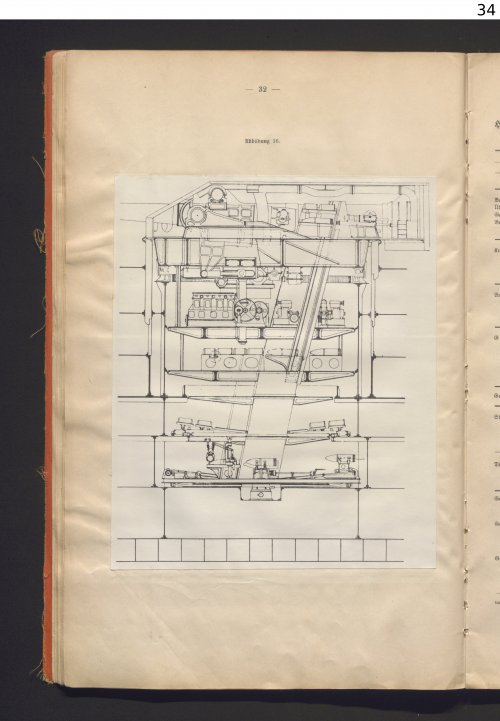
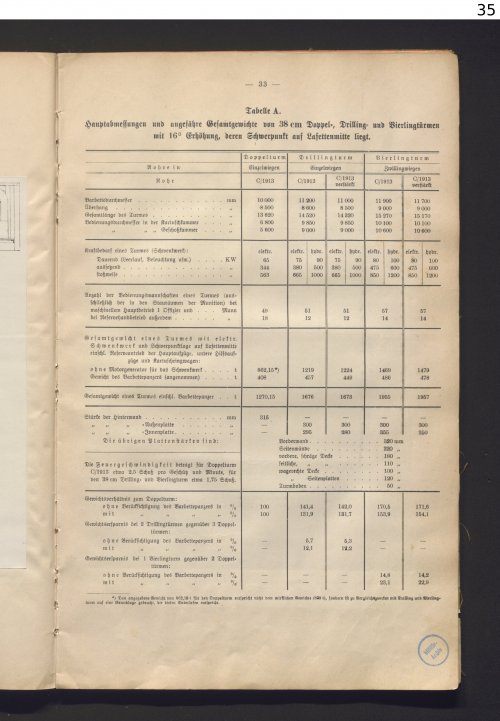

- Joined
- 11 March 2006
- Messages
- 8,538
- Reaction score
- 5,022
The text says, that „In conclusion, it can be stated that neither the single, nor the triple, nor the quad turret are acceptable from an artillery-related point of view“.
So the given data may just be for proving this point ?
So the given data may just be for proving this point ?

- Joined
- 1 February 2011
- Messages
- 3,347
- Reaction score
- 5,034
I post these info on the FK or Flottenkreuzer or Flotten Kreuzer series of cruiser designs from 1916 I've gathered from a discussion and comes from the book:
The Kaiser's Cruisers by Dirk Nottlemann
PHANTOMS AND FUTURE In addition to the ‘real’ Cöln class, reports reaching the UK during 1918 alleged that she and an alleged sister Mannheim were of a much-enlarged type.³⁴ This was supposedly of 6,300 tons, 520ft x 49ft x 17/f ft in size, and armed with two 21cm and six 15cm guns, plus four torpedo tubes, with a range of some 12,000nm. These rumours led to the British sketching a 7.5in- gunned version of the ‘E’ class to match it. Less extreme reports dating to 1916 suggested that new construction German cruisers would be armed with ten or eleven 15cm weapons, and this had contributed to the construction of the new British ‘D’ class.³⁵ It was long thought that no such vessels had ever been actually contemplated in Germany, but, as Quite common with rumours, they contained a grain of truth.
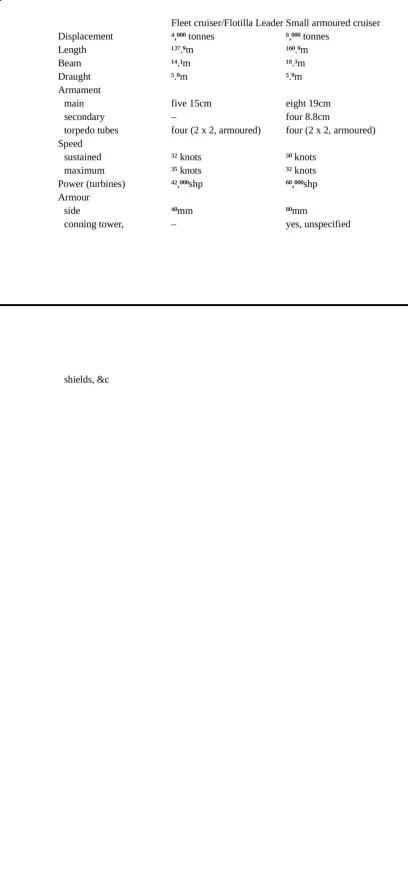
As early as the winter of 1915, a Questionnaire had been circulated to the commanding officers of the larger vessels of the fleet – including cruisers – regarding the experience gained so far during the war, and the potential lessons for the future. The responses were, unsurprisingly, diverse, with little unanimity as to desiderata. However, focussing on those that potentially impacted the future development of cruisers, one extremely detailed proposal came from FKpt Heinrich Retzmann, then CO of Strassburg, who felt that the events of the war indicated that the present small cruiser was something of an evolutionary dead end.
In particular, he believed that none of the current vessels were capable of waging commerce warfare west of the British Isles – the only kind of maritime warfare that he saw as endangering to the British war effort. In his view, a split was necessary in future development. One line should comprise a smaller- sizedtrue ‘fleet cruiser’ or ‘flotilla leader’, principally capable of fighting British destroyers that, he anticipated, might some day be eQuipped with 12.7cm (5in) guns.³ The other line would develop into a cruiser intermediate between small and large cruisers in capability, which he dubbed an ‘armoured cruiser’. The key characteristics of the two proposals are given below:
A similar opinion was voiced by the temporary leader of the IV. SG, Kpt Karl von Resto rff (1871-1944), who stated that the small cruiser had not proven its worth in action thus far. Accordingly, it should be developed into a true cruiser for distant stations, while the type for service at home must be developed into a small armoured cruiser.

Both (and further similar) opinions were initially rejected by FO II. SG, KAdm Georg Hebbinghaus (1866-1944) because he foresaw that the development of the newly proposed ‘armoured cruiser’ would ultimately end in the logical culmination of the ‘battlecruiser’, as had been the case with large cruisers.³⁷ However, he saw some merit in the smaller ‘flotilla leader’, explicitly referring to the British ‘C’ class in comparison.
On the contrary assumption that the existing division of cruiser types should be maintained and continued, several proposals came in – none of which were new.
For example: design speed should be raised to at least 30 knots; protection should be raised to 100mm in some areas (unspecified); an enlarged forward conning tower, giving good visibility aft, plus an additional command post aft should be fitted; ten 15cm guns should be mounted; the forward torpedo flat should be omitted, with four torpedo tubes (four singles or two twins) mounted on the upper deck under protected shields instead; the manual steering position should be brought under armour protection.
The preliminary closing verdict came from VAdm Hipper, commander of the Scouting Force, in August 1915. For the time being, he did not agree with the dissenting voices, seeing the recent small cruiser not replaceable by other types
Nevertheless, the seed was sown, and the discussion would reemerge during 1915. Perhaps surprisingly, sometime during the second half of that year, Hipper would change his mind and also become a promoter of the ‘flotilla leader’ design
In May 1916, Tirpitz’s successor as State Secretary at the RMA, Adm Eduard von Capelle (1855-1931), was summoned to brief the Kaiser regarding the future development of the fleet in the context of the existing Fleet Law. In his review, topics other than the development of future battleships and large cruisers were dealt with only very briefly. But regarding small cruisers, the main reQuirements for future types for service abroad were seen as settled, although any detailed design work would have to be postponed indefinitely, for the lack of personnel.
The same applied to designs for ‘fleet cruisers’ (FK) that had been worked out as pure studies during the initial months of the year. One issue already apparent was that all of their design speeds were inadeQuate for working in conjunction with the modern torpedo boats that they were intended to lead
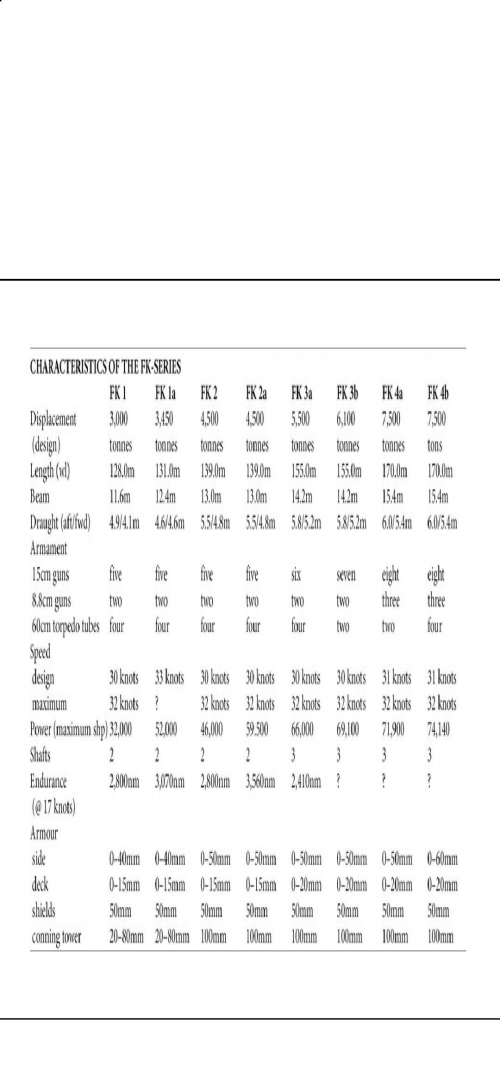
These studies for FKs clearly originated from the desiderata of a number of the front-line commanders, now with support from Hipper. The Kaiser was apparently³⁸ impressed enough by some of these sketches to have ordered in November and December 1915 – via Tirpitz – their development by ‘K’, under the direction of Baurat Alfred Blechschmidt, into true design studies. Numbered in an ‘FK’ seQuence, these ranged in size from 3,000 tonnes (FK 1), through 4,500 tonnes (FK 2) and 6,000 tonnes (FK 3) to 7,500 tonnes (FK 4). Some of their known – not totally consistent – vital statistics are noted opposite.
The logic behind studies FK 3 and FK 4 is hard to see, as they were contrary to the reQuest for a smaller flotilla leader type, instead growing to a size well beyond the latest 1914-15 small cruisers. Quite probably they were simply studies of what was possible, and would most unlikely have been chosen to be actually built. Blechschmidt himself would call them in 1931, ‘material to choose suitable reQuirements for design from, in case new buildings of this type could be afforded’. Further support for this statement may be taken from discussions during the winter of 1916, when several options were tabled at the RMA. One originated from the Question of whether it would really be necessary to build expensive cruisers (costing some 20-25 million Marks) for ‘service abroad’ (code for cruisers intended for commerce raiding), when their potential effectiveness seemed dwarfed by the successes of auxiliary cruisers: for example, Möwe had sunk vessels with goods worth some 60 million Marks during her first cruise during 1915-16, compared to her conversion costs of about 0.5 million Marks!
The true death knell of the existing type, however, came in the wake of Jutland, when the leaders of tactical units and captains of individual ships were once more invited to share their recent battle experienceswith senior officers, guided by another Questionnaire. Of special interest regarding cruisers were, of course, the responses of theleaders of the II. SG, KAdm Friedrich Boedicker (1866-1944), and of the IV. SG, Kdr Ludwig von Reuter (1869-1943), to the Questionsraised by their direct superior, Hipper. He wanted to know:
1. In which way may the existing type to be improved in new construction?
2. In which way may the existing vessels be improved through the lessons learned in battle?
3. Has any type of vessel been proven worthless for further development?

Assuming that the two senior officers had not conferred before submitting their individual answers, their opinions proved to be very similar.
If the existing type of small cruiser was to be continued, both of them reQuired a higher continuous speed in new ships, preferably by employment of a higher degree of oil firing. Further, as one lesson learned from battle, splinter protection must be improved in existing vessels as well as new-builds. Third, protection against underwater weapons must be improved: since the installation of anti-torpedo bulkheads would be futile, because of the lack of beam to provide enough depth for the protection system, the subdivision of the hull must be further elaborated.
In their response to Question 3, Boedicker and von Reuter made it very clear that they did not recommend the continuation of the existing type of small cruiser.
They saw it as outdated for several reasons. First, the existing type had already become too large and expensive to be easily risked against anything smaller than themselves. Regarding a ship’s value as a fighting unit, the protection (for example) was regarded as too weak compared with the size of the vessel, yet the cruiser was already too slow and unhandy to perform its intended tasks of either leading torpedo boat flotillas in battle, or reconnoitring enemy forces. With explicit regard to the latter, both officers stated that the effective controlled range of heavy guns had become so great that the small cruiser was unable to gain any visual information on the enemy fleet before entering the danger zone and presenting an easy target. In addition, von Reuter saw the beginning of another arms spiral, as he – rightfully – expected the Royal Navy to counter the most modern German cruisers with a super-type of their own, armed with 19cm (7.5in) guns (as would actually emerge as the Cavendish class, although their genesis actually lay in providing trade protection in distant waters).
In the opinion of both officers, the only solution was the creation of a force of smaller-sized fleet cruisers, armed with five 15cm guns, to counter the growing number of British ‘C’ class cruisers, and be capable of high-speed raids. The ships should not, however, be eQuipped for minelaying, since this task could be done more effectively by submarines.
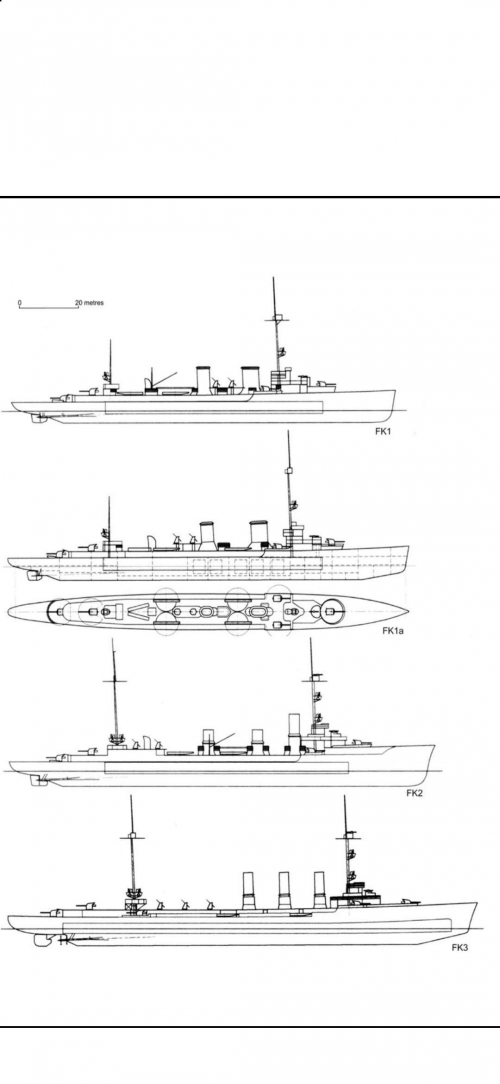
Sketch drawings of FK cruisers were, except for FK1a, long thought to have been lost. However, a number of others have now come to light, as shown here.
FK1 and FK1a owe much to destroyer design, especially the 1918 Mob type, while FK3 shares the profile of the post-Graudenz ‘standard’ small cruisers fleet cruisers. (DN drawing In his report to the CinC, Adm Scheer, on the results of the Questionnaires, Hipper gave Qualified endorsement to the views of his two most important subordinates. Like them, he would postpone any decisions regarding the ‘cruiser for foreign duties’ until after the war, when Germany’s political situation would have become clearer. Regarding the ‘fleet cruiser’, however, he held back from a definite decision against the current type of small cruiser. In his view, the prevailing negative mood against it was, at least in part, influenced by the loss of four such vessels at Jutland which, however, were only partly the result of enemy action or design issues. Nevertheless, he also saw the deficiencies of the type, which could be partly solved by the introduction of a smaller ‘fleet cruiser’ or ‘flotilla leader’, a type whose utility, he admitted, he had not initially been persuaded.
However, he still had his reservations, particularly in view of discussions regarding future battleships and large cruisers, which would be able to wage war on the oceans and thus would need adeQuate escorts, over and above the current small cruiser. In conclusion, Hipper, saw the design ‘FK 2’ as probably the best, but Queried whether the situation really reQuired a completely new design.
Might it not be sufficient to simply reduce the armament of the existing type and use the weight saving to improve their other capabilities? It is unlikely that an answer was forthcoming. In his subseQuent report to Capelle, Scheer supported Hipper in his reluctance to abolish the ‘standard type’ entirely, not the least because there were still ten cruisers of that type under construction, but warmly endorsed the decision for a special ‘flotilla leader’.
At this point in the summer and autumn of 1916, the discussion began to move in circles. On one hand, the creation of a new type was strongly recommended;
on the other, its creation should have to be postponed until after the war. Yet by this time, the ‘flotilla leader’ role would have begun to be taken up by the S113-type ‘large torpedo boats’ that were just being begun in 1916, armed with four 15cm guns, displacing well over 2,000 tonnes, and designed for 34.5 knots.³ The development of cruisers had come to a halt for the time being. However, it seems certain that the ‘unification’ of the two lines of development in the 1890s was about to be split again. The story of the‘classic’ German small cruiser therefore ends with the end of the German Imperial navy itself.⁴
34. N Friedman, British Cruisers: Two World Wars and After (Barnsley:
Seaforth, 2010), pp 339–40 n.30; on the other hand, by the time that the July 1918 Admiralty Confidential Book covering German cruisers was issued, the Cöln class had been correctly identified as similar to the Königsbergs, along with the names Wiesbaden, Leipzig and Magdeburg for vessels under construction.
On the other hand, another of the latter was believed to be a ‘Bremen’, with all provisional names wrong. British intelligence had assumed that Ersatz-names after Cöln (correctly noted as ‘Ersatz-Ariadne’) would then continue the sequence of replacements under the Fleet Laws, rather than war-losses, as was actually the case (Cöln confused matters, as Ariadne was both one of the first war-losses and due to be replaced directly after Thetis – the last of the Königsbergs, Nürnberg, having been Ersatz-Thetis). Thus, Dresden is listed as ‘Ersatz-Amazone’ and Wiesbaden as ‘Ersatz-Medusa’. The later vessels are cited as having the provisional designations ‘P’, ‘Q’ and ‘R’ – continuing the small cruiser sequence last used for Stuttgart (N. Friedman [ed.], German Warships of World War I: The Royal Navy’s Official Guide to the Capital Ships, Cruisers, Destroyers, Submarines and Small Craft, 1914–1918 (London: Greenhill Books, 1992), p 114).
35. Friedman, British Cruisers: Two World Wars, p. 54.
36. The 4.7in [120mm]-gunned ‘Modified W’ class would be laid down during 1918.
37. Probably with some justification one is similarly inclined to see this as the road leading the future ‘light cruiser’ and ‘heavy cruiser’ categories. Besides this, it may be interesting to note that both protagonists, Retzmann and Hebbinghaus, were soon promoted to posts in the RMA.
38. Whether he really was inspired by the reports, or got the initial spark by other means, remains obscure.
39. The first vessel of the type, V116, was commissioned in July 1918, followed by S113 in August 1919 – just in time to be surrendered to the Allies. As the French Amiral Sénès, the latter was used as leader of Mediterranean torpedo craft down to the 1930s.
40. The subsequent Emden (iii) has often been seen as a final continuation of the ‘classic’ small cruiser: but see p 240, below, for her true background.
The Kaiser's Cruisers by Dirk Nottlemann
PHANTOMS AND FUTURE In addition to the ‘real’ Cöln class, reports reaching the UK during 1918 alleged that she and an alleged sister Mannheim were of a much-enlarged type.³⁴ This was supposedly of 6,300 tons, 520ft x 49ft x 17/f ft in size, and armed with two 21cm and six 15cm guns, plus four torpedo tubes, with a range of some 12,000nm. These rumours led to the British sketching a 7.5in- gunned version of the ‘E’ class to match it. Less extreme reports dating to 1916 suggested that new construction German cruisers would be armed with ten or eleven 15cm weapons, and this had contributed to the construction of the new British ‘D’ class.³⁵ It was long thought that no such vessels had ever been actually contemplated in Germany, but, as Quite common with rumours, they contained a grain of truth.
As early as the winter of 1915, a Questionnaire had been circulated to the commanding officers of the larger vessels of the fleet – including cruisers – regarding the experience gained so far during the war, and the potential lessons for the future. The responses were, unsurprisingly, diverse, with little unanimity as to desiderata. However, focussing on those that potentially impacted the future development of cruisers, one extremely detailed proposal came from FKpt Heinrich Retzmann, then CO of Strassburg, who felt that the events of the war indicated that the present small cruiser was something of an evolutionary dead end.
In particular, he believed that none of the current vessels were capable of waging commerce warfare west of the British Isles – the only kind of maritime warfare that he saw as endangering to the British war effort. In his view, a split was necessary in future development. One line should comprise a smaller- sizedtrue ‘fleet cruiser’ or ‘flotilla leader’, principally capable of fighting British destroyers that, he anticipated, might some day be eQuipped with 12.7cm (5in) guns.³ The other line would develop into a cruiser intermediate between small and large cruisers in capability, which he dubbed an ‘armoured cruiser’. The key characteristics of the two proposals are given below:
A similar opinion was voiced by the temporary leader of the IV. SG, Kpt Karl von Resto rff (1871-1944), who stated that the small cruiser had not proven its worth in action thus far. Accordingly, it should be developed into a true cruiser for distant stations, while the type for service at home must be developed into a small armoured cruiser.
Both (and further similar) opinions were initially rejected by FO II. SG, KAdm Georg Hebbinghaus (1866-1944) because he foresaw that the development of the newly proposed ‘armoured cruiser’ would ultimately end in the logical culmination of the ‘battlecruiser’, as had been the case with large cruisers.³⁷ However, he saw some merit in the smaller ‘flotilla leader’, explicitly referring to the British ‘C’ class in comparison.
On the contrary assumption that the existing division of cruiser types should be maintained and continued, several proposals came in – none of which were new.
For example: design speed should be raised to at least 30 knots; protection should be raised to 100mm in some areas (unspecified); an enlarged forward conning tower, giving good visibility aft, plus an additional command post aft should be fitted; ten 15cm guns should be mounted; the forward torpedo flat should be omitted, with four torpedo tubes (four singles or two twins) mounted on the upper deck under protected shields instead; the manual steering position should be brought under armour protection.
The preliminary closing verdict came from VAdm Hipper, commander of the Scouting Force, in August 1915. For the time being, he did not agree with the dissenting voices, seeing the recent small cruiser not replaceable by other types
Nevertheless, the seed was sown, and the discussion would reemerge during 1915. Perhaps surprisingly, sometime during the second half of that year, Hipper would change his mind and also become a promoter of the ‘flotilla leader’ design
In May 1916, Tirpitz’s successor as State Secretary at the RMA, Adm Eduard von Capelle (1855-1931), was summoned to brief the Kaiser regarding the future development of the fleet in the context of the existing Fleet Law. In his review, topics other than the development of future battleships and large cruisers were dealt with only very briefly. But regarding small cruisers, the main reQuirements for future types for service abroad were seen as settled, although any detailed design work would have to be postponed indefinitely, for the lack of personnel.
The same applied to designs for ‘fleet cruisers’ (FK) that had been worked out as pure studies during the initial months of the year. One issue already apparent was that all of their design speeds were inadeQuate for working in conjunction with the modern torpedo boats that they were intended to lead
These studies for FKs clearly originated from the desiderata of a number of the front-line commanders, now with support from Hipper. The Kaiser was apparently³⁸ impressed enough by some of these sketches to have ordered in November and December 1915 – via Tirpitz – their development by ‘K’, under the direction of Baurat Alfred Blechschmidt, into true design studies. Numbered in an ‘FK’ seQuence, these ranged in size from 3,000 tonnes (FK 1), through 4,500 tonnes (FK 2) and 6,000 tonnes (FK 3) to 7,500 tonnes (FK 4). Some of their known – not totally consistent – vital statistics are noted opposite.
The logic behind studies FK 3 and FK 4 is hard to see, as they were contrary to the reQuest for a smaller flotilla leader type, instead growing to a size well beyond the latest 1914-15 small cruisers. Quite probably they were simply studies of what was possible, and would most unlikely have been chosen to be actually built. Blechschmidt himself would call them in 1931, ‘material to choose suitable reQuirements for design from, in case new buildings of this type could be afforded’. Further support for this statement may be taken from discussions during the winter of 1916, when several options were tabled at the RMA. One originated from the Question of whether it would really be necessary to build expensive cruisers (costing some 20-25 million Marks) for ‘service abroad’ (code for cruisers intended for commerce raiding), when their potential effectiveness seemed dwarfed by the successes of auxiliary cruisers: for example, Möwe had sunk vessels with goods worth some 60 million Marks during her first cruise during 1915-16, compared to her conversion costs of about 0.5 million Marks!
The true death knell of the existing type, however, came in the wake of Jutland, when the leaders of tactical units and captains of individual ships were once more invited to share their recent battle experienceswith senior officers, guided by another Questionnaire. Of special interest regarding cruisers were, of course, the responses of theleaders of the II. SG, KAdm Friedrich Boedicker (1866-1944), and of the IV. SG, Kdr Ludwig von Reuter (1869-1943), to the Questionsraised by their direct superior, Hipper. He wanted to know:
1. In which way may the existing type to be improved in new construction?
2. In which way may the existing vessels be improved through the lessons learned in battle?
3. Has any type of vessel been proven worthless for further development?
Assuming that the two senior officers had not conferred before submitting their individual answers, their opinions proved to be very similar.
If the existing type of small cruiser was to be continued, both of them reQuired a higher continuous speed in new ships, preferably by employment of a higher degree of oil firing. Further, as one lesson learned from battle, splinter protection must be improved in existing vessels as well as new-builds. Third, protection against underwater weapons must be improved: since the installation of anti-torpedo bulkheads would be futile, because of the lack of beam to provide enough depth for the protection system, the subdivision of the hull must be further elaborated.
In their response to Question 3, Boedicker and von Reuter made it very clear that they did not recommend the continuation of the existing type of small cruiser.
They saw it as outdated for several reasons. First, the existing type had already become too large and expensive to be easily risked against anything smaller than themselves. Regarding a ship’s value as a fighting unit, the protection (for example) was regarded as too weak compared with the size of the vessel, yet the cruiser was already too slow and unhandy to perform its intended tasks of either leading torpedo boat flotillas in battle, or reconnoitring enemy forces. With explicit regard to the latter, both officers stated that the effective controlled range of heavy guns had become so great that the small cruiser was unable to gain any visual information on the enemy fleet before entering the danger zone and presenting an easy target. In addition, von Reuter saw the beginning of another arms spiral, as he – rightfully – expected the Royal Navy to counter the most modern German cruisers with a super-type of their own, armed with 19cm (7.5in) guns (as would actually emerge as the Cavendish class, although their genesis actually lay in providing trade protection in distant waters).
In the opinion of both officers, the only solution was the creation of a force of smaller-sized fleet cruisers, armed with five 15cm guns, to counter the growing number of British ‘C’ class cruisers, and be capable of high-speed raids. The ships should not, however, be eQuipped for minelaying, since this task could be done more effectively by submarines.
Sketch drawings of FK cruisers were, except for FK1a, long thought to have been lost. However, a number of others have now come to light, as shown here.
FK1 and FK1a owe much to destroyer design, especially the 1918 Mob type, while FK3 shares the profile of the post-Graudenz ‘standard’ small cruisers fleet cruisers. (DN drawing In his report to the CinC, Adm Scheer, on the results of the Questionnaires, Hipper gave Qualified endorsement to the views of his two most important subordinates. Like them, he would postpone any decisions regarding the ‘cruiser for foreign duties’ until after the war, when Germany’s political situation would have become clearer. Regarding the ‘fleet cruiser’, however, he held back from a definite decision against the current type of small cruiser. In his view, the prevailing negative mood against it was, at least in part, influenced by the loss of four such vessels at Jutland which, however, were only partly the result of enemy action or design issues. Nevertheless, he also saw the deficiencies of the type, which could be partly solved by the introduction of a smaller ‘fleet cruiser’ or ‘flotilla leader’, a type whose utility, he admitted, he had not initially been persuaded.
However, he still had his reservations, particularly in view of discussions regarding future battleships and large cruisers, which would be able to wage war on the oceans and thus would need adeQuate escorts, over and above the current small cruiser. In conclusion, Hipper, saw the design ‘FK 2’ as probably the best, but Queried whether the situation really reQuired a completely new design.
Might it not be sufficient to simply reduce the armament of the existing type and use the weight saving to improve their other capabilities? It is unlikely that an answer was forthcoming. In his subseQuent report to Capelle, Scheer supported Hipper in his reluctance to abolish the ‘standard type’ entirely, not the least because there were still ten cruisers of that type under construction, but warmly endorsed the decision for a special ‘flotilla leader’.
At this point in the summer and autumn of 1916, the discussion began to move in circles. On one hand, the creation of a new type was strongly recommended;
on the other, its creation should have to be postponed until after the war. Yet by this time, the ‘flotilla leader’ role would have begun to be taken up by the S113-type ‘large torpedo boats’ that were just being begun in 1916, armed with four 15cm guns, displacing well over 2,000 tonnes, and designed for 34.5 knots.³ The development of cruisers had come to a halt for the time being. However, it seems certain that the ‘unification’ of the two lines of development in the 1890s was about to be split again. The story of the‘classic’ German small cruiser therefore ends with the end of the German Imperial navy itself.⁴
34. N Friedman, British Cruisers: Two World Wars and After (Barnsley:
Seaforth, 2010), pp 339–40 n.30; on the other hand, by the time that the July 1918 Admiralty Confidential Book covering German cruisers was issued, the Cöln class had been correctly identified as similar to the Königsbergs, along with the names Wiesbaden, Leipzig and Magdeburg for vessels under construction.
On the other hand, another of the latter was believed to be a ‘Bremen’, with all provisional names wrong. British intelligence had assumed that Ersatz-names after Cöln (correctly noted as ‘Ersatz-Ariadne’) would then continue the sequence of replacements under the Fleet Laws, rather than war-losses, as was actually the case (Cöln confused matters, as Ariadne was both one of the first war-losses and due to be replaced directly after Thetis – the last of the Königsbergs, Nürnberg, having been Ersatz-Thetis). Thus, Dresden is listed as ‘Ersatz-Amazone’ and Wiesbaden as ‘Ersatz-Medusa’. The later vessels are cited as having the provisional designations ‘P’, ‘Q’ and ‘R’ – continuing the small cruiser sequence last used for Stuttgart (N. Friedman [ed.], German Warships of World War I: The Royal Navy’s Official Guide to the Capital Ships, Cruisers, Destroyers, Submarines and Small Craft, 1914–1918 (London: Greenhill Books, 1992), p 114).
35. Friedman, British Cruisers: Two World Wars, p. 54.
36. The 4.7in [120mm]-gunned ‘Modified W’ class would be laid down during 1918.
37. Probably with some justification one is similarly inclined to see this as the road leading the future ‘light cruiser’ and ‘heavy cruiser’ categories. Besides this, it may be interesting to note that both protagonists, Retzmann and Hebbinghaus, were soon promoted to posts in the RMA.
38. Whether he really was inspired by the reports, or got the initial spark by other means, remains obscure.
39. The first vessel of the type, V116, was commissioned in July 1918, followed by S113 in August 1919 – just in time to be surrendered to the Allies. As the French Amiral Sénès, the latter was used as leader of Mediterranean torpedo craft down to the 1930s.
40. The subsequent Emden (iii) has often been seen as a final continuation of the ‘classic’ small cruiser: but see p 240, below, for her true background.
Scott Kenny
ACCESS: USAP
- Joined
- 15 May 2023
- Messages
- 19,668
- Reaction score
- 28,151
I would suggest possibly for coastal monitors, if the layout worked.there is also a data table for 42cm gun as well in single (why?), twin, triple and quadruple turret.
Similar threads
-

-
Kriegsmarine - KM Naval Armament Plans/Discussion
- Started by _Sarcasticat_
- Replies: 315
-
Kriegsmarine Naval What-If Ships
- Started by _Sarcasticat_
- Replies: 22
-

-