bring_it_on

I really should change my personal text
Joined
4 July 2013
Messages
4,225
Reaction score
5,769
Just from a mission planning perspective. The current Anti Ship weapon planned for B-1 has a range that could be 2 to 3 times of this weapon (which iirc is 100-150nm class). This means the B-1s would need to get closer to a potential target, and also mean that you will need more aircraft to support the mission. While high performance supersonic or even Hypersonic anti-ship missiles will greatly enhance the USAF's B-1s in this role they really need something of that performance in the 500 nautical mile class. These missiles will be great if 2-4 can be carried by the Navy Super Hornets however - would offer a significant survivability bump over the block II Harpoons.
 
https://web.archive.org/web/2003102...earing.jda.go.jp/kunrei/i_fd/iz1990p1010.html
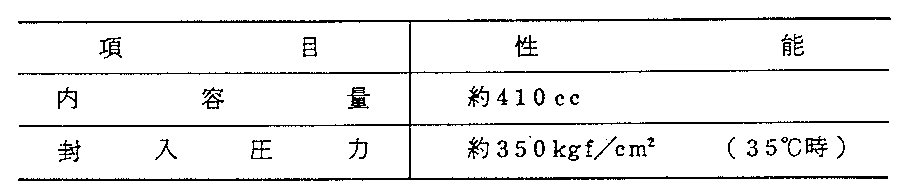
Old JDA website on AAM-3. Unfortunately most of the images are dead. Supposedly AAM-3 was something between the all aspect generation of missiles like AIM-9l and the high off boresight missiles like the AIM-9x. Independently articulated dogtooth canards, duel color seeker, and apparently claimed three times AIM-9L off boresight capabilities.
 
https://web.archive.org/web/2003102...earing.jda.go.jp/kunrei/i_fd/iz1990p1010.html
Old JDA website on AAM-3. Unfortunately most of the images are dead. Supposedly AAM-3 was something between the all aspect generation of missiles like AIM-9l and the high off boresight missiles like the AIM-9x. Independently articulated dogtooth canards, duel color seeker, and apparently claimed three times AIM-9L off boresight capabilities.
What difference does it make if a seeker is capable of detecting multiple spectrum (IR and UV)?

Also, does the AAM-3 uses tracking suspension, gatewidth or both method for irccm?

I think for the time it was operational, it's one if not the best short range missile available regardless
 
What difference does it make if a seeker is capable of detecting multiple spectrum (IR and UV)?

Also, does the AAM-3 uses tracking suspension, gatewidth or both method for irccm?

I think for the time it was operational, it's one if not the best short range missile available regardless
Tracking UV lets you ignore counter measures designed for IR only. Stinger uses this approach, I believe Python 4 does as well.

I am hoping to find a member in Japan who could request a better version of the above document with pictures.

Yes I believe it was for a time the most capable western IR missile. I think it’s a really novel missile.
 
What difference does it make if a seeker is capable of detecting multiple spectrum (IR and UV)?
The typical IR flare in the 80s used magnesium, which was much hotter than jet engine exhaust and could be identified by its characteristic UV radiation.
Later, with the advent of flare decoys with emission characteristics consistent with jet engine exhaust, this type of seeker lost its effectiveness and was replaced by IIR homing.
Also, does the AAM-3 uses tracking suspension, gatewidth or both method for irccm?
I have not heard much about these.

I am hoping to find a member in Japan who could request a better version of the above document with pictures.
Frankly, I doubt those images even existed on the original website. I don't believe that the Japanese MoD released detailed specs of their most advanced missiles then, and if they did, I suspect that someone would have saved and shared those images.
Also, no images exist on the same type of page (制式要綱) for Type 69, AAM-1 too.

https://web.archive.org/web/2003102...aring.jda.go.jp/kunrei/i_fd/iz1969xp1004.html
Yes I believe it was for a time the most capable western IR missile. I think it’s a really novel missile.
...and most expensive SRAAM. The AAM-3 was roughly twice the price of the AIM-9L when delivered to the JASDF, and the total production was about just ~3000 missiles, one order of magnitude less than the AIM-9 of the same generation.
 
The typical IR flare in the 80s used magnesium, which was much hotter than jet engine exhaust and could be identified by its characteristic UV radiation.
Later, with the advent of flare decoys with emission characteristics consistent with jet engine exhaust, this type of seeker lost its effectiveness and was replaced by IIR homing.

I have not heard much about these.


Frankly, I doubt those images even existed on the original website. I don't believe that the Japanese MoD released detailed specs of their most advanced missiles then, and if they did, I suspect that someone would have saved and shared those images.
Also, no images exist on the same type of page (制式要綱) for Type 69, AAM-1 too.

https://web.archive.org/web/2003102...aring.jda.go.jp/kunrei/i_fd/iz1969xp1004.html

...and most expensive SRAAM. The AAM-3 was roughly twice the price of the AIM-9L when delivered to the JASDF, and the total production was about just ~3000 missiles, one order of magnitude less than the AIM-9 of the same generation.
I have one of them IMG_1397.gif
 
All in all, why wouldn't they invest in a new air-to-air missile?
I don't know why you think that?

View attachment 707056

Slightly related, as Japan has allocated budget for the development of AAM-4 follow-up missile called "next-gen MRAAM (次期中距離空対空誘導弾の開発). This is separate from "future MRAAM R&D (将来中距離空対空誘導弾に関する研究)", which the JNAAM programme was part of.
 
Here's a video about the development of Japanese AAMs starting with the AAM-1 through to the AAM-5:


We are investigating the AAM-1 (Type 69), XAAM-2, AAM-3 (Type 90), AAM-4 (Type 99), and AAM-5 (Type 04), the claws of raptors of the Japan Air Self-Defense Force. #airtoairmissiles #missile #JASDFhttps://www.youtube.com/hashtag/jasdf
How far back does Japan's air-to-air missile development date?
What factors impeded the progress of these studies?
Why did Japan acquire the AIM-9X Sidewinder and the AIM-120 AMRAAM, even though it has its own successful products?
Are the Japanese missiles a new hope for the region?
00:00 Introduction
01:03 AAM-1 / Type 69
02:41 XAAM-2
03:43 AAM-3 / Type 90
06:33 Specifications (AAM-3)
07:03 AAM-4 / Type 99
10:21 Specifications (AAM-4)
10:52 AAM-4 variants (AAM-4B - Type 99 Kai / Joint New Air-to-Air Missile / XRIM-4)
12:06 AAM-5 / Type 04
13:17 Specifications (AAM-5)
13:42 AAM-5 variants (AAM-5B - Type 04 Kai)
 
This is a record of the Technical Research and Development Institute.
I have a question for everyone. I do not translate primary source materials. This is because, if my translation resulted in incorrect English, there would be no way to verify the accuracy. What do you think about this?
 

Attachments

  • mergded.pdf
    18.8 MB · Views: 51
It is possible to use Google Translate online tool to translate PDF or image, subjected to file size limits.....

If unsure, you can submit one page at a time to see the results first before trying out more pages. Also, it will help if the Japanese text is clearer so that the tool can have better translation accuracy ....
 
It is possible to use Google Translate online tool to translate PDF or image, subjected to file size limits.....

If unsure, you can submit one page at a time to see the results first before trying out more pages. Also, it will help if the Japanese text is clearer so that the tool can have better translation accuracy ....
Since Japanese is my native language, I’m fully capable of extracting text from Japanese documents—what do you think? If you’d like me to help, I’d be happy to.
 
Last edited:
Since I only use Japanese, I have no choice but to rely on LLM-based translation—something everyone is currently interested in.
I am also capable of digitizing text via OCR.
 
This is a record of the Technical Research and Development Institute.
I have a question for everyone. I do not translate primary source materials. This is because, if my translation resulted in incorrect English, there would be no way to verify the accuracy. What do you think about this?
I think even without translating it, just scanning the full book and uploading it would be a major service. Just from the handful of pages you have uploaded, there is a lot of information on programs that have mostly been lost online. Some university libraries have ways to scan books and the staff can assist you. There are also professional services like BOOKSCAN or SCANBASE that will scan books for less than 1 yen/page, but those typically damage the book during the scanning process or refuse to return the book after scanning to prevent resale.
 

Similar threads

Back
Top Bottom