Japanese gamble on the USA not declaring war on them?

tomo pauk

ACCESS: Top Secret
Joined
1 May 2011
Messages
1,122
Reaction score
890
... and go South in the thousands mile 'blitzkrieg'?

Premise of the thread is that Japanese decide that USA will not likely go militarily after them once they attack the British and Dutch possessions in the SE Asia. Or, at least, that it will take for the USA to actually intervene before these areas are firmly in the Japanese hands. How the things might've developed from there? Americans will wait a few months, or perhaps they will declare immediately, so the Japanese contingency plan better be a good one.
 
Far too risky from Japanese point of view. They would be forced to circumvent Philippines... which basically would leave all their empire extremely vulnerable. American would be able to completely destroy them at any moment, by merely moving massive reinforcements to Philippines - thus either forcing Japanese to hastly retreat all their major forces to Japan, or risking them being cut & caught unprepared far from homeland.

Don't forget, Japanese pre-war strategy against USN was defensive in nature, and worked from the assumption that Japanese fleet would be in defense against advancing American (yes, they hoped to force American advance by attacking Philippines). A situation when Japanese Navy would be forced to advance AGAINST American, holding Philippines was considered basically hopeless from the beginning.
 
For the needs of this thread, the decision is made not to attack the Americans or their possesions.
And? The Japanese would leave a massive American fortress right in the middle of their communication system? So Americans could just rush their forces here, and cut the Japanese Empire in two - anytime they would want? How could Japanese be sure that Americans would leave them alone? Frankly, it would be next thing to impossible for American NOT to backstab the Japanese, if they made such mistake.
 
Far too risky from Japanese point of view. They would be forced to circumvent Philippines... which basically would leave all their empire extremely vulnerable. American would be able to completely destroy them at any moment, by merely moving massive reinforcements to Philippines - thus either forcing Japanese to hastly retreat all their major forces to Japan, or risking them being cut & caught unprepared far from homeland.

Don't forget, Japanese pre-war strategy against USN was defensive in nature, and worked from the assumption that Japanese fleet would be in defense against advancing American (yes, they hoped to force American advance by attacking Philippines). A situation when Japanese Navy would be forced to advance AGAINST American, holding Philippines was considered basically hopeless from the beginning.
Nonetheless important segments of the Japanese military, particularly the Naval General Staff, were willing to take that risk and Yamamoto had to resort to some serious shenanigans to get his way on attacking American holdings.

In answer to the question, that depends a lot on how soon Roosevelt can get a declaration of war on Japan. It took the Japanese until March to complete the necessary conquests aside from Burma, which dragged on until May.
 
Nonetheless important segments of the Japanese military, particularly the Naval General Staff, were willing to take that risk and Yamamoto had to resort to some serious shenanigans to get his way on attacking American holdings.
Erm, IRRC the main question was, should IJN stick to the old "Kantai Kessen" plan (attack Philippines to force American Pacific Fleet into offensive, so IJN could meet it on defensive position), or try something new. Naval General Staff was for old doctrine; Yamamoto was sure that it wouldn't work (he righfully suspected that USN would prefer to sacrifice Philippines, and won't launch any major counter-offensive before receiving massive reinforcements from Atlantic), and argued that IJN should go into offensive themselves.
 
Erm, IRRC the main question was, should IJN stick to the old "Kantai Kessen" plan (attack Philippines to force American Pacific Fleet into offensive, so IJN could meet it on defensive position), or try something new. Naval General Staff was for old doctrine; Yamamoto was sure that it wouldn't work (he righfully suspected that USN would prefer to sacrifice Philippines, and won't launch any major counter-offensive before receiving massive reinforcements from Atlantic), and argued that IJN should go into offensive themselves.
Maybe after taking the Southern Region, because both the General Staff and Combined Fleet were united in its necessity and the fact that they couldn't enact the Kantai Kessen plan while it was going on.

But for December 1941? Everything I've read points to the strategic break being what I outlined prior.
 
The problem with trying to attack the British and Dutch, but not the US is that the US was being extremely aggressive politicallt and economically towards Japan, with a strategy based on denying them oil, and is not going to ignore the Japanese trying to seize supplies from someone else. If the US was comfortable ordering Japan to withdraw from China and Indo-China*, what would they do if faced with a Japanese strike against Malaya and the DEI?

* The Hull Note, presented on 26th November was regarded by Tojo as an ultimatum. It stated:

"Steps to be taken by the Government of the United States and by the Government of Japan
  1. multilateral non-aggression pact among the British Empire, China, Japan, the Netherlands, the Soviet Union, Thailand and the United States
  2. pledge itself to respect the territorial integrity of French Indochina
  3. withdraw of all military, naval, air and police forces from China and from Indo-China
  4. no support (militarily, politically, economically) of any Government or regime in China other than the national Government of the Republic of China
  5. Both Governments to give up all extraterritorial rights in China
  6. enter into negotiations for the conclusion between the United States and Japan of a trade agreement, based upon reciprocal most favored-nation treatment
  7. remove the freezing restrictions on Japanese funds in the United States and on American funds in Japan
  8. agree upon a plan for the stabilization of the dollar-yen rate
  9. no agreement with any third powers to conflict with the fundamental purpose of this agreement
  10. influence other Governments to adhere to the basic political and economic principles in this agreement."

    Japan would actually get quite a bit under the proposals, but the pre-requisites were politically impossible.
 
Is there any possibility that Japan can swoop in on the DEI without a fight like they did in Vietnam? Was there a puppet Dutch government that could invite Japan in?
 
Japan would have needed to invade the Dutch East Indies to dislodge the colonial government, which would have greatly displeased the USA. The colonial government government considered itself, and was viewed as such by the exiled Dutch leadership in the UK, as the continuation of the Dutch kingdom.
Sukarno, Mohammed Hatta and others might have been inclined to take part in governing. In real life, the Japanese simply imposed their harsh military regime.
 
The problem with trying to attack the British and Dutch, but not the US is that the US was being extremely aggressive politicallt and economically towards Japan, with a strategy based on denying them oil, and is not going to ignore the Japanese trying to seize supplies from someone else. If the US was comfortable ordering Japan to withdraw from China and Indo-China*, what would they do if faced with a Japanese strike against Malaya and the DEI?

* The Hull Note, presented on 26th November was regarded by Tojo as an ultimatum. It stated:

"Steps to be taken by the Government of the United States and by the Government of Japan
  1. multilateral non-aggression pact among the British Empire, China, Japan, the Netherlands, the Soviet Union, Thailand and the United States
  2. pledge itself to respect the territorial integrity of French Indochina
  3. withdraw of all military, naval, air and police forces from China and from Indo-China
  4. no support (militarily, politically, economically) of any Government or regime in China other than the national Government of the Republic of China
  5. Both Governments to give up all extraterritorial rights in China
  6. enter into negotiations for the conclusion between the United States and Japan of a trade agreement, based upon reciprocal most favored-nation treatment
  7. remove the freezing restrictions on Japanese funds in the United States and on American funds in Japan
  8. agree upon a plan for the stabilization of the dollar-yen rate
  9. no agreement with any third powers to conflict with the fundamental purpose of this agreement
  10. influence other Governments to adhere to the basic political and economic principles in this agreement."

    Japan would actually get quite a bit under the proposals, but the pre-requisites were politically impossible.
Correct on all counts. The General Staff plan was incredibly risky because of this. They were betting hard on the US not declaring war in defense of European colonial possessions, and though I think in hindsight they were probably right at the time they were showing impressive intestinal fortitude.

It's why I've stated elsewhere that Pearl Harbor was a strategically sound operation - with the problem of being a grand strategy own goal of colossal proportions and a good example of why you don't let the military dictate national geopolitical policy.

As for why I think they were right, reviewing Gallup polls of November 1941, the American public was very much in a "we're not going to start a war, but by God we're gonna finish it!" mood. After all the shit Germany got away with, I genuinely don't think Japan's big invasion south is going to be enough to prompt Congress to declare war, not without a lot of cajoling and probably downright coercion by the Roosevelt administration.

Of course, that comes with the very big caveat of Japanese forces not attacking something American anyway. I don't think they could get away with another Panay incident.
 
It's a terrible idea to leave the US-controlled Philippines between the Home Islands and their conquered territories.
 
Japan would have needed to invade the Dutch East Indies to dislodge the colonial government, which would have greatly displeased the USA. The colonial government government considered itself, and was viewed as such by the exiled Dutch leadership in the UK, as the continuation of the Dutch kingdom.

I though as much, therefore the Japanese reasoning to attack Pearl Harbour is 'sound' in the circumstances where Japan has to fight for British and Dutch colonies in S.E.A.
 
Compared to the great idea to provoke the USA?

You have to game it out for the Japanese attack on Pearl Harbor to make sense.

The aim is to capture the DEI as a major source of oil, and British colonies for rubber, tin and other stuff.

Even if this doesn't provoke the US to war the US can immediately send 3 carriers, 7 battleships, 8 cruisers and 30 destroyers to the Philippines and other locations in the Western Pacific. Atlantic Fleet units can be transferred to the Pacific to back-fill the eastern Pacific. Then there's the hundreds of land based aircraft that can be deployed to the Philippines and western Pacific, protected by a large number of troops that can be deployed. Once in place these forces can be used to totally isolate the Japanese gains from the homeland the day the US decides to enter the war.

The other option is that the southern offensive provokes the US to war pretty much immediately. In this case the USN move to the Philippines would be a contested naval offensive instead of an administrative peacetime move. IIUC the IJN would try to use 'torpedo tactics' to harass and attrit the USN as it crossed the Pacific before engaging in a decisive battle in the far western Pacific, near IJN bases. Winning this battle secures the shipping lanes to the southern conquests and keeps Japan supplied with oil and other stuff.

Both of these involve major risk. Attacking Pearl Harbor massively reduces the risk, it basically meant the US could not deploy to the Philippines/western Pacific for years. Indeed it likely facilitated the 2nd phase of the initial Japanese advance to PNG and Southwest Pacific, meaning the US counter-offensive included the long road through the SWP.
 
Even if this doesn't provoke the US to war the US can immediately send 3 carriers, 7 battleships, 8 cruisers and 30 destroyers to the Philippines and other locations in the Western Pacific. Atlantic Fleet units can be transferred to the Pacific to back-fill the eastern Pacific. Then there's the hundreds of land based aircraft that can be deployed to the Philippines and western Pacific, protected by a large number of troops that can be deployed. Once in place these forces can be used to totally isolate the Japanese gains from the homeland the day the US decides to enter the war.

Japanese doctrine of the decisive battle is geared towards this - the USN trying to teach the Japanese the lesson, only to be cut to pieces as they try it. As for the hundreds of aircraft to be deployed in the Philippines and around - Japanese do not know about the future US ability to make new air bases, stock them out with aircraft, fuel, bombs and men, so the danger from all that might not be seen as a problem. Thee is also a thing of supplying the American forces across the Pacific, that is again the American future ability, so again a thing that Japanese might decide to worry about, and deal with being closer to their bases.
 
Japanese doctrine of the decisive battle is geared towards this - the USN trying to teach the Japanese the lesson, only to be cut to pieces as they try it. As for the hundreds of aircraft to be deployed in the Philippines and around - Japanese do not know about the future US ability to make new air bases, stock them out with aircraft, fuel, bombs and men, so the danger from all that might not be seen as a problem. Thee is also a thing of supplying the American forces across the Pacific, that is again the American future ability, so again a thing that Japanese might decide to worry about, and deal with being closer to their bases.

Sure, but battle is always risky, even when more or less on your own terms. For example IIRC the IJN wanted a 15% hit rate with torpedoes in their harassment of the US Fleet's advance across the Pacific, but in practice a good result was 12% and I think the average hit rate in engagements was well below 10%. Does this mean that the USN would be too strong for the I when it arrived for the battle, and/or the IJN would be too weak?
 
It all sounds so easy. Dispatch the USN Pacific Fleet and military & air units from the West Coast or Hawaii to reinforce / relieve the Philippines. But there are two major problems for the USN - geography & logistics.

Geography
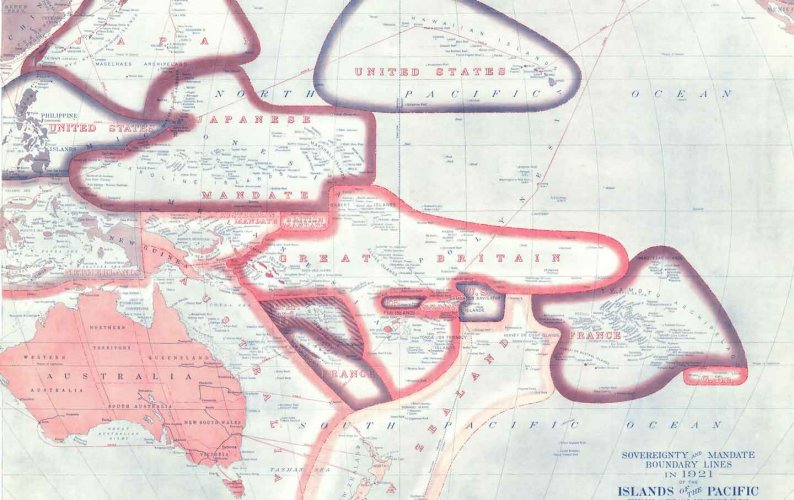
This is a map of the various Pacific Mandates inter war. Note the large Japanese occupied gap between the Hawaiian area and Guam in the Marianas as the most easterly part of the next US territory. Guam was the only one of the major islands in the Marianas that was US controlled. The remainder were under Japanese control. And the Japanese also have the Palau Islands to the South West between Guam & the Philippines. Guam was little more than a waypoint on the route west in 1941. It was the Japanese who began to develop it in WW2 with a massive expansion of air & naval facilities by the US after it was reoccupied in July / Aug 1944.

1765721917927.jpeg

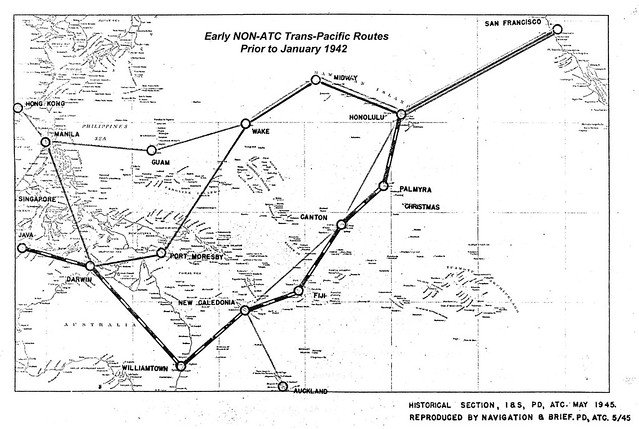
This is a map of the various air routes developed across the Pacific inter war.

1765722099216.jpeg

Pan American developed a trans Pacific flying boat route to the Philippines & beyond inter war flying west coast of USA - Hawaii Midway - Wake - Guam - Manila. The first airfields on Guam were built by the Japanese after they captured Guam in Dec 1941. So the earliest route to fly B-17s to the Philippines took them along the same route until they reached Wake. They then had to be flown across Japanese controlled airspace to Port Moresby (a distance of 2,100 miles). The threat of interception was recognised and it was done at night and in radio silence to minimise that risk. Then onto Darwin and from there to Manila. But if Japan had taken the DEI that last leg is again over Japanese controlled airspace. How long before the Japanese cut these air reinforcement routes off?

To minimise the risk of flying the Wake - Port Moresby leg, the South Pacific air route was developed in 1940-42. This had its origins in the pre-war Pan Am South Pacific flying boat route to Australia & New Zealand.

Palmyra Is - airfield built from end of 1939
Canton Island - airfield constructed Nov / Dec 1941
Fiji - Nadi airfield completed by British authorities in March 1940. Lengthened in Nov 1941 and further expanded in early 1942.
New Caledonia - Tontouta airfield built early 1942.


"The new route, at best, was painfully long—more than 7,800milesfrom California to Australia. Its longest jump, that from HamiltonField near San Rafael, California, to Hickam Field, west of Honolulu,was 2,398 statute miles. Hickam was the principal AAF base in theHawaiian archipelago and, like Pearl Harbor, had suffered severely atthe hands of the Japanese on 7 December 1941. It was a well-equippedpermanent installation, however, and the damage was quickly repaired.Some 1,346 miles to the south lay Christmas Island, a tiny coral atollonly a few feet above high tide. Next came Canton Island, a still morebarren islet, 1,055 miles west and south of Christmas and 1,920 milesout of Hickam Field by direct flight. Its runways, like those onChristmas Island, were rolled coral. Another 1,274-mile flight broughtthe Australia-bound aircraft to Nandi Airport, a Royal New Zealand AirForce Field on the northwest coast of Viti Levu Island in the Fijigroup. The next stop was at Tontouta Airport, near Noumea, capital ofthe French island of New Caledonia, approximately 850 miles out ofNandi, The last lap of the route, another 915 miles, took the aircraftfrom Tontouta into the mainland of Australia. Originally, Townsville inQueensland was the intended terminus, but William-town, approximately88 miles northeast of Sydney, and Charleville, some 430 miles inlandfrom Brisbane, actually served as transport and ferrying termini,respectively, until September 1942. Not until 1944 did the AirTransport Command establish a terminal to the north at Townsville,which at first had been too near to enemy air bases and too far fromArmy and AAF headquarters at Melbourne.1"


https://www.ibiblio.org/hyperwar/AAF/VII/AAF-VII-7.html

Logistics
Naval facilities in the Philippines to support a battleship / carrier fleet if it was able to get there?
Basically there were none. The largest dry dock available could only take cruiser sized vessels. Other docks could accomodate destroyer & submarine sized vessels. This was the principle reason that Britain prosposed in 1941 that the USN should base a battlefleet at Singapore which did have the facilities to service such vessels. That proposal was rejected in the US as it didn't want to be seen propping up a colonial power. Outwith Singapore (which I assume is lost in this scenario) the nearest dry docks capable of taking battleships or carriers are at Pearl Harbor, Hawaii or Durban, South Africa.

Oil to support the US Asiatic Fleet was drawn from refineries in the DEI, principally Balikpapan, using just a couple of old tankers that were 20 years old. Is that still going to be available? If not oil will have to be hauled across the Pacific from California (see above about the dangers of that) or from the British refinery at Abadan at the top of the Persian Gulf, and around the south side of Australia to keep it safe from possible predation from a Japanese occupied DEI.

Even on the route across the Pacific USN logistics are going to be stretched, if indeed they would be possible at all.

"In 1940 the Base Force Train included a total of 51 craft of all types, among them 1 floating drydock of destroyer capacity. By 1945 the total was 315 vessels, every one of them needed. The 14 oilers which were all the Navy owned in 1940 had leaped to 62, in addition to merchant tankers which brought huge cargoes of oil, aviation gasoline, and Diesel fuel to bases where the Navy tankers took them on board for distribution to the fleet. No less than 21 repair ships of various sizes had supplanted the 2 the Navy had 5 years before. The battleships had 3 floating drydocks, the cruisers 2, and the destroyers 9, while small craft had 16. Hospital ships had risen from 1 to 6, and in addition there were 3 transport evacuation vessels, while the ammunition ships numbered 14, plus 28 cargo carriers and 8 LST's (Landing Ship, Tanks). The number of combatant ships had increased materially, and it is natural to ask if the auxiliaries should not have increased comparably. The answer is, of course, yes. But the increase of combatant ships had been visualized, and the building programs were undertaken before the war began. It flourished with increased momentum during the early part of the war, long before the minimum auxiliary requirements could be correctly estimated and the rush of procurement started. The original planers had done their best, but it was not until the urgency for auxiliaries developed as a vital element of the war that we fully realized what was needed, and met the demand. Merchant ships were converted whenever possible, and this, with concentrated efforts to provide drydocks and other special construction, produced every required type in numbers that would have been considered preposterous only a short time before."

https://www.history.navy.mil/resear...betically/b/beans-bullets-black-oil.html#wwiihttps://www.history.navy.mil/resear...alphabetically/b/beans-bullets-black-oil.htmlhttps://www.ibiblio.org/hyperwar/USN/BBBO/index.html

In summer 1942 the the USN had insufficient oiler resources to support operations in the South Pacific as historical AND allow the use of the 7 battleships of Task Force 1 to augment them in that theatre. Instead TF1 was relegated to protecting the US West Coast and patrolling between between there and Hawaii where they could get oil. IIRC the Pacific Fleet only had 4 fast tankers to support carrier operations in the first few months of the war. Perhaps things might have been eased slightly if 4 of those in the Atlantic were not diverted to CVE conversion in Feb 1942, but that of course means no war with Germany becomes another pre-condition.

A study of the development of US War Plan Orange against Japan will highlight the issues that arose from exercises. A fast strike across the Pacific was effectively impossible. Even with there being peace with Japan the risks for the USN were enormous should that suddenly change. A much slower island hopping campaign became the only viable alternative. Also this from the Army perspective
https://www.ibiblio.org/hyperwar/USA/USA-P-PI/USA-P-PI-4.html#4-2
https://en.wikipedia.org/wiki/War_Plan_Orange
 
It's why I've stated elsewhere that Pearl Harbor was a strategically sound operation - with the problem of being a grand strategy own goal of colossal proportions and a good example of why you don't let the military dictate national geopolitical policy.
At this point the distinction between the military factions and the Japanese government has all but disappeared. It was either Strike North or Strike South, the only people saying "Maybe we shouldn't" weren't in power anymore.

As for why I think they were right, reviewing Gallup polls of November 1941, the American public was very much in a "we're not going to start a war, but by God we're gonna finish it!" mood. After all the shit Germany got away with, I genuinely don't think Japan's big invasion south is going to be enough to prompt Congress to declare war, not without a lot of cajoling and probably downright coercion by the Roosevelt administration.
I think America was on a slow drift towards hostilities whatever happened, because Roosevelt had it doing everything short of hostilities, in both Atlantic and Pacific which only leaves you a single slip from crossing the line. Germany could legitimately have considered US escorts for British convoys as an act of war, while in the Pacific it was clear economic warfare was being used as a diplomatic lever to try and force Japanese compliance - we can see that in the Hull Note with its promises to revert sanctions and give Japan most favoured nation status, but also the threat of the slip to war, because Hull apparently doesn't have the first clue of how unacceptable his demands are to Japan, articles 2 to 5 basically reverse every Japanese gain since the Treaty of Shimonoseki in 1895.

Of course, that comes with the very big caveat of Japanese forces not attacking something American anyway. I don't think they could get away with another Panay incident.
Germany had just gotten away with sinking the Reuben James and torpedoing the Kearney, it seems to me another Panay incident is entirely possible.
 
Japan was being economically strangled by the US, the only choices to its eyes were surrender, economic failure, or war.
No one was demanding Japan surrender. Yes, I just checked the Hull note; that is not a demand for surrender and more to the point, Japan had earned harsh terms like that after four years of fucking around in China.

I think America was on a slow drift towards hostilities whatever happened, because Roosevelt had it doing everything short of hostilities, in both Atlantic and Pacific which only leaves you a single slip from crossing the line. Germany could legitimately have considered US escorts for British convoys as an act of war, while in the Pacific it was clear economic warfare was being used as a diplomatic lever to try and force Japanese compliance - we can see that in the Hull Note with its promises to revert sanctions and give Japan most favoured nation status, but also the threat of the slip to war, because Hull apparently doesn't have the first clue of how unacceptable his demands are to Japan, articles 2 to 5 basically reverse every Japanese gain since the Treaty of Shimonoseki in 1895.
This is true. And if you go back to the polls I mentioned the public was strongly in support of such measures. Options such as "support Britain with all our might even if it leads to war" had something like 80% approval with the American public.

Nonetheless, it is also true that the American public was not interested in starting the war themselves, which is why the Roosevelt administration was using such measures instead of just getting a declaration of war.

And zooming out a bit... I've seen these talking points brought up before, and I just want to reiterate: Japan was not some innocent victim being bullied by the United States, they were a hostile power committing crimes against humanity on the regular. They fully earned the United States trying to force them into compliance.
 
This is a map of the various air routes developed across the Pacific inter war.

View attachment 795155


To minimise the risk of flying the Wake - Port Moresby leg, the South Pacific air route was developed in 1940-42. This had its origins in the pre-war Pan Am South Pacific flying boat route to Australia & New Zealand.

Palmyra Is - airfield built from end of 1939
Canton Island - airfield constructed Nov / Dec 1941
Fiji - Nadi airfield completed by British authorities in March 1940. Lengthened in Nov 1941 and further expanded in early 1942.
New Caledonia - Tontouta airfield built early 1942.
Work on Tontouta, Plaine des Gaiacs and Koumac on New Caledonia just predates the attack on Pearl Harbour, being started with Australian support after the pro-Free French populace (with Australian support) deposed the pro-Vichy Governor of New Caledonia in late September 1941. While Tontouta was the initial destination for the US air route, Plaine des Gaiacs ended up being the permanent base.

Initial planning for war with Japan under Plan Orange was based on the 'Through-ticket to Manila', in which the US fleet would sail direct to the Philippines, but as they gamed that out during the 20s, they realised they would need supply and repair anchorages en-route, which led to the development of the Fleet Train and the replacement of Plan Orange with Rainbow 5, with a presumption of an island hopping campaign (though it was still dependent on the US garrison in the Philippines crawling into a corps-sized bunker on Bataan and hoping it could hold out long enough.
 
Last edited:
No one was demanding Japan surrender. Yes, I just checked the Hull note; that is not a demand for surrender and more to the point, Japan had earned harsh terms like that after four years of fucking around in China.

From the Japanese point of view it absolutely is a demand for surrender. It requires them to give up their entire foreign policy objectives and gains of the entire last half century. Japan controls more than half of China at this point, is gradually strangling the rest of it, and they're expected to give that up.

I've seen these talking points brought up before, and I just want to reiterate: Japan was not some innocent victim being bullied by the United States, they were a hostile power committing crimes against humanity on the regular. They fully earned the United States trying to force them into compliance.
No one is saying that, but you have to put yourself in Tojo's position to assess the acceptability of the demands to Japan, and Hull failed to do that (well, either that, or the intention was to provoke war). Not only were the demands completely unacceptable to Tojo's faction, but accepting them would likely be signing his own death warrant given the pattern of assassinations by ultra-nationalist junior Army officers.
 
No one was demanding Japan surrender. Yes, I just checked the Hull note; that is not a demand for surrender and more to the point, Japan had earned harsh terms like that after four years of fucking around in China.
The US provided 95% of Japan's petroleum supply before the embargo.

What the hell do you think is going to happen if you stopped 95% of the petroleum flowing to a country?


It was worse to invade the Philippines, though.
Arguable. Pass a beer, we'll debate it.
 
The US provided 95% of Japan's petroleum supply before the embargo.

What the hell do you think is going to happen if you stopped 95% of the petroleum flowing to a country?

Didn't they historically stopped that by 7th Dec 1941 anyway?
 
After the abolition of feudalism in 1871, Japan hastened to create an industrial monster that quickly exceeded the very few natural resources of the country. The inertia generated by the machines led the Japanese to a militaristic spiral that only a major defeat, could stem.

They annexed Taiwan in 1895, defeated Russia in 1905 and invaded Korea in 1910 to seize large amounts of coal. To save Japan from the effects of the Great Depression, the Imperial Japanese Army occupied Manchuria in 1931, giving the Japanese industry access to its numerous natural resources of iron, aluminium, coking coal, soybeans and salt. In 1933 Japan occupied the Chinese province of Jehol and in 1937 they initiated a large-scale warfare that alarmed the international community. After the short war with the Soviets in Nomonhan, Japan lost its access to oil concessions in Northern Sakhalin.

When France capitulated in June 1940, Japan moved into French Indochine and the U.S. Administration reacted by banning the export of essential defence materials: aviation motors, high-octane aviation fuel, lubricants, melting iron and steel scrap. The embargo was expanded in July 1941 to such grades of oil. The British and the Dutch followed suit, and embargoed export to Japan of copper, tin, bauxite, rubber and petroleum from their colonies in Southern Asia. The Allies were putting Japan in an untenable position that would force oil-starvation Japan to seize the oil fields of the Dutch East Indies.

For this purpose, the Imperial Japanese Army (IJA) should neutralize the powerful Singapore British defences, and the Imperial Japanese Navy (IJN) should make landings in the Philippines, defended by the Americans. The war would be inevitable and the Allies knew it, but they did not expect the attack to be successful and were surprised when 17 Mitsubishi G4M bombers only, from the IJN Genzan Kokutai, managed to sink two of the most modern British battlecruisers in a few minutes.

Little afterwards, eighty-seven Nakajima Ki.27b and fifty-nine Nakajima Ki.43-Ia, from the IJA, destroyed the hundred-and-fourteen Brewster Buffalo and fifty-one Hawker Hurricane that defended Malaya, pushing back the British to Sumatra and Burma initially and then up to Ceylon and Australia. The Mitsubishi A6M2 Zero-Sen wrought havoc in Pearl Harbour, Philippines, Java and Ceylon by annihilating most of the fighters P-35, P-36, P-40, Hurricane Mk. II, Curtiss CW.21B and Fairey Fulmar that opposed them.

The exceptional dog fighting capabilities of the Japanese fighters and the ferocity and experience of their pilots had been virtually ignored by the Allied intelligence officers ... how could this happen?

In my opinion this war was deliberately provoked by the American government to overcome the resistance of public opinion to become actively involved against the Reich.

They were only hoping for some struggle in the Philippines against an antiquated war machine, perhaps that would be a good pretext to "provisionally" occupy the enormous British and Dutch riches as collateral for repayment of war loans.

The Japanese had no choice, but they knew from the first shot that it would be a fight to the death with little chance in the long run if Germany lost the war.
 
In my opinion this war was deliberately provoked by the American government to overcome the resistance of public opinion to become actively involved against the Reich.
How was provoking a war against Japan supposed to overcome the resistance of public opinion to to directly fighting Germany?

The exceptional dog fighting capabilities of the Japanese fighters and the ferocity and experience of their pilots had been virtually ignored by the Allied intelligence officers ... how could this happen?
Distraction by Germany, racism, and just the fact this shit is hard. No conspiracy required.

In 1933 Japan occupied the Chinese province of Jehol and in 1937 they initiated a large-scale warfare that alarmed the international community.
I think you need to ask yourself why this alarmed the international community, in light of the later parts of your posts.

The Japanese had no choice, but they knew from the first shot that it would be a fight to the death with little chance in the long run if Germany lost the war.
The Japanese had every choice, but their government was run by the screaming lunatics in the military. The start of the Pacific War is on no one's heads but their own.

Genuinely, I despise this conspiracy theory and the fact that it's gotten traction. Cease, please.

The US provided 95% of Japan's petroleum supply before the embargo.

What the hell do you think is going to happen if you stopped 95% of the petroleum flowing to a country?
Presumably, they would actually rethink what they were doing. Obviously, in 2025 we know that was never going to happen, but the US government of the time did not have the level of insight into Japanese politics we enjoy.

Make no mistake, the US' actions were obviously coercive, but, well, I've made no secret of the fact that my stance was that Japan had earned coercive measures to stop them by prior actions.
Didn't they historically stopped that by 7th Dec 1941 anyway?
This is a bad argument, since the Japanese needed the intervening months between the embargo and Pearl Harbor to plan the op.
 
How was provoking a war against Japan supposed to overcome the resistance of public opinion to to directly fighting Germany?


Distraction by Germany, racism, and just the fact this shit is hard. No conspiracy required.


I think you need to ask yourself why this alarmed the international community, in light of the later parts of your posts.


The Japanese had every choice, but their government was run by the screaming lunatics in the military. The start of the Pacific War is on no one's heads but their own.

Genuinely, I despise this conspiracy theory and the fact that it's gotten traction. Cease, please.


Presumably, they would actually rethink what they were doing. Obviously, in 2025 we know that was never going to happen, but the US government of the time did not have the level of insight into Japanese politics we enjoy.

Make no mistake, the US' actions were obviously coercive, but, well, I've made no secret of the fact that my stance was that Japan had earned coercive measures to stop them by prior actions.

This is a bad argument, since the Japanese needed the intervening months between the embargo and Pearl Harbor to plan the op.
-The American people associated the intervention of American troops in World War I with the flu epidemic of 1919 and the Great Depression of 1929; they did not want more wars.

-Racism?.. Perhaps, but for the military, the archaic appearance of Japanese fighters with fixed landing gear and only two 0.3-in machine guns as an indicator of Japanese technological level was more important.

The Nakajima Ki.27 had been operating in China since March 1938, and several units were captured and tested by Chinese and Soviets. Its performances were known in the West, but the archaic aspect of its airframe, with fixed undercarriage (inspired by that of the Northtrop XFT of 1934), made the Allies think that it was a design technologically surpassed.

Under the protection of the six-hundred Ki.27 fighters, the IJA conquered 90 per cent of the territories occupied during the World War Two. The Ki.27 was not examined by experts of the Allies until the capture of one from the 77th Sentai in Burma, in April 1942.

The Zero was also unknown to the Allies. In the spring of 1941, the Chinese succeeded in shooting down an A6M2 over Chengdu. They managed to assemble very accurate data sheet and three-view drawings were given to the U.S. Navy Department and the U.S. War Department, but the experts did not consider the data credible and the report was ignored.

The Zero was designed to meet specification IJN 19 May 1937 that required a fighter capable of flying at more than 500 kph and with an exceptional range, to escort the bombers on the specific conditions of the war in China. Its construction was only made possible by adopting a retractable landing gear (based on that of the prototype Chance Vought V.143 acquired by the Japanese in 1937) and removing the armour and all the auxiliary equipment typical of a naval fighter, until the airplane weighted 25 per cent less than the Grumman F4F, even keeping its powerful armament. Nobody in the Western countries believed that a fighter with these characteristics could exist until the attacks to Pearl Harbour, Philippines and Java.

In July 1942, American experts could examine a Zero captured in Akutan Island and identified the weak points of its construction, an information that saved the lives of U.S. airmen and that was used to design the Grumman Hellcat. On the other hand, the Nakajima Ki.43 was completely unknown outside of Japan. The success of the Ki.27 had delayed the start of production until April 1941 with only 40 units having entered service in December. That was a complete surprise to the Allies, who at first mistook it for the Zero. The Japanese Army decided to reveal its existence in April 1942.

Equipped with butterfly combat flaps and weighting 33 per cent less than the P-40B, the Ki.43 was able to out-manoeuvre the Buffaloes, Hurricanes and Tomahawks. The first unit was captured at Chittagong, in the spring of 1942. Tested by the Australians, the Chinese and the Americans, it revealed some shortcomings in combat: lack of pilot armour and self-sealing fuel tanks.

-The international community is alarmed when the press is alarmed, and the press is alarmed when some important economic group begins to lose power. The international community was not alarmed when Kennedy lost Cuba, nor when Carter lost Iran, nor when England and France lost the Canal... that was simply the right thing to do for public opinion.

-The Japanese had no choice, they were ruled by a military dictatorship far worse than Germany's, and the military (riding the tiger) could not afford dishonor or defeat. Speaking of memory, I think that at the end of 1941 the Rengo Kentai only had fuel for six months of training or two months of combat, they had no choice.

 
-The international community is alarmed when the press is alarmed, and the press is alarmed when some important economic group begins to lose power. The international community was not alarmed when Kennedy lost Cuba, nor when Carter lost Iran, nor when England and France lost the Canal... that was simply the right thing to do for public opinion.
Or, y'know, stuff like this:

https://www.readex.com/sites/defaul...ages/LuSeattleDailyTimes12-17-1937DISPLAY.pdf
Yes, economic interests were at play, but don't underestimate the humanitarian concerns at play. The full scale of Japanese atrocities in China were not known, but articles like the above would have painted a very grim picture. And the decisionmakers in power had seen the aggressive behavior coming, after years of Japanese attempts - contrary to popular belief, the collapse of the Anglo-Japanese naval alliance had more to do with British alarm at things like the 21 Demands than anything to do with the US.

Let me be perfectly blunt here: Japan's actions since 1937 were flatly unacceptable and US diplomatic measures to get them to cease these actions by hook or crook were completely justified.

-The Japanese had no choice, they were ruled by a military dictatorship far worse than Germany's, and the military (riding the tiger) could not afford dishonor or defeat. Speaking of memory, I think that at the end of 1941 the Rengo Kentai only had fuel for six months of training or two months of combat, they had no choice.
That's not them having no choice, that's them having waltzed themselves into a corner of their own making. In general, I find your framing overly disregarding of Japanese agency in this whole mess.

-The American people associated the intervention of American troops in World War I with the flu epidemic of 1919 and the Great Depression of 1929; they did not want more wars.
That doesn't answer how a war with Japan was supposed to make it easier to declare war on Germany.
 
British intelligence had reasonably accurate details, including ranges and armament loads, of all the major Japanese aircraft by about mid-1941. That included the Zero fighter. Those were circulated and were either ignored or did not filter down to the pilots in Malaya. The Air Ministry recirculated that information just a few days after Japan invaded Malaya.

See Boyd "The Royal Navy in Eastern Waters. Linchpin of Victory 1935-1942"

One of several myths that were refuted in that book.
 
See Boyd "The Royal Navy in Eastern Waters. Linchpin of Victory 1935-1942"

One of several myths that were refuted in that book.
It really is a must read for both the myth-busting and the strategic analysis.
 
Zero was already flying 2,250 km missions eighteen months before the attack on Pearl Harbor.

Early in 1941, P-40 fighters from the American Volunteer Group entered combat over China against Zeros of 12th Kokutai.

Warnings had repeatedly been sent to Washington since the appearance of the new Japanese fighter in China. General Chennault and French observers in occupied Indochina sent back sketches and data.

In early 1942, Eugene E. Wilson was invited to examine the wreckage of a Zero from the Akagi carrier, marked AI-154, shot down during the attack on Pearl Harbor, Wilson identified the engine mounting and the undercarriage as the technology used in the construction of the Vought V-143 and Vought Chief Engineer Fred Dickerman was of the same opinion.

In the spring of 1941, the Chinese managed to shoot down an A6M2 Model 21 over Chengdu, very accurate data sheet and three-view drawings were delivered to the U.S. Navy Department and the U.S. War Department, but experts did not consider the data to be credible, and the report was ignored. Nobody in the Western countries believed that a fighter with these characteristics could exist until the attacks to Pearl Harbour, Philippines and Java.

On November 26, 1941, two A6M2 fighters from 22nd Kokutai, marked V-172 and V-174, landed by mistake on the Liuchow Peninsula and were captured by local Chinese militia.

The V-174 was partially destroyed during landing, but the V-172 (c/n 3372) was captured intact and was repainted with the olive drab/pale grey camouflage scheme and markings of the C.A.F. and marked P-5016.

During the summer of 1942 it was revealed to the USAAF, tested by AVG pilots and turned over for a complete overhaul to the technicians of the 23rd U.S. Fighter Group. The Japanese fighter was then sent to the United States for further evaluation but was damaged during the voyage and did not arrive at Eglin Field until September 1943.

On June 4, 1942, a Zero from the aircraft carrier Ryujo strafing shipwrecks near Dutch Harbor, was hit by ground fire and crash-landed in a swamp off Akutan Island.

Six days after the accident, the Japanese fighter wreckage was located by a PBY flying boat of VP-41 Sqn, yanked out of the swamp and taken to North Island Naval Air Station, San Diego, there the Zero was repaired and flight-tested between September 20 and October 15, 1942.

During testing, American pilots discovered that the Zero had superior maneuverability only at the lower speed used in dogfighting, with short turning radius and excellent aileron control at very low speeds. It rolled to the left much easier than to the right, however the ailerons froze up at speeds above 200 knots, and the engine cut out under negative acceleration due to its float-type carburetor.

The captured aircraft was tested in mock dog fights with American fighters P-38, P-39, P-40, P-51, F4U and F4F and the best combat tactics against the Zero were developed for each type.

As a result of these investigations on October 19, 1942, the U.S. Navy Bureau of Aeronautics sent to War Department a memorandum giving Zero performance data.

On November 4, the U.S. Navy released the Technical Aviation Intelligence Brief No. 3 “Performance and Characteristics Trials. Japanese Fighter”.

In December 1942, the U.S. Army published the Intelligence Summary No. 85.

In February 1944 he was captured at Kwajalein a Japanese manual of the Zero’s flight characteristics, dated October 1943.

Several sources claimed that the Zero was copied from the Northrop FT-1, the Vultee Vanguard, the Gloster F.5/34 or the Chance-Vought V-143.

These data were published by the U.S. Popular Press in alarming terms that forced the government to create the Pearl Harbor Committee to find out if the Zero was a copy of the V-143 prototype sold to Japan by Douglas and Vought.

In 1946 journalist Drew Pearson published documents from the Japanese Export-Import Company dated 1938 that revealed Commander Wada's performance and his interest in mounting cannons on the wings of the V-143.
 
Back
Top Bottom