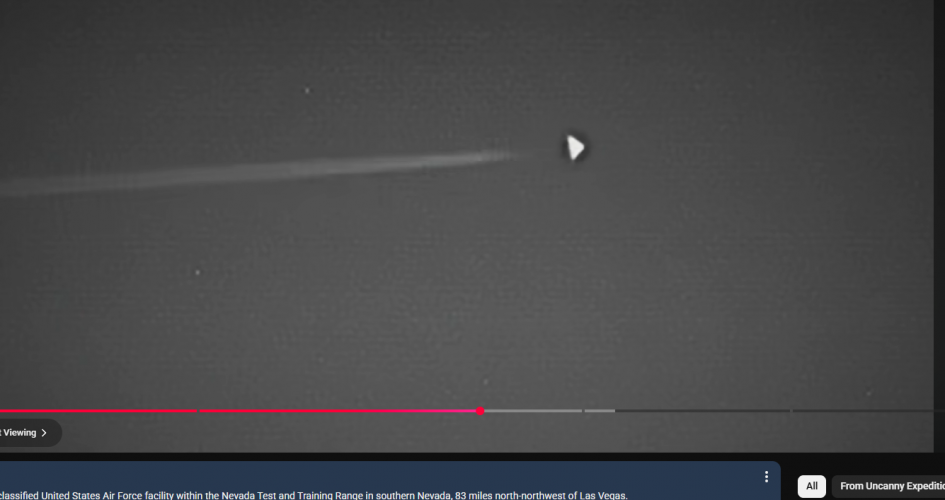
January 2026 'Dorito' sighting over Area 51

Maybe there's a correlation between major operations in the Middle East and these kind of sightings coming out of the desert.
 
I’m skeptical of the story and especially of the Daily Mail, but it is perhaps interesting to note that if it flew from one of the bases of SE Australia that the USAF uses from time to time, the location it was filmed at was right on it’s great circle route to… Diego Garcia.

Still, the altitude doesn’t make sense as the nearest air force base is hundreds of km’s away.
 
According to Joerg from DLR a B2 was active in the NTTR when the mysterious picture was taken. As much as I want it to be a new platform, I’ll stick with Occam’s Razor and I will assume it’s a B2.
 
I was going to say, those Flying Doritos have a major stealth flaw: the straight back edge would reflect straight back at the emitter from head on.
 
Yes, “pics or it didn’t happen”, we get that.

If photos of the X-planes were posted here half the forum would fall into a deep depression upon seeing that the aircraft were not C-17-sized “battlestars”. And then the photos would be posted by commercial sites without attributing the original source.

So…. Keep waiting.
Private group of trustees?
 
So what role will the new mystery aircraft take? UCAV or something like what the A-12 was suposed to have been before it was cancled. I find it strange that they are bringing back an aircraft like the A-12 again, but I think that they might have learned from the problems that the A-12 had back in the 1990s.
 
So what role will the new mystery aircraft take? UCAV or something like what the A-12 was suposed to have been before it was cancled. I find it strange that they are bringing back an aircraft like the A-12 again, but I think that they might have learned from the problems that the A-12 had back in the 1990s.
Penetrating ISR is still a missing capability, and the US has been wanting that since, well, the 1940s.

But I still think that any penetrating ISR needs to be slower than A-12/Blackbird. At those speeds, the skin temperatures are enough to show at screaming long ranges.
 
I'm not convinced that enough of those [RQ-180] are in service.

Given the number of SR71s the US had, for example.

That feels like an "apples & oranges" comparison. The Blackbird had a high-speed dash mission (and was not a VLO configuration) whereas the RQ-180 was designed for stealthy loiter capability and real-time data transmission.

How many Blackbirds were mission-ready at any given time and how much did it cost to fly each sortie?

For what it's worth, there may have been as many as 25 RQ-180 airframes built. One of the nine preproduction models was reportedly lost in a crash in 2016 and I wouldn't be surprised if at least some of the dedicated test aircraft had been retired.
 
The Blackbird had a high-speed dash mission (and was not a VLO configuration)
The A-12/Sr-71 were absolutely designed for reduced RCS, though just how far they could push it was pretty limited at the time.
 
The A-12/Sr-71 were absolutely designed for reduced RCS, though just how far they could push it was pretty limited at the time.

Yes, the Blackbirds were designed for reduced RCS. No one knows that better than I. They were not, however, in any way considered VLO (very low observable, i.e. "stealth") platforms as we have today.
 
The radio comms sound like a pretty textbook flight test profile, minus the novel codewords. If this thing has really been flying for a while, I wonder if it's tactics, equipment or envelope test
 
The radio comms sound like a pretty textbook flight test profile, minus the novel codewords. If this thing has really been flying for a while, I wonder if it's tactics, equipment or envelope test
'fridge' and 'hydrate' and the US tendency to not be nearly random enough in codeword selection make me wonder if it's an icing test and the aircraft we're hearing is the spray tanker.
 
'fridge' and 'hydrate' and the US tendency to not be nearly random enough in codeword selection make me wonder if it's an icing test and the aircraft we're hearing is the spray tanker.
Definitely could be, I discounted trying to apply known uses due to their use of beer brands in a way that wasn't tanker or SEAD callsigns. It does fit the expected profile for an icing test.
 
That feels like an "apples & oranges" comparison. The Blackbird had a high-speed dash mission (and was not a VLO configuration) whereas the RQ-180 was designed for stealthy loiter capability and real-time data transmission.
Disagree. Blackbird gave a "target is not aware they're being watched in time to get items of interest under cover" capability comparable to what a VLO/ELO ISR drone could do.

If they were still in service (I believe it'd be possible, as each flight re-heat-treated the entire airframe), blasting along [insert country name] ADIZ edge or national airspace edge to get information snapshots is still a useful capability. And they'd have the real-time datalink, simply because that wasn't an available technology when the Blackbirds were built.


How many Blackbirds were mission-ready at any given time and how much did it cost to fly each sortie?
I'd guesstimate 1/3 of them. Cost per sortie is basically a non-issue, as the Blackbird's competitor for intel was satellites, at 2025-dollar costs of billions each including launching costs (based on Hubble, probably 125mil just for the satellite). Also, given that spy satellites are on sun-following orbits, passing over the same place on earth at the same time every day, they're not exactly persistent.


For what it's worth, there may have been as many as 25 RQ-180 airframes built. One of the nine preproduction models was reportedly lost in a crash in 2016 and I wouldn't be surprised if at least some of the dedicated test aircraft had been retired.
And the USAF had 32x Blackbirds. Assuming that the preproduction airframes were refitted to full capability the same way that the B-2s were, that would bring us down to a maximum of ~24, likely under 20 if the early test airframes were retired, best case scenario.

It'd take an RQ-180 mission-ready rate of ~50% to equal the number of Blackbirds the USAF had available for missions, under that best case scenario. MRR of 70% or more in the worst case scenario of no preproduction airframes refitted.


==========================

'fridge' and 'hydrate' and the US tendency to not be nearly random enough in codeword selection make me wonder if it's an icing test and the aircraft we're hearing is the spray tanker.
Is it possible or probable that the B-21 is doing icing testing? just as a stupid question.

 
Disagree. Blackbird gave a "target is not aware they're being watched in time to get items of interest under cover" capability comparable to what a VLO/ELO ISR drone could do.

With VLO a platform like the RQ-180 can loiter, continuously, over a target that is unaware of being watched. Even the arguably less capable RQ-170 Sentinel has been employed in that type of scenario (as during the Abbottabad raid in 2011 and the recent action in Venezuela).
 
With VLO a platform like the RQ-180 can loiter, continuously, over a target that is unaware of being watched. Even the arguably less capable RQ-170 Sentinel has been employed in that type of scenario (as during the Abbottabad raid in 2011 and the recent action in Venezuela).
Yes, loitering is an advantage over raw speed for ISR in a lot of cases.

Sheer speed for making interception a pain in the butt still has its uses.
 
I wonder why they chose that silhouette. Someone brought up the RCS spike the back end of the a-12. So I would imagine there is some other function for the shape other than VLO. My first thought was a glide wedge. Obviously its not traveling in a hypersonic glide, but idk food for thought.
 
I wonder why they chose that silhouette. Someone brought up the RCS spike the back end of the a-12. So I would imagine there is some other function for the shape other than VLO. My first thought was a glide wedge. Obviously its not traveling in a hypersonic glide, but idk food for thought.
Maybe if there's a "Dorito" out there then it doesn't aim for the level of LO using traditional measures B-2s had.
 
I'm still wondering if this has anything to do with the black market program where Lockheed was losing money, or if it's another contractor that nobody knew about before.
 
What about a stealthy Electronic Warfare aircraft supporting USAF high threat missions? The B-2, an aircraft designed in the 1980s, with 56% readiness issues across 19 airframes at $2.1 billion a copy, I could imagine the Air Force investing in a very limited production of a dedicated EW platform to protect the B-2. Possibly a failed prototype or a technology demonstrator pressed into occasional service against intense and overlapping IAD networks, space-based sensors, and far ranging IR sensors, to protect the B-2 that might not launch completely 'stealth qualified,' due to forward deployed maintenance concerns and or quick turn needs. I have no evidence, but it sounds nice.
 
Last edited:

Similar threads

Back
Top Bottom