Is there any point to reserve/mothball fleet?

There may be some of the Ticos left, there were supposed to be 15 in reserve, but no idea if that's still true.
Apparently no Mk-II Tico's were scrapped yet.

1777238386045.png

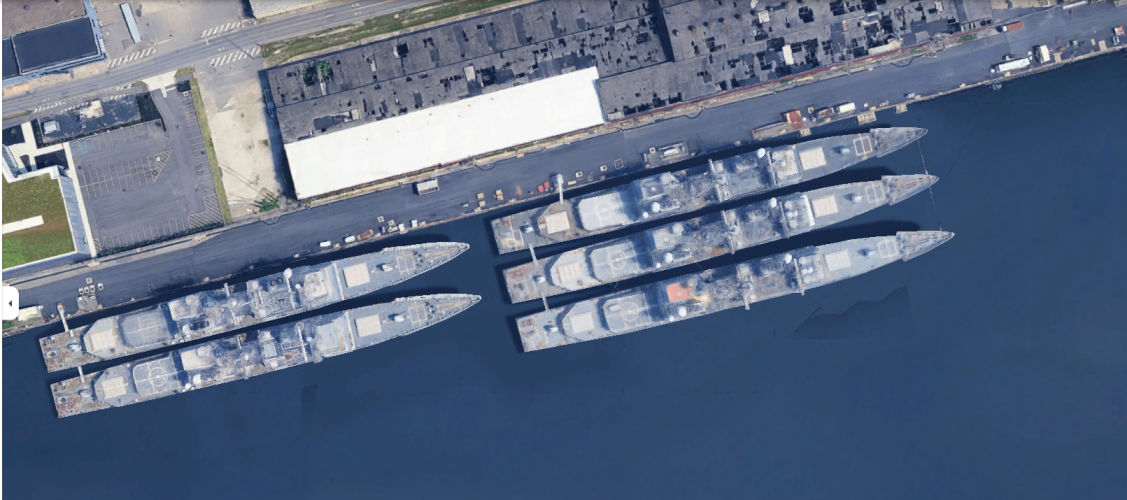
Five cruisers are moored at Philadelphia Naval Shipyard, according to Google Earth. Doesn't seems to be dismantled. Assuming crews could be found, they probably could be re-activated reasonably fast.
 
Assuming crews could be found, they probably could be re-activated reasonably fast.
Given the condition in which many Ticos left service, simply due to their age and fatigue on the vessels structure, it may take a bit more to get them into reasonable condition again. But if you just want VLS, that's maybe not what you'd have to do.
 
Apparently no Mk-II Tico's were scrapped yet.

View attachment 810335

Five cruisers are moored at Philadelphia Naval Shipyard, according to Google Earth. Doesn't seems to be dismantled. Assuming crews could be found, they probably could be re-activated reasonably fast.
I guess what do you mean by ‘reasonably fast’?
How many shipyards do we have that could do the work they need? How many of those shipyards already have contracts to build or repair other ships in coming into service or already in service?

Even if we had 3 slots and work force available to put these ships into a shipyard, it would probably take a year to get them back into service.
 
Be interesting to know how long it took to de-mothball everything in WWII.

There basically wasn't a mothball fleet before WW2. There were a bunch of laid up 4-stack DDs in the 1920s, and they did manage to reactivate like 60 of them over a period of about 6 months in 1929-30. But that was done because they had to retire a similar number of sister ships with bad boilers, so they basically cross-decked the crews and had them do the reactivation work, presumably swapping any necessary replacement parts from their old ships.
 
I guess what do you mean by ‘reasonably fast’?
I meant that their main systems could likely be re-activated without the need to completely diassemble and reassemble them, and their their electronics is still up to date enough to not require immediate refit to be useful. They probably would be glitchy and prone to malfunction; but could be restored to somewhat combat condition in several months, not years.
 
I meant that their main systems could likely be re-activated without the need to completely diassemble and reassemble them, and their their electronics is still up to date enough to not require immediate refit to be useful. They probably would be glitchy and prone to malfunction; but could be restored to somewhat combat condition in several months, not years.
Their propulsion systems would likely need to be completely rebuilt. Sitting around for years they’re likely seized up.
I have no idea how long it would take to refurbish their engines, you’d have to go through all of their electronics and wiring to ensure there’s nothing corroded, again no clue how long that will take, but I seriously doubt we could have one ready for service in under a year, and years for multiple to be brought back.

But that would be perfect timing for plugging holes in the fleet after a war win or lose.
 
There basically wasn't a mothball fleet before WW2. There were a bunch of laid up 4-stack DDs in the 1920s, and they did manage to reactivate like 60 of them over a period of about 6 months in 1929-30. But that was done because they had to retire a similar number of sister ships with bad boilers, so they basically cross-decked the crews and had them do the reactivation work, presumably swapping any necessary replacement parts from their old ships.
I was under the impression the Ships for Bases deal used newly reactivated four stackers - looking at the wiki entry for Craven/Lewes as an example, it says:

"Still in reduced commission, Craven arrived at Charleston, South Carolina, 10 February 1921. She transported liberty parties between Charleston and Jacksonville, Florida, and took part in the fleet maneuvers off Virginia and in Narragansett Bay. Arriving at Philadelphia 29 March 1922, Craven was placed out of commission 15 June 1922.

On 12 November 1939, Craven was renamed USS Conway — for William Conway (1802–1865), the first U.S. Navy ship of the name — to free the name Craven for the new destroyer USS Craven (DD-382),[9] Recommissioned on 9 August 1940, Conway arrived at Halifax, Nova Scotia, Canada, on 17 October 1940, where she was decommissioned on 23 October 1940.

Turned over to British authorities as part of the Destroyers for Bases Agreement, the destroyer commissioned in the Royal Navy as HMS Lewes (after Lewes in East Sussex, England), with the pennant number G 68, on 23 October 1940, the day of her transfer"
 
The logistical ships wound useful; the combatants would likely take so long to be restored to any fighting condition and be so marginal as to be worthless in a modern conflict.
 
the combatants would likely take so long to be restored to any fighting condition and be so marginal as to be worthless in a modern conflict.
Against a Day 1 fleet, possibly (though I don't think any US fleet commander would turn down an extra Tico and its magazine depth). But against the other guy's surviving fleet at Day 180, or Day 365? A four stacker was far, far behind the mid-WWII state of the art, but you didn't see the RN or USN turning them down when they finally came out of reserve. Or look at Ukraine, for that matter - four years on and there's Russia digging T-55s out of the scrapyards and sending them up to the front.
 
Against a Day 1 fleet, possibly (though I don't think any US fleet commander would turn down an extra Tico and its magazine depth). But against the other guy's surviving fleet at Day 180, or Day 365? A four stacker was far, far behind the mid-WWII state of the art, but you didn't see the RN or USN turning them down when they finally came out of reserve. Or look at Ukraine, for that matter - four years on and there's Russia digging T-55s out of the scrapyards and sending them up to the front.
Which is why I think we need to build new low end ‘reserve’ vehicles for all branches tbh.
 
I'm not usre about combat vessels (posts above raised valid questions about crews and level of obsoleteness and wear), but logistic/support vessels? Definitely. They don't require big of a crew, they don't become obsolete (you can ferry cargo even using 70 yeas vessel, provided it's in good shape), usually use civilian/COTS parts so mothballing them actually makes sense.
 
I hope they kept some of the Pegasus hulls. High speed transit hugging coastlines can be extremely useful.
 
1993 is the decommission dates. 1 was preserved. But I found no articles on the other 5.

According to George Jenkins, the others were sold for scrap - foil-less and stripped of propulsion. If you really want to know the fate of those hulls, you could probably trace the firm in Charleston, SC, from disposal records.

Patrol Combatant Missile (Hydrofoil) PHM History 1973 - 1993
By George Jenkins
Presented 14 June 1995

[Pages 14-15]

Whatever the actual motivation for the early retirement proposal, it was approved by the CNO (as acting SECNAV), as observed above. In terms of ultimate disposition of the ships, some staff thought was given to retaining the PHMs as future mobilization assets (i.e., “moth balled”), but this approach was rejected, initially. The rationale was that the infrastructure that supports PHM-unique logistics and maintenance would quickly dissipate when the ships are inactivated. In the absence of a continuing American hydrofoil industrial capability, it would be nearly impossible to recreate this infrastructure in the future. Accordingly, PMS 330 and the OPNAV platform sponsor recommended to N86 that the ships be offered for foreign military sale (FMS). If this offer were to be accepted, the hydrofoil infrastructure would be preserved, and the ships would be used, presumably in support of common goals of the USA and its allies.

The Foreign Military Sale option was approved by N86 on 10 February 1993 [...]

[Pages 16-17]

In fact the PHMs, having been stripped of all salvageable systems including electronics, turbines, diesel engines and the like, were sold as scrap to a commercial enterprise in Charleston, SC. One ship with foil systems intact was bought by B. J. Meinhof and Elliot James and transported to Missouri. Their ongoing efforts to restore it and to return it to use commercially are frequently discussed on the International Hydrofoil Society website. At this writing, the other hulls (less foil systems and in generally poor states of preservation) are still in place in Charleston and offered for sale. [...]

 
There basically wasn't a mothball fleet before WW2. There were a bunch of laid up 4-stack DDs in the 1920s, and they did manage to reactivate like 60 of them over a period of about 6 months in 1929-30. But that was done because they had to retire a similar number of sister ships with bad boilers, so they basically cross-decked the crews and had them do the reactivation work, presumably swapping any necessary replacement parts from their old ships.
The surviving pre-WW1 armoured cruisers were kept in reserve until 1930 or so (except for a couple that remained active). Also, I think a few auxiliaries sent periods laid up between the wars
 
The surviving pre-WW1 armoured cruisers were kept in reserve until 1930 or so

I wonder if they'd been maintained until 1939 or 1940 if they would've seen service in WWII?
 
I wonder if they'd been maintained until 1939 or 1940 if they would've seen service in WWII?
Probably. Might not have been fast enough to chase modern cruisers, but were armed and armored enough to be a threat to just about any modern cruiser of the period.
 
but were armed and armored enough to be a threat to just about any modern cruiser of the period.

They probably could've been used for convoy escort duty too or patrolling the UK's home waters to free up more modern warships to operate in the Mediterranean.
 
They probably could've been used for convoy escort duty too or patrolling the UK's home waters to free up more modern warships to operate in the Mediterranean.
Yep. Maybe some minor modifications to fit depth charge racks, or k-guns etc.
 
Yep. Maybe some minor modifications to fit depth charge racks, or k-guns etc.
Per Friedman, there were concrete plans in the late 20's to re-engine them with the same power plant as USS Ranger CV4. They were also to get a new, longer bow. The 6" guns were to be reduced in number and relocated to the upper deck, with replacement of the twin 10" guns by triple 8" turrets was also considered. I don't know if the ships with 4 x 8" main guns were to retain theirs as-is. The bridge and foremast were to be replaced with a new structure and tripod mast similar to the Pensacolas. The fore funnel would also be removed
 
Per Friedman, there were concrete plans in the late 20's to re-engine them with the same power plant as USS Ranger CV4. They were also to get a new, longer bow. The 6" guns were to be reduced in number and relocated to the upper deck, with replacement of the twin 10" guns by triple 8" turrets was also considered. I don't know if the ships with 4 x 8" main guns were to retain theirs as-is. The bridge and foremast were to be replaced with a new structure and tripod mast similar to the Pensacolas. The fore funnel would also be removed

A pity that modification programme hadn't gone through because IMO they would've served in WWII.

PS: What was the name of this USN pre-dreadnought class?
 
A pity that modification programme hadn't gone through because IMO they would've served in WWII.

PS: What was the name of this USN pre-dreadnought class?
They were the Pennsylvania- and Tennessee-classes of armoured cruisers. They were initially named after states, reflecting their 'almost battleship' status in the USN. They were later renamed to the state capital of those states (I think...). Their original names were then re-used by new dreadnought battleships
 
I wonder if they'd been maintained until 1939 or 1940 if they would've seen service in WWII?
Very unlikely. They were obsolete, slow, and without a major refit - not able to fight even enemy light cruisers, due to lack of gun range and deck protection. They were also manpower-heavy. Most likely they would be disarmed, guns sent to coastal defense, and hulls repurposed as training ships or auxilary units.
 
Probably. Might not have been fast enough to chase modern cruisers, but were armed and armored enough to be a threat to just about any modern cruiser of the period.
Not exactly. USN make calculations in early 1930 about possibility of moderatedly refitted armored cruiser fighting modern heavy cruiser, and results weren't encouraging. The main problem was, that armored cruiser was not designed for long-range combat. Its heavy guns weren't numerous enough to reliably straddle - or hit - a maneuvering enemy at long ranges. Its armored deck was of insufficient thickness to survive long-range plunging hits of 8-inch shells. And armored cruiser speed was not sufficient to prevent enemy cruiser from dictating combat distance.

In short, in the majority of possible situations, the armored cruiser would be disabled by multiple hits from heavy cruiser numerous 8-inch guns, before armored cruiser would manage to score a single hit with her few heavy guns against heavy cruiser. Due to speed difference, the heavy cruiser woud dictate the distance, fighting long-range duel - where armored cruiser advantage in side armor would play no role. And against plunging hits, the 1910s armored cruiser was much worse protected than 1930s heavy cruiser.
 
Very unlikely. They were obsolete, slow, and without a major refit - not able to fight even enemy light cruisers

I suppose they could've been used as convoy escorts.
 
I suppose they could've been used as convoy escorts.
Only in very rear areas, such as Indian Ocean (like Averof). They can't engage anything more than auxilary cruiser, so North Atlantic is out of question for them. And they are very vulnerable to submarines, with their torpedo defense deemed inadequate even before World War I. So basically they would be a waste of manpower.

P.S. The only potential role I could envision for them is to be gifted for smaller allied nations - like Mexico and Brazil - as a token of American friendship.
 
They were the Pennsylvania- and Tennessee-classes of armoured cruisers. They were initially named after states, reflecting their 'almost battleship' status in the USN. They were later renamed to the state capital of those states (I think...). Their original names were then re-used by new dreadnought battleships
One the former USS Seattle was used as an accommodation ship during WW2. Disposal was made in 1946.
 
P.S. The only potential role I could envision for them is to be gifted for smaller allied nations - like Mexico and Brazil - as a token of American friendship.

I'm surprised that didn't happen OTL.
 
What about selling them?
For Brazil, Argentina and Chile such ships would be of no interest; they already have dreadnoughts (and Argentina - modern medihm cruisers), and they didn't want to spend money on obsolete units. Of other Latin American nations, only Peru and Mexico might be interested (but Peru at this time preferred submarines, and Mexico did not have ocean-capable navy at all).
 

Similar threads

Back
Top Bottom