I guess theoretically if you target the escorts now, there’s fewer in the future making it easier to get at the convoys more easily and safely?That strategy is flawed actually. Sinking the escorts, unless you get most or all of them, leaves the convoy intact. It is the merchant ships and their cargo in a guerre de course that are the important target. Better a U-boat sinks one or two merchants and spends time evading the escort's retaliation, than sinking an escort and facing that same retaliation having accomplished next to nothing for it.

You are using an out of date browser. It may not display this or other websites correctly.
You should upgrade or use an alternative browser.
You should upgrade or use an alternative browser.
Is a modern Flower class corvette even realistic?
- Thread starter Mk38
- Start date

T. A. Gardner
ACCESS: Top Secret
- Joined
- 18 February 2021
- Messages
- 2,031
- Reaction score
- 3,580
The Allies were turning out escort ships faster than the Germans could build submarines. Also, they had the capacity to repair escorts that were damaged but not sunk.I guess theoretically if you target the escorts now, there’s fewer in the future making it easier to get at the convoys more easily and safely?
Scott Kenny
ACCESS: USAP
- Joined
- 15 May 2023
- Messages
- 19,688
- Reaction score
- 28,179
But do we still have that capability now?The Allies were turning out escort ships faster than the Germans could build submarines. Also, they had the capacity to repair escorts that were damaged but not sunk.
T. A. Gardner
ACCESS: Top Secret
- Joined
- 18 February 2021
- Messages
- 2,031
- Reaction score
- 3,580
I'd say, it depends. The big issue in the US, and I assume it's a major one in Europe too, is that environmental and safety laws get in the way of production. These raise the cost of production machinery, techniques, and everything else massively, often for little or no return on investment.But do we still have that capability now?
That in turn slows production and makes it grossly expensive. Manufacturers of physical 'stuff' see this and offshore their operations to other countries where such rules are far laxer or simply don't exist.
So, if those rules were suddenly tossed aside for mass production, it would again happen pretty quickly.
Scott Kenny
ACCESS: USAP
- Joined
- 15 May 2023
- Messages
- 19,688
- Reaction score
- 28,179
They'd still have to hire a whole crapton of workers.So, if those rules were suddenly tossed aside for mass production, it would again happen pretty quickly.
While the repair capacity might have existed the RN began to take a more pragmatic view from mid-war. So in 1939/40 significantly damaged ships were repaired, sometimes at great cost in time and resources. The following come to mind:The Allies were turning out escort ships faster than the Germans could build submarines. Also, they had the capacity to repair escorts that were damaged but not sunk.
Belfast - mined. Repairs took nearly 3 years.
Eskimo - destroyer. Lost bow at Narvik. Rebuilt
https://en.wikipedia.org/wiki/HMS_Eskimo_(F75)#/media/File:HMSEskimoBowTorpedoDamageMay1940.jpg
Javelin - destroyer. Lost bow and stern (Over half her length). Rebuilt.
From 1943 there are some of ships not repaired despite mine, bomb or torpedo damage. These immediately come to mind.
Porcupine - destroyer torpedoed Dec 1942. Cut in two and towed home for scrap
Derwent - Hunt class victim of aerial torpedo March 1943. Not repaired.
Chanticleer - sloop victim of a T5 in Nov 1943. Not repaired. Became a base ship in Azores.
Carlisle - cruiser bombed in Aegean Oct 1943. Not repaired. Became base ship at Alexandria.
RHNS Adrias - Hunt class destroyer mined in Adriatic Oct 1943 losing bow back to bridge. Not repaired. Compare to Eskimo above.
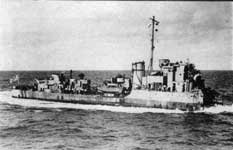
Loyal - destroyer mined Adriatic Oct 1944. Not repaired.
Pathfinder - bombed Burma Feb 1945. Not repaired.
Escort carriers Nabob (Aug 1944) and Thane (Jan1945) torpedoed but not repaired.
8 Captain class frigates in 1944/45 - badly damaged from various causes but not repaired.
5 RN/RCN River class frigates mostly victims of T5s. Not repaired.
Salamander - minewweeper victim of friendly fire Aug 1944. Not repaired.
Wensleydale - Hunt class Dec 1944 damaged in collision with LST. Not repaired.
Goathland - Hunt class mined July 1944. Not repaired.
Fury - destroyer mined and suffered collision damage June 1944. Not repaired.
With plenty of new ships entering service, from mid-1944 the repair effort in British yards was going into work relating to ships and vessels destined for campaigns in the far East. "Non standard" US built vessels were just an added complication.
T. A. Gardner
ACCESS: Top Secret
- Joined
- 18 February 2021
- Messages
- 2,031
- Reaction score
- 3,580
The British have, had, far less shipyard capacity than the US did. So, for them the choice was different.While the repair capacity might have existed the RN began to take a more pragmatic view from mid-war. So in 1939/40 significantly damaged ships were repaired, sometimes at great cost in time and resources. The following come to mind:
Belfast - mined. Repairs took nearly 3 years.
Eskimo - destroyer. Lost bow at Narvik. Rebuilt
https://en.wikipedia.org/wiki/HMS_Eskimo_(F75)#/media/File:HMSEskimoBowTorpedoDamageMay1940.jpg
Javelin - destroyer. Lost bow and stern (Over half her length). Rebuilt.
From 1943 there are some of ships not repaired despite mine, bomb or torpedo damage. These immediately come to mind.
Porcupine - destroyer torpedoed Dec 1942. Cut in two and towed home for scrap
Derwent - Hunt class victim of aerial torpedo March 1943. Not repaired.
Chanticleer - sloop victim of a T5 in Nov 1943. Not repaired. Became a base ship in Azores.
Carlisle - cruiser bombed in Aegean Oct 1943. Not repaired. Became base ship at Alexandria.
RHNS Adrias - Hunt class destroyer mined in Adriatic Oct 1943 losing bow back to bridge. Not repaired. Compare to Eskimo above.
View attachment 824645
Loyal - destroyer mined Adriatic Oct 1944. Not repaired.
Pathfinder - bombed Burma Feb 1945. Not repaired.
Escort carriers Nabob (Aug 1944) and Thane (Jan1945) torpedoed but not repaired.
8 Captain class frigates in 1944/45 - badly damaged from various causes but not repaired.
5 RN/RCN River class frigates mostly victims of T5s. Not repaired.
Salamander - minewweeper victim of friendly fire Aug 1944. Not repaired.
Wensleydale - Hunt class Dec 1944 damaged in collision with LST. Not repaired.
Goathland - Hunt class mined July 1944. Not repaired.
Fury - destroyer mined and suffered collision damage June 1944. Not repaired.
With plenty of new ships entering service, from mid-1944 the repair effort in British yards was going into work relating to ships and vessels destined for campaigns in the far East. "Non standard" US built vessels were just an added complication.
If you look at the US, they would simply toss cubic dollars into repairing or rebuilding ships. The USS Cassin Young (DD 372) for example at Pearl Harbor was a constructive loss. The US pulled the usable bits and machinery off the wreck and built an entirely new destroyer around that recommissioning it. Look at the reconstruction of the battleships sunk at Pearl Harbor.
Like I said ‘theoretically’The Allies were turning out escort ships faster than the Germans could build submarines. Also, they had the capacity to repair escorts that were damaged but not sunk.
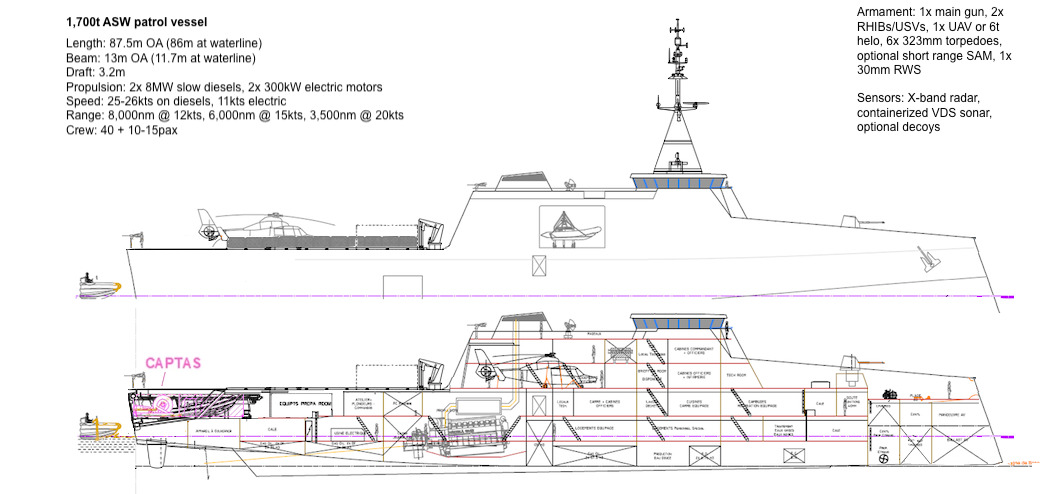
Thought I'd sketch out what a small ~1,700t ocean-going ASW corvette might look like, based on one of the early design studies that led to the Adroit/Bouchard class OPVs.1,300 to 2,500 tonnes displacement (full load) is the minimum size for decent seakeeping, 6,000nm+ range, and payload capacity (this is a rough range based on existing OPV designs). In Europe alone there must be 20+ smaller shipyards that can build large patrol vessels in that size range.
Ultimately many existing OPVs could probably be used as a starting point for a mass produced Flower class. All you really need is space in the stern for a towed sonar, diesel electric propulsion with ~12kt speed in electric mode, 22-24 knot top speed, and enough fuel for a 2,000nm transatlantic crossing at an average speed of advance of 18-20 knots (plus say 30% fuel reserves). Effectors can be a mix of LWTs welded to the deck, UAVs dropping sonobuoys, ideally also a few ramp launched ASROC that fit in the footprint of a 20ft container. Perhaps 1-2 small davit or ramp launched USVs can also help (though I’m not convinced they can maintain the speed of advance, so probably best used against already identified sub contacts).
Every element shown here is from a real design (Adroit or related concept studies) such as the containerized VDS, reverse bow, armament, modular spaces for containers, mast arrangement etc, so I'm not really making anything up - it's all within the art of the possible. The main advantage of this design is that it could be built (and maintained) in almost any civilian yard, as it uses mostly civilian standards, merchant propulsion, and is length constrained (<90m). But it still meets the minimum hull size for blue water ops (seakeeping, stability for aviation ops, endurance/range etc).
The design compromise is that the corvette would have to slow down to 10-12kts for silent running on electric motors in order to effectively use its VDS, then speed up to ~25 knots on diesels to maintain a high average speed of advance. To offset that, it could use onboard UAVs with sonobuoys or its USV with dipping sonar to extend coverage (especially during sprint phases when it is blind). Also 2 corvettes escorting a convoy could alternate listening and sprint phases to provide permanent VDS sonar coverage.
Attachments
Last edited:
Similar threads
-
Modern submarine chaser
- Started by johnpjones1775
- Replies: 96
-
Potential Low-Cost Distributed Air Defense Solution Using Anduril Technologies
- Started by SrsTwist
- Replies: 2
-
A crash fleet and supplementing the US fleet
- Started by johnpjones1775
- Replies: 11
-
Do UUVs and USVs make subchasers viable again?
- Started by johnpjones1775
- Replies: 23
-
RAN Type 23 based ANZAC Class Frigate
- Started by Volkodav
- Replies: 27