I guess theoretically if you target the escorts now, there’s fewer in the future making it easier to get at the convoys more easily and safely?That strategy is flawed actually. Sinking the escorts, unless you get most or all of them, leaves the convoy intact. It is the merchant ships and their cargo in a guerre de course that are the important target. Better a U-boat sinks one or two merchants and spends time evading the escort's retaliation, than sinking an escort and facing that same retaliation having accomplished next to nothing for it.

You are using an out of date browser. It may not display this or other websites correctly.
You should upgrade or use an alternative browser.
You should upgrade or use an alternative browser.
Is a modern Flower class corvette even realistic?
- Thread starter Mk38
- Start date

T. A. Gardner
ACCESS: Top Secret
- Joined
- 18 February 2021
- Messages
- 2,030
- Reaction score
- 3,580
The Allies were turning out escort ships faster than the Germans could build submarines. Also, they had the capacity to repair escorts that were damaged but not sunk.I guess theoretically if you target the escorts now, there’s fewer in the future making it easier to get at the convoys more easily and safely?
Scott Kenny
ACCESS: USAP
- Joined
- 15 May 2023
- Messages
- 19,687
- Reaction score
- 28,175
But do we still have that capability now?The Allies were turning out escort ships faster than the Germans could build submarines. Also, they had the capacity to repair escorts that were damaged but not sunk.
T. A. Gardner
ACCESS: Top Secret
- Joined
- 18 February 2021
- Messages
- 2,030
- Reaction score
- 3,580
I'd say, it depends. The big issue in the US, and I assume it's a major one in Europe too, is that environmental and safety laws get in the way of production. These raise the cost of production machinery, techniques, and everything else massively, often for little or no return on investment.But do we still have that capability now?
That in turn slows production and makes it grossly expensive. Manufacturers of physical 'stuff' see this and offshore their operations to other countries where such rules are far laxer or simply don't exist.
So, if those rules were suddenly tossed aside for mass production, it would again happen pretty quickly.
Scott Kenny
ACCESS: USAP
- Joined
- 15 May 2023
- Messages
- 19,687
- Reaction score
- 28,175
They'd still have to hire a whole crapton of workers.So, if those rules were suddenly tossed aside for mass production, it would again happen pretty quickly.
While the repair capacity might have existed the RN began to take a more pragmatic view from mid-war. So in 1939/40 significantly damaged ships were repaired, sometimes at great cost in time and resources. The following come to mind:The Allies were turning out escort ships faster than the Germans could build submarines. Also, they had the capacity to repair escorts that were damaged but not sunk.
Belfast - mined. Repairs took nearly 3 years.
Eskimo - destroyer. Lost bow at Narvik. Rebuilt
https://en.wikipedia.org/wiki/HMS_Eskimo_(F75)#/media/File:HMSEskimoBowTorpedoDamageMay1940.jpg
Javelin - destroyer. Lost bow and stern (Over half her length). Rebuilt.
From 1943 there are some of ships not repaired despite mine, bomb or torpedo damage. These immediately come to mind.
Porcupine - destroyer torpedoed Dec 1942. Cut in two and towed home for scrap
Derwent - Hunt class victim of aerial torpedo March 1943. Not repaired.
Chanticleer - sloop victim of a T5 in Nov 1943. Not repaired. Became a base ship in Azores.
Carlisle - cruiser bombed in Aegean Oct 1943. Not repaired. Became base ship at Alexandria.
RHNS Adrias - Hunt class destroyer mined in Adriatic Oct 1943 losing bow back to bridge. Not repaired. Compare to Eskimo above.
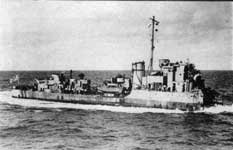
Loyal - destroyer mined Adriatic Oct 1944. Not repaired.
Pathfinder - bombed Burma Feb 1945. Not repaired.
Escort carriers Nabob (Aug 1944) and Thane (Jan1945) torpedoed but not repaired.
8 Captain class frigates in 1944/45 - badly damaged from various causes but not repaired.
5 RN/RCN River class frigates mostly victims of T5s. Not repaired.
Salamander - minewweeper victim of friendly fire Aug 1944. Not repaired.
Wensleydale - Hunt class Dec 1944 damaged in collision with LST. Not repaired.
Goathland - Hunt class mined July 1944. Not repaired.
Fury - destroyer mined and suffered collision damage June 1944. Not repaired.
With plenty of new ships entering service, from mid-1944 the repair effort in British yards was going into work relating to ships and vessels destined for campaigns in the far East. "Non standard" US built vessels were just an added complication.
Similar threads
-
Modern submarine chaser
- Started by johnpjones1775
- Replies: 96
-
Potential Low-Cost Distributed Air Defense Solution Using Anduril Technologies
- Started by SrsTwist
- Replies: 2
-
A crash fleet and supplementing the US fleet
- Started by johnpjones1775
- Replies: 11
-
Do UUVs and USVs make subchasers viable again?
- Started by johnpjones1775
- Replies: 23
-
RAN Type 23 based ANZAC Class Frigate
- Started by Volkodav
- Replies: 27