

- Joined
- 22 April 2012
- Messages
- 2,274
- Reaction score
- 2,848
I came across this whilst looking at 1960s phased array radar technology, it was an Air Force funded programme that produced a sub-scale demonstrator for a future BMD radar. The best description comes from a June 1970 edition of Electronics, though the exact accuracy is questionable (Link):
A 2010 article by former Hughes employee Jeff Stitt in The Microwave Journal (Link) stated that:
Forty Years of Research and Development at Griffiss Air Force Base (Link) states the following in relation to ADAR:
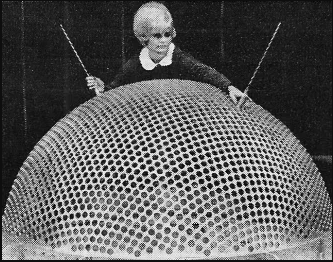
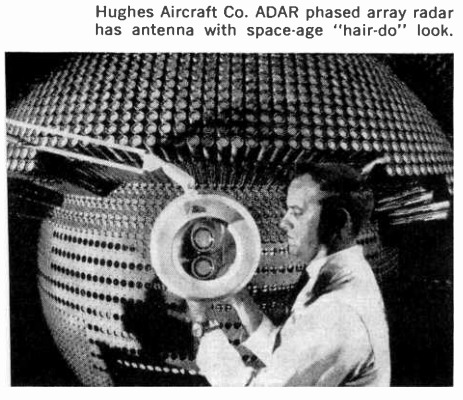
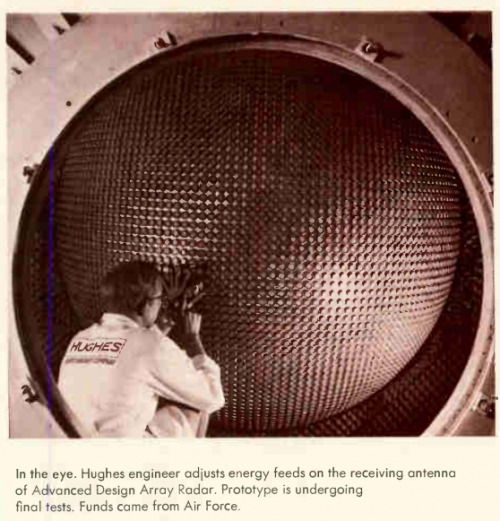
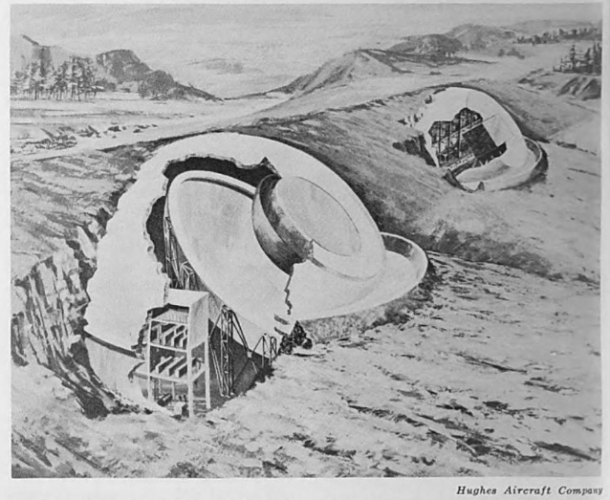
ADAR was apparently the most powerful radar built at Hughes up to that point and included 16,000 energy feeds. Hughes released a number of images of the hemispherical receiver during manufacture and an artist impression of a full size, deployed, ADAR.
Sorting it out
A prototype radar using a beam-steering technique that appears to be significantly better than that of antiballistic-missile radars has been tested successfully. Built by the Hughes Aircraft Co., the radar, with its hemispherical bugeye antenna, is the first to use real-time delays for beam steering and to compensate a receiver array for short-pulse, off-boresight reception.
ADAR, for Advanced Design Array Radar, is being funded by the Air Force's Rome Air Development Center; however, it's no doubt being eyed by the Army's Advanced Ballistic Missile Defense Agency for its potential in target discrimination.
While details of such systems are secret, insiders can put together bits and pieces of information and make some strong assumptions.
Compensation. One problem with such radars as the Perimeter Ac- quisition Radar (PAR) and Missile Site Radar (MSR) of the Safeguard system, is that their compressed pulse widths must be at least twice as long as the radar antenna aperture to prevent ruinous dispersion of signals received from off bore-sight. In an ordinary uncompensated array, the edge of the array closer to the target receives the signal first, while the farther edge receives the signal last. Unless the signal is at least long enough to simultaneously illuminate all ele- ments of the array, it cannot be efficiently summed. Instead, the signal becomes smeared through several resolution cells, contaminating them while causing a loss in system sensitivity.
ADAR solves this problem by steering with real-time delays so that the whole signal, received from whatever angle, can be summed. Furthermore, the hemispherical shape puts most of the effective aperture broadside to the beam angle; this minimizes the required compensating real-time delays.
Hughes' radar uses a standard, phase-steered planar array for transmission. The bugeye array is for reception only. The radar is a small version of the full-scale array that might be used in an ABM role. It appears to operate at S-band and to cover a 120° cone so that three arrays could provide full 360° coverage. The array elements are scanned much less than 60°, since the antenna shape itself is used to accomplish most of the off-boresight pointing by simple activation of the appropriate array elements. Fine pointing is then accomplished by trimming the beam angle through real-time delays for each element. These delays are in addition to those required to compensate for the array's shape.
Cut down. The experimental array is about five feet in diameter and appears to house several thousand traveling-wave tubes in its face. The real-time delay system permits the use of much shorter pulses: a compressed pulse width of 10 nanoseconds, equivalent to a five-foot range resolution, may be practical even in a full-scale array.
A 2010 article by former Hughes employee Jeff Stitt in The Microwave Journal (Link) stated that:
Tunnel diode amplifiers were first used at Hughes, at least in large numbers, in the ADAR radar. This was a very state of the art (bleeding edge might be a better term) hemispherical shaped phased array radar that was perhaps the first of the many predecessors to the current very large scale phased-array based National Missile Defense (NMD) Ground Based Radar (GBR).
Forty Years of Research and Development at Griffiss Air Force Base (Link) states the following in relation to ADAR:
Advanced Design Array Radar. In May [1970], a test program for an Advanced Design Array Radar (ADAR) prototype was completed. The tests yielded successful results in high resolution automatic tracking. The purpose of the program was to develop a powerful high-resolution phased array radar for ballistic missile defense.
ADAR was apparently the most powerful radar built at Hughes up to that point and included 16,000 energy feeds. Hughes released a number of images of the hemispherical receiver during manufacture and an artist impression of a full size, deployed, ADAR.
Attachments
Last edited:
