How to make large costly radars less physically vulnerable

Dilandu

I'm dissatisfied, which means, I exist.
Joined
30 May 2013
Messages
7,369
Reaction score
10,586
Website
fonzeppelin.livejournal.com
The events of the recent "not-the-war-just-(special)-military-operation" in Iran demonstrated something that was suspected for a while; big, high-powerful radars, deployed near battlefield, are very vulnerable:

1772895379417.png

While the problem could be mitigated a bit by using mobile systems - aerial or naval - it's far from universal solution. Naval radars couldn't be efficiently deployed far from sea, and airborne radars have weight and size limitations. And land-based radars of large size are more transportable than mobile (if even transportable) anyway.

So... what could be done to reduce the vulnerability of large, high-powered radars near battlefield?

My idea: switch to multi-static radars. Deploy several transmitter antennas - made as compact and as sturdy as possible, and fully mobile - around one big complicated receiver antenna (fully passive and basically undetectable). Switch between transmitter antennas constantly, and move the inactive antennas around constantly. Any single transmitter antenna should stay active only as long as it took to move the other one on a new position. So the enemy would not have the good targeting solutions; the main (receiver) antenna is fully passive and invisible to detection (multiple decoys could be easily build to confuse satellite recon), and the active (transmitter) antennas are constantly switched between and moved around.
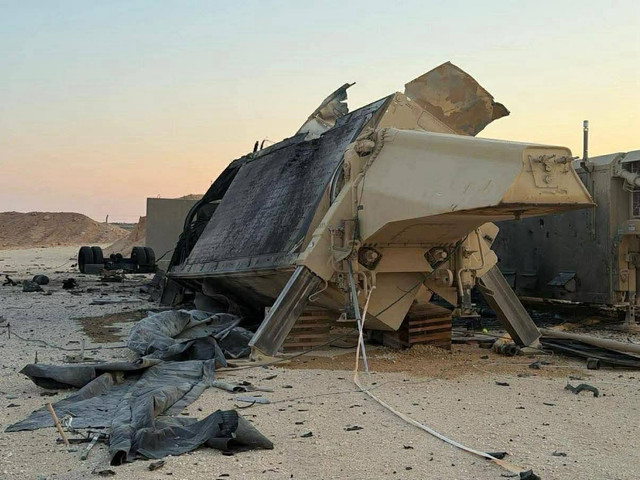
 
The events of the recent "not-the-war-just-(special)-military-operation" in Iran demonstrated something that was suspected for a while; big, high-powerful radars, deployed near battlefield, are very vulnerable:

View attachment 804591

While the problem could be mitigated a bit by using mobile systems - aerial or naval - it's far from universal solution. Naval radars couldn't be efficiently deployed far from sea, and airborne radars have weight and size limitations. And land-based radars of large size are more transportable than mobile (if even transportable) anyway.

So... what could be done to reduce the vulnerability of large, high-powered radars near battlefield?

My idea: switch to multi-static radars. Deploy several transmitter antennas - made as compact and as sturdy as possible, and fully mobile - around one big complicated receiver antenna (fully passive and basically undetectable). Switch between transmitter antennas constantly, and move the inactive antennas around constantly. Any single transmitter antenna should stay active only as long as it took to move the other one on a new position. So the enemy would not have the good targeting solutions; the main (receiver) antenna is fully passive and invisible to detection (multiple decoys could be easily build to confuse satellite recon), and the active (transmitter) antennas are constantly switched between and moved around.

Problem of course is that multi static radars are inherently more complex and less precise than conventional ones.

Ironically, that TPY-2 radar is relocatable. But they probably hadn't moved it in some time, because why bother, right?
 
Problem of course is that multi static radars are inherently more complex and less precise than conventional ones.
Yes, agreed - but on the other hand, having several transmitters allowed to have several "observation points" on target, thus partially compensating for precision loss.
 
No defense could be perfect,
But it helps if you actually have one, instead of a giant radiating bullseye.


and something like phased array antenna is pretty hard to armor.
As I've been reminded a couple of times, part of the US Army FCS program was small arms/shrapnel resistant radome materials. Still won't help versus shaped charges, but it'll help with near misses.
 
Just because an AN/TPY-2 radar from a THAAD system appears to have been hit, why is there any need for this thread?
Because those systems are costly and hard to replace. And disabling them could knock out a very significant part of theater missile defense at once. Their tactical and operational value is much greater than the value of typical PATRIOT radar.
 
How is a "big radar" any different from any other largely fixed/semi-fixed target? Just because an AN/TPY-2 radar from a THAAD system appears to have been hit, why is there any need for this thread?

They are more fragile. Because they deal with RF they can't easily be "armored" in any meaningful way. Other fixed targets certainly can be. Radar antennas can't be covered by concrete, steel, etc. to protect them.
 
Because those systems are costly and hard to replace. And disabling them could knock out a very significant part of theater missile defense at once. Their tactical and operational value is much greater than the value of typical PATRIOT radar.
Still doesn't justify a dedicated thread talking about. Many other targets are also costly and hard to replace and have major impacts if hit.
 
They are more fragile. Because they deal with RF they can't easily be "armored" in any meaningful way. Other fixed targets certainly can be. Radar antennas can't be covered by concrete, steel, etc. to protect them.
Same can be said for many other targets. My point is that the approaches to defend radars such as that mentioned here are essentially identical to other targets. There is nothing special in terms of defence tactics that would be any different.
 
Same can be said for many other targets.
But:

* Not many other targets are so high-value and hard to replace
* Not many other targets are so fragile to damage
* Not many other targets of such high value and fragility are supposed to be deployed on theater
* Not many other targets are so freakingly hard to hide or camouflage due to their massive - easiy to detect - emissions

Complex of those factors, IMHO, made ballistic defense radars a very specific class of targets, having little direct analogues.
 
Same can be said for many other targets. My point is that the approaches to defend radars such as that mentioned here are essentially identical to other targets. There is nothing special in terms of defence tactics that would be any different.
The difference I can think of is that most sites don't constantly broadcast their position as part of ordinary operation. An artillery piece exposes itself to counterbattery fire once it shoots, but you can hold fire. Furthermore, the most effective counterbattery method is active radar, itself exposed to EW.

You can't easily turn a radar on and off when needed, because...how do you know you need it? You need a radar to detect and track incoming threats, so you should turn it on once there are incoming threats, that you detect...how?

My answer to my own question and the thread: other, crappier, more numerous and mobile radar systems, and a network of passive detectors. Your biggest, most expensive, most capable radar systems should relocate frequently and should not radiate as a matter of course, to prevent detection. When other systems detect possible threats, it should turn on and do its job, and then relocate again. The military needs to get good at EMCON again if it is going to credibly face a peer threat.

Plus all the standard defensive stuff. Layered SHORAD, redundancy.
 
mabye a reversed approach:
set up a huge portable air dome(like which for exhibition/construction),and park the radar into it;
and if possible,fill the dome with SF6(or someting like),
both prevent fire and reduce speed of shrapnel as much as possible by it's high density.
 
In ancient times asian riders used flowing/bloated cloaks in the wind to ward of arrows from the back.
Basically, the pressure generated by the wind and the heavy cloak dampen the arrows.
Just like with clean rooms the dome could be put under high pressure to somewhat lessen damage from slow incoming fragments.
Ofc this won't do much against anthing bigger.
 
At least a dome would make decoys more effective if cheap enough. Multistatic is useful, especially if not constantly transmitting. That could evolve into a multistatic network of passive antennas that picks up reflections of ambient radiation, in addition to potentially cheaper transmitters that may or may not be networked to the multistatic system for extra accuracy/range on demand. I think theres s concept like that in Ukraine that detects reflections of FM radio frequencies. Likely more of an early warning system.
 
My answer to my own question and the thread: other, crappier, more numerous and mobile radar systems, and a network of passive detectors. Your biggest, most expensive, most capable radar systems should relocate frequently and should not radiate as a matter of course, to prevent detection. When other systems detect possible threats, it should turn on and do its job, and then relocate again. The military needs to get good at EMCON again if it is going to credibly face a peer threat.
ABM radars are not easy to relocate and really need to radiate 24/7.


Plus all the standard defensive stuff. Layered SHORAD, redundancy.
Which the US hasn't invested in since the 1980s.
 
Which the US hasn't invested in since the 1980s.
To my knowledge, only Russian VKS bought dedicated SHORADs for large batteries with inherently vulnerable stance (Pantsirs) in operationally significant numbers before the war.
This was overall circumstantional - need was quite apparent, doctrinal focus allowed allocation of resources, and suitable system was available off the shelf (thanks gulf financing...irony).
Others have and/or tried to deploy only broader SHORAD assets. usually in very limited numbers.

As soon as real war actually hit, those SHORADs turned rather scarce - everyone and their mother needs one, and this role is growing increasingly dangerous(significant attrition).
With current C-UAS threat, literally everything needs protection, both individual and collective.
 
Last edited:
Just put SHORAD around them. No system is perfect or invulnerable.

Valuable targets should have layered defense around them. Clearly this doesn't. All this proves is the incompetency of the US Army ADA.
 
The difference I can think of
Neither makes any difference to what I am trying to point out. The mechanisms to defend any fixed/semi-fixed target are essentially identical. About the only difference I can imagine is if your target is deeply buried in which case you may not bother but rather just absorb the hit. For anything else the defence options are essentially identical. A more relevant question would be "how to defend against <insert attack mechanism here>..." and we already have plenty of those threads. This thread adds nothing.
 
Last edited:
Neither makes any difference to what I am trying to point out. The mechanisms to defend any fixed/semi-fixed target are essentially identical. About the only difference I can imagine is if your target is deeply buried in which case you may not bother but rather just absorb the hit. For anything else the defence options are essentially identical. A more relevant question would be "how to defend against <insert attack mechanism here>..." and we already have plenty of those threads. This thread adds nothing.

Perhaps the theme should be re-named "how to make large radars less physically vulnerable"? Because that's what was my intention.
 
Neither makes any difference to what I am trying to point out. The mechanisms to defend any fixed/semi-fixed target are essentially identical. About the only difference I can imagine is if your target is deeply buried in which case you may not bother but rather just absorb the hit. For anything else the defence options are essentially identical. A more relevant question would be "how to defend against <insert attack mechanism here>..." and we already have plenty of those threads. This thread adds nothing.
I've got to push back again. The difference is, the answer to most of these threads is "hide." A radar can't hide. I think that is significant enough.
 
Space is probably the ultimate answer. The U.S. is already orbiting passive IR satellites for missile track, and this is probably supplemented by AMTI in the early 30s.

In the meantime, so way you defend any other static target. Nets, guns, point defense missiles, etc.
 
Space is probably the ultimate answer. The U.S. is already orbiting passive IR satellites for missile track, and this is probably supplemented by AMTI in the early 30s.

In the meantime, so way you defend any other static target. Nets, guns, point defense missiles, etc.
It's hardly ultimate. It's more of a yet another failure of late Rahbar - i.e. to push for emergency development of denial ASAT at least for LEO. It was perfectly within their capabilities, and arguably would've hurt US far more than any THAAD radars.

Against thinking opponent, frankly speaking, it's air and sea infrastructure is by far the most survivable. Space is protected either by fear of bringing US into war...or outright decision making failures, like in current case.
 
An AN/TPY-2 has 25,344 T/R modules. The only reason they're all in the same place is convenience. Split them up, precisely geolocate them, time-stamp every signal and feed them into the cloud for correlation. They'll still be capable of functioning as a single antenna, it'll just be a geographically dispersed sparse antenna array, with the added bonus of increased aperture size.
 
... go Soviet/Russian IADS.

We've long ignored the lesson that we've seen whenever Soviet/Russian IADS is allowed to be (at worst) semi-competent: locking down the airspace.

Now? We have to fast-track the development of such an IADS force. Yesterday.
 
Play shell games with radomes, as in have a lot of randomes around as decoys but only a few with the radar in it.

Any semi-mobile valuable target that can be identified from space is just indication of gross failure against opposition down to drug gangs (which now have drones). Put a tent over it for gods sake. Even bored forum posters can buy some space imagery and we seems to be heading towards a world where space tourists can ISR with nikons~
 

Similar threads

Back
Top Bottom