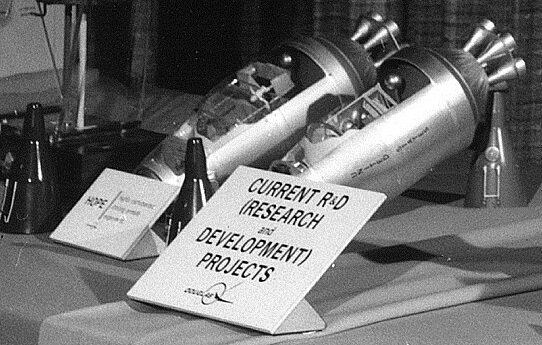
Holy Gemini !!

SAustin16 said:
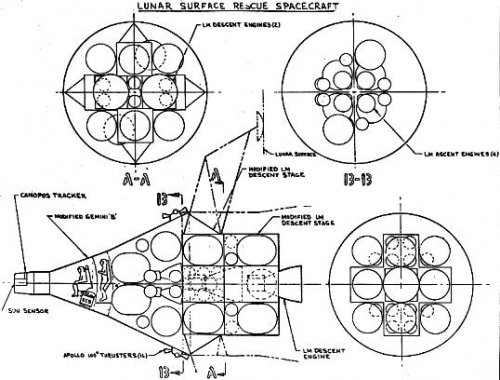
Regarding the Gemini / Saturn V Rescue Vehicle...Does anyone know if there was a spacecraft with a heat shield inside the fairing behind the Gemini that the rescued party would enter the atmosphere in? There was certainly not enough room in the Gemini for more than the two astronauts.

Cheers from Texas

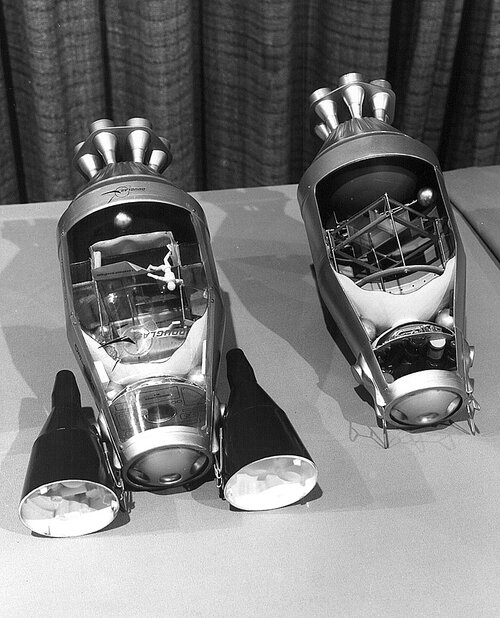
The Proposal had stretch Gemini capsule, like Big G, after two men cockpit is compartment with pace for three Astronauts, then enlarged Heat shield
 

Attachments

  • gemlulsr.jpg
    gemlulsr.jpg
    50.3 KB · Views: 478
Michel,

Thank you very much for the answer and drawing. That Gemini Lander would make a fascinating desk model.

Landing a Gemini backwards on an "unprepared field" on the Moon would have taken a bold pilot. At least on the Apollo LM the pilots could look down.

Cheers from Texas
 
Carmelo's images on page one of this thread don't come up anymore. Well at least on my phone anyway.
 
XP67_Moonbat said:
Carmelo's images on page one of this thread don't come up anymore. Well at least on my phone anyway.

the problem the picture are uploaded at imageshack.us
somehow they lost those picture...
 
Hello All,

My favorite Giuseppe De Chiara Gemini "family tree" artwork is at the PDF link below. Guiseppe is one of my heroes for documenting so many spacecraft and aircraft so technically and artistically. Bravo Guiseppe!

http://forum.nasaspaceflight.com/index.php?action=dlattach;topic=35340.0;attach=597348

Cheers from Texas
 
Thanks SAustin16 you're really kind...

Ciao
Giuseppe


SAustin16 said:
Hello All,

My favorite Giuseppe De Chiara Gemini "family tree" artwork is at the PDF link below. Guiseppe is one of my heroes for documenting so many spacecraft and aircraft so technically and artistically. Bravo Guiseppe!

http://forum.nasaspaceflight.com/index.php?action=dlattach;topic=35340.0;attach=597348

Cheers from Texas
 
Time to clear the mess related to paraglider and all the other aerodynamic chutes: parasail, parafoil, sailwing...

PARAGLIDER
-semi-rigid, triangular wing. Was intensively tested for Gemini, 1961-64: NAA ultimately made it work, but too little, too late. Rogallo.

The Gemini paraglider development program was initiated in July 1961. Development continued through 1964 at which time the program was terminated. The program identified many problems. The system was heavy and required a large volume for stowage. Deployment was difficult and complex. Structural problems were encountered with the semi-rigid members. The wing was difficult to control and required a high degree of pilot proficiency to fly.

PARASAIL
-a semi-guided round chute, was the backup for Gemini land landings but abandonned, would need Soyuz like rockets for landing.

After these two: three more inventions: Rogallo's parawing, Jalbert's parafoil and Barish's sailwing.

All five concepts are detailed in the attached document: an excerpt from a 1300 page Hearing, courtesy of Google books.
 

Attachments

  • Hearings-934-941.pdf
    3.9 MB · Views: 35
I have question on Lunar Gemini

Instead the Original Beryllium shingles
They had to replace Single Face Corrugated ablation panels.

are more information on Material or any picture of those panels design ?
 
Regarding the Gemini / Saturn V Rescue Vehicle...Does anyone know if there was a spacecraft with a heat shield inside the fairing behind the Gemini that the rescued party would enter the atmosphere in? There was certainly not enough room in the Gemini for more than the two astronauts.

Cheers from Texas
It is very small. They had one on display in Lincoln, NE when I was a teenager. Much bigger than Mercury. Might have been able to cram a third person in there. Maybe. It would have obviously required smaller astronauts in general, considering how short they were that is easier said then done. They didn't nickname them space jockeys for nuthing.

View: https://www.reddit.com/r/space/comments/3ecdkm/size_comparison_of_apollo_gemini_and_mercury_from/

Funny how they insisted Gemini to pronounced Jiminy.
 
Last edited:
I've seen tiny lunar ascent vehicles... little more than chairs.

Anyone think to use that as a descent vehicle...then climb in a prepositioned Lunar Gemini for the trip up?
 
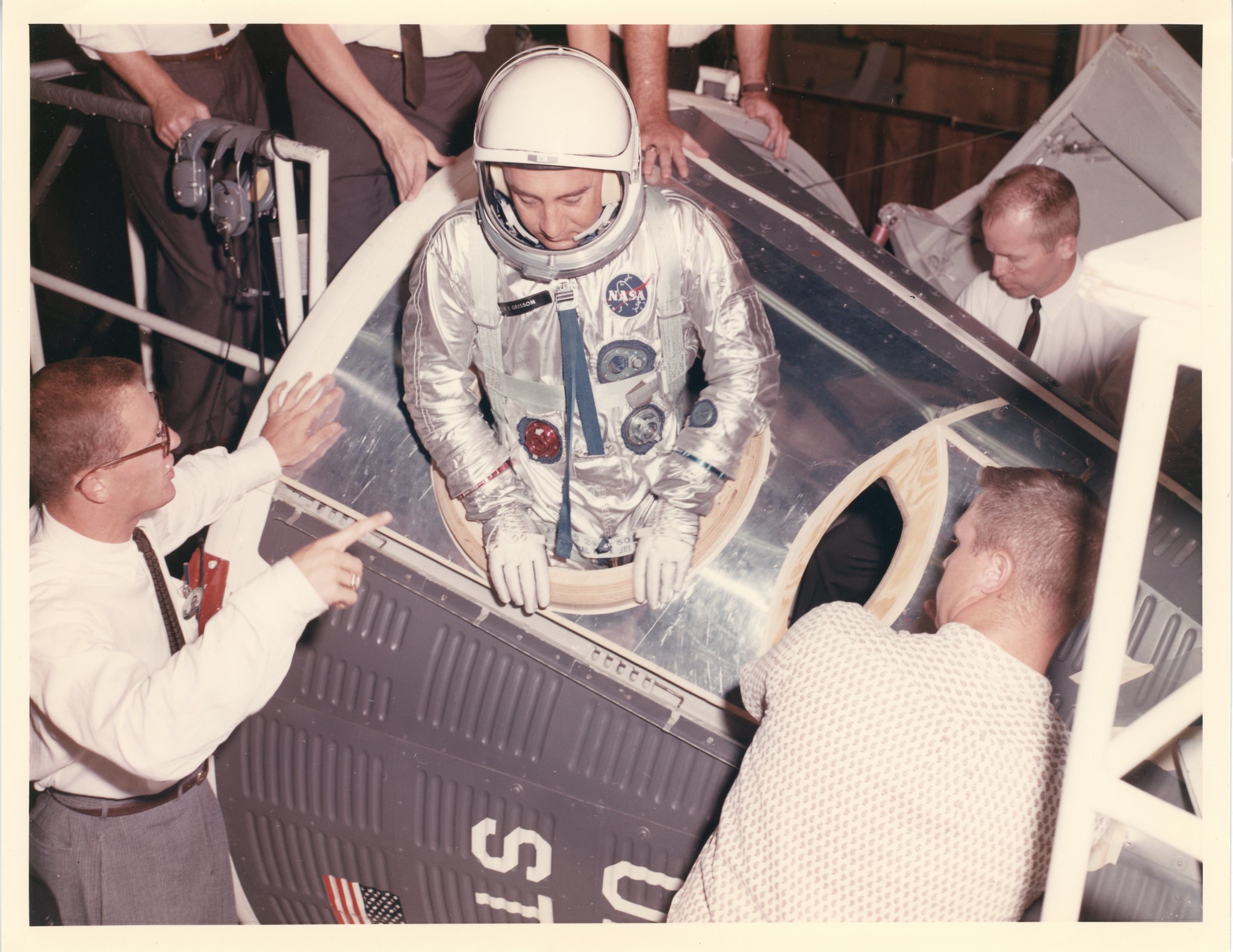
I found this Picture at Flickr
ca. 1963, McDonnell Aircraft Corp. photo no. D4C 15149
it from 1963 and show test at Mockup of Gemini Capsule.
unclear for EVA or Docking at MORL

source
View: https://www.flickr.com/photos/apollo4ever/53628587501/in/feed-146402711-1712112293-1-72157721713708526

53628587501_e028c07f4f_k.jpg
 
Going by size of hatch opening it seems that wearing a life support pack was not expected to be part of the process.
That hole is around 80 cm ø
Early EVA were with umbilical connection to capsule life support systems, so no life support pack.
but i have no idea how there do transfer between Gemini to MORL over that Hatch in Space...
 
Apollo was ugly but capable with that nose hatch.

The Johnson Sea Link had a divers' lock-out behind the self contained control sphere. Any similar ideas? Winged Gemini with a payload bay for EVAs behind?
 
i found more info at NSF

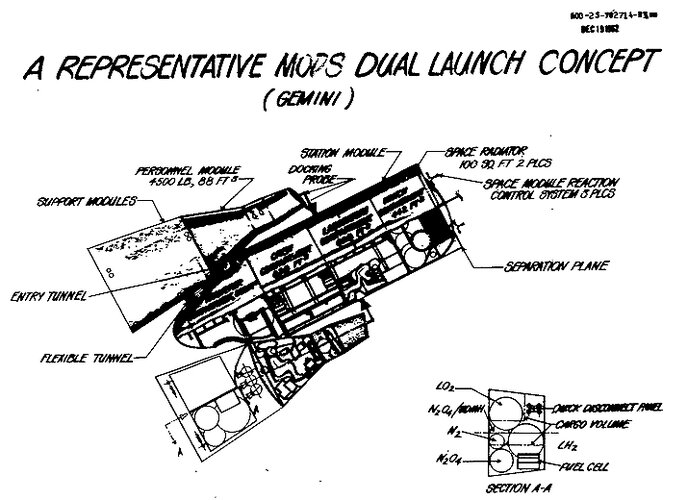
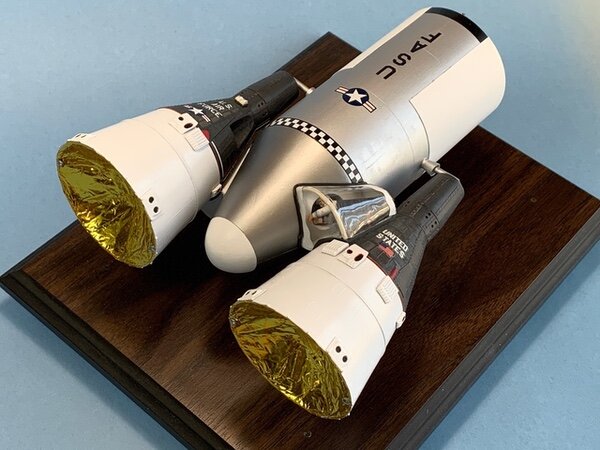
There was 1963 USAF program called Military Orbital Development System in short: MODS
It feature a Space Station were two Gemini docked and crew transfer true that hatch into MODS
More here
https://www.thespacereview.com/article/4448/1
and Picture from my archive
 

Attachments

  • 435356177_10162270446563072_8319809666061500768_n.jpeg
    435356177_10162270446563072_8319809666061500768_n.jpeg
    188.3 KB · Views: 89
  • Military orbital development system.jpeg
    Military orbital development system.jpeg
    106.4 KB · Views: 85
  • hope01.jpg
    hope01.jpg
    265.5 KB · Views: 92
Thanks to @blackstar I've understand at last why Gemini paraglider sucked at deploying the right way.

Key words : inflatable booms. The booms had to inflate first, to give the whole thing its triangular shape, fabric included. The fabric would deploy out of the inflated booms, or from them or over them - you get the point.

If the booms did not inflated correctly, then the fabric wouldn't work either and very bad things would happen.

The paraglider successors were, first the parasail (a modified round parachute with holes and vanes and very limited manoeuverability) - and then an even better trio of aerodynamic chutes called sailwing, parafoil and parawing. Much like parachutes, all of them inflated the direct way : no goddam inflatable booms going first.

Somewhat ironically, parawing was another Rogallo concept, still triangular but much simpler to inflate. Probably the right way to go, but it did not appeared before the late 1960's, many years after paraglider went to hell.
 
Last edited:
Then how about hang-gliding paragliders, also called Rogallo wing* ? they have no inflatable booms because they don't deploy midair like parachutes after a jump (or a Gemini atmospheric reentry).

Instead takeoff is horizontal like a glider, and without any in-flight deployment, there is no need for inflatable booms.

Instead a rigid structure of metallic tubes can be used - somewhat an airframe, again like a glider.

*in french we call that a deltaplane. No possible confusion with Gemini own Rogallo system, nor with any chute-something.

And now I need a ton of aspirin, because my brain is screaming in pain.
 
Instead takeoff is horizontal like a glider, and without any in-flight deployment, there is no need for inflatable booms.
From a ground launch, of course, you could use inflatable booms. If it doesn't inflate right, you can manipulate it into shape, deflate it and try again, or just give up on the whole idea and walk down the hill instead.

None of those are credible options when you're in a metal box plummeting to Earth at 9.81 m/s².
 
Thanks to @blackstar I've understand at last why Gemini paraglider sucked at deploying the right way.

Key words : inflatable booms. The booms had to inflate first, to give the whole thing its triangular shape, fabric included. The fabric would deploy out of the inflated booms, or from them or over them - you get the point.

If the booms did not inflated correctly, then the fabric wouldn't work either and very bad things would happen.

They had success with inflating the booms. I don't know if they got to 100% success by the end of the program, but they did better.

To the first order, the biggest problem was that the test program was not moving fast enough to be incorporated into Gemini. But I think an equal problem was that it required more mass, and Gemini allocated that mass to other things.
 
Considering the size of those Rogallo wings, and how little space there was a in Gemini (ask the astronaut pair who spent almost tww weeks crammed inside) it was probably for the better it was canned.
 
Perhaps the technology can be looked at for smaller booster recovery. Perhaps a return to cluster tankage could allow some pre-deployed elements in the hollows between tanks, the wing on the surface to smooth out airflow.

I am surprised that parachutes work as well as they do. I remember reading where a packed parachute has the consistency of hardwood. Something deployed lengthwise would not have to be packed as densely.

Saturn I might have been the best vehicle for the concept.

Gemini allowed a comparatively easy egress.
Were there ever plans such that the two crewman could use that wing as a hang-glider--cutting the Gemini away under them?
 
Perhaps a return to cluster tankage
Nobody is going to return to cluster tanks. That was outdated as soon as the S-IV stage was developed.
Cluster tanks only existed because at the time, it was the fastest way to build a large booster. And for shipping it to the launch site in pieces. Those reasons no longer exist.
 
Considering the size of those Rogallo wings, and how little space there was a in Gemini (ask the astronaut pair who spent almost tww weeks crammed inside) it was probably for the better it was canned.

When researching the subject I did not see anything about how it would be packaged, but I also did not see anything expressing concern that there was not enough room. I'd add that they also had to incorporate landing gear. They must have carved out volume to accommodate all that stuff at first.

When designing a spacecraft, engineers have to set aside margins like mass and volume (mostly mass) for things that will be decided later. But as the rest of the design advances, other subsystem teams want to use that mass and volume, and they may be forced to spend more money and time to solve their own problems when it would be easier and cheaper to use up some of that unallocated mass and volume. So setting that stuff aside has a cost during the design process. The paraglider testing was moving along, but not as fast as the Gemini spacecraft development needed. At some point it became easier to delete the paraglider and apply all that mass and volume margin to other systems that needed it.

One of the things that makes me a bit squeamish about the design is the way the cables were controlled to move the wing. The first article in the series had some drawings showing how that would have been mounted between the pressure bulkhead and the heat shield. I think any actual use of the paraglider would have required an all-up flight test with deployment of the paraglider after reentry, without a crew, of course.
 
That alone makes the concept better for booster recovery---having everything lengthwise means less deployment hassles and no deaths.

There is a related advancement:
https://www.nature.com/articles/s41586-025-09515-9https://techxplore.com/news/2025-10-kirigami-parachute-suitable-humanitarian-missions.html
"The parachute's behavior doesn't change even when the size of the device is augmented," says Frédérick Gosselin. "This suggests that it could be scaled up for larger applications."

The Polytechnique Montréal research team is now working on identifying new cutting patterns to endow the parachutes with different and new properties.

"We want to change the patterns in order to go even further: the parachutes could descend in a spiral, for example, or glide before dropping," says Mélançon. "We would also like to be able to vary the trajectory of descent depending on the payload, so the cargo could be sorted as the parachutes come down to Earth. This is a whole new design endeavor that opens up a multitude of possibilities."


Perhaps this will allow for a return of the Rogallo wing. Then too, perhaps something like SERV/Big Onion might benefit even more.
A wider LV would seem to lend itself to this concept. Visually this would go with the slitted exterior of Gemini, for whatever that's worth.
 
Last edited:
That alone makes the concept better for booster recovery---having everything lengthwise means less deployment hassles and no deaths.
Large booster retrieval by parachute is a non starter. Shuttle SRBs used the largest parachutes ever, which was the upper limit or close to it. Anyways, other than for small vehicles like Electron, propulsive recovery is the way going forward.
 
Large booster retrieval by parachute is a non starter. Shuttle SRBs used the largest parachutes ever, which was the upper limit or close to it. Anyways, other than for small vehicles like Electron, propulsive recovery is the way going forward.
Or wiings a la Red Bull...
 
Last edited:

Similar threads

Back
Top Bottom