
You are using an out of date browser. It may not display this or other websites correctly.
You should upgrade or use an alternative browser.
You should upgrade or use an alternative browser.
AETP Three-stream VCE - GE XA100 and P&W XA101 engines
- Thread starter Flyaway
- Start date


bring_it_on
I really should change my personal text
- Joined
- 4 July 2013
- Messages
- 4,203
- Reaction score
- 5,730
No, engines are harder and take longer.
Exactly! Hence the sarcasm. Given the support these programs have had from Congress over the last few years it would be better for the AF to begin thinking of further testing and integration starting immediately after the FY20 activities concludes. A roadmap to flight test it over the FYDP should work with Congress and should get them the required funding.
It's also funny that PW brand the X101 as incompatible with the folding nozzle of the Bee. I don't see why a co-axial design would not be possible (2 stream at nozzle level) with what info we have so far.
It will be interesting to follow what's the position of GE on that.
It will be interesting to follow what's the position of GE on that.

- Joined
- 21 April 2009
- Messages
- 14,348
- Reaction score
- 9,429
- Joined
- 21 April 2009
- Messages
- 14,348
- Reaction score
- 9,429
aonestudio
I really should change my personal text
- Joined
- 11 March 2018
- Messages
- 3,376
- Reaction score
- 9,218
aonestudio
I really should change my personal text
- Joined
- 11 March 2018
- Messages
- 3,376
- Reaction score
- 9,218
Raytheon Technologies is working to take the heat off a new generation of fighters
The solutions the company is developing will have applications for a range of platforms, including the U.S. Air Force and U.S. Navy’s future fighter programs, the U.S. Army’s Future Vertical Lift program, battlefield air mobility, and the F-35 and F-22 modernization programs.
“We want to find the most efficient way to integrate between propulsion, electric power generation and thermal management,” said Bill Dolan, vice president of engineering and technology at Collins Aerospace’s Power & Controls unit. “Current systems cannot support the increased heat loads that future enhancements will require without detracting from desired aircraft performance, so we are actively exploring new architectures, new packaging and new methods of integration.”
“As we look to the future, power and thermal management system capacity will be a key enabler for next-generation fighter aircraft as well as for capability growth of existing aircraft,” said Dave Stagney, senior director for Pratt & Whitney’s GATORWORKS organization. “Pulling additional power from our engines under existing approaches has a significant negative impact on engine life and maintenance costs. Our integrated approach – leveraging advanced systems architectures but also state-of-the-art digital engine controls – not only results in lower fuel burn and lifecycle costs, but also less weight, better packaging and higher overall aircraft performance.”
https://www.rtx.com/news/2021/06/22/thermal-management
The solutions the company is developing will have applications for a range of platforms, including the U.S. Air Force and U.S. Navy’s future fighter programs, the U.S. Army’s Future Vertical Lift program, battlefield air mobility, and the F-35 and F-22 modernization programs.
“We want to find the most efficient way to integrate between propulsion, electric power generation and thermal management,” said Bill Dolan, vice president of engineering and technology at Collins Aerospace’s Power & Controls unit. “Current systems cannot support the increased heat loads that future enhancements will require without detracting from desired aircraft performance, so we are actively exploring new architectures, new packaging and new methods of integration.”
“As we look to the future, power and thermal management system capacity will be a key enabler for next-generation fighter aircraft as well as for capability growth of existing aircraft,” said Dave Stagney, senior director for Pratt & Whitney’s GATORWORKS organization. “Pulling additional power from our engines under existing approaches has a significant negative impact on engine life and maintenance costs. Our integrated approach – leveraging advanced systems architectures but also state-of-the-art digital engine controls – not only results in lower fuel burn and lifecycle costs, but also less weight, better packaging and higher overall aircraft performance.”
https://www.rtx.com/news/2021/06/22/thermal-management
aonestudio
I really should change my personal text
- Joined
- 11 March 2018
- Messages
- 3,376
- Reaction score
- 9,218
- Joined
- 21 April 2009
- Messages
- 14,348
- Reaction score
- 9,429
- Joined
- 21 April 2009
- Messages
- 14,348
- Reaction score
- 9,429

https://www.flightglobal.com/fixed-...adaptive-engines-from-ge-pandw/145613.article
Some figures mentioned here are interesting. For the F-35A, 30% increase in range and 18% reduction in acceleration time parameter. The modulation of the third stream will be interesting; will it be something that’s commanded by the pilot, or automatically incorporated in the engine control system?
Some figures mentioned here are interesting. For the F-35A, 30% increase in range and 18% reduction in acceleration time parameter. The modulation of the third stream will be interesting; will it be something that’s commanded by the pilot, or automatically incorporated in the engine control system?
Last edited:
https://www.airforcemag.com/re-engining-f-35-ge-aetp-boost-speed-payload-range/
GE-sponsored story about the XA100, so obviously there’s an agenda here, but the benefits they are touting from the new architecture are quite substantial. Also, I find it interesting that GE continues to state that the XA100 is compatible with both the F-35A and F-35C. If this is the case and GE/LM didn’t make a massive oversight, then this can be quite a powerful argument for the XA100.
The nerd side of me hopes that an AETP engine will be adopted especially considering the projected service life of the aircraft, but realistically, to borrow a phrase from P&W’s Matthew Bromberg, the engine will have to “buy its way in” to the program.
GE-sponsored story about the XA100, so obviously there’s an agenda here, but the benefits they are touting from the new architecture are quite substantial. Also, I find it interesting that GE continues to state that the XA100 is compatible with both the F-35A and F-35C. If this is the case and GE/LM didn’t make a massive oversight, then this can be quite a powerful argument for the XA100.
The nerd side of me hopes that an AETP engine will be adopted especially considering the projected service life of the aircraft, but realistically, to borrow a phrase from P&W’s Matthew Bromberg, the engine will have to “buy its way in” to the program.
Last edited:
aonestudio
I really should change my personal text
- Joined
- 11 March 2018
- Messages
- 3,376
- Reaction score
- 9,218

- Joined
- 3 June 2011
- Messages
- 20,895
- Reaction score
- 19,083
That's not a real achievement as they're basically the same engine. Now if the GE engine were compatible with the F-35B that would be something.Also, I find it interesting that GE continues to state that the XA100 is compatible with both the F-35A and F-35C. If this is the case and GE/LM didn’t make a massive oversight, then this can be quite a powerful argument for the XA100.
bring_it_on
I really should change my personal text
- Joined
- 4 July 2013
- Messages
- 4,203
- Reaction score
- 5,730
Both the adaptive engines are designed for similar requirements so both should fit the F-35C. That said, it has been revealed that to do so, the tailhook needs to be moved. That wouldn't be different from one engine to the other. They are both virtually designed around the same specs.
Congress's insistence on a completely new competitively acquired new engine will offer a fairly significant capability but at a cost that will likely severely limit what other enhancements are funded particularly in a future block 5. We are basically back to square one in terms of depot capacity, investments and sustainment and if we go forward with two engines (keep the F-135 on the B and C) then that means doubling these investments.
Congress's insistence on a completely new competitively acquired new engine will offer a fairly significant capability but at a cost that will likely severely limit what other enhancements are funded particularly in a future block 5. We are basically back to square one in terms of depot capacity, investments and sustainment and if we go forward with two engines (keep the F-135 on the B and C) then that means doubling these investments.
aonestudio
I really should change my personal text
- Joined
- 11 March 2018
- Messages
- 3,376
- Reaction score
- 9,218
https://www.ge.com/news/press-relea...testing-on-second-xa100-adaptive-cycle-engine
December 15, 2021
EVENDALE, Ohio – GE has concluded phase 1 testing on its second XA100 adaptive cycle engine as part of the U.S. Air Force’s Adaptive Engine Transition Program (AETP). Phase 1 testing took place at GE’s Evendale, Ohio, altitude test facility and enabled GE to continue gathering high-quality performance data validating the engine’s transformational propulsion capability. Phase 2 tests will begin at the U.S. Air Force’s advanced testing facilities at Arnold Engineering Development Complex (AEDC) in the first quarter of 2022.
“Phase 1 testing allowed us to further characterize the operation of the engine and puts us in a great position to begin Phase 2 testing at AEDC,” said David Tweedie, GE Edison Works’ general manager for Advanced Combat Engines. “We continue to burn down risk with full-scale engine testing, which is why the XA100 is the lowest risk, most capable, and fastest approach to keep the F-35 a preeminent fighter platform for the long term.”
GE’s XA100 became the world’s first ever flight-weight, three-stream adaptive cycle engine in December 2020 before initiating tests on its second engine in August 2021. GE’s engine is uniquely designed to fit both the F-35A and F-35C without any structural modifications to either airframe, enabling better aircraft range, acceleration, and cooling power to accommodate next-generation mission systems.

Bhurki
ACCESS: Secret
- Joined
- 16 July 2020
- Messages
- 345
- Reaction score
- 389
I can give you 2 x 55k max (considering it needs to fit into F135 dimensions)I want to see 2X 70k thrust on NGAD!
- Joined
- 21 April 2009
- Messages
- 14,348
- Reaction score
- 9,429
https://gbp.com.sg/stories/ge-concludes-phase-1-testing-on-second-xa100-adaptive-cycle-engine/I got a kick out of this sentence
———————————
“The XA100’s improved fuel efficiency provides significant reduction in carbon emissions.”
———————————
Maybe they can regulate warfare to maximum carbon emissions allowed. Too much CO2 wars over other side wins
———————————
“The XA100’s improved fuel efficiency provides significant reduction in carbon emissions.”
———————————
Maybe they can regulate warfare to maximum carbon emissions allowed. Too much CO2 wars over other side wins

- Joined
- 15 January 2021
- Messages
- 649
- Reaction score
- 2,859
Every fighter training mission I’ve seen at Luke and Nellis AFB continued until the fuel state reaches Bingo. Longer mission maybe, but the same amount of CO2 produced. Everybody has to include their environmental credentials these days, even when it really doesn’t matter in final result.https://gbp.com.sg/stories/ge-concludes-phase-1-testing-on-second-xa100-adaptive-cycle-engine/I got a kick out of this sentence
———————————
“The XA100’s improved fuel efficiency provides significant reduction in carbon emissions.”
———————————
Maybe they can regulate warfare to maximum carbon emissions allowed. Too much CO2 wars over other side wins

- Joined
- 21 April 2009
- Messages
- 14,348
- Reaction score
- 9,429
That’s how I describe my fists and mouth in a fight.Reminds me of the tempest next gen fighter advertisement that called weapons and EW warfare as "kinetic and non kinetic effectors". Was amusing but slightly unsettling too.
Better listen to what the non-kinetic effector is saying before I bring out the kinetic ones


X-39
To post or not to post, that is the question
- Joined
- 20 February 2021
- Messages
- 382
- Reaction score
- 954
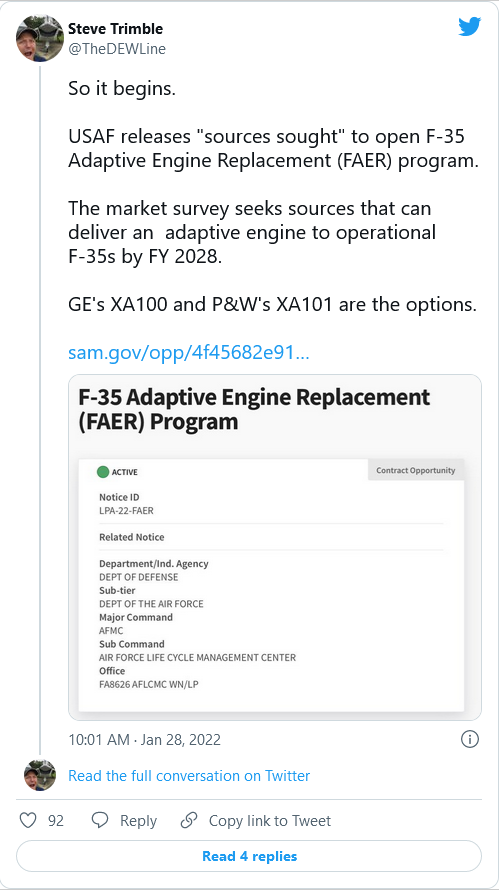
On Friday, the Air Force made the first meaningful step toward sourcing advanced new adaptive cycle engines for its primary stealth fighter, the F-35. These new engines, while still a ways from service, would offer a significant leap in capability for the aircraft practically across the board, giving the F-35 an advantage over the growing slew of foreign 5th generation competition.
The branch issued a “sources sought notice” for planning purposes only, which means we’re still a long way off from putting these next-generation engines in America’s top-tier fighters, but it could be well worth the wait.
In order to do so, these engines are designed to operate in different “modes.” When the pilot needs the engine’s peak performance in combat, he or she can lean hard on the throttle and the engine’s management system will take its cue to switch into its heavy-burning high-thrust mode. Conversely, while on a patrol, the engine would stay in its high-efficiency, low-burning mode to stretch the mileage or loiter time provided by each gallon of fuel.“The goal for the Air Force was to develop the next-generation fighter engine architecture and technologies to provide a generational step-change in combat propulsion capability,” David Tweedie, GE Edison Works’ General Manager of Advanced Combat Engines, told Sandboxx News last May.
“GE has worked hard to achieve the challenging objectives the Air Force has set out, and we believe we are delivering on what they’ve asked us to do.”
Incredibly, we’re not just talking about matching the power output of previous engines while increasing range… we’re talking about a 10% or better increase of thrust practically across the flight envelope alongside a 25% or better jump in range.“The mode transition is seamless to the pilot, and they won’t even know when it happens,” Tweedie said.
“They will control engine power using the throttle the way they always have, and the engine schedule will determine the appropriate operational mode.”
More range, more power, more capability
While the Air Force is now exploring the idea of sticking these engines under the hoods of F-35As, that boost in range would be especially valuable to the Navy. The F-35C has a total range of approximately 1,200 nautical miles, giving it a 600 mile combat radius in the best of times. That’s not far enough to launch sorties at China without putting America’s carriers in range of China’s hypersonic anti-ship weapons. A 25% boost in range, say to 750 miles, isn’t enough to eliminate this capability gap, but it’s a step in the right direction.
GE tested their XA100 at their high altitude test cell in Evendale, Ohio over the span of more than three months, starting at the tail end of 2020. According to their reports, their XA100 actually exceeded their performance targets on top of successfully demonstrating its ability to operate in both high-thrust and low-burn modes. The engine produces a total of 45,000 pounds of thrust, slightly better than the 43,000 pounds offered by the F-35’s current Pratt & Whitney F135-PW-100 afterburning turbofan.
The aim of the program was to increase thrust by 10% and fuel efficiency by 25% over conventional designs, but in testing, the engine did even better than that.
While this new engine’s ability to seamlessly transition between tearing through the sky like a top fuel dragster and minding the fuel gauge like a Toyota Prius might catch the attention of aviation enthusiasts, it might be the engine’s thermal management and use of advanced component technologies that really make the XA100 a huge leap forward in fighter engines.“Not only are we meeting that, we’re actually exceeding that pretty much everywhere in the flight envelope—and in a few places—up to 20% [more thrust],” Tweedie said. “We are very happy with where we are from thrust in terms of over-delivering versus the program requirement.”
“When you translate that to what it means to the platform, it’s 30% more range or 50% more loiter time depending on how you want to utilize that fuel burn improvement. It’s a significant increase in acceleration and combat capability with the increased thrust,” he added.
According to Tweedie, the XA100’s “three-stream architecture” enables a doubling of thermal management capacity, or in other words, a real reduction in the heat created by the engine’s operation. Heat is currently a limiting factor in power production for fighters, which have to limit their output to avoid damaging the aircraft itself. That will no longer be the case with the new generation of adaptive cycle engines, meaning fighters will have more electrical power to run systems.
“We see a significant increase in capability there [with] up to two times mission systems growth enabled by the [improved] thermal management,” Tweedie said.
[...]According to GE, advanced component technologies used in the construction of their XA100 engine, including additive and Ceramic Matrix Composites, also reduce the overall weight of the engine while also increasing durability over previous designs.
The result combination of power, fuel efficiency, heat management, and resilient but lightweight construction make the XA100 the physical embodiment of a fighter engine wish-list. While any of these improvements in capability would be welcome in most fighter designs, the collection of them in a single system could well make for a power plant that is even greater than the sum of its parts.
Of course, a sources sought notice is no guarantee that these new adaptive cycle engines will find their way into America’s F-35s, but this new approach to engine design will almost certainly be incorporated into future platforms, like the Air Force’s Next Generation Air Dominance fighter.
https://www.sandboxx.us/blog/the-air-force-is-eyeing-groundbreaking-new-engines-for-the-f-35/
X-39
To post or not to post, that is the question
- Joined
- 20 February 2021
- Messages
- 382
- Reaction score
- 954
https://www.ge.com/news/press-relea...tive-cycle-engine-tests-at-arnold-engineeringGE begins industry’s first adaptive cycle engine tests at Arnold Engineering Development Complex
March 30, 2022
TULLAHOMA, Tenn. – The U.S. Air Force and GE on March 25th initiated Phase 2 testing of GE’s second XA100 adaptive cycle engine at the Air Force’s Arnold Engineering Development Complex (AEDC). This milestone marks the first test of an Adaptive Engine Transition Program (AETP) engine at AEDC.
“AEDC’s advanced testing facilities are a unique national asset. We’re thrilled to begin testing here and continue maturing this propulsion system that we believe represents the future of the F-35,” said David Tweedie, GE Edison Works’ general manager for Advanced Combat Engines. “Our testing to date has validated the XA100’s transformational capability, and we’re looking forward to seeing the performance data from Phase 2 testing.”
GE completed Phase 1 testing of this XA100 test engine in November 2021 in Evendale, Ohio. Phase 2 testing will take place entirely at AEDC, representing the capstone of AETP and signaling readiness to transition this technology into full-scale development...
X-39
To post or not to post, that is the question
- Joined
- 20 February 2021
- Messages
- 382
- Reaction score
- 954
Ahhh.. yes, of course replacing the F-135 with entirely new engines will be too expensive. Just go with the EEP route and equip every F-35 with a couple of LO EFTs too, then... Boom! There you have 900-1000nmi combat radius. Better reserve the AETP towards it's intended platform (NGAD) that would really benefit from it, being designed with really long range in mind for the long distances in the Pacific, unlike the F-22 & F-35 airframes, which are disadvantaged by being too small , and since you can't cheat physics, there is only so much you can do to extend the reach of a certain aircraft with reengining and buddy tanking until it hits the point of diminishing returns.
https://www.airforcemag.com/decision-on-new-f-35-engines-predicted-in-2024-defense-budget/Decision on New F-35 Engines Predicted in 2024 Defense Budget
May 17, 2022 | By Greg Hadley
Whether the F-35 fighter will get new engines from the Air Force’s cutting-edge Adaptive Engine Transition Program is a question that needs to be resolved at the Defense Department level, Air Force Secretary Frank Kendall told lawmakers May 17—and he anticipates an answer in the 2024 budget.
“There are a number of options to improve the performance of the F-35 engine,” Kendall told the Senate Appropriations defense subcommittee. “The problem we have is that it’s a fairly complicated situation.”
For months now, members of Congress, Air Force officials, industry partners, and the F-35 Joint Program Office have talked about potential changes to the F-35’s F135 engine manufactured by Pratt & Whitney. Options have included either a modernized F135 “Enhanced Engine Package” or an advanced engine from AETP, which would provide substantial increases in performance and efficiency.
Engines from AETP are likely to power the Air Force’s planned sixth-generation fighter, the Next Generation Air Dominance platform. But both Congress and the Air Force has expressed an interest in getting those engines on the F-35 as well—lawmakers have introduced legislation requiring such a change starting in 2027, and Kendall said early in his tenure that he’d like to do so if it’s affordable.
That, however, has been a major sticking point. The Joint Program Office has made clear that any member of the F-35 program that wants to be “different” has to pay the full cost for that, which would include the development and integration of the AETP engines.
It’s unclear whether the Navy, the Marine Corps, or any of the other nations in the F-35 program are interested in splitting the costs of such an effort with the Air Force. GE Aviation, the maker of one of the AETP engines, has said its engine wouldn’t be able to go in the Marines’ F-35Bs and would need modifications for the Navy’s F-35Cs.
None of the other services or partners have agreed on the need for the AETP engine, Kendall confirmed to Sen. Susan Collins (R-Maine).
“Each of the services and each of our partners is in a different situation with regard to the economics of doing that and the performance requirements,” Kendall said. “We have the largest fleet in the Air Force—we will have the largest fleet. So we have the greatest interest in this, I think, but there’s a significant cost associated with a brand new engine, development of that. It’s less expensive to do an upgrade, perhaps, and get increased performance, and then there are other options in between.”
With so many different perspectives and needs to juggle, Kendall said that the Office of the Secretary of Defense will need to make a final call on any changes, seemingly hinting that the Air Force won’t look to “go it alone” with their own separate effort.
“The Department of Defense has to make a decision overall about engine modifications and upgrades for the F-35. I expect that process to take place over the next few months as we build the [2024] budget,” Kendall told Collins. “What the Air Force has funded is continuing the AETP technology development, but we’re going to need to have a decision at a higher level about the overall program for F-35 engine modifications and upgrades.”
The Pentagon and the Air Force released their 2023 budget request in late March, and Congress is in the process of marking up that budget. Planning for the 2024 budget, however, is already underway.
“It’s a complicated situation, and we’re going to have to sort it out at the DOD level as we go through the process of preparing the 2024 budget,” Kendall said.
X-39
To post or not to post, that is the question
- Joined
- 20 February 2021
- Messages
- 382
- Reaction score
- 954
https://aviationweek.com/defense-sp.../ges-xa100-poised-vie-new-f-35-engine-programGE’s XA100 Poised To Vie for New F-35 Engine Program
July 04, 2022
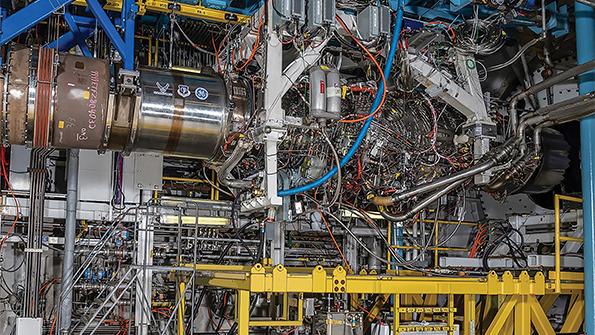
The XA100 is undergoing dynamic tests across a range of simulated altitude conditions at AEDC.
Credit: U.S. Air Force
General Electric says the XA100 adaptive-cycle fighter engine is on track to complete an exhaustive two-phase evaluation later this summer as a new U.S. Air Force leadership team moves forward with a proposal to reengine the domestic Lockheed Martin F-35A fleet.
aonestudio
I really should change my personal text
- Joined
- 11 March 2018
- Messages
- 3,376
- Reaction score
- 9,218

- Joined
- 21 April 2009
- Messages
- 14,348
- Reaction score
- 9,429
Aircraft propulsion is one of our technology Crown Jewels
https://www.defensenews.com/air/202...utm_medium=social&utm_campaign=fb_defensenews
https://www.defensenews.com/air/202...utm_medium=social&utm_campaign=fb_defensenews
So basically F-135EEP give 10% improvement in range and thrust and 50% improvement in cooling
XA100 AETP gives 20% improvement in thrust, 30% improvement in range and 100% improvement in cooling.
Though to be fair, if they don't choose the XA100 then it likely stall the tech just like what happen to scramjet tech
XA100 AETP gives 20% improvement in thrust, 30% improvement in range and 100% improvement in cooling.
Though to be fair, if they don't choose the XA100 then it likely stall the tech just like what happen to scramjet tech
Last edited:
- Joined
- 15 January 2021
- Messages
- 649
- Reaction score
- 2,859
Don’t forget the P&W XA101, which has also demonstrated the AETP performance goals.So basically F-135EEP give 10% improvement in range and thrust and 50% improvement in cooling
XA100 AETP gives 20% improvement in thrust, 30% improvement in range and 100% improvement in cooling.
Though to be fair, if they don't choose the XA100 then it likely stall the tech just like what happen to scramjet tech
But if the F-35 picks the XA101, doesn’t that also cause the same industrial base issue as retaining the F135 in EEP form?

- Joined
- 4 July 2010
- Messages
- 2,689
- Reaction score
- 3,748
Depends. If all the partners and all the variants switch over, then eventually yes. Won't happen overnight, and USAF would hope the Next-Gen program would reach down-select before then. GE's supporters are arguing that if they get canned, the company's going to struggle to keep in the game for the Next-Gen engine without a hot advanced turbine production line.Don’t forget the P&W XA101, which has also demonstrated the AETP performance goals.So basically F-135EEP give 10% improvement in range and thrust and 50% improvement in cooling
XA100 AETP gives 20% improvement in thrust, 30% improvement in range and 100% improvement in cooling.
Though to be fair, if they don't choose the XA100 then it likely stall the tech just like what happen to scramjet tech
But if the F-35 picks the XA101, doesn’t that also cause the same industrial base issue as retaining the F135 in EEP form?
- Joined
- 3 June 2011
- Messages
- 20,895
- Reaction score
- 19,083
I don't see how. GE is also in the running for the NGAD engine (which is a separate program).Depends. If all the partners and all the variants switch over, then eventually yes. Won't happen overnight, and USAF would hope the Next-Gen program would reach down-select before then. GE's supporters are arguing that if they get canned, the company's going to struggle to keep in the game for the Next-Gen engine without a hot advanced turbine production line.Don’t forget the P&W XA101, which has also demonstrated the AETP performance goals.So basically F-135EEP give 10% improvement in range and thrust and 50% improvement in cooling
XA100 AETP gives 20% improvement in thrust, 30% improvement in range and 100% improvement in cooling.
Though to be fair, if they don't choose the XA100 then it likely stall the tech just like what happen to scramjet tech
But if the F-35 picks the XA101, doesn’t that also cause the same industrial base issue as retaining the F135 in EEP form?
- Joined
- 4 July 2010
- Messages
- 2,689
- Reaction score
- 3,748
GE's not in the same business position it was when it lost the last two advanced turbine competitions, nor are it's suppliers. Considering the current leadership of their parent company, they may decide not to put in the money to go for a fourth if this one gets deep-sixed.I don't see how. GE is also in the running for the NGAD engine (which is a separate program).Depends. If all the partners and all the variants switch over, then eventually yes. Won't happen overnight, and USAF would hope the Next-Gen program would reach down-select before then. GE's supporters are arguing that if they get canned, the company's going to struggle to keep in the game for the Next-Gen engine without a hot advanced turbine production line.Don’t forget the P&W XA101, which has also demonstrated the AETP performance goals.So basically F-135EEP give 10% improvement in range and thrust and 50% improvement in cooling
XA100 AETP gives 20% improvement in thrust, 30% improvement in range and 100% improvement in cooling.
Though to be fair, if they don't choose the XA100 then it likely stall the tech just like what happen to scramjet tech
But if the F-35 picks the XA101, doesn’t that also cause the same industrial base issue as retaining the F135 in EEP form?
- Joined
- 3 June 2011
- Messages
- 20,895
- Reaction score
- 19,083
They're ALREADY putting money in the next gen.GE's not in the same business position it was when it lost the last two advanced turbine competitions, nor are it's suppliers. Considering the current leadership of their parent company, they may decide not to put in the money to go for a fourth if this one gets deep-sixed.I don't see how. GE is also in the running for the NGAD engine (which is a separate program).Depends. If all the partners and all the variants switch over, then eventually yes. Won't happen overnight, and USAF would hope the Next-Gen program would reach down-select before then. GE's supporters are arguing that if they get canned, the company's going to struggle to keep in the game for the Next-Gen engine without a hot advanced turbine production line.Don’t forget the P&W XA101, which has also demonstrated the AETP performance goals.So basically F-135EEP give 10% improvement in range and thrust and 50% improvement in cooling
XA100 AETP gives 20% improvement in thrust, 30% improvement in range and 100% improvement in cooling.
Though to be fair, if they don't choose the XA100 then it likely stall the tech just like what happen to scramjet tech
But if the F-35 picks the XA101, doesn’t that also cause the same industrial base issue as retaining the F135 in EEP form?
Post #51 above:
https://www.airforcemag.com/air-force-looks-beyond-aetp-for-engines-to-power-ngad-fighter/
bring_it_on
I really should change my personal text
- Joined
- 4 July 2013
- Messages
- 4,203
- Reaction score
- 5,730
So basically F-135EEP give 10% improvement in range and thrust and 50% improvement in cooling
XA100 AETP gives 20% improvement in thrust, 30% improvement in range and 100% improvement in cooling.
Though to be fair, if they don't choose the XA100 then it likely stall the tech just like what happen to scramjet tech
The AETP contracts that each vendor is working on currently (testing) had options for NGAD engine (NGAP) built in. Both of those were exercised a while ago. So both OEM's have a shot at one adaptive cycle engine in the next 2 years (NGAP selection is in 2024). This leaves the F-35 re-engine effort to carry the water for sustaining another engine with its own design, and production base. This is why the USAF thinks it is so critical because they want two robust designs and production engines. I don't see any relation to "scramjet tech" whatever happened to it..I don't see any alternative to not pursuing an adaptive engine for the F-35 for industrial base reasons alone. But we'll see. We're seeing this now because of the FY-24 budget prep where these trades are likely to be made.
Similar threads
-

-

-
-
 ATK's Hypersonic Thermally Throated RamJet
- Started by bobbymike
- Replies: 4
-
