GE hybrid electric turbofan

Could this be related to the wing-tip electric fans proposed else-where ?

Also, is there 'useful' difference between maximum engine power and what open / closed turbo-fans can use at low level ??

Especially concerning airport tip-noise, regulatory requirements etc etc...

But, agreed: We seem to be missing *something* in GE's proposal...
 
https://www.geaerospace.com/news/pr...ates-narrowbody-hybrid-electric-engine-system
It's not clear to me how they use additional electric energy (eg for take off) without battery storage.
Good question. Their demonstrator has motor / generators on both the high and low rotors. The only thing I can think of is that they are transferring energy from one rotor to the other, effectively changing the work split between the rotors. I’m not exactly sure how this improves performance or efficiency, but they may be able to vary the bypass ratio to optimize takeoff vs cruise operation.
 
Good question. Their demonstrator has motor / generators on both the high and low rotors. The only thing I can think of is that they are transferring energy from one rotor to the other, effectively changing the work split between the rotors. I’m not exactly sure how this improves performance or efficiency, but they may be able to vary the bypass ratio to optimize takeoff vs cruise operation.

I also thought about this but I do not see a flight regime for subsonic passenger aircrafts where you gain efficiency by not transferring the powersplit to the fan as much as possible.
 
Without batteries, it's essentially a geared turbofan that can tune the gear ratio for optimal performance. An eCVT transmission in a car uses two electric motors and a planetary gear in a broadly similar way.
 
“Hybrid electric propulsion is central to how GE Aerospace is redefining the future of flight,” said Arjan Hegeman, vice president of future of flight for GE Aerospace. “Our latest milestone successfully demonstrated a narrowbody hybrid electric engine architecture that doesn’t require energy storage to operate. It’s a critical step to making hybrid electric flight a reality for commercial aviation with technologies that meet customer needs for greater efficiency, durability, and range.”
Huh.

Electric motors on both the HP and LP spools?
 
It's not clear to me how they use additional electric energy (eg for take off) without battery storage.

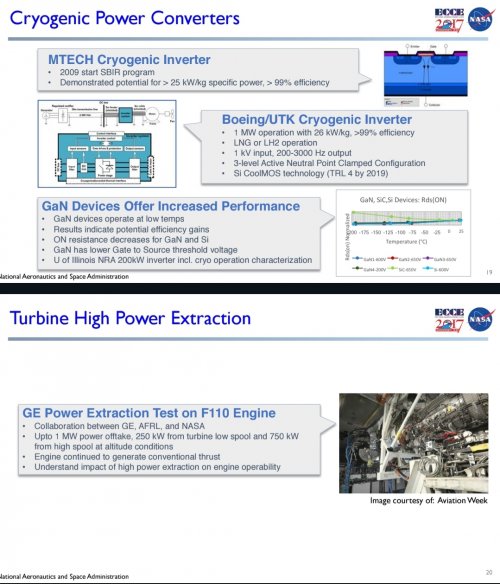
This is actually a research program for military applications. I have attached a screenshot from a 2017 NASA presentation.

Note how Boeing is designing the inverter which is very unusual. This is because the inverter has to be highly integrated into the airframe. It also shows that it needed to be tech ready by 2019. This lines up perfectly with the first flight of the Boeing F/A-XX demonstrator in 2019.

On the very next slide they show the modified F110 engine that has 1MW of peak power generation and about 200kw continuous power generation. This is about 10-15 times more electricity than the existing F110 generators. This allows the F110 to meet the electrical generation requirements of a 6th gen fighter. The US Navy F/A-XX requirement was for a modified version of an existing off the shelf engine.

Screenshot_20260507_092252_Chrome.jpg


Huh.

Electric motors on both the HP and LP spools?
Yes electric motors on the shafts. Deep inside the engine instead of on the outside. This will be how all the new fighter jet engines will generate electricity and they will also be used as starter motors. Rolls Royce has excellent renderings on this technology for Tempest.

 
Should make it much more resistant to stalling. And the technology could perhaps boost acceleration when combined with storage.
 
Should make it much more resistant to stalling. And the technology could perhaps boost acceleration when combined with storage.
That definitely won't be the case. While 1 Megawatt of electricity sounds a lot it would be a couple percent of the shaft power of a F110 engine.

The F35B lift fan for example takes away 22 megawatt from the F135 engine and that is only a small fraction of the total engine power. If too much shaft power is taken away the engine would stall.

I estimate close to 100 Megawatt of shaft power in the F110 engine with the majority being used by the engines own fan and compressor. A 1 Megawatt electric motor would do hardly anything.

The resson for the large 1MW size is primarily for starting the engine. That equals the power of the gas starting system and it is why they have an electric motor on both shafts so they can both be spun up to idle speed. It removes all of the accessories attached to the engine. Everything runs off electricity.

The F110 was the test bed for this technology as that engine was selected for multiple new fighters. All the technology would be going into the XA102 and XA103. The F110 is then on par with the 6th gen engines in terms of power generation.
 
Last edited:
Note how Boeing is designing the inverter which is very unusual. This is because the inverter has to be highly integrated into the airframe. It also shows that it needed to be tech ready by 2019. This lines up perfectly with the first flight of the Boeing F/A-XX demonstrator in 2019.

On the very next slide they show the modified F110 engine that has 1MW of peak power generation and about 200kw continuous power generation. This is about 10-15 times more electricity than the existing F110 generators. This allows the F110 to meet the electrical generation requirements of a 6th gen fighter. The US Navy F/A-XX requirement was for a modified version of an existing off the shelf engine.

That was not requirement for the AII-X demonstrator that first flew in 2019.

For a technology to be “ready” for a first flight on a manned demonstrator it would need to be “ready” 2 years before, during the design stage.
 
This is actually a research program for military applications. I have attached a screenshot from a 2017 NASA presentation.

Note how Boeing is designing the inverter which is very unusual. This is because the inverter has to be highly integrated into the airframe. It also shows that it needed to be tech ready by 2019. This lines up perfectly with the first flight of the Boeing F/A-XX demonstrator in 2019.

On the very next slide they show the modified F110 engine that has 1MW of peak power generation and about 200kw continuous power generation. This is about 10-15 times more electricity than the existing F110 generators. This allows the F110 to meet the electrical generation requirements of a 6th gen fighter. The US Navy F/A-XX requirement was for a modified version of an existing off the shelf engine.

View attachment 811468


Yes electric motors on the shafts. Deep inside the engine instead of on the outside. This will be how all the new fighter jet engines will generate electricity and they will also be used as starter motors. Rolls Royce has excellent renderings on this technology for Tempest.
This isn't exactly new per se. I've learned this in school's physics class. Basic thermodynamics and electric circuitry.
https://en.wikipedia.org/wiki/Thermoelectric_generator
The new thing are the new and more efficient silicon technology with GaN which makes it far more feasible than in the past.
In any case, it's basically using a cryogenic liquid as a battery. The advantage here compared to a normal battery is that it's perishable, hence, the aircraft gets lighter. But this also means it has a time limited use. Obviously, there's a lot to balance here, the volume and mass verses ordinary fuel & generators etc.
Then we have to consider it requires a large supply tail that, frankly would be more vulnerable than the usual under ground tanks.
I'm not so sure how viable this is in wartime and under combat or unexpected mission time extensions/diversions etc.
 
Last edited by a moderator:
This is actually a research program for military applications. I have attached a screenshot from a 2017 NASA presentation.

Note how Boeing is designing the inverter which is very unusual. This is because the inverter has to be highly integrated into the airframe. It also shows that it needed to be tech ready by 2019. This lines up perfectly with the first flight of the Boeing F/A-XX demonstrator in 2019.

On the very next slide they show the modified F110 engine that has 1MW of peak power generation and about 200kw continuous power generation. This is about 10-15 times more electricity than the existing F110 generators. This allows the F110 to meet the electrical generation requirements of a 6th gen fighter. The US Navy F/A-XX requirement was for a modified version of an existing off the shelf engine.

View attachment 811468


Yes electric motors on the shafts. Deep inside the engine instead of on the outside. This will be how all the new fighter jet engines will generate electricity and they will also be used as starter motors. Rolls Royce has excellent renderings on this technology for Tempest.
Talking about electric motors and generators on engine shafts - looking decades back the F-86 also had the startergenerator mounted at the front of the intake on the engine shaft (at least on the Orenda-powered versions).
 
That was not requirement for the AII-X demonstrator that first flew in 2019.

This is incorrect.

Increased electricity generation is a key requirement for all 6th generation fighters. The Navy has been clear that the F/A-XX engine must be a modified version of an existing design.

The Navy confirmed to Aviation Week in 2024 that the F/A-XX will be powered by a derivative of an existing engine, and none of the range-boosting adaptive turbofans is still in development by the Air Force.

https://aviationweek.com/defense/ai...act-award-long-term-plan-eludes-fa-xx-program

Boeing developing the invertor for the F110 test engine is not a coincidence.
 
Talking about electric motors and generators on engine shafts - looking decades back the F-86 also had the startergenerator mounted at the front of the intake on the engine shaft (at least on the Orenda-powered versions).
So did J34s and IIRC J79s.
 
Might electric motor coils best be located just behind the wing leading edge to help de-icing?

Opposed piston engines could fit in flat wings, and supply electrical power even if sliding back and forth on tracks....useful to slide them to the fuselage for internal repair/removal:
https://hackaday.com/2026/05/06/why-opposed-piston-internal-combustion-engines-are-great/

Big turbines need nacelles, and thus have to be more of a part of an airframe.

Internal modularity better?
 
Last edited:
massive power generation headroom is fantastic, but these power generation figures may impose other consequences on the aircraft: robust cooling systems could be needed especially for high load duty cycles (to say nothing of these slightly incredible rumblings a pew pew dew is going into F-47) and crucially for a VLO aircraft, a way of managing and dumping that heat with minimal IR signature consequences.

In theory, adaptive three stream engines with spool integrated generators (or whatever clever trick is used) could address all of the above points.

if f/a-xx doesn’t in fact use a three stream engine, perhaps the simpler approach here is to use the likely high fuel fraction of f/a-xx arising from range goals to design a fuel system that also capably cools major subsystems.
 
perhaps the simpler approach here is to use the likely high fuel fraction of f/a-xx arising from range goals to design a fuel system that also capably cools major subsystems.
That's what I expect to happen. The weather at 35,000ft is kinda chilly as long as you're subsonic, and even the Blackbird was able to dump heat into the fuel and out the engines.
 
Might electric motor coils best be located just behind the wing leading edge to help de-icing?
We got electric sheets for that today.

Fuel cooling has been standard for decades. Bleed air and additional inlets are still needed. And with AFC the heatexchangers dump it all there for the pressure. It's gotten complicated with EPACS that combines compressors and (emergency) turbine/generator etc.
Having cryongenics is one solution the chinese are pursuing for the DEW but that has a time limit all the same.
 
massive power generation headroom is fantastic, but these power generation figures may impose other consequences on the aircraft: robust cooling systems could be needed especially for high load duty cycles
That 1MW is a peak figure which would only be the starting. Continuous power is not that massive. It's hard to imagine a fighter sized radar doing bursts over 100kw.

if f/a-xx doesn’t in fact use a three stream engine, perhaps the simpler approach here is to use the likely high fuel fraction of f/a-xx arising from range goals to design a fuel system that also capably cools major subsystems.
The three stream engines would provide minimal range advantage over the F110. The F110 has a unusually high 0.76:1 bypass ratio which provides excellent fuel burn. The F414, F119, F100, EJ200 and M88 are all at 0.4:1 or lower. The F135 is 0.57:1.

The best way to describe the XA102 and XA103 engine performance is that it performs like the F110 in high bypass efficiency mode and performs like the F119 in low bypass power mode. Going from the high 0.76:1 BPR of the F110 to the low 0.25:1 BPR of the F119 is already a large adaption. The F119 has 20% more thrust than the F110. The F110 has 20% better fuel burn than the F119. 20% was the goal of the adaptive engines.

The F110 then performs similar to the three stream engines that are stuck in efficiency mode. So in terms of range the F110 performs well and most likely satisfied the F/A-XX requirement. The three stream engines primary advantage would be a higher supercruise speed when in low bypass mode.

The US Navy was clear for many years that they did not want to spend $5+ billion on their own engine development. If that cost is amortised over 400 F/A-XX it could increase the flyaway cost by ~20%.

However that quote from aviation week was from 2024 and before the F-47 was selected by the USAF. The USAF has now fully funded a three stream engine that is F110 sized. This completely changes the cost/benefit analysis for the Navy. A three stream engine might now only increase the F/A-XX flyaway cost by 5%.
 
This is incorrect.

Increased electricity generation is a key requirement for all 6th generation fighters. The Navy has been clear that the F/A-XX engine must be a modified version of an existing design.

No, it is not.

Requirements for military aircraft are about what it *does*. Fly this far, this fast, and do this mission. There is very little about the "how" it does the mission, and NOTHING about the electrical power. That wouldn't make any sense. "Fly 1000nm at Mach 1.2, find 3 enemy fighters and kill them.... while generating 1.21 gigawatts of energy". Yeah, that makes no sense, which is why that is never part of the requirements. If the contractor responding to the requirements can do it with 100w, 2kw, 1gw, whatever, the customer doesn't care.

The AII-X designs demonstrated key technologies for advanced aircraft. The program started more than 10 years ago.


The Navy has NEVER stated that the F/A-XX engine "must" be a modified version of existing design. That is not a requirement. What the Navy actually said is this:

The Navy previously confirmed that the F/A-XX required a different airframe than the Air Force's next fighter, ending speculation about a multiservice program. But naval officials never clarified whether the F/A-XX would share a propulsion system with the NGAD platform. The service once appeared interested in adaptive-cycle technology, participating in the Air Force’s early development work and investing in its own Variable-Cycle Advanced Technology program.

In the past decade, however, propulsion plans for the Air Force and Navy have diverged, Donnelly says. The Air Force continues to develop Next-Generation Adaptive Propulsion (NGAP), the only one of five new technologies confirmed to be funded by the NGAD program. But the industry proposals submitted for the F/A-XX contract are based on older engines that lack the variable bypass flow of adaptive engines.

“We're looking at more of a deriva- tive-type engine solution,” Donnelly says. “That’s just one example where we probably are different in many ways from the Air Force. In totality, they are two unique programs from an acquisition point of view and also going forward, so we’re relatively independent of each other at this point.”

The industry proposals for F/A-XX used "older" engines. The Navy did not require that they do so.

You will also note that here, as well as in many other places, the Navy has been explicit that they require a different aircraft design than the Air Force.

What does any of this have to do with a GE hybrid electric turbofan?
Nothing.
 
That 1MW is a peak figure which would only be the starting. Continuous power is not that massive. It's hard to imagine a fighter sized radar doing bursts over 100kw.
For 1950s fighter aircraft radars like in the F-86D etc peak pulse powers of 250kw are mentioned.
 

Similar threads

Back
Top Bottom