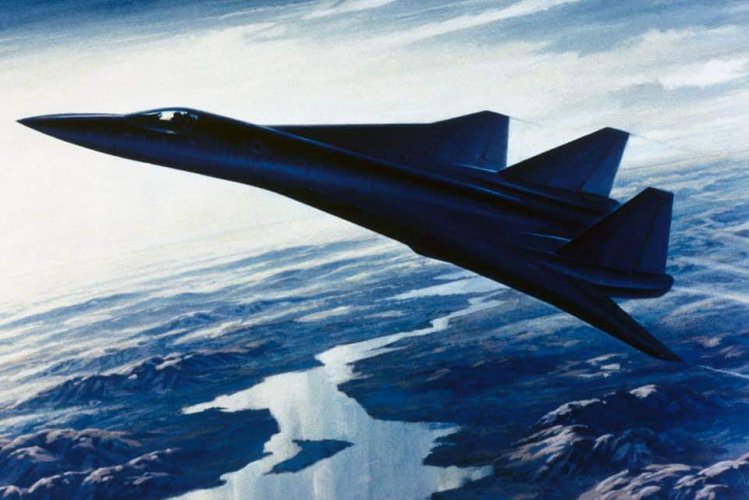
Forum Design Challenge: Conceptualizing a modern interceptor, forum input requested.

Since search is a key aspect, i am thinking a re-purposed active homing guidance section might be adequate rather than an expensive single purpose design for it. Keep it simple, stupid. Let EOTS and gun take its information to quickly find targets and aim the gun.
 
I have a soft spot for this General Dynamics early ATF concept. Coupled with the AIM-152 AAM (tube launched, two stage, interchangeable seeker head), it was to me exactly what an interceptor should be: sleek, fast, painted black.
I wouldn’t mind seeing a modernized variant of this...
 

Attachments

  • FB_IMG_1588434161413.jpg
    FB_IMG_1588434161413.jpg
    55.5 KB · Views: 17
So, no AT802/OA-1Ks with the F-16 radar in a pod?
It's a two-way problem.
1 part is police action, taking into account explosive growth of civilian UAV usage. Those can keep rotorcraft speeds, but they will probably need hover as a prerequisite. Helicopters probably do that.

2 part is military intercept. And here problem is one continuous threat profile from 100 to 1100 km/h, from 5 to 5000m. It should be something with extremely capable sensor field, capable of flying slow and fast, safely and precisely.

Then big intercept.

Skipping smaller types(fighter-interceptor, etc), we broadly speak about 3 tasks.

-Defca. Should be done with an air superiority fighter, but either fighter or entire system should be focused on being able to target and entangle LO threat, including one flying at low altitudes. Basic assumption is that this threat not just fights back, but actively seeks to destroy defca fighters and win air superiority.
Broadly, it's su-57 personified. But there's a question how you do it on the next tech turn.

-LACM intercept. LACM intercept is catching many individual LO or VLO targets, which also get AI and are likely to learn to defend themselves.
This task always require largest possible pool of MRAAMs (and ideally IIR-APKWS type as a backup) and powerful search/targeting sensor, but geographic spread determines optimal carrier.
Broadly, best available modern LACM interceptor is likely F-15EX, but many fighters can do it in principle.

-Loitering interceptor(BARCAP is a subtype), probably against modern bomber threat. A major problem, requiring ability to rapidly scan wast space(speed, powerful sensors) against broadband VLO targets, which can't be effectively found/targeted via radar (and which also can and will fight back).
Some respite can be found in that modern generation of VLO bombers likely can't really go down, i.e. large aperture optics(J-36) are likely the way.
But J-36 in my opinion is a subsonic cruiser, which can go supersonic if really necessary. Here you'd need a supercruiser, operating with multiple loyal wingmen.

 
It's a two-way problem.
1 part is police action, taking into account explosive growth of civilian UAV usage. Those can keep rotorcraft speeds, but they will probably need hover as a prerequisite. Helicopters probably do that.
The problem I see is that helicopters aren't fast enough to redeploy at present.

That is getting developed out, but nobody currently has armed fast helos. Lynx/Wildcat has gotten significantly slowed by all the drag added, for example, and loaded AH1 or AH64 isn't doing 200 knots.


2 part is military intercept. And here problem is one continuous threat profile from 100 to 1100 km/h, from 5 to 5000m. It should be something with extremely capable sensor field, capable of flying slow and fast, safely and precisely.
That would suggest something like a Super Bug or F-35C, for the better slow flight. Or a high-speed tiltrotor?


-Defca. Should be done with an air superiority fighter, but either fighter or entire system should be focused on being able to target and entangle LO threat, including one flying at low altitudes. Basic assumption is that this threat not just fights back, but actively seeks to destroy defca fighters and win air superiority.
Broadly, it's su-57 personified. But there's a question how you do it on the next tech turn.
For North America, that's not a significant problem until someone mounts AAMs and radars on Skyfalls.

For Europe and Asia, it's an issue.


-LACM intercept. LACM intercept is catching many individual LO or VLO targets, which also get AI and are likely to learn to defend themselves.
This task always require largest possible pool of MRAAMs (and ideally IIR-APKWS type as a backup) and powerful search/targeting sensor, but geographic spread determines optimal carrier.
Broadly, best available modern LACM interceptor is likely F-15EX, but many fighters can do it in principle.
I was trying to find a cheaper way to do it than F-15EXs. (It still boggles my mind that an EX is the cost of an F-35!)


-Loitering interceptor(BARCAP is a subtype), probably against modern bomber threat. A major problem, requiring ability to rapidly scan wast space(speed, powerful sensors) against broadband VLO targets, which can't be effectively found/targeted via radar (and which also can and will fight back).
Some respite can be found in that modern generation of VLO bombers likely can't really go down, i.e. large aperture optics(J-36) are likely the way.
But J-36 in my opinion is a subsonic cruiser, which can go supersonic if really necessary. Here you'd need a supercruiser, operating with multiple loyal wingmen.
IIRC, the radar of the E-2D Hawkeye was specifically chosen for its better ability to detect LO/VLO aircraft.

There is also the option of looking for where radio signals are getting distorted in the air, but that takes immense computational power and a good baseline for what the skies look like.
 
IIRC, the radar of the E-2D Hawkeye was specifically chosen for its better ability to detect LO/VLO aircraft.
UHF will help against modern tactical stealth.(like, F-35)

Against stealth bombers with large enough geometry to both avoid smaller features and tolerate thicker RAMs - it doesn't work.
 
Back
Top Bottom