- Joined
- 26 May 2006
- Messages
- 38,253
- Reaction score
- 20,390
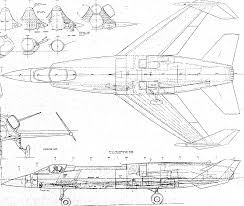
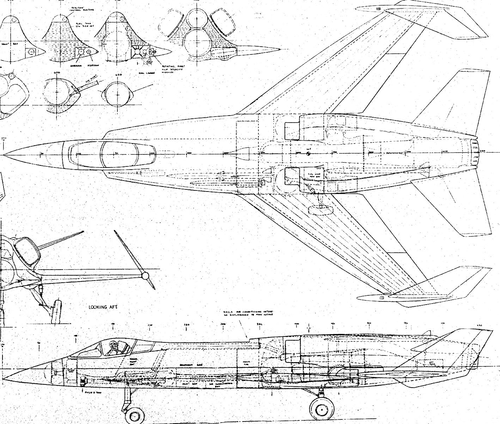
P.1240 Stealth ASTOVL 1 x vectored thrust reverse engine installation * 1987 Swept wing with tip fins
Hi,
https://www.sae.org/publications/technical-papers/content/2003-01-3050/

P.1240 Stealth ASTOVL 1 x vectored thrust reverse engine installation * 1987 Swept wing with tip fins


These were very minimal 'quick looks' at things like how to put in a backwards engine etc. One of them says 'as seen on Tomorrow's World'; apparently a manager saw the episode and asked for a drawing.From the above source
"The P1237 was another RALS concept while the P1240 was a semi-stealth design with a reverse-flow Pegasus engine and dorsal intakes. A centreline mounted ‘clang box’ exhausted the core flow for vertical flight while the fan exhausted aft through two vectoring nozzles in the wing roots. In wing-borne flight the core flow was directed through an afterburning rear nozzle. It also featured a butterfly tail, highly swept wing with tip-mounted fins and internal weapons carriage.
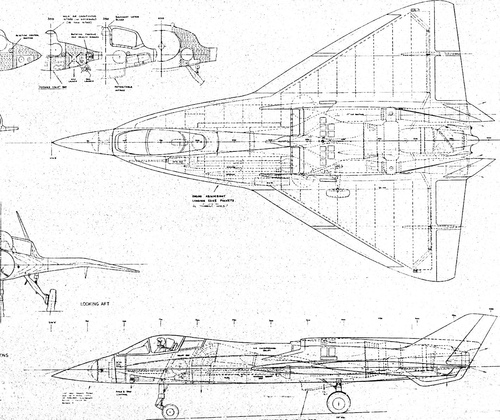
Stealth also led to internal weapons carriage being used on the RALS equipped P1241, which featured a delta wing and inward canted fins aft of the dorsal intakes. Both projects featured a blended wing/body layout with large wing root extensions to enhance maneuverability."
View attachment 620305View attachment 620306
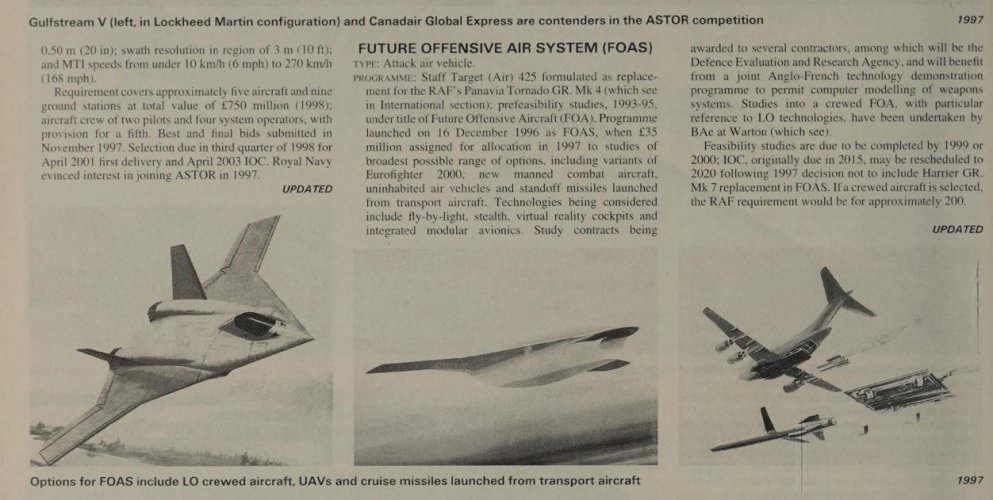
 ) Hercules-based missile launching FOAS concept?
The new Chris Gibson book "Typhoon to Typhoon" gives a detailed description of a BAe P195 project with stovl capability that fits in this. Sadly no illustration
no, they tested the "motorcycle" style cockpit, in the 1950s IIRC, and it isn't as good as people thought it would be.Hmmm....I remember reading comments of a synthetic vision system in the context of FOAS.
Odd though is the pilot's head is the wrong way around for maximum G tolerance IMO.
Large, probably F-22 sized, IMO. Larger than an F-35 for sure.What would folks say the size of this machine was if built?
I seem to remember a comment along the lines of "the prone position is a very good position... just not for flying an aircraft"no, they tested the "motorcycle" style cockpit, in the 1950s IIRC, and it isn't as good as people thought it would be.
Large, probably F-22 sized, IMO. Larger than an F-35 for sure.
Rather the complexity of trying to cram 50's cockpit systems and ejection systems. Proved not worth the benefits it THEN delivered.no, they tested the "motorcycle" style cockpit, in the 1950s IIRC, and it isn't as good as people thought it would be.
Probably so. At least in lengthLarge, probably F-22 sized, IMO. Larger than an F-35 for sure.
The reporting I remember was specifically that there wasn't any better G-tolerance in the motorcycle cockpit.Rather the complexity of trying to cram 50's cockpit systems and ejection systems. Proved not worth the benefits it THEN delivered.
With respect to the mid-fifties RAE Meteor trials, poor visibility and lack of 'seat-of-the-pants' feel were noted downsides.Rather the complexity of trying to cram 50's cockpit systems and ejection systems. Proved not worth the benefits it THEN delivered.
RAE found the improvement of g-tolerance (w/o g-suit considered to be ~4.1g grey/~4.7 black-out) was improved such that it exceeded the Meteor's structural limit of 6.5g.The reporting I remember was specifically that there wasn't any better G-tolerance in the motorcycle cockpit.
Weird, that completely reverses what I had read...With respect to the mid-fifties RAE Meteor trials, poor visibility and lack of 'seat-of-the-pants' feel were noted downsides.
RAE found the improvement of g-tolerance (w/o g-suit considered to be ~4.1g grey/~4.7 black-out) was improved such that it exceeded the Meteor's structural limit of 6.5g.
ref:. Research paper published in The Journal of Aeronautical History by Dr Graham Rood, 'The Royal Aircraft Establishment Farnborough: 100 years of Innovative Research, Development and Application'.

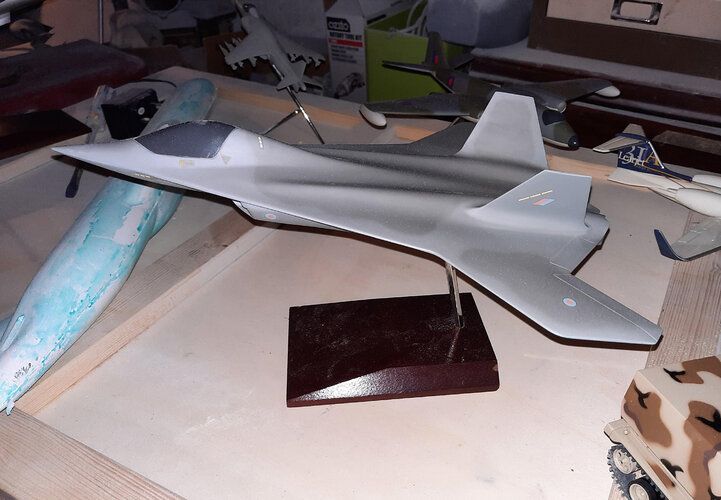
OMG! You guys finally found the "Testors" F-19! (P.1241).
Seriously, though, thanks for finding these designs. Especially the P.1240, even though those wing tip controls would have made it excessively heavy. It just looks really cool!

15 years ago https://www.secretprojects.co.uk/threads/foas-fcba-foa-fcac.1202/post-58751has this been posted here yet? https://www.airwar.ru/enc/xplane/foas.html


Warton drew a lot of concepts for FOAS (et al) under various P numbers. I think it'll be awful for a historian to find them let alone sort as this time period coincided with the end of paper...The high number of the P.149 sub-variant indicates that a fair amount of work must have been done on stealthy designs.
Spreadsheet with a copy-pasted "no paper files found for this number" entry. Simple. Yet absolutely rage-inducing because they can't find it.Warton drew a lot of concepts for FOAS (et al) under various P numbers. I think it'll be awful for a historian to find them let alone sort as this time period coincided with the end of paper...

RAF aims for multiple arrays
By FlightGlobal | 17 April 1996
Douglas Barrie/EDINBURGH
THE ROYAL Air Force’s next generation of strike aircraft is likely to be designed with multiple radar-antenna-arrays located around the airframe. This will provide a “radar picture” considerably larger than at present.
The Future Offensive Aircraft (FOA), now in the conceptual-design phase, will include a series of low-observable features, and a traditional large-diameter radar bay in the nose is unlikely to be available. The aircraft could be a joint French/German/UK project.
The $150 million GEC -Thomson-DASA Airborne Radar consortium is working on an airborne multi-function solid-state active-array radar (AMSAR) which could be used on projects such as the FOA and a mid-life update of the Eurofighter EF2000.
Flight testing of a prototype of the X-band radar is scheduled to begin in 2002.
Prof John Roulston, technical director at GEC-Marconi Avionics, says that “side arrays” provide several opportunities and advantages. He says that the FOA radar-antenna technology “…is really very important”.
With FOA liable to have an “irregular shape”, the ability to compensate for limited radar space in the nose section by using multiple-aperture options becomes increasingly important.
Roulston says that antenna arrays could be placed along the front of the shoulder area of a blended wing/fuselage, or on the forward lower section of the fuselage. Appropriately placed active arrays could also provide rear-hemisphere coverage.
Roulston says that moving towards multiple arrays for strike/attack and air-intercept radar applications (rather than pursuing the Russian approach of mounting electronically scanned antenna on gimbals) offers size and cost advantages, as well as an increased “look area”. The trend is away from big aircraft, he notes.
The EF2000 and the Dassault Rafale are earmarked to benefit from the AMSAR as part of mid-life update programmes to replace the current ECR-90 and the RBE2 radars, respectively.
Multiple radar-arrays also offer offensive and defensive advantages to fighter aircraft. As well as rear-hemisphere coverage, they could also increase the action-manoeuvre area for aircraft involved in beyond-visual-range missile engagements.
Tracking the target and providing updated information using an antenna array placed elsewhere than in the nose section would allow the pilot greater flexibility in moving the aircraft, and increasing the so-called F-Pole: the distance between the launch aircraft and the target at the time of missile impact.

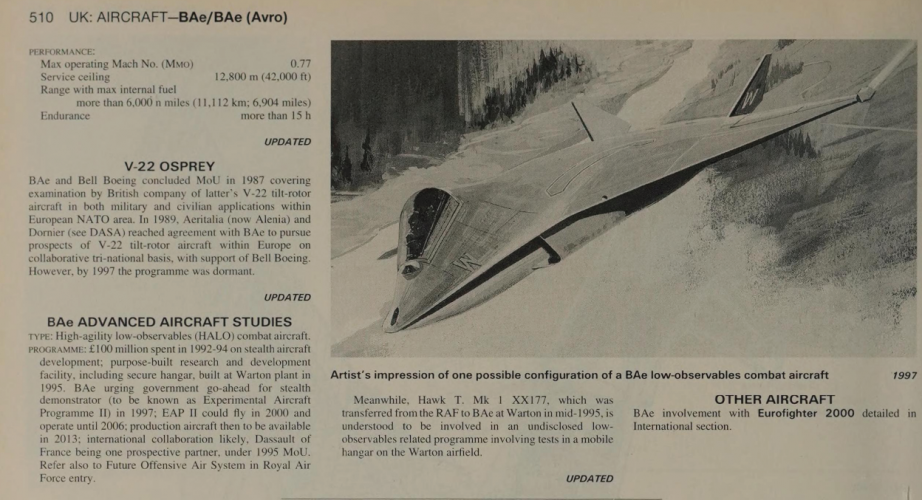
Because text is also important:From JAWA 1998/99
First use of this name - also later applied by some to REPLICA and now the Tempest demonstrator, though I have no idea if that's official in any way.BAe ADVANCED AIRCRAFT STUDIES
Type: High-agility low-observables (HALO) combat aircraft
PROGRAMME: £100 million spent in 1992-94 on stealth aircraft
development; purpose-built research and development
facility, including secure hangar, built at Warton plant in
1995. BAe urging government go-ahead for stealth demonstrator (to
be known as Experimental Aircraft Programme Il) in 1997; EAP
II could fly in 2000 and operate until 2006; production aircraft
then to be available in 2013; international collaboration likely,
Dassault Aerospatiale of France being one prospective partner,
under 1995 MoU.

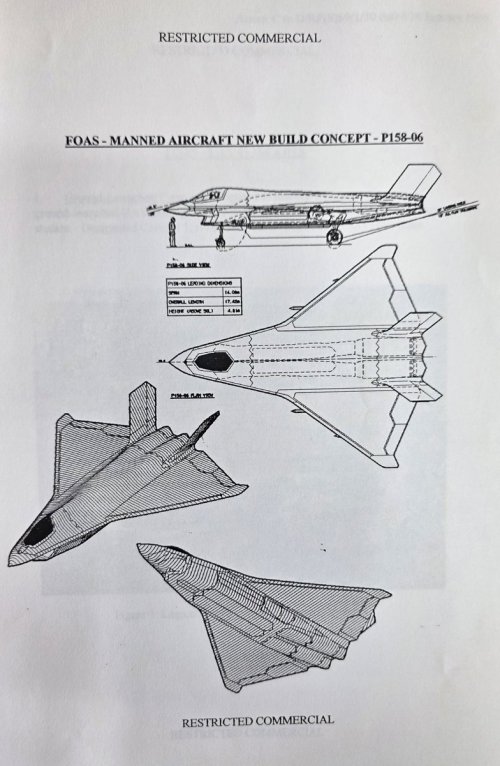
If thats meter then roughly 8?How big is that main weapons bay?
Based on the overall length being given as (what looks like) 17.4m I estimate it is very approximately 5.3m long by 1.6m wide. Depending on the depth, potentially sufficient for two Storm Shadows in addition to, presumably ASRAAM, in the side bays. Note that the plan view appears to show two pylons under each wing too. Curious lack of any obvious aperture for an electro-optical sensor under the fuselage though there might be one immediately in front of the canopy on the topside of the nose....?How big is that main weapons bay?
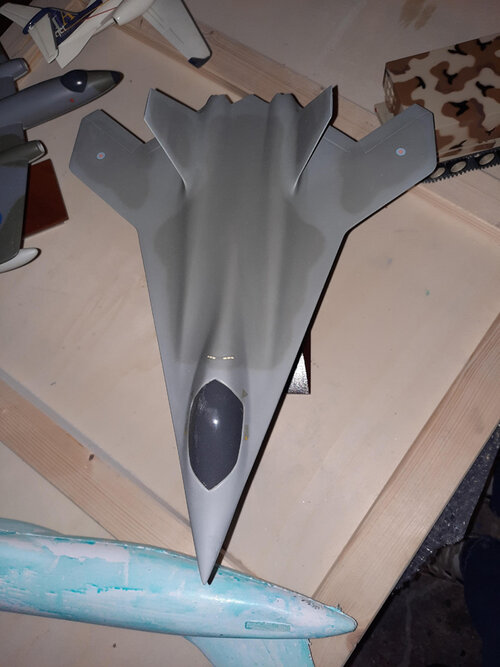
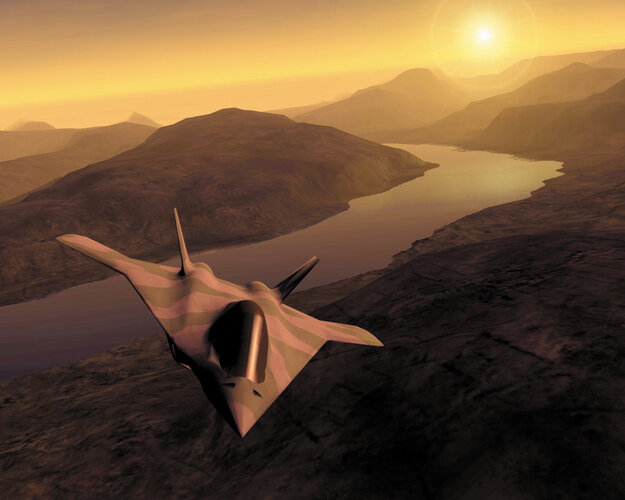
There's a pile of FOAS stuff that may be about to be declassified. If it is, the Jump Jet paperback will get a refresh as I will be able to say what I saw in old jobs.A very interesting find indeed and good to finally see one of the FOAS concepts in the flesh (so to speak) rather than the artists impressions we've had floating about since the 90s.
P158-06 from the 1999 paper Sir Humphrey has unearthed takes us beyond the P149-25 and the Eurofighter derivative P151-02 I found in a 1998 paper within file DEFE 69/2082 CVSG(R)/CV(F) Concept Wkg Groups.
https://www.secretprojects.co.uk/threads/foas-fcba-foa-fcac.1202/page-5#post-772337
Technological & conceptual shock driven by RAF getting embeds within the F-117 programme etc. I think is a succinct way to put it.When Britain had its own views on how to use stealth, driven by doctrine. Then we just dropped it and copied the US.
The artists impressions are also FOAS concepts though. BAES drew up a lot of different concepts.A very interesting find indeed and good to finally see one of the FOAS concepts in the flesh (so to speak) rather than the artists impressions we've had floating about since the 90s.