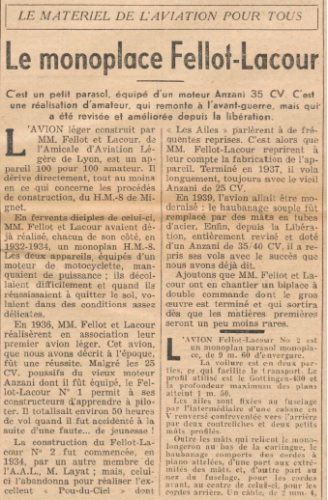
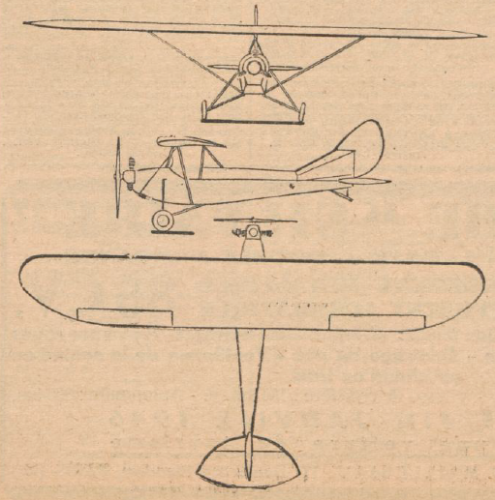
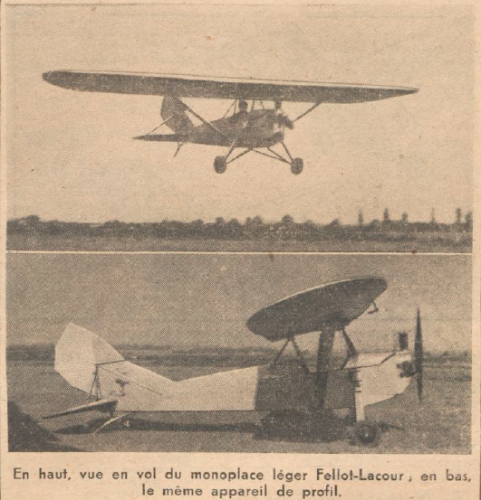
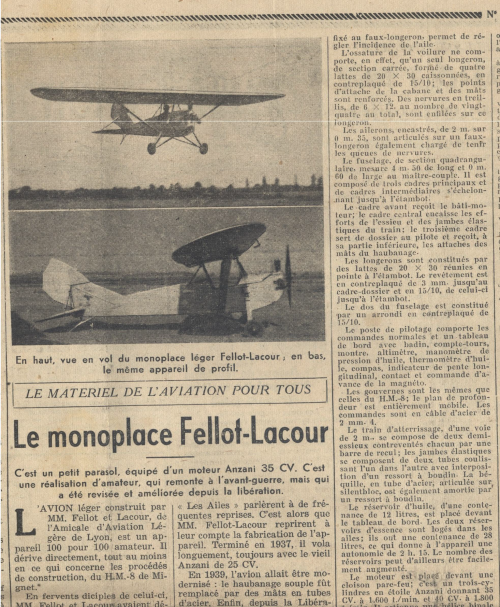
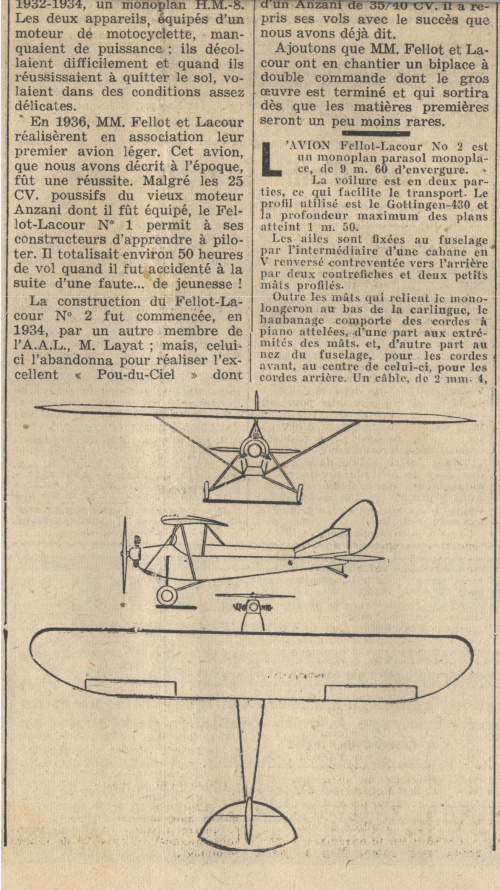
From Avions No. 127, a little-known prototype identified as the "Fellot Lacour" [F-PJCV], christened "L'ancêtre" (the ancestor), though the spelling is apparently unsure.
From Avions No. 127, a little-known prototype identified as the "Fellot Lacour" [F-PJCV], christened "L'ancêtre" (the ancestor), though the spelling is apparently unsure.
Pierre Lacour was born on March 14, 1914 in Lyon. As early as 1930, he piloted an Emile Chapeau EC.19 monospar glider as part of the sailing association Les Mouettes Lyonnaises (Lyon Seagulls), but since powered aircraft had more appeal to him, he contacted his friend, the mechanic Antonin Frémion, with whom he built his first airplane over a period of 18 months, a Mignet HM.8 type powered by a motorcycle's engine. The plane was tested in 1932 at Corbas, alongside the similar "avionnettes" of his friends Lemaire and Fellot. Back from military service in 1935, he joins the Amicale d’Aviation Légère de Lyon, the first gathering of amateur builders created in Lyon in 1934, building the Fellot-Lacour n°1. In 1938, the Reyrieux airfield, first of its kind for amateur flying in France, welcomes the Fellot-Lacours, avionnettes and Poux-du-Ciel of the time.
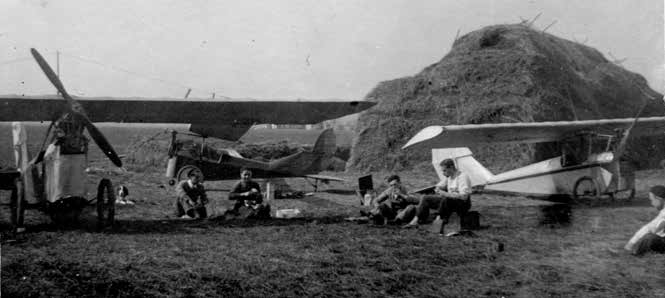
Lacour, Lemaire and Fellot avionnettes on March 12, 1933:
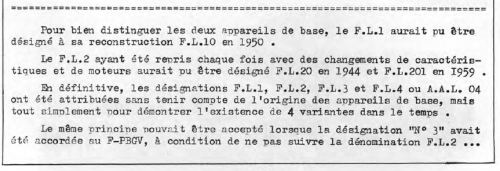
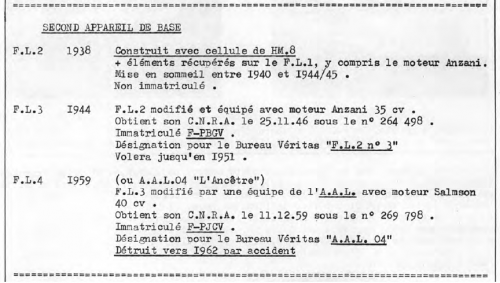
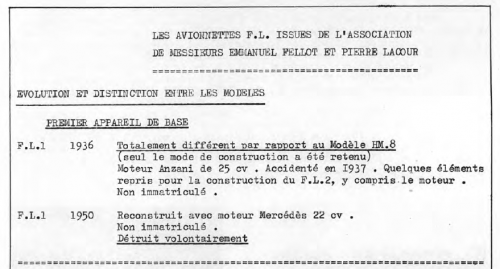
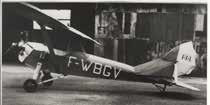
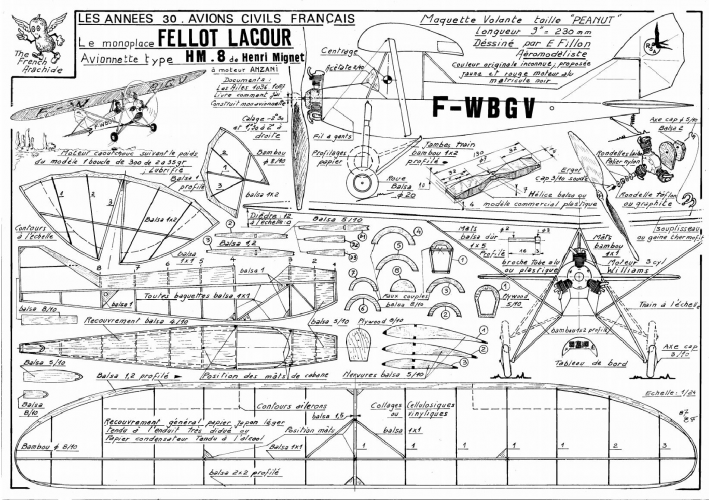
The FL.1 of 1936 was powered by a 25 hp Anzani; it was followed by the F.L.2, a machine which Layat had started building from a Mignet HM.8 plan in 1934, and that Fellot and Lacour completed in 1937, also with a 25 hp Anzani. Then in 1946 came the FL.3. It was the former FL.2 modified, improved, reengined with a more powerful 35 hp Anzani, and registered as [F-WBGV, then F-PBGV].
Note that a two-seater with dual controls was planned, but never built.
In November 1946, Pierre Lacour proposed the creation of the Réseau du Sport de l’Air (RSA), also known as the Groupement des Constructeurs Amateurs d’Aviation légère de France (GRAA)—sort of France's equivalent of the E.A.A. in the United States. The first air meet took place on the Châteauroux airfield in August 1948. Lacour continued to work on a local scale as part of the Amicale d’Aviation Légère de Lyon at the Planaise/ Satolas airfield, then in Bron.
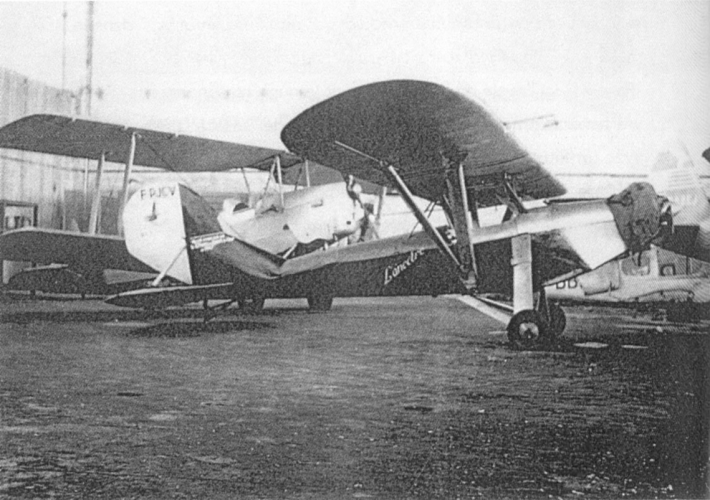
Finally, the FL.3 was once again rebuilt and improved by the Amicale d'Aviation Légère in 1959 as the FL.4, or AAL.04 [now registered as F-PJCV]. This time, the engine fitted was a 40 hp Salmson 9 Ad. The airplane was nicknamed "L'ancêtre" (the ancestor) as an affectionate tribute to its longevity:
Pierre Lacour passed on Jan. 13, 1996 at age 81, but will always be remembered for creating the RSA.
Information and photos originated with the Cercle Aéronautique Louis Mouillard.
Wonderful material for the weekend. Thank you so much for your work!With so much new information, more questions naturally arise. Here's a question about Emile Chapeau, whom you mentioned. Could you also provide information about him and his designs?
Wonderful material for the weekend. Thank you so much for your work!With so much new information, more questions naturally arise. Here's a question about Emile Chapeau, whom you mentioned. Could you also provide information about him and his designs?
Careful: it's CHAPEAUX, with the final "X"! (there is a postwar Jean Chapeau without the "X", who is covered in a separate topic already). Émile Chapeaux is one of those complicated subjects which I have promised myself for some time to dig deeper into, but haven't had the time. There aren't many sources for his work, and he did quite a lot of stuff, it seems! I have a few things though, and therefore I'll be starting a new topic on the subject since you've asked...
This site uses cookies to help personalise content, tailor your experience and to keep you logged in if you register.
By continuing to use this site, you are consenting to our use of cookies.




![Fellot Lacour [F-PJCV].jpg](/data/attachments/90/90816-1276ed631ed6b34456f5e6247adbc829.jpg)