Falklands War fought today?

Status
Not open for further replies.
I would not be surprised if the successor of Keir Stramer, (he will fall after May 7 local elections)
just accept a Mielei offer and sell the Falklands, South Georgia and the South Sandwich Islands to Argentina...

Why would they immediately commit electoral suicide....
 
the Labour Party has done it before...
...ironical after Falkland war.
https://en.wikipedia.org/wiki/The_longest_suicide_note_in_history
They weren't in power then...

Any post-Starmer Gov will ditch Chagos, as all the supporters are closely linked to Starmer and will be gone, after that they will focus on survival mode in an attempt to save as many seats as possible. And the Falklands goes down like a lead balloon in the areas they need to retain....
 
Any post-Starmer Gov will ditch Chagos
The last word in that has USA and not post-starter government !
why ? it most important Base for US in India ocean and Near East.
 
The last word in that has USA and not post-starter government !
why ? it most important Base for US in India ocean and Near East.
I think he meant that a successor government would kill off that deal altogether.
 
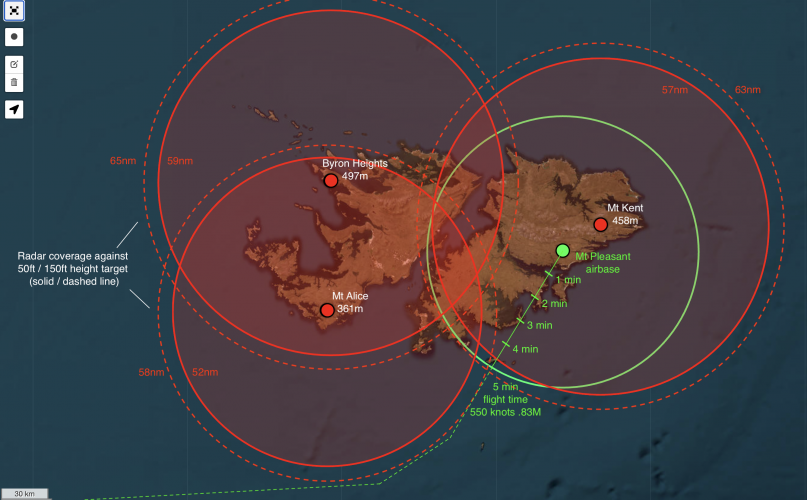
That's not what the air strike scenario would look like. It would have to be a low level ingress coming under the radar horizon of the Mt Alice and Mt Kent radars. Flying about 100ft above the waves, then 50ft for the last minute or so. That gets you within ~55nm of the Mt Kent radar and ~40nm of Mt Pleasant before there's any chance of detection. At that point you're about 4.5 minutes flying time and depending on how quickly the Mt Kent radar crew can confirm inbound bogeys, notify HQ and the officer on watch decides to launch the QRA Typhoons (30 seconds, 1 minute?), the Argentine strike might get to Mt Pleasant before the QRA is in the air...

This doesn't ring true, H_K. In his book The Fight for the 'Malvinas': The Argentine Forces in the Falklands War (Penguin, 1990), Martin Middlebrook wrote (p207) that the primary target for later Black Buck raids by Avro Vulcans armed with US-supplied Shrike anti-radiation missiles was the "Westinghouse ANTPS-44 'Alert' radar which could provide all-around surveillance within a radius of 200 miles from Stanley". This radar was in fact captured intact and taken as a war prize to Scotland. Current British capability in the Falkland Islands is less than 1982 Argentina's? Unlikely. Detection range of only 40 nautical miles from RAF Mount Pleasant is five minutes at 480 knots, which would mean this crucial and expensive base is helpless against a strike by Argentine A-4 Skyhawks such as was common in 1982—not just against the first surprise attack, but every subsequent attack. I don't believe this; rather I suspect you have misplaced a decimal point somewhere. And you overlook the active British radars on Mt Alice and Byron Heights in West Falkland, which are well sited to provide timely warning of low-flying (or high-flying) intruders from South America.

As you yourself noted, "There are no gaps in radar coverage". For a chance of success, a second Argentine invasion of the Falklands, this time on a shoestring, would have to begin with a sudden unconventional crippling attack. Only then could Argentina's few planes approach, and a small fleet put to sea to make unopposed landings at Stanley and Mare Harbour before the Royal Navy's single operational submarine could arrive in the region.

There would still be a war—assuming the current UK government retains the pluck of Winston Churchill (quoted in post #61 above about the Falklands) and Margaret Thatcher, which despite what EWPT2 and Timmymagic wrote is hardly a given, to say no more.
 
The only realistic situation is, if Argentinean claims would be (for some reason) supported by some other major South American power - Brazil or Chile. Not sure why they might be interested in doing this. But well, modern geopolitical situation is so unpredictable, that it's not impossible to suggest that some South American leader would decide to support Argentina for some reason.
Okay, let's think about a bit different scenario. Let's assume, that China decided to support Argeninean claims on Falkland, at least indirectly. What exactly equipment and how much time for training Argentina might need to have a realistic chance of another Falkland attempt?
Hm. Most realisically, I think, would be a JF-17 fleet - those export fighters are available, and have enough range to reach Falklands. They are also capable of carrying anti-ship missiles, which is quite important advantage. What could be really advantageous for Argentinean to obtain, is a pair of AEW planes. A KJ-200 seems to be export-able (they were offered to Pakistan). Also, a naval question matters. A purely aerial assault on Falklands would be... highly problematic, even not considering RN relief attempts. So a naval force must be recreated. A pair of Type 054A frigates (for aerial defense) supported by 4-6 older Type 053H3 units (those are being replaced now, and PLAN rather eagerly sells decommissioned warships for export) would likely be sufficient - anything else would be too costly.
...Concurrent support from China and the US, as it seems possible at the moment, would indeed be very funny, but even this may not be enough

In fact all Latin American countries do support Argentinian sovereignty over the Falkland Islands and South Georgia. Chile, Brazil, Bolivia, and Uruguay have publicly reiterated support this year. But that support is diplomatic, via press releases and UN votes, and denial of ports to Falklands-bound ships. Talk is cheap. No country has agreed to fight side by side with Argentina, and there is zero chance of them doing so if fighting over the Falklands breaks out again. Peru shared Mirage jets with Argentina in 1982, but even Peru did not enter the war, or break UK ties. The Cuban dictator tried to exploit the war by making noise, but didn't actually do anything.

Unlike the Soviet Empire, which would profligately supply arms to foreigners for a pittance if they thought this could advance Soviet interests or create mischief among its foes, Communist China learned from Soviet bankruptcy and demands hard cash for its wares—no charity. Argentina doesn't have the budget to purchase a new air force or a new navy, and won't for some time. And as you might have heard, Argentina's credit has been a poor risk for decades (sail training ship Libertad was embarrassingly impounded in Ghana for the country's bad debts). There were talks with China over the past fifteen years about purchasing one or two dozen FC-1 fighter planes, even assembling them at state-owned Fábrica Argentina de Aviones; but after dithering Buenos Aires finally passed. In any case, Chinese-made weapons do not have a high reputation internationally.
 
Last edited:
This doesn't ring true, H_K. In his book The Fight for the 'Malvinas': The Argentine Forces in the Falklands War (Penguin, 1990), Martin Middlebrook wrote (p207) that the primary target for later Black Buck raids by Avro Vulcans armed with US-supplied Shrike anti-radiation missiles was the "Westinghouse ANTPS-44 'Alert' radar which could provide all-around surveillance within a radius of 200 miles from Stanley". This radar was in fact captured intact and taken as a war prize to Scotland. Current British capability in the Falkland Islands is less than 1982 Argentina's? Unlikely. Detection range of only 40 nautical miles from RAF Mount Pleasant is five minutes at 480 knots, which would mean this crucial and expensive base is helpless against a strike by Argentine A-4 Skyhawks such as was common in 1982—not just against the first surprise attack, but every subsequent attack. I don't believe this; rather I suspect you have misplaced a decimal point somewhere. And you overlook the active British radars on Mt Alice and Byron Heights in West Falkland, which are well sited to provide timely warning of low-flying (or high-flying) intruders from South America.

As you yourself noted, "There are no gaps in radar coverage". For a chance of success, a second Argentine invasion of the Falklands, this time on a shoestring, would have to begin with a sudden unconventional crippling attack. Only then could Argentina's few planes approach, and a small fleet put to sea to make unopposed landings at Stanley and Mare Harbour before the Royal Navy's single operational submarine could arrive in the region.

There would still be a war—assuming the current UK government retains the pluck of Winston Churchill (quoted in post #61 above about the Falklands) and Margaret Thatcher, which despite what EWPT2 and Timmymagic wrote is hardly a given, to say no more.

The ANTP-44 radar's cited 200 mile range would be for high altitude targets, it would still be bound by the radar horizon. IIUC was sited in or near Port Stanley town to make it difficult to attack without civilian casualties rather than where it could generate the best coverage, which reduced it's effectiveness particularly at low level. Perhaps it low level detection range would be ~20 miles.

In contrast the 3 radars the British set up postwar are on the highest points on the islands, so a 40nm detection range would be for low level and is pretty good for a ground based radar. What's more by being sited on West Falkland the two radars there are effectively picket stations, low level aircraft being detected 40nm west of Mt Alice give Mt Pleasant what could be considered 'good' warning time.

Your point about the unconventional attack is spot on; the radars, the Typhoons etc would have to be knocked out before the infantry company could be engaged successfully by a strong landing force.
 
@Owens Z what matters is the radar horizon against low level targets flying at 50 to 150ft above sea level, not the maximum theoretical detection range against high altitude aircraft.

I've drawn the Falklands low altitude radar coverage below. It shows the 3 main radar stations and a likely path of approach that would skirt just under their radar horizon. If the threat is coming low enough and fast enough (e.g. 550 knots / 50ft above the waves), then Mt Kent radar won't even start painting the targets until they're ~4.5 minutes from Mt Pleasant.

In real life add a few radar rotations to create a solid track, possible sea clutter masking, the OODA loop for the radar operator and the officer in charge at the radar site to identify a bogey, comms out to HQ, decision to launch the QRA Typhoons, comms to the aircraft shelter etc... best case the pilots have under 4 minutes to taxi, take-off, engage and destroy the threat before weapons start hitting the airfield...

I'm not sure Argentina would be up for such a high stakes gamble, but if they had evidence that the QRA was at lower readiness and wouldn't be able to launch in less than 5 minutes, then such a sneak attack under the radar horizon would be an option. Or at least would have been an option until recently. IMHO the presence of new Sky Sabre SAM defenses significantly raises the bar for a successful low altitude attack as now you have to launch guided munitions from 20+ nm and be able to correctly steer them to the right aircraft shelters / QRA pads where the Typhoons are located.
 

Attachments

  • Falklands radar coverage.png
    Falklands radar coverage.png
    1.6 MB · Views: 29
How difficult would it be in practical terms to plug that coverage shortfall south of Mt Pleasant? Would a smallish radar, of the type a mobile SAM battery has, be easy to tow out to Lafonia as a picket? Or what about putting a similar SAM radar on a tower at Mt Pleasant or something?
 
In his itemized list of deployable Royal Navy combatants as of March 2026 (see post #21 above), Mark Felton, who commented "here things have improved slightly" in a notably arch tone, counted seven Duke-class Type 23 frigates still in commission, of which five were operational (frigate HMS Richmond was in the process of being retired, while HMS Kent has been refitting since 2024). According to reports yesterday, it turns out that one of those five, HMS Iron Duke, has in fact not been operational this year, and was quietly stripped of weapons and sensors. She is unlikely ever to sail again. Inexplicably, this comes after Iron Duke emerged fresh in May 2023 from a five-year, 100-million-pound refit. This news leaves just four RN frigates active today (Portland, St Albans, Somerset, Sutherland). This is a sad state of affairs, which the Ministry of Defence tried to conceal. See for example the article < https://www.navylookout.com/another...drawn-royal-navy-now-down-to-just-5-frigates/ >.
 
...You mean the QRA..at 5 mins readiness...

Quick Reaction Alert: two Typhoon fighters at five minutes readiness is small comfort if five minutes is the time between a wave of twelve Argentine A-4AR Fightinghawks first being spotted and those planes arriving directly overhead. No, I don't actually believe H_K's numbers. But I am reinforced in my belief that RAF Mount Pleasant's runways are the key to Falklands defense. With those suddenly unusable for at least a few days, Argentina's Typhoon problem takes care of itself. Indeed, I can guess a few nations that would pay Argentina handsomely for an intact example.
 
Quick Reaction Alert: two Typhoon fighters at five minutes readiness is small comfort if five minutes is the time between a wave of twelve Argentine A-4AR Fightinghawks first being spotted and those planes arriving directly overhead. No, I don't actually believe H_K's numbers. But I am reinforced in my belief that RAF Mount Pleasant's runways are the key to Falklands defense. With those suddenly unusable for at least a few days, Argentina's Typhoon problem takes care of itself. Indeed, I can guess a few nations that would pay Argentina handsomely for an intact example.
Good joke; you should write more of them down and publish them. We are talking about 50-year-old airframes that are expected to attack a heavily defended airfield undetected, without any prior training or reconnaissance.
 
Not just attack it, but render it unusable for fighter operations for more than a couple of hours.
Are the Matra/MBDA Durandal anti-runway bombs still in production? And do they fly like 500lb retarded bombs, whether Snakeeye rigid airbrakes or ballutes?

Wiki says they were in Argentine service at one point, so it'd be easy to practice dropping them onto whichever airfield at 400ish knots and 250ft AGL.
 
A better scenario is the president of the US realizing he is about to be impeached and cuts a deal with his buddy in Argentina for asylum which includes a nice batch of sulprus US aircraft and weapons and maybe some LCS. Argentine already got a nice 40 billion bailout and F-16s...
 
Are the Matra/MBDA Durandal anti-runway bombs still in production? And do they fly like 500lb retarded bombs, whether Snakeeye rigid airbrakes or ballutes?

Wiki says they were in Argentine service at one point, so it'd be easy to practice dropping them onto whichever airfield at 400ish knots and 250ft AGL.

It would take a very hefty attack to make Mt Pleasant unusable by fighters for very long, there's a lot of runway and several ways to access them.

1778054666691.png
 
I've drawn the Falklands low altitude radar coverage below. It shows the 3 main radar stations and a likely path of approach that would skirt just under their radar horizon. If the threat is coming low enough and fast enough (e.g. 550 knots / 50ft above the waves), then Mt Kent radar won't even start painting the targets until they're ~4.5 minutes from Mt Pleasant.
Such a profile would give an Argentinian attack a good change of evading radar coverage on the Falklands. However, it would require an extended period of low-level flying to avoid radar coverage, which is (a) technically challenging, and (b) fuel-hungry.

The technical challenge would increase the risk of aircraft either colliding with the sea and being lost, or inadvertently entering radar coverage and reducing surprise. Mitigating this would require better equipment and/or training for the mission, which could increase strategic warning.

The fuel consumption isusue would require basing substantially nearer the Falklands than Villa Reynolds, where I understand the A-4AR is currently based. That deployment in substantial numbers would again increase strategic warning, and it's likely that air refuelling would be required. The necessary tanker(s) would increase the risk of detection, especially if radio communications are needed to achieve linkup with the strike force, and tanker availability might limit the number of aircraft and weapons load.

None of these issues are insoluble, but they do result in a situation where a surprise attack on Mount Pleasant isn't trivial for Argentina to carry out.

I were an Argentine planner forced to consider this scenario, I'd be looking long and hard at an information operations campaign to degrade and distract the defences, leading to a reverse MIKADO. Training would still be an issue, and the C-130s would be at risk for longer, but they have the range to make the flight from normal bases. If the defence response time can be got down to 15 minutes, that's long enough for a 300 knot aircraft to make an ingress below 500 feet. But getting that defence response time down is key.
 
It would take a very hefty attack to make Mt Pleasant unusable by fighters for very long, there's a lot of runway and several ways to access them.
Well, the alternative might be a prolonged barrage attacks with large numbers of (relatively) cheap drones, to keep RAF forces pinned down.
 
Such a profile would give an Argentinian attack a good change of evading radar coverage on the Falklands. However, it would require an extended period of low-level flying to avoid radar coverage, which is (a) technically challenging, and (b) fuel-hungry.

The technical challenge would increase the risk of aircraft either colliding with the sea and being lost, or inadvertently entering radar coverage and reducing surprise. Mitigating this would require better equipment and/or training for the mission, which could increase strategic warning.
Alternative: use a long-range low-flying munitions, which could be launched from standoff distance.
 
If the defence response time can be got down to 15 minutes, that's long enough for a 300 knot aircraft to make an ingress below 500 feet. But getting that defence response time down is key.

And would waddle straight into a CAMM missile....

Airspace around the Falklands is pretty easy to manage...if its not from Mount Pleasant squawking IFF codes, or a BN Islander FIGAS from Stanley trundling around, or the weekly LATAM flight / bi-weekly Voyager from Ascension then you know its hostile....
 
Alternative: use a long-range low-flying munitions, which could be launched from standoff distance.
Does Argentina have such weapons in its inventory today? I don't believe so. 'Falklands War fought after Argentina buys new weapons systems specifically to attack the Falklands' is a very different topic!
And would waddle straight into a CAMM missile....
Yep. Which is why the information operations to degrade defences are essential.
Seriously, in modern conditions, its simply pointless to even consider non-standoff attack against defended airspace.
In the absence of standoff attack weapons, the only alternative is to use non-kinetic means to make the airspace not be defended.

Leading ultimately to the solution of 'play the geopolitical game until the UK just gives them to you', of course. Which would have worked in 1982 if the Junta hadn't needed a short victorious war, and which seems to be Argentina's actual plan today.
 
'Falklands War fought after Argentina buys new weapons systems specifically to attack the Falklands' is a very different topic!
Yes, that's one of the indicators to watch for, and such things never happen unnoticed, not in today's information environment.
 
Yes, that's one of the indicators to watch for, and such things never happen unnoticed, not in today's information environment.
Well, lets explore this scenario: Argentineans turning some old IA-63 Pampa airframes into Starlink-controlled target drones) This could be done without much attention - turning the old aircraft into remote-controlled target drones is hardly uncommon, after all! And if the target drone could be fitted with bombs & sent in one-way attack run on Falklands... well, no reason to even mention such possibility?)
 
So a possibility: a IA-63 Pampa based one-way attack drone, with enough range to reach Falklands on low-altitude approach (after all, one-way) under GPS/Starlink command guidance, and make the attack run with Durandal bombs on Mt Pleasant airfields. Could be done rather covertly, with only existing commercial equipment used, under cover story of converting old planes into target drones.
 
So a possibility: a IA-63 Pampa based one-way attack drone, with enough range to reach Falklands on low-altitude approach (after all, one-way) under GPS/Starlink command guidance, and make the attack run with Durandal bombs on Mt Pleasant airfields. Could be done rather covertly, with only existing commercial equipment used, under cover story of converting old planes into target drones.
You attack, you destroy the runway—then what? Sky Sabre would remain active regardless, and repair crews can still patch the runway while waiting for reinforcements from the UK. Additionally, a NOTAM will be issued following the attack, and electronic warfare units will commence jamming. The question is: do they have MANPADS in their inventory? There is still an infantry company and volunteer forces stationed on the island.
 
Well, lets explore this scenario: Argentineans turning some old IA-63 Pampa airframes into Starlink-controlled target drones) This could be done without much attention
Let's face it - it's South America, someone will brag about it. "We are going to retake the Malvinas", that sort of thing. Also, using Starlink means US techies will know, and US government will know, and that means it'll leak online almost immediately.

We'll also see preparations for amphibious operations, increase in ship deployments, orders for ammunition and spare parts will spike, lots of those small things that the osint crowd will pick up and post, for attention if nothing else. Because it could signify popcorn time.
 
On the other hand, should Argentina enlist a real US support, it could be possible to lay a blockade to the islands and combined with denial of use of Ascension island, refueling airspace and limitations on the use of F-35 (which renders the British carriers inoperative) this could get very ugly indeed.
 
One flight of 4 down each runway, and maybe two flights across the ramp on the west end.
Assuming 100% reliability of the warheads and successful target acquisition, any attempt to use radar for navigation will be detected by SIGINT units.
 
Assuming 100% reliability of the warheads and successful target acquisition, any attempt to use radar for navigation will be detected by SIGINT units.
Use the Instrument Landing System to line up. Passive in the aircraft.
 
One flight of 4 down each runway, and maybe two flights across the ramp on the west end.
Some thoughts from my extensive research on this topic.

1. Damaging the 2 runways through direct attack is likely too dangerous due to the SAM defenses which would prevent any overflight. This method would require sophisticated anti-runway cruise missiles with submunitions.

2. Also typically runway attacks are at an angle, aiming for a "cut". This enhances chances of survival but the number of cuts required to prevent Typhoons from short take offs would be prohibitive... the long runway alone would need 6 cuts, the short runway 3 cuts, all perfectly positioned. More in practice to account for bombing accuracy, in flight aborts, and aircraft losses.

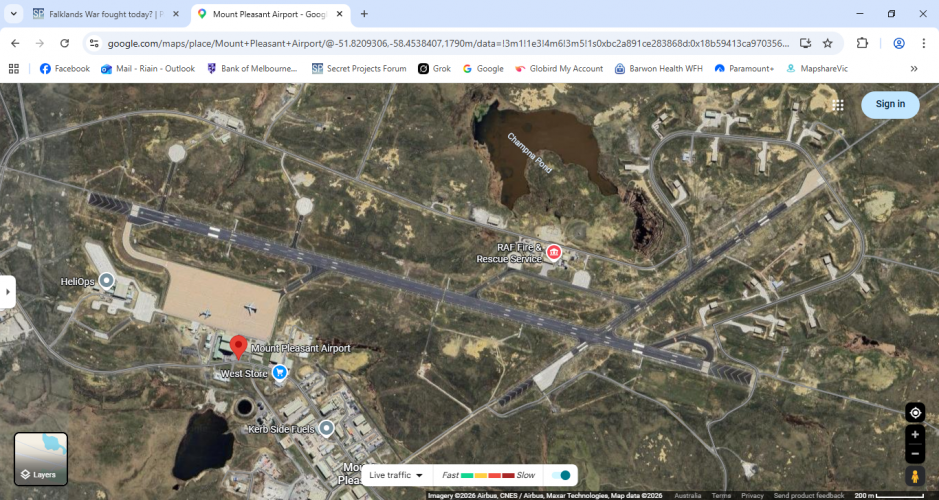
3. The better option by far is to hit the 3 Typhoons directly, if you can determine where they are located. There are 20 possibilities (16 hardened aircraft shelters and 4 QRA pads). However it's unlikely that they are all in regular use, so observation by human assets or drones might help pinpoint the Typhoons' locations or detect patterns that could simplify the targeting problem to <10 aimpoints. This still requires a 250lb smart munition with 20nm+ standoff range, ideally powered to reduce time of flight (e.g. Spice 250ER).

4. Hitting the Typhoons on the ground also requires the ability to destroy QRA aircraft in the event that they are able to start taxiing. The mobile targeting problem is significantly harder as it requires either (a) very smart munitions with imaging seekers, (b) laser designation from a ground observer with direct line of sight, or (c) a ground team with fiber-optic drones, loitering munitions or NLOS missiles (e.g. Spike) that can find and hit mobile targets from a safe distance outside the base perimeter. The first two options are probably very hard, the last option being the likely best course of action.

5. If you can combine air attack against the hardened shelters and QRA pads and a ground team against taxiing aircraft, chances of success increase even with only a small strike package of ~4 aircraft (each with 4-6 smart munitions). This is important as any major preparations or deployments at Argentine airbases could raise the alarm, whereas a flight of 4 aircraft might look like a regular training mission.

6. Range limitations can be reduced by flying the return leg at high altitude, with air refueling closer to home. The outbound leg has to be flown in radio silence and at progressively lower altitude. Buddy refueling might still be an option.

7. Rio Grande airport in Tierra del Fuego is the closest base... 700nm round trip. Other options would add 60-100nm round trip. However like most Argentine airbases it combines civilian flights and is right next to a town so any significant air operations might be noticed, especially a very loud night time departure of 4+ jets. The Argentinians would have to take the risk and hope that any alarm would not reach RAF Mt Pleasant in time.

 
If the RAF said the sun was rising, Ward would have insisted that the darkness on the western sky proved they were lying.

In his interesting 1992 book, Fleet Air Arm squadron leader Nigel 'Sharkey' Ward stated that decorations earned among the services for the 1982 South Atlantic campaign should have (at least roughly) approximated the ratio of men killed in action: Royal Navy + Royal Marines 113; British Army 123; Royal Air Force 1. This opinion seems reasonable. According to Ward, however, RAF personnel received a grossly disproportionate share of decorations, to his expressed chagrin. He claimed the Black Buck raids by RAF Vulcans with extreme tanker support accomplished little at great expense, certainly less than his Sea Harrier squadron on site could have. And he said flatly that published stories of RAF Nimrods over the British Task Force and patrolling to 60 miles off Argentina's coastline are fiction. Ward did salute the RAF's public relations arm for a job well done.
 
In his interesting 1992 book, Fleet Air Arm squadron leader Nigel 'Sharkey' Ward stated that decorations earned among the services for the 1982 South Atlantic campaign should have (at least roughly) approximated the ratio of men killed in action: Royal Navy + Royal Marines 113; British Army 123; Royal Air Force 1. This opinion seems reasonable. According to Ward, however, RAF personnel received a grossly disproportionate share of decorations, to his expressed chagrin. He claimed the Black Buck raids by RAF Vulcans with extreme tanker support accomplished little at great expense, certainly less than his Sea Harrier squadron on site could have. And he said flatly that published stories of RAF Nimrods over the British Task Force and patrolling to 60 miles off Argentina's coastline are fiction. Ward did salute the RAF's public relations arm for a job well done.

Sharkey Ward sad a lot of things, however only Black Buck dropped bombs from a flight profile that damaged the runway, something the Sea Harriers couldn't/didn't do, so added to what the Task Force could achieve.

Nimrod MR 1 & 2s flew 111 sorties in 67 days, including from 9 May, 21 in-flight refueled missions deep into the South Atlantic, one of which lasted 18h50m.
 
I see that UK-made YouTube videos pertinent to our thread have multiplied in recent weeks. An interesting representative example is this candid interview with retired Rear Admiral Christopher John Parry about the state of the Royal Navy. The Falklands situation is discussed starting around the 22-minute mark. "If we had to retake the Falklands today, we couldn't do it..." As a Westland Wessex (Sikorsky S-48) helicopter crewman aboard destroyer HMS Antrim, Parry fought against Argentine forces during the 1982 South Atlantic campaign, and was mentioned in despatches (i.e. commended). Parry's particular Wessex is now an exhibit at the Fleet Air Arm Museum in Somerset.

Take a look:
View: https://www.youtube.com/watch?v=tPHQolZKx8A
 
Rio Grande airport in Tierra del Fuego is the closest base... 700nm round trip. Other options would add 60-100nm round trip. However like most Argentine airbases it combines civilian flights and is right next to a town so any significant air operations might be noticed, especially a very loud night time departure of 4+ jets. The Argentinians would have to take the risk and hope that any alarm would not reach RAF Mt Pleasant in time.
As I said - use old attack planes, converted into attack drones. No need to fly back at all, could be done with commercial-grade equipment. Perfectly doable even with Argentinean industrial capabilities (they aready produce recon drones, by the way, even export them).

P.S. IA-63 Pampa III have fully-digital avionic, so turning it into pilotless drone would require relatively small efforts.
 
By the way, Argentina already started to receive ex-European F-16 (with AMRAAM missiles and Paveway bomb kits) and got interested into procuring two Iver Huitfeld-class frigates from Denmark. So it seems that by 2040s Argentina woupd generally rebuild its strike aviation and naval area defense capability to some extent.
 
As I said - use old attack planes, converted into attack drones. No need to fly back at all, could be done with commercial-grade equipment. Perfectly doable even with Argentinean industrial capabilities (they aready produce recon drones, by the way, even export them).

P.S. IA-63 Pampa III have fully-digital avionic, so turning it into pilotless drone would require relatively small efforts.

They'll just be shot down. Drones are not goof because the drones are good, but because it costs 20 times more to shoot them down than they cost to build. Unless you can launch so many that it exhausts the SAM magazines drones aren't much good per se.
 
  • Like
Reactions: H_K
Status
Not open for further replies.
Back
Top Bottom