Eurofighter Typhoon's FBW FCS and AOA limits

Daineli

ACCESS: Restricted
Joined
13 September 2025
Messages
2
Reaction score
1
"If the speed slows down the Eurofighter Typhoon is still able to manoeuvre effectivly thanks to the exceptional low speed flight charachteristics and high angle of attack (AOA) performance and handling. The flight control system provides carefree handling. That means the pilot can easily fly the aircraft to its limits and hasn’t to care about technical limitations, parameters and configurations. The FCS will automatically control all the control surfaces and limit the loadings to prevent the pilot from overstressing the airframes structure or exceeding aerodynamical limits. If he looses the orientation the pilot can simply press a button and the aircraft will automatically recover".
(by Scorpion82)

...
so
i didn't saw any pics of EF hud and any pics where EF is flying at high AOA
if you, guys, have any, can you please share them to me?
 
Last edited:
Not as high as Hornet 70+ and F-22 I think 60 and F-35 50.

Hornet max angle of attack is 35, the HARV had a 65-70 range with thrust vectoring that in some situations could exceed 70 but it was just a NASA demonstrator. All F-35 are software limited to 50 but the F-35B variant exceeded that in testing.
 
Hornet max angle of attack is 35, the HARV had a 65-70 range with thrust vectoring that in some situations could exceed 70 but it was just a NASA demonstrator. All F-35 are software limited to 50 but the F-35B variant exceeded that in testing.
Mate I've flown a Hornet way past 35 degrees.
 

That says the max AOA that can generate lift is 35 degrees, it can exceed AOA limits but with instability and a warning tone. Before the upgrade it experienced severe instability and 10-20,000 feet of lost altitude in a turn, after it will experience mild instability and 8-10,000 feet of lost altitude. It always had the feather spin mode where it drops like a stone with an AOA of 70 degrees but with a AOA of around 50 degrees it will enter low control spin conditions with around 18-21,000 feet per minute and 1,500 to 5,000 feet per turn of lost altitude depending on the manoeuvre.
 
Last edited:
That says the max AOA that can generate lift is 35 degrees, it can exceed AOA limits but with instability and a warning tone. Before the upgrade it experienced severe instability and 10-20,000 feet of lost altitude in a turn, after it will experience mild instability and 8-10,000 feet of lost altitude. It always had the feather spin mode where it drops like a stone with an AOA of 70 degrees but with a AOA of around 50 degrees it will enter low control spin conditions with around 18-21,000 feet per minute and 1,500 to 5,000 feet per turn of lost altitude depending on the manoeuvre.
CLmax and max AOA are different things, though some jets stop at CLmax (and the viper long before). Where you generate max lift isn’t necessarily your maximum AoA. Basically all thrust vectoring jets can reach AoA well beyond CLmax.
 
That says the max AOA that can generate lift is 35 degrees, it can exceed AOA limits but with instability and a warning tone. Before the upgrade it experienced severe instability and 10-20,000 feet of lost altitude in a turn, after it will experience mild instability and 8-10,000 feet of lost altitude. It always had the feather spin mode where it drops like a stone with an AOA of 70 degrees but with a AOA of around 50 degrees it will enter low control spin conditions with around 18-21,000 feet per minute and 1,500 to 5,000 feet per turn of lost altitude depending on the manoeuvre.

Watch a demo of a Finnish or Swiss AF Hornet. They go well beyond 35 degrees AoA without crashing. ;)
 
There's a difference between instantaneous nose pointing and sustainable controlled flight, and I'm not certain everyone here is talking about the same thing.
 
Most AoA value discussed here are in controlled flight, at least in alpha pitch. Most of the aircraft mentioned here are unable to use yaw and very modestly roll when approaching their max alpha. Still, those domain extensions are in controlled flight and are meaningful for scoring a gun shot.
On the contrary, post stall excursions, like infamously displayed by Flanker and Fulcrum Russian jets at airshows, are inertia driven and don't allow their pilots to point and shoot. They are still however maneuver useful to alter a trajectory.

Modern high performance fighters like the F-35 or F-22, can point at such extreme on alpha (pitch) AND yaw. This is a new domain and a must have for any future fighter project IMOHO.
 
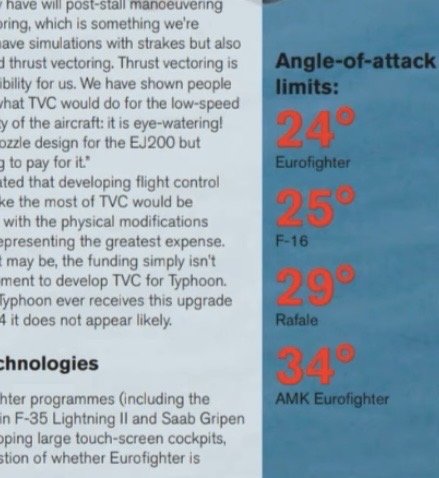
Stolen from the warthunder forum
I'm not sure I trust that source. IIRC it's from a magazine article written by one of the engineers pushing for the EFT consortia to purchase AMK more than a decade ago, and doesn't specify configuration.

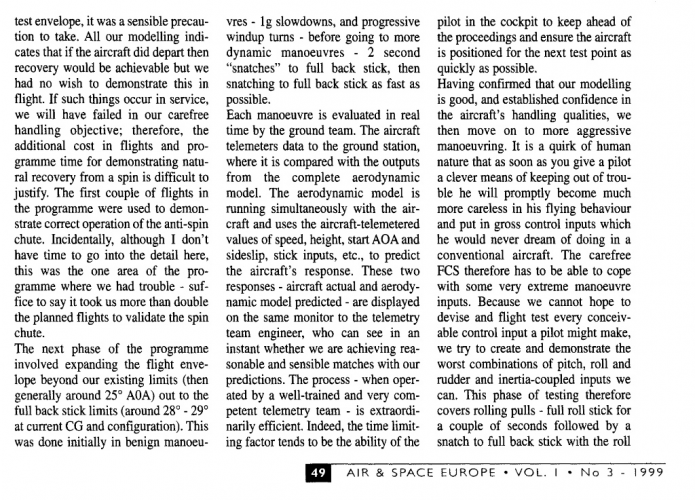
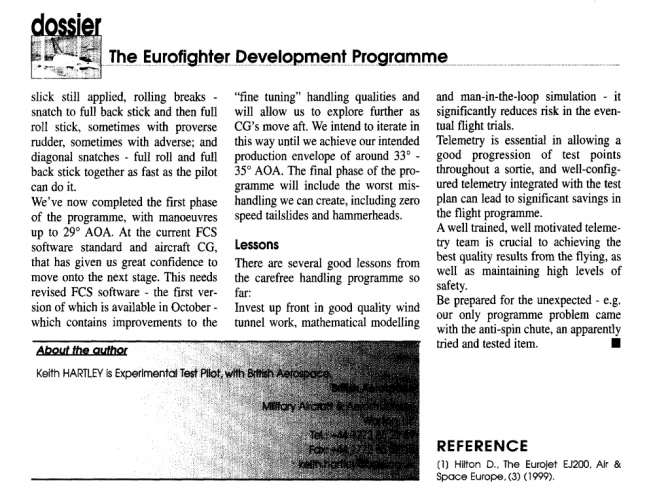
This is from an article written by one of the EFT test pilots which talks about them testing and expanding the flight envelope
1780139869857.png
1780139321884.png

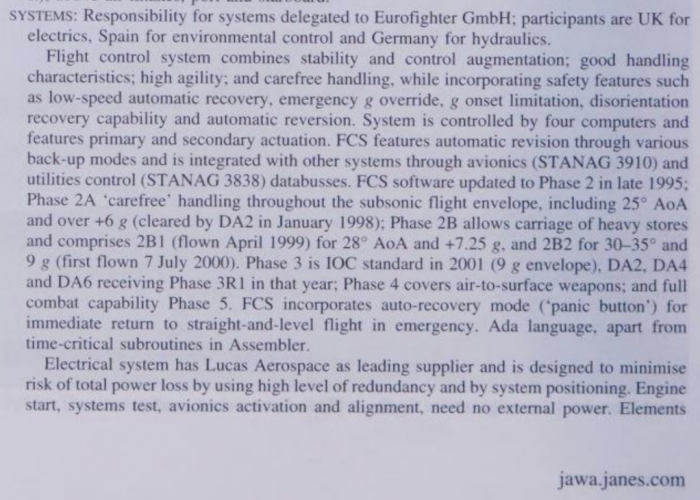
Jane's All the World's Aircraft 2008 seems to corroborate the above:
1780139812443.png

Assuming the above is correct, it will be very interesting to see what it's capable of with AMK.
 
Last edited:
Paper with mention of issues that caused AoA to be caped in the first place
 

Attachments

  • MP-AVT-307-19.pdf
    2.4 MB · Views: 26
Paper with mention of issues that caused AoA to be caped in the first place
That mentions Eurofighter precisely once. It's a discussion of the generic issues, not the specifics of a single aircraft.
 
Paper with mention of issues that caused AoA to be caped in the first place
Interesting read.

That mentions Eurofighter precisely once. It's a discussion of the generic issues, not the specifics of a single aircraft.
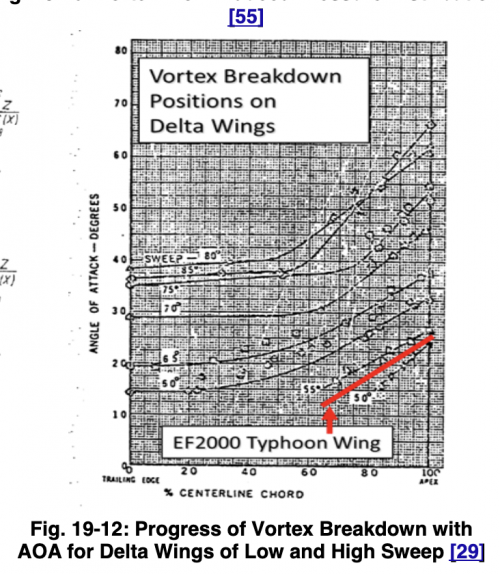
I think the misunderstanding stems from this image:
1780183349898.png

Without any further context - someone might look at that and assume that because it's labelled "EF2000", that the Eurofighter's wing vortices completely break down at ~25 degrees AoA, and thus that should be the aerodynamic limit of the FCS.

The issue is that this entire section of the paper is talking about modelling, via simulations and water-tunnel testing, of essentially flat triangle "delta wings" with different sweep angles. The red "EF2000 Typhoon wing" line is a reference point to show the wing-sweep angle present on an actual current aircraft, as if it were modelled as a triangle with no canards and no leading/trailing edge aerodynamic surfaces. Suggesting that the real Eurofighter aircraft stalls at ~25 degrees AoA just because a 1971 experiment observed a flat triangle with the same wing sweep angle having total vortex breakdown at ~25 deg AoA is a little bit ridiculous.
 
Last edited:
SETP paper on strake testing in the 2000s
 

Attachments

  • Eurofighter wing root strakes for high aoa.pdf
    1,020.8 KB · Views: 20
In this case, like with the F-16, the Typhoon FCS limits the AOA to safe values. This is what 'carefree handling' means. The FCS won't let you go outside the safe flying envelope (up to 35 deg AOA) so there is no risk of departing from controlled flight. F-16 has some nasty departure modes around 40 deg AOA I think, and Typhoon may be similar.

In practice this matters little enough outside airshows. Anyone exceeding 35 deg AOA is going to be losing speed and energy.
 
In this case, like with the F-16, the Typhoon FCS limits the AOA to safe values. This is what 'carefree handling' means. The FCS won't let you go outside the safe flying envelope (up to 35 deg AOA) so there is no risk of departing from controlled flight. F-16 has some nasty departure modes around 40 deg AOA I think, and Typhoon may be similar
Definitely.
Basically the pilot can do whatever they like with the stick, but the FCS is only going to give the maximum g and/or AoA that it is programmed to allow for the current flight parameters.

I've read the F-16 has a relatively strict AoA limit because it has a tendency to enter a deep stall once AOA reaches a certain point. Essentially the position of the horizontal stabiliser being behind and lower than the wing means that at high AoA it becomes ineffective due to the turbulent air, and stall recovery becomes very difficult. I've seen US fighter pilot podcasts talking about if an F-16 gets very low on speed and is pulling high AoA, the FCS jumps in and the aircraft will basically power slide to prevent a full departure/spin.

In practice this matters little enough outside airshows. Anyone exceeding 35 deg AOA is going to be losing speed and energy.
Especially in the modern day where we have helmet mounted cueing systems and missiles capable of extreme HOBS kills.
It does look cool at airshows though.
 
The impression I get, and it may be off, is that the AMK kit is desired now because of air to ground and SEAD type roles. It’s better with asymmetric loads and apparently simplifies the qualification process. Basically it would make a great Strike Typhoon (the landfall?)
 
35° was the actual target, but it was never achieved. 29° was about the max. in actual flight test. All prototypes, except for DA2, were never flying with an AoA greater than 27°. Production aircraft were caped at 24° and attempts to at least restore the 27° value with the FPSP2 (Phase 4) software let to a grounding of the Block 2B fleet and suspension of deliveries in 2006, before an FCS fix became available by July 2006. That fix returned the AoA to the FPSP1 limit of 24° (25° with gear down) and this was never again increased for the baseline aircraft, in addition the roll authorities were reduced at high AoA. Further tests with an experimental FCS software in 2007, didn't produce the desired results, as the root cause is aerodynamics. The XP1 strakes tested on DA5 in September 2007 were a first step, in fact the EFEM programme was launched years earlier. AMK represented the next step with a trials campaign in 2014/2015. The config was as tested in the wind tunnel, with two Sidewinders and 4 AMRAAMs and PIRATE removed (the wind test model had no PIRATE fairing).

Ever wondered why the target stated in 1999 by test pilots was never confirmed thereafter and talk about AoA authorities was being avoided for many years? Compare the flying displays of the prototypes (1997-2002) with those of the production aircraft after 2002. You can notice the difference! The famous HAVV roll, which was a trademark of the Typhoon prototypes has never been flown again by production aircraft, as the producion FCS software is more restrictive.

Chris Worning, Airbus DS test pilot, confirmed the 24° AoA limit in one of his interviews and the 45% increase in AoA authorities touted for the AMK equipped aircraft in fact restores the original target of 35°!

It's important to obey the timeline here and discriminate between stated objectives and confirmed achievements.
 
Last edited by a moderator:
35° was the actual target, but it was never achieved. 29° was about the max. in actual flight test. All prototypes, except for DA2, were never flying with an AoA greater than 27°. Production aircraft were caped at 24° and attempts to at least restore the 27° value with the FPSP2 (Phase 4) software let to a grounding of the Block 2B fleet and suspension of deliveries in 2006, before an FCS fix became available by July 2006. That fix returned the AoA to the FPSP1 limit of 24° (25° with gear down) and this was never again increased for the baseline aircraft, in addition the roll authorities were reduced at high AoA. Further tests with an experimental FCS software in 2007, didn't produce the desired results, as the root cause is aerodynamics. The XP1 strakes tested on DA5 in September 2007 were a first step, in fact the EFEM programme was launched years earlier. AMK represented the next step with a trials campaign in 2014/2015. The config was as tested in the wind tunnel, with two Sidewinders and 4 AMRAAMs and PIRATE removed (the wind test model had no PIRATE fairing).
That's really interesting, thanks.
The 2008 Jane's reference above does imply they didn't meet their full target (it says 30-35 deg, as opposed to the 33-35 deg target mentioned in Hartley's article).
But I hadn't heard of groundings/procurement suspensions due to FCS issues before, or a significant reversion in the FCS limits.
The only major grounding during development I was aware of was when DA6 crashed due to a double engine flameout.
If you have more details it would be much appreciated - I'd love to read more about this.
 
Last edited:
Makes one wonder whether the German insistance on chin intakes for high alpha performance was a flawed requirement.

My understanding is that other decisions were not ideal for high alpha, such as the long arm canards (which generate less lift than close coupled canards… though the X-31 seemed to do OK with thrust vectoring), plus the decision to allocate FCS development to a team that perhaps wasn’t the most qualified in this area, so the end result was neither fish nor fowl?
 
There's a few different issues:

What's the max usable lift coefficient and what AoA is this generated at? Which will drive instantaneous turn performance. But this varies with Mach, altitude etc. Rather than being a fixed value

Do you want to do post stall manoeuvring past the max lift coefficient? Can help with nose pointing, or to bleed speed faster to get down to min radius turns.

Long coupled canards are "better" for high AoA recovery as they give greater moment/authority. It's not about lift generation.

X-31 (and EAP) has a cranked LE on the wing giving greater vortex stability at higher AoA at low Mach and hence reduced pitching moment change.

But lots of Typhoon design is driven by sustained turn performance at higher Mach numbers where you're at moderate AoA

NB. It's also difficult to predict forces and moments at higher AoA with older, simpler CFD codes and wind tunnel tests as Reyholds number effects are significant
 
Last edited:
That's really interesting, thanks.
The 2008 Jane's reference above does imply they didn't meet their full target (it says 30-35 deg, as opposed to the 33-35 deg target mentioned in Hartley's article).
But I hadn't heard of groundings/procurement suspensions due to FCS issues before, or a significant reversion in the FCS limits.
The only major grounding during development I was aware of was when DA6 crashed due to a double engine flameout.
If you have more details it would be much appreciated - I'd love to read more about this.

30-35° AoA target was stated by DASA chief test pilot Wolfgang Schirdewahn in an interview with Flug Revue (Issue 5/99).

The DA6 crash related grounding lasted only 24h. You probably confuse this with the ST8 crash on 24 August 2010, which led to a month long grounding.

The 2006 grounding didn't receive much public attention from the ordinary press as it wasn't a fleet wide grounding, only impacting some airframes (Block 2B with FPSP2 software) and it wasn't linked to an accident either. When I have the time I can check my archieves for records from that time, but there weren't too many that I'm aware of. I remember a German and an English source.
 
Last edited:
Makes one wonder whether the German insistance on chin intakes for high alpha performance was a flawed requirement.

My understanding is that other decisions were not ideal for high alpha, such as the long arm canards (which generate less lift than close coupled canards… though the X-31 seemed to do OK with thrust vectoring), plus the decision to allocate FCS development to a team that perhaps wasn’t the most qualified in this area, so the end result was neither fish nor fowl?

When MBB settled on the configuration in 1977, TVC formed a part of the equation. The refined config with cranked delta wings and twin vertical stabilizers was a better solution in this respect and it formed the baseline for the ECF and ACA. EAP was so to speak a compromised single fin solution based on the ACA. The eventual Eurofighter design from 1985 was another compromise with its plain delta wing and single fin as a result of the multinational configuration finding process. EAP achieved the AoA capability that was targeted for EFA, but it still featured the cranked delta. Dassault did it the other way round, normal delta on Rafale A and adding the LEX for the eventual Rafale.

As stated, long coupled canards offered greater high AoA recovery, due to the greater moment arm and with the targeted level of instability was seen as the overall better solution in this respect, add lesser foreplane wing interference and resulting drag. The original vision of the MBB engineers was sound in this respect, even if the British felt that the Germans were "to obsessed" with super manoeuvrability and their vision didn't come to fruition in the multinational programme, TVC still is an option, but its prospects are rather low.

Concerning the FCS part, how much more experience did Dassault have in this respect? Already the Tornado had a FBW for the pitch channel, the F-104CCV demonstrated with quadruplex digital FBW flew even before the analogue FBW equipped Mirage 2000. The exact FCS related problems from the early 1990s have never been detailed, though the workshare split between MBB/BAe was part of the prpblem and was eventually resolved when a truely integrated team was formed. The critical stage in which that programme was politically was another aspect, fueled by concerns from the Gripen and YF-22 FCS related accidents.
 
30-35° AoA target was stated by DASA chief test pilot Wolfgang Schirdewahn in an interview with Flug Revue (Issue 5/99).
I've not seen/read that, although it's dated May 1999. The date of first flight for the 2B2 software (30-35AoA & 9g) according to Jane's was July 2000. This is in agreement with the RAF museum's history of DA2:
Jul 00 Flew with 2b2 flight control software installed, as the first of the
development aircraft to receive the upgrade.

The DA6 crash related grounding lasted only 24h. You probably confuse this with the ST8 crash on 24 August 2010, which led to a month long grounding.
Sorry I should have been more specific - I meant groundings during the "development phase" of the programme (although upon further reading I've seen there was also an issue in 2003, due to landing gear/brake malfunctions). I know there have been a few occasions since it was fully cleared for service.

The 2006 grounding didn't receive much public attention from the ordinary press as it wasn't a fleet wide grounding, only impacting some airframes (Block 2B with FPSP2 software) and it wasn't linked to an accident either. When I have the time I can check my archieves for records from that time, but there weren't too many that I'm aware of. I remember a German and an English source.
Thanks, I would be interested to see.
 
I've not seen/read that, although it's dated May 1999. The date of first flight for the 2B2 software (30-35AoA & 9g) according to Jane's was July 2000. This is in agreement with the...

Jane's may have simply correlated the pre-2000 plan of 2B2 with the actual 2B2 first flight. But who tells you that 2B2 was delivered as planned? I admit it's partially quite difficult, if you are restricted to public sources only, as it's a bits and pieces collection, with many holes in between that leave a lot of room for interpretation and speculation.
 
From this HUSHKIT article
The Typhoon’s current AoA limit is slightly more than twenty four degrees, approximately the same as an F-16. The new changes are expected to increase the limit to at least 34 degrees which will give pilots in combat a many more possibilities for nose-pointing.
 
From this HUSHKIT article
Yeah, that article is paraphrasing from the same Aerospace magazine interview with Chris Worning mentioned earlier in the thread.

My main issue with Worning's interview is that he doesn't specify configuration, and I assume the limits of the carefree handling vary by what weight and stores the aircraft currently has.
 
Yeah, that article is paraphrasing from the same Aerospace magazine interview with Chris Worning mentioned earlier in the thread.

My main issue with Worning's interview is that he doesn't specify configuration, and I assume the limits of the carefree handling vary by what weight and stores the aircraft currently has.

Yes they vary, but 24 is actually the max with the current airframe plus 1 deg with landing gear extended. You can believe it, or not. It becomes a bit too time consuming for me to browse through all the old public stuff.
 
plus the decision to allocate FCS development to a team that perhaps wasn’t the most qualified in this area,
Actually, I may be biased, but it's difficult to think of a team that was more qualified. At the time FBW control of an actively unstable aircraft was a new technology and teams with experience were in short supply. Typhoon was the third FBW/unstable FCS developed by BAE Systems Rochester* (after ACT Jaguar and EAP), with a flight controls heritage going back to TSR2 and beyond. Concurrent with Typhoon, Rochester was developing the 777 PFCS (and 757RT), with degrees of redundancy that had never been seen before (triplex triplex across dissimilar hardware), while Rochester were one of the very early sites awarded CMM Level 5, rating us at the peak of software capability, and that definitely leant on the Flight Controls development processes.

Of the competitors, Lockheed/Boeing and Saab/Lear Siegler lost aircraft with FCS issues, and GD were lucky not to lose the F-16 on first flight.

And the USN certainly thought the product was good enough, ordering Typhoon derivative FCSs for the retrofits of F-14 and A-6 (plus the YEZ-2A/Sentinel 5000).

* Probably GEC Avionics at contract award and later passing through Marconi Avionics.
 
Yes they vary, but 24 is actually the max with the current airframe plus 1 deg with landing gear extended. You can believe it, or not. It becomes a bit too time consuming for me to browse through all the old public stuff.
If you can't show it's public, you shouldn't be quoting it!
 

Similar threads

Back
Top Bottom