I hope the probe survive that ordeal
The Juno probe is designed to handle this environment.

I hope the probe survive that ordeal

https://www.nasa.gov/missions/juno/salts-and-organics-observed-on-ganymedes-surface-by-nasas-juno/NASA’s Juno mission has observed mineral salts and organic compounds on the surface of Jupiter’s moon Ganymede. Data for this discovery was collected by the Jovian InfraRed Auroral Mapper (JIRAM) spectrometer aboard the spacecraft during a close flyby of the icy moon. The findings, which could help scientists better understand the origin of Ganymede and the composition of its deep ocean, were published on Oct. 30 in the journal Nature Astronomy.


Sophia Gad-Nasr
@Astropartigirl
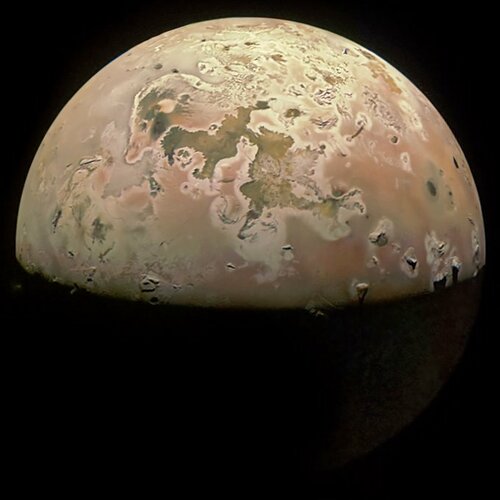
Friends: the latest photo of Jupiter's moon Io, the most volcanically active body in our solar system! It is the closest moon to Jupiter and is one of four Galilean moons (these are the four moons you'll typically see in telescopes). Its surface is speckled with lava lakes and…
Now you’ve said that I cannot unsee it.... And I move that Io be renamed Ferret Face.

I am honored to have been given the privilege of adding content to your life experience.Now you’ve said that I cannot unsee it.

https://www.missionjuno.swri.edu/news/nasa-shares-how-to-save-camera-370-million-miles-awayAn experimental technique rescued a camera aboard the agency’s Juno spacecraft, offering lessons that will benefit other space systems that experience high radiation.
https://arstechnica.com/space/2025/...-americas-primacy-exploring-the-solar-system/In an interview with Ars, Bolton suggested the radiation issue creates another opportunity for NASA to learn from the Juno mission. Ground teams are attempting to repair the JunoCam imager through annealing, a self-healing process that involves heating the instrument's electronics and then allowing them to cool. Engineers sparingly tried annealing hardware space, so Juno's experience could be instructive for future missions.
In an email shared with Space.com, NASA Planetary Science Division Media Lead Molly Wasser referenced Juno's 2021 extension saying the "mission was extended to September of 2025. This is the most recent update. Regarding the future of the mission, NASA will abide by the law."
Due to the government shutdown, NASA is currently unable to say whether Juno is still operating or already powered down.
AMSAT-DL@amsatdl
·
JUNO at Jupiter is still alive!!️@NASAJuno
Just received it's X-Band transmitter (carrier only) at 781 Million kilometer distance with the Bochum 20m antenna. The first extended mission began in August 2021 and ended September 2025. There might be an second extended mission (EM2) starting in October 2025 according to
"The absence of the need to dispose of the Juno spacecraft to satisfy planetary
protection requirements allows continued collection of science data for the full
operational life of the spacecraft."