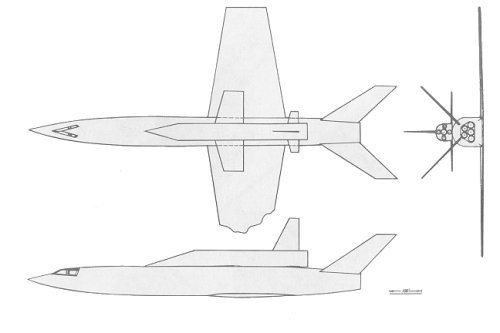
Drake-Carman two stage vehicle

hesham

ACCESS: USAP
Senior Member
Joined
26 May 2006
Messages
38,252
Reaction score
20,390
Hi,

http://www.hq.nasa.gov/pao/History/x15conf/history.html
 

Attachments

  • ihi-21.jpg
    ihi-21.jpg
    13.8 KB · Views: 108
Hesh,

I'm pretty sure that was the proposed Mach 10 demonstrator. It's in Dennis Jenkin's "Space Shuttle". Good read if you have a chance to get it.

Moonbat
 
And I quote from Space Shuttle by Dennis Jenkins (1996 ed.):

" a vehicle with a 100,000 pound gross weight could obtain Mach 6.4 at 660,000 feet and have a sustained seed of Mach 5.3 for over one minute. The vehicle would be rocket-powered, burning liquid oxygen and water-alcohol propellants. Using this as a carrier aircraft, a vehicle the same general size and weight of the Bell X-2 could be launched at Mach 3.0 and 50,000 feet, attaining speeds up to Mach 10.0 at altitudes approaching 1,000,000 feet. It was felt that a duration time of one minute over Mach 8.0 would be achievable by this second stage."

Moonbat

 
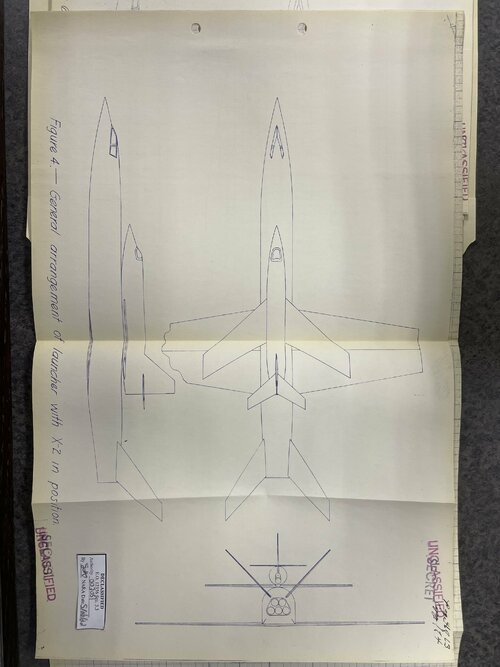
Here is the actual drawing from the 1952 NACA proposal, "A Suggestion of Means for Flight Research at Hypersonic Velocities and High Altitudes" by Hubert M. Drake and L. Robert Carman. As shown, everyone can clearly see that the Drake Carman launcher proposal originally had the Bell X-2, not the X-15 as many assume with the drawing published on pdf page 110 of The Hypersonic Revolution Volume 1 (which shows the later and watered-down 1953 proposal) also shown in John Anderson's booking on Hypersonic and High Temperature Gas Dynamics.

The Mach 10 demonstrator was a different vehicle, the NASA Ames version of the NASA High L/D project that later wound up as HYWARDS. NASA Langley also had a version - a Mach 15 glider. The vehicle was written about on pdf page 312 of The Hypersonic Revolution Volume 1. Moonbat, what Mr. Jenkins is quoting there is the second paragraph of the summary of the aforementioned NACA proposal by Drake and Carman.
 

Attachments

  • IMG_1375.jpg
    IMG_1375.jpg
    1.6 MB · Views: 62
Last edited:
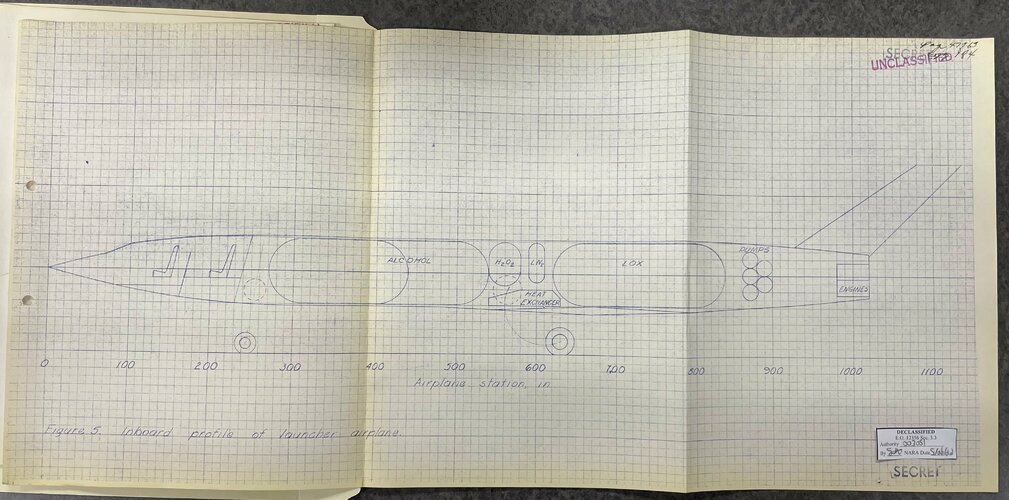
For those who say the Drake Carman Launcher would have been ginormous, what folks in academia need to know is that in the industry, airplanes are measured according to their fuselage stations in inches from the nose. The Anderson book portrays the launcher aircraft as multiple hundreds of feet long, which is incorrect - likely because the scale key is very hard to see in The Hypersonic Revolution Volume 1. Here is the original drawing from the same proposal. The launcher aircraft is over 1,000 inches long, not feet. Please note the declassification slug for both photos.
 

Attachments

  • IMG_1376.jpg
    IMG_1376.jpg
    1.5 MB · Views: 62
Last edited:
I know I'm late in this discussion but I was researching my father, L. Robert Carman's contributions to high speed flight. He and his design partner Hubert M. Drake were mentioned in some articles and biographies of the test pilots ( Scott Crossfield ) but this is the first mention of their "proposal" that my father and mother spoke to me about... it was "peg-holed" they said as it was deemed too advanced! I have some drawings / paintings and scale models that may relate to this "proposal". My brothers lived there ( Andy was born there) when my father worked at Edwards Air force Base as one of two Advanced Design Engineers. My mother had some interesting stories of the wives and lives of these guys who made space flight possible. Unfortunately Bob Carman passed away in his late 60's. In a twist of fate mom remarried, Randy a college friend of my parents and moved to Aptos, Ca. Across the street she meets her new neighbor Hubert M. Drake, OMG. If I only knew what I do now, I could have spoke to Hubert and written the sequel to "The Right Stuff" from an engineer's prospective. What the drinking and partying was really like at the start of The Right Stuff movie... Thank for listening, Jimmy.
 

Similar threads

Back
Top Bottom