Did the USN continue converting cruisers to missile ships for too long?

uk 75

ACCESS: Above Top Secret
Senior Member
Joined
27 September 2006
Messages
6,622
Reaction score
7,443
I love the big US Navy missile cruisers. Only Long Beach was a new built ship the others were converted from legacy gun cruisers.
By the 1960s the US Navy had stopped building or converting cruisers instead of what it for a while called frigates then destroyer leaders. Later these ships of Bainbridge, Leahy, Truxtun and Belknap classes would be called cruisers.
Did the USN do the right thing by stopping building or converting real cruisers or should they have even done it sooner?
 
It's hard to argue against the advantages of "these ships already exist and are fairly low-mileage, why wouldn't we use them?" especially at the time. We can look back through history and point out how unoptimized the resulting ships were and how decisions based on bad assumptions or excessive optimism hurt them, but the solutions weren't as obvious in the environment these decisions were made.
 
There were shitloads of Baltimore, Oregon and Des Moines CAs, plus even more CLs. So the temptation was strong. The ships were large and powerful, guns could be removed to make room - so why not ?

Asking in passing - were there any plans to convert Worcesters into guided missile cruisers ?

https://en.wikipedia.org/wiki/Baltimore-class_cruiserhttps://en.wikipedia.org/wiki/Oregon_City-class_cruiserhttps://en.wikipedia.org/wiki/Des_Moines-class_cruiser
https://en.wikipedia.org/wiki/Cleveland-class_cruiserhttps://en.wikipedia.org/wiki/Fargo-class_cruiserhttps://en.wikipedia.org/wiki/Worcester-class_cruiser
 
Did the USN do the right thing by stopping building or converting real cruisers or should they have even done it sooner?
You can possibly rip the guts out of a Cleveland or Baltimore and stuff the missile system in faster than you can build a complete new ship. That gives you missile-armed hulls in the water while you work out what a clean sheet of paper design should look like.

It may be worth noting that:
a) Long Beach was the only new-build missile ship ever to operate Talos; all the other Talos ships were Baltimore or Cleveland rebuilds.
b) Long Beach was a one-off; the USN built multiple nuclear powered cruisers (well, DLGNs that were later redesignated), but no others quite like her. As I understand it, she was expensive and troublesome (and consequently even more expensive).
 
As I've posted elsewhere a follow-on to Long Beach (Same armament as SCB-173/Albany-class, armed with with Talos, potentially with with Tartar and/or Regulus) was planned in 1957 to be built in FY60. This died due to a combination of Polaris eating up the funding, and over-optimism over how early Typhon would enter service.
 
I love the big US Navy missile cruisers. Only Long Beach was a new built ship the others were converted from legacy gun cruisers.
By the 1960s the US Navy had stopped building or converting cruisers instead of what it for a while called frigates then destroyer leaders. Later these ships of Bainbridge, Leahy, Truxtun and Belknap classes would be called cruisers.
Did the USN do the right thing by stopping building or converting real cruisers or should they have even done it sooner?
In terms of getting some missile capability right now (well, within a few years, but faster than a new build ship would be ready), then using the experience of those ships to design the next generation, I think the USN did the right thing. Get enough ships for each heavy carrier to have one or two cruiser escorts, then design some new ships from the keel up as missile escorts.
 
I remember seeing the Long Beach in the late 1950s or early 1960s. My most vivid impression was that very little hull paint remained from the bow back to the superstructure region. Apparently, the ship had been making some high speeds runs before I saw her.

ArtieBob
 
I remember seeing the Long Beach in the late 1950s or early 1960s. My most vivid impression was that very little hull paint remained from the bow back to the superstructure region. Apparently, the ship had been making some high speeds runs before I saw her.

ArtieBob
The Kentucky had a radioman come down with kidney stones blocking both sides, resulting in a week-long sprint towards the California coast to get close enough to medevac poor Dempewolf, and then two weeks more sprinting back to the area around Hawaii. When we pulled into Pearl Harbor for the exercise torpedo load, we didn't have much nonskid left on the hull, and the whole area was orange rust...
 
Rereading Friedman's US Cruisers, there was expressed preference for new ships as early as 1953/1954, mostly to avoid having to rip out a bunch of bulkheads, but the design exercises of those years also showed that new-build missile cruisers would be prohibitively expensive. It seems that nuclear power proved the impetus to build new missile cruisers, rather than convert more ships; the nuclear cruiser was part of the ongoing push to bring nuclear power to the surface fleet.

The other major driver was Typhon, in that the Navy was unable to keep frigate designs out of the cruiser size bracket due to the power and space demands of SPG-59.

So given these factors, I don't think the Navy would have or should have stopped the conversions sooner.
 
I see. So your reply to Artie Bob about something he had seen in the late 1950s or 1960s* was that he had seen CGN-9 after a run you made sometime after 1991**.

CGN-9 was fast enough to go back in time... cool.


* CGN-9 commissioned 9 Sept. 1961, decommissioned 1 May 1995 (deactivated 2 July 1994)
** SSBN-737 commissioned 13 July 1991
 
I see. So your reply to Artie Bob about something he had seen in the late 1950s or 1960s* was that he had seen CGN-9 after a run you made sometime after 1991**.

CGN-9 was fast enough to go back in time... cool.


* CGN-9 commissioned 9 Sept. 1961, decommissioned 1 May 1995 (deactivated 2 July 1994)
** SSBN-737 commissioned 13 July 1991

It was just about the impact of high-speed runs in general on marine paints, I think. They're all ablative to some degree, so speed scrubs the paint off.
 
Also applies to other hull coatings. The VA boats, earlier blocks in particular, have trouble with loosing their coating during prolonged high speed transits.
 
I see. So your reply to Artie Bob about something he had seen in the late 1950s or 1960s* was that he had seen CGN-9 after a run you made sometime after 1991**.

CGN-9 was fast enough to go back in time... cool.


* CGN-9 commissioned 9 Sept. 1961, decommissioned 1 May 1995 (deactivated 2 July 1994)
** SSBN-737 commissioned 13 July 1991
Commenting about how high speed, cavitation and vibration due to that speed, and how quickly bare Naval steel rusts.

That 3 week sprint was in 2003 or 04.
 
but the design exercises of those years also showed that new-build missile cruisers would be prohibitively expensive.
There was another problem; technology changed so fast, that nobody could be sure that by the time new-build ships would be ready, they won't be half-obsolete and require THEIR bulkhead being rearranged during major refit to stay useful. Old hulls were at least considered more or less expendable.
 
Do you have more data on these? Displacement for example?
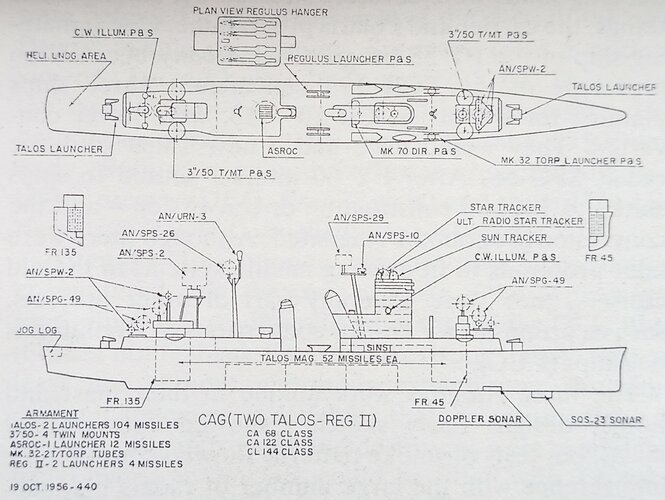
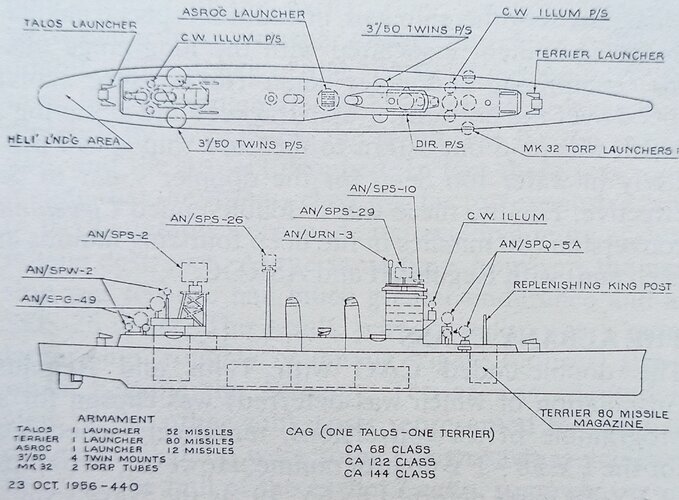
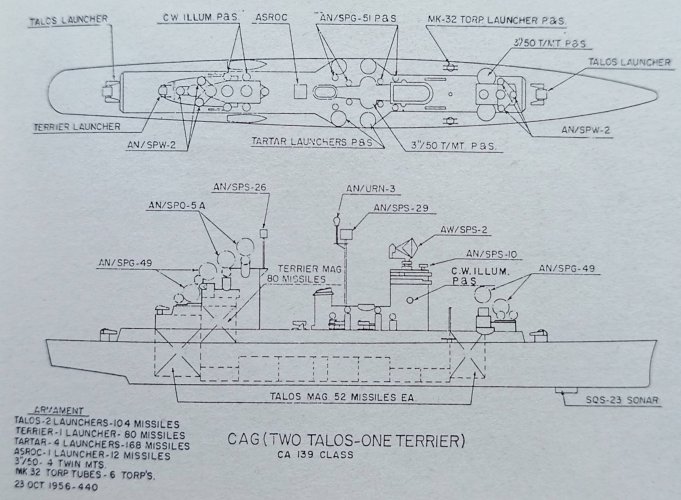
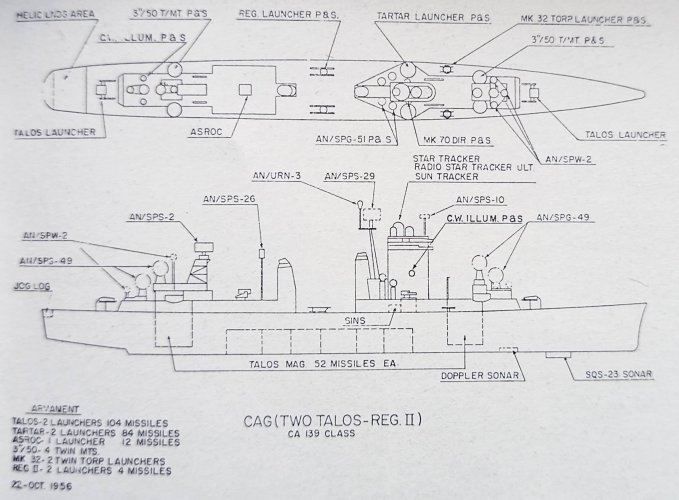
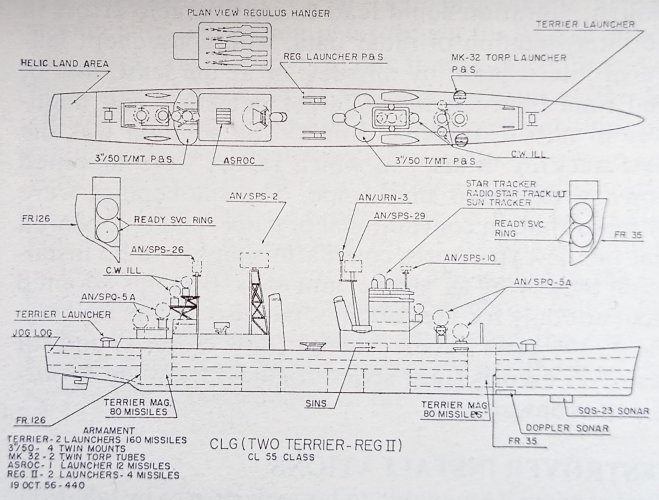
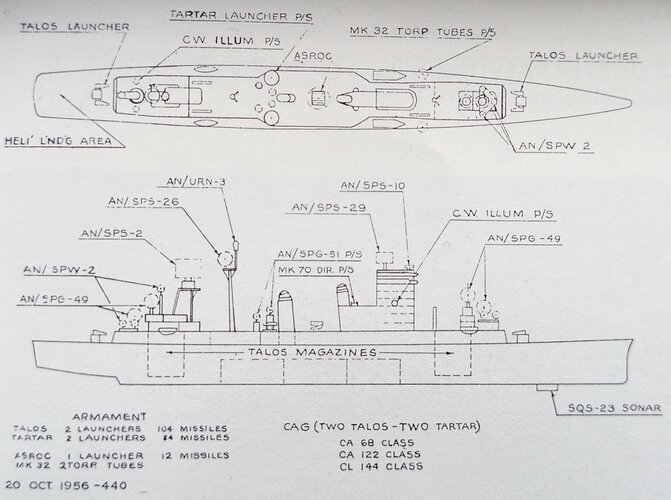
Given the sketches in question are for the arrangements of missile cruiser conversions of three different cruiser classes, I don't think they got as far as calculating exact displacements at this stage of the design, beyond confirming that the ships in question had the necessary volume, too weight reserves and centerline lengths for the armament and radars of the various different armament fits.

As part of the same series they also looked at a double-ended Cleveland Terrier conversion, and two double ended Des Moines conversions, with either Talos, Tartar and Regulus, or Talos, Terrier and Tartar:

original_81f01dbb-3482-44b5-8763-23c4d0213817_IMG_20230712_123554.jpg
IMG_20230712_123857.jpg
IMG_20230712_124741.jpg

Friedman doesn't seem to provide any information on displacement in either the Warship article the images come from, nor in his book on US Cruisers (in which two of the October 1956 sketches are reproduced). The upside is that they are all conversions of then-extant ships, and one of them was selected to become the Albany class, so dimensions would be mostly unchanged, and changes in displacement from the original gun cruisers could be estimated by looking at the displacement changes of those conversions.
 
I thought that 3 I quoted in your post are e variants for each class (Baltimore, Oregon City and Worcester) for a total of 9 proposals!
Note that the first drawing text does not indicate 3" guns but the side view shows a platform near the aft superstructure.

By the way does anybody knows how the USN structured it design documents? The RN had Ship Covers, Admiralty Papers and Constructors Workbooksbut for USN I have no idea! Do they had similar ship covers? Describing the development of a class/ship and includes modification proposals? Or the various Bureaus had these papers/documents?
 
Huh, I can't see the logic in converting the Worcester class. Not when the US had 14 Baltimores and 3 Oregon Cities available to convert, plus all previous CA and CL classes.

While the hulls of the "Woosters" are about the same size as a Baltimore, they're a bit differently shaped (a few feet longer and a foot or so narrower) and are very differently arranged internally due to the 3+3 turret layout. Plus, the "Woosters" are the greatest gun-AA ships ever built, they're practically ideal for "goalkeeper"/plane guard duties right next to the carrier.

By the time you'd be taking the "Woosters" out of service as gun-AA cruisers, you'd be building dedicated missile ships from the keel up.
 
While there were fewer Baltimore hulls available than that number suggests, that was in fact what eventually scuppered the conversion. Two ships was just not enough of a homogeneous group to justify the conversion.
 
While there were fewer Baltimore hulls available than that number suggests, that was in fact what eventually scuppered the conversion. Two ships was just not enough of a homogeneous group to justify the conversion.
Depends on how many 8" gun cruisers the Navy/Marines want for gunfire support.

Ideally, the USN would have continued building Des Moines-class post war for gunfire support, and turned all the Baltimores/ORCities into CGs. And even on the new-build Des Memes, I'd swap at least one of the broadside 5" turrets for a Mk11 or Mk13 launcher. The centerline 5" turrets are too useful as guns, IMO.
 
Depends on how many 8" gun cruisers the Navy/Marines want for gunfire support.

Ideally, the USN would have continued building Des Moines-class post war for gunfire support, and turned all the Baltimores/ORCities into CGs. And even on the new-build Des Memes, I'd swap at least one of the broadside 5" turrets for a Mk11 or Mk13 launcher. The centerline 5" turrets are too useful as guns, IMO.
Not just gunfire support - the Baltimores spent the 1950s acting as global presence ships in the traditional cruiser manner, and Helena, Macon, Toledo, and Los Angeles were a major part of the Navy's nuclear force as Regulus platforms. Of the follow-ons planned for the first three Albanies, Fall River and Oregon City, having sat in reserve since 1947, were the preferred option (and in fact had been selected originally before cost measures intervened - Albany was in better condition and Columbus was just coming out of service making her cheaper than reactivating Fall River). In addition to those two Rochester and Bremerton were also candidates for the second batch, both of which were soon to come out of active service in FY'59.

Baltimore, Quincy, and Pittsburgh, who all went out of service in the mid-50s, would also be potential conversion candidates.
 
Huh, I can't see the logic in converting the Worcester class. Not when the US had 14 Baltimores and 3 Oregon Cities available to convert, plus all previous CA and CL classes.
They were the most modern cruiser hulls in USN (so they would have the longest service life), and their main battery was deemed... unsatisfactory.
 
Not just gunfire support - the Baltimores spent the 1950s acting as global presence ships in the traditional cruiser manner, and Helena, Macon, Toledo, and Los Angeles were a major part of the Navy's nuclear force as Regulus platforms. Of the follow-ons planned for the first three Albanies, Fall River and Oregon City, having sat in reserve since 1947, were the preferred option (and in fact had been selected originally before cost measures intervened - Albany was in better condition and Columbus was just coming out of service making her cheaper than reactivating Fall River). In addition to those two Rochester and Bremerton were also candidates for the second batch, both of which were soon to come out of active service in FY'59.

Baltimore, Quincy, and Pittsburgh, who all went out of service in the mid-50s, would also be potential conversion candidates.
Okay, so that's 4 in 1959, and 3 others sometime in the 1950s. 7 of 17 heavy cruisers available to convert. 3 Albany-class were converted from those 17, so that's 14 total left available.

The 4 Regulus ships would not be available for conversion until the SSBNs came online in the mid 1960s, so it's just about guaranteed that they would not be converted.

That only leaves 3 other heavy cruisers available to convert, anyways.


They were the most modern cruiser hulls in USN (so they would have the longest service life), and their main battery was deemed... unsatisfactory.
What was wrong with the 6"/47? 12 RPM for 105lb HE shells times 12 tubes.
 
What was wrong with the 6"/47? 12 RPM for 105lb HE shells times 12 tubes.
Not with the guns themselves; the turrets were viewed as unreliable and overcomplicated, prone to malfunction. And by the mid-1950s, the efficiency of 6-inch DP guns against jet bombers & missiles was rathet doubtful. Considering that those not very efficient guns occupied two most modern cruiser hulls that USN have, I understood why they wanted to replace thwm with much more capable missiles.
 
Not with the guns themselves; the turrets were viewed as unreliable and overcomplicated, prone to malfunction. And by the mid-1950s, the efficiency of 6-inch DP guns against jet bombers & missiles was rathet doubtful. Considering that those not very efficient guns occupied two most modern cruiser hulls that USN have, I understood why they wanted to replace thwm with much more capable missiles.
Okay, I can see that argument.
 
The 2nd drawing mentions and shows 2/3 interesting radio ewuipment:
Star Tracker
Radio Star Tracker ULT and
Sun Tracker.
All 3 in rather small domes.
I know the Radio Star Tracker was connected to the predecessor of the GPS the NAVSAT system but the only depiction of such radar system on ships is a very large dome like 15m in diameter.
But what are the other two? Sun Tracker and plain Radio Tracker?
Or the Radio Tracker AND Radio Star Tracker ULT could substitute the large Radio Star Tracker dome?

Also shouldn't this thread be in the Naval subforum rather then the Bar?
 

Similar threads

Back
Top Bottom