De Monge/Buscaylet Prototypes & Projects

hesham

ACCESS: USAP
Senior Member
Joined
26 May 2006
Messages
38,278
Reaction score
20,412
Hi,

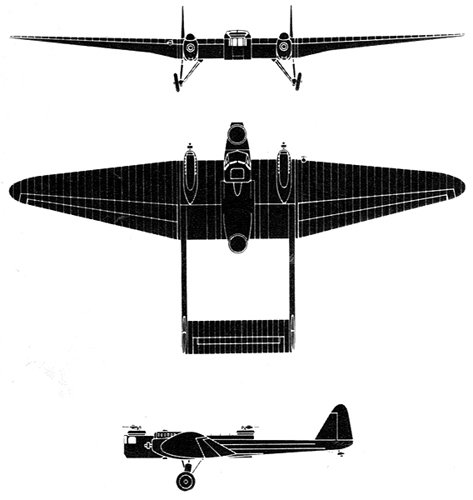
in the 1928 competition for RN.3 three-seat night recce aircraft,
which the main tenders were,ANF-120,Loire-30,Wibault-220 and
De Monge M-120.
The aircraft actually built and here is its data;

http://www.aviafrance.com/9972.htm
 

Attachments

  • De Monge 120.jpg
    De Monge 120.jpg
    70.6 KB · Views: 866
Last edited:
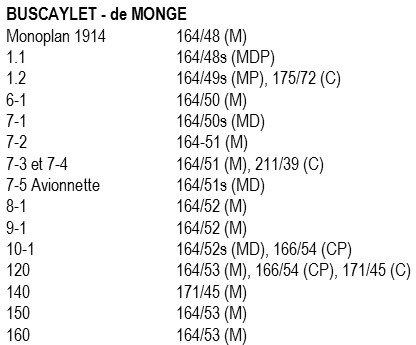
But you may understand I will not scan and post 9 full pages of magazine, so choices have to be made. Next week-end maybe, I will check what has already been posted and what is still new. OK.
 
OK my dear Tophe,

I am interesting in 1.1,1.2,6.1,8-1,9-1,10-1,140 and 160.
 
My friend Tophe,

I´m intersted in the Monoplane 1914 / 1.1 / 1.2 / 6-1 / 8-1 / 9-1 / 10-1 / 120 / 140 / 150 and 160. Hope you understand, but all thiese birds are new for me.

Thanks Maveric
 
All right, I will check and scan and post the forthcoming week-end. For the items with just a Mention, it will be even more simple: I just have to translate into English without scan. Soon.
 
From "Le Trait d'Union" #171:
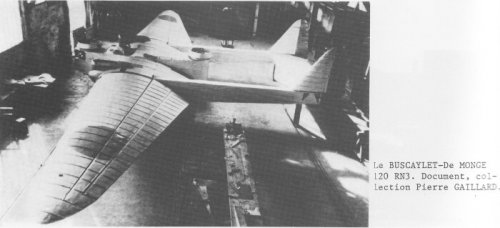
The Type 120 of the Exino company founded by Louis De Monge was a 3-seater for night reco. A derivative with 2 engines of 400hp would have reached 230km/h and 7,000m (instead of 200km/h and 5,700m). The program it was competing in was canceled in 1932. The 120 never flew and the Exino Co. disappeared.
 
“Le Trait d’Union” #171:
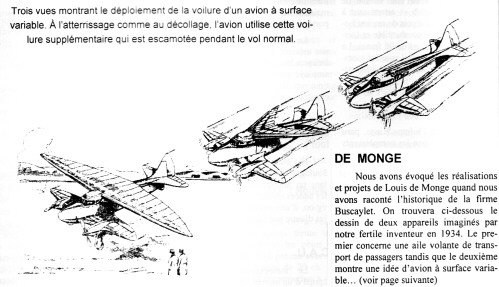
- The Exino company created by Louis De Monge presented in December 1930 a project Type 140, three-engined airliner with inhabited wing. Weight 18 tons, power 2,000 hp total , flying at 230km/h 5,000m.
- A mock-up has been built in 1931 of a BN-4 class “flying wing” (like the Type 120). 245km/h 7,000m. Cancelled because the company disappeared.
- In 1935, De Monge designed a small 2-seat “flying-wing”, to be constructed at Starck and Guénot Co. With a Rubis-Péquignol engine.
 
“Le Trait d’Union” #164, texts without picture:
- Type 6.1: designed in 1921, amphibious with hull for 15 passengers, Paris-NewYork line (imagined…). 3 engines of 500hp. Looking like the Richard Penhoet 2. Not built.
- Type 8-1: for the program 52/3, De Monge presented in 1926 a biplane CN2 built in wood (only one copy built). 1 engine Fiat 700hp.
- Type 9-1: monoplane fighter with a 500hp Salmson engine. Static tests but not flown.
- 10-1: licence-built Koolhoven FK31 slightly modified of military class C2. One prototype built.
- 160: tourism single-engine two-seater, 1926, 1 engine Anzani 35hp.
 
Excellent my dear Tophe,

thank you very very much,and can I ask about two aircraft,
the first 8-1 CN2 and what is that mean,two-seat naval fighter
or not,and the second 9-1,I think it was submitted to 1923 C.1
competition.
 
hesham said:
and can I ask about
the first 8-1 CN2 and what is that mean,two-seat naval fighter
or not,
According to http://www.aviafrance.com/aviafrance1.php?ID=3749
it seems a CN2 is "un Chasseur de Nuit biplace" (a 2-seat Night Fighter)
 
Marvelous projects my dear Tophe,


Thank you very much,and for Hanriot projects,I will open a new
topic for it.
 
hesham said:
Excellent my dear Tophe,

thank you very very much,and can I ask about two aircraft,
the first 8-1 CN2 and what is that mean,two-seat naval fighter
or not,and the second 9-1,I think it was submitted to 1923 C.1
competition.

Hi,

I check about those projects,the 8-1 was two-seat day and night fighter,and I think
it was submitted to the C.2 1925 competition with De Monge M.101,which
the main tenders were;

ANF.3,ANF.4,Avimeta Av.88,Breguet Br.25,De Monge M.101 & M.8-1,Dewotine D.25,
Hanriot HD.33,Levasseur PL-6,Nieuport NiD-47,Potez-31,Salmson-Bechereau SB-5 &
SB-6,SPAD S.60 & S.70,Villiers V.24 and Wibault Wib.8 & Wib.12.


-Also for the De Monge 9-1,it was submitted to C.1 1926 Jockey Fighter competition,
which the main contenders were;

Amiot-110,Bernard-20,De Monge M.9-1,Dewoitine D.27,Gourdou-Leseurre GL-351,
Morane-Salnier MS.121 & MS.221,Nieuport NiD-48 & NiD-49,SPAD S.91 and Wibault
Wib.13,Wib.15,Wib.160 & Wib.170.
 
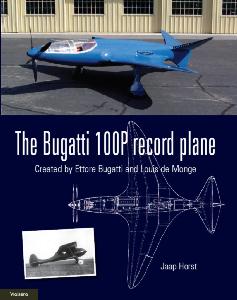
100p-books.jpg


Almost everything on de Monge can now be found in the book about the Bugatti 100P, which has a complete chapter on all of the de Monge designs!

http://www.bugattipage.com/bugatti-100p-record-plane.htm
 
'J.J. Horst' might just be 'Jaap Horst', the author of 'The Bugatti 100P record plane'
In that case, 'good read' would be more appropriate than 'great find' :)
 
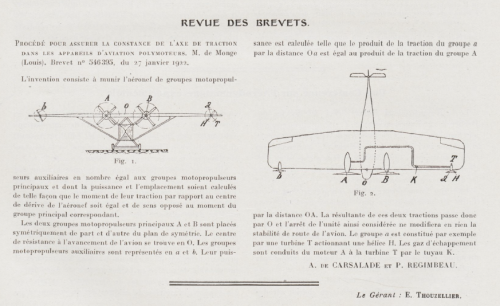
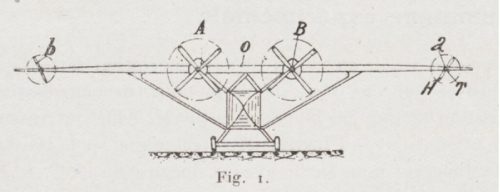
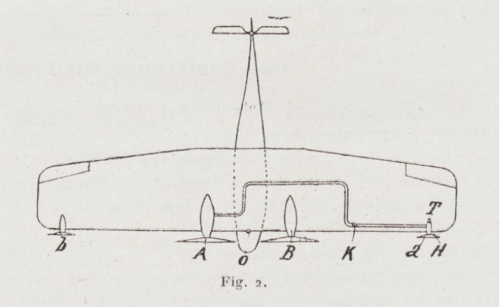
From l'Aeronautique journal 1923,


here is a strange patent to De Monge.
 

Attachments

  • 3.png
    3.png
    604.5 KB · Views: 115
  • 2.png
    2.png
    282.9 KB · Views: 194
  • 1.png
    1.png
    402.5 KB · Views: 211
Interesting, four propellers, but why? More cargo capacity? Greater stability? It seems that the smaller ones were connected to the main propellers.
 
bigvlada said:
Interesting, four propellers, but why? More cargo capacity? Greater stability? It seems that the smaller ones were connected to the main propellers.


My dear Bigvlada,frankly,I don't know why four propellers ?.
 
To provide a contant airflow axis over the wing. Small outboard props were driven by the
exhaust gas of the main engines.
 
Many thanks for explanations my dear Lark and Bill Walker.
 
Tophe said:
I start from the end of the Trait d'Union collection, to get corrections before mistakes.
#175:
In 1922 Show was presented the Buscaylet-De Monge 5-2 fighter and a drawing of the 3-engined 7-2 (9000kg weight plane for 30 passengers on 1000km distance at speed over 200km/h).
Louis-Pierre de Monge de Franeau was a Belgium citizen, born in 1890 and deceased July 25th 1977 in New York. He built his first airplane in 1911. He worked during WW1 for the Lumière company. After the war, he stayed technical director for Lumière while creating his own design bureau. He designed and built many machines in France. After the failure of them, he went and worked in Belgium for Imperia. In 1937, he has been the designer of the Bugatti racer for the Deutsch de la Meurthe Cup.

My dear Tophe spoke here about Type 1.2,a 30 passenger aircraft Project.
 
De Monge's automatic stability prototypes of 1914 and 1918 are now in a separate topic:
https://www.secretprojects.co.uk/forum/index.php/topic,30570/all.html
 
Hi,

I can't translate well,they mentioned here a helicopter and de Monge in the article,
what is that mean ?.

https://gallica.bnf.fr/ark:/12148/bpt6k9794881f/f3.item
 
Google is your friend here, too !
The article mentions the "S.I.A.", which quite probably means the "Société des Ingénieurs de l’Automobile"
(Society of automotive engineers). A bit strange, as this would mean people workings mostly on cars, not
aircraft, but at least with regards to the engines, both means of transportation often share the same interests.
And especially after the war, a much more widespread use of aircraft as means of private (!) transport was expected
by many. And then an online translator can do its task by translating the two sentences at the start:
"considerations of the stuff for private transport" and "The S.I.A. discusses the question: Aircraft or helicopter?"
If really Louis de Monge is meant, I'm not sure, because the first sentence, which certainly caught your eye says
"Sous la présidence de M. de Monge ...", meaning "under the presidency of M. (NOT "L." !) de Monge.
So, the article is about a discussion amongst the French engineers and manufacturers of means of transportation,
which way is better: The fixed-wing aircraft, fast, but needing runways, or the helicopter, slower, but able to take
off from nearly any spot.
That answer isn't complete, but shows, that there's no mention of an unknown helicopter and that the question probably is
wrong in this thread. And finding it took about ten minutes and very nearly no knowledge of the French language, just
typing in a number of letters and I think, that much research is reasonable for everyone here. ;)
 
Jemiba said:
..."Sous la présidence de M. de Monge ...", meaning "under the presidency of M. (NOT "L." !) de Monge....
M is probably for 'Monsieur' (Mister), as 'Mr de Monge' in English, and not related with the firstname.
 
patvig said:
Jemiba said:
..."Sous la présidence de M. de Monge ...", meaning "under the presidency of M. (NOT "L." !) de Monge....
M is probably for 'Monsieur' (Mister), as 'Mr de Monge' in English, and not related with the firstname.

Maybe that's right ?.
 
Yes, maybe that's right, it may well be, that Monsieur (thanks for the clue, Patvig) Louis de Monge was president of the S.I.A. then. I haven't found a forename during my quick search.
But what be the difference in this case ?
 
Hi,

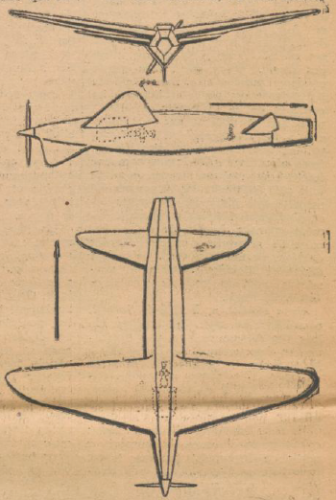
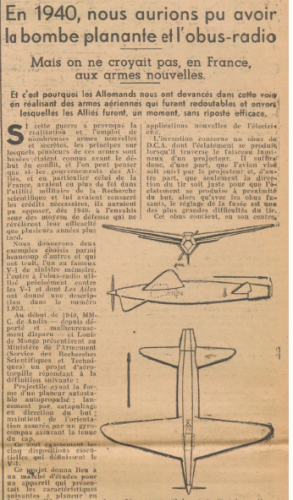
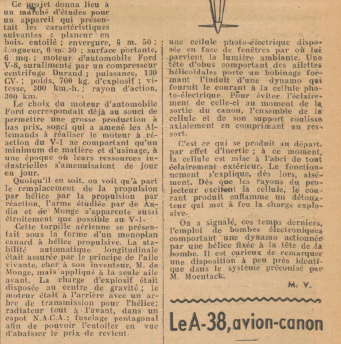
here is a strange Project for flying bomb with 700 kg explosives load,mentioned
in the book; The Bugatti 100P record plane

Ailes 1/1946
 

Attachments

  • 1.png
    1.png
    296.1 KB · Views: 201
  • 2.png
    2.png
    422.4 KB · Views: 183
  • 3.png
    3.png
    255.8 KB · Views: 187
Jemiba said:
Google is your friend here, too !
The article mentions the "S.I.A.", which quite probably means the "Société des Ingénieurs de l’Automobile"
(Society of automotive engineers). A bit strange, as this would mean people workings mostly on cars, not
aircraft, but at least with regards to the engines, both means of transportation often share the same interest.
———————————————————-
Yes Hesham,
Since most of the work of aeronautical engineers overlaps the work of automotive engineers, AE is often referred to as a sub-set of automotive engineering.
The Society of Automotive Engineers has a sub-organization of aeronautical engineers. The American Institute of Aviation and Aerspace Engineering is the academic side.
Even more narrowly defined is the Parachute Industry Association which includes manufacturers and PIA’s Sepifications Commitee maintains SAE specifications for parachute fabric, lines, hardware, etc. The Federal Aviation Adminstration and US military recognize PIA specifications as the successors to old Military Specifications. PIA specs are respected the same as SAE specs.
If you ask SAE about parachute specs, they will refer you to PIA.
 
riggerrob said:
Yes Hesham,
Since most of the work of aeronautical engineers overlaps the work of automotive engineers, AE is often referred to as a sub-set of automotive engineering.
The Society of Automotive Engineers has a sub-organization of aeronautical engineers. The American Institute of Aviation and Aerspace Engineering is the academic side.
Even more narrowly defined is the Parachute Industry Association which includes manufacturers and PIA’s Sepifications Commitee maintains SAE specifications for parachute fabric, lines, hardware, etc. The Federal Aviation Adminstration and US military recognize PIA specifications as the successors to old Military Specifications. PIA specs are respected the same as SAE specs.
If you ask SAE about parachute specs, they will refer you to PIA.

Thank you Riggerrob.
 

Similar threads

Back
Top Bottom