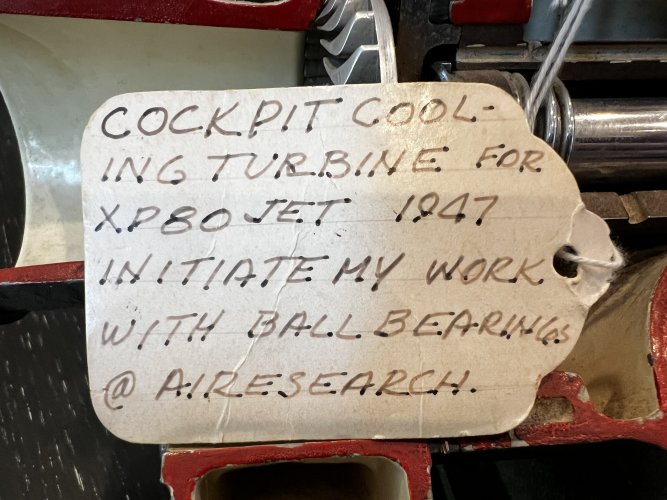
Title: Cutaway Cockpit-Cooling Turbine from the Lockheed XP-80 (with tag likely in Clarence “Kelly” Johnson’s hand) — Seeking insights & handwriting comparisons
Hi all—sharing a piece that I think will interest the Skunk Works and early-jet crowd.
(“AiResearch” here refers to the Garrett/AiResearch division that supplied environmental-control hardware to early U.S. jets.)
I’m not presenting this as definitive authentication, but after comparing the tag to a period flight log page attributed to Johnson (image attached in the thread), a few things line up. Here’s what I’m seeing:
Again: I’m not a forensic examiner. I’m posting this to collect opinions from folks who have seen more of Johnson’s handwritten shop notes, memos, or log pages from the mid-1940s.
Happy to provide more dimensions, weights, or higher-res macros of the stampings and bearing cartridge if helpful. Appreciate any leads, corrections, or handwriting exemplars you’re willing to share!

Hi all—sharing a piece that I think will interest the Skunk Works and early-jet crowd.
What I have
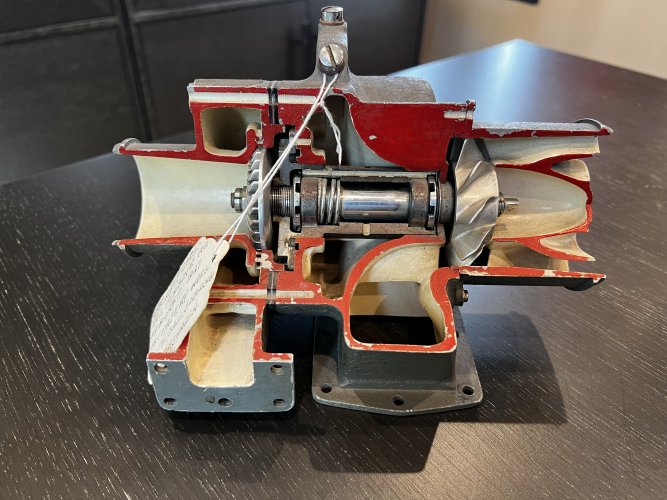
- Object: Cockpit-cooling turbine/air-cycle unit component attributed to the Lockheed XP-80 program.
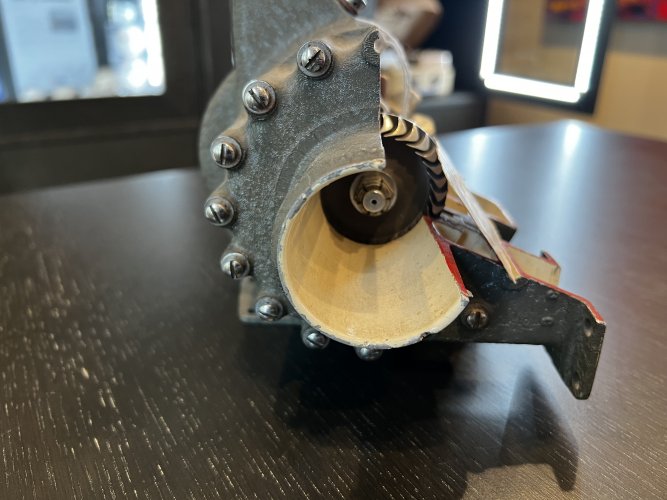
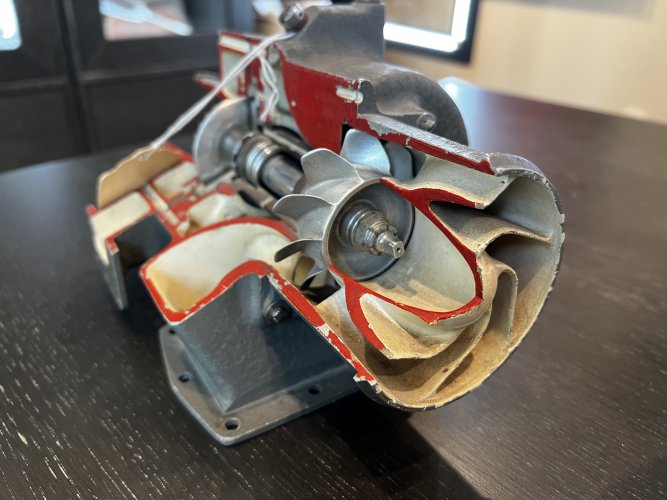
- Form: Factory/engineering cutaway showing the impeller, diffuser passages, and bearing cartridge.
- Size: ~8½" L × 6" H × 5½" D.
- Provenance note: Attached to the housing is a handwritten tag that reads:
“COCKPIT COOL-ING TURBINE FOR XP80 JET 1947 INITIATE MY WORK WITH BALL BEARINGS @ AIRESEARCH.”
(“AiResearch” here refers to the Garrett/AiResearch division that supplied environmental-control hardware to early U.S. jets.)
Why it matters
- The XP-80 was America’s first successful operational jet fighter lineage (leading to the P-80/F-80, then T-33/F-94).
- Early cockpits ran hot and pressurized; turbine-type air-cycle machines from AiResearch were the bleeding edge of thermal management.
- A period cutaway is the kind of teaching/briefing aid that lived in engineering offices and test hangars—rare to see outside museums.
The tag & why I think it’s Kelly Johnson’s handwriting (inviting critique!)
I’m not presenting this as definitive authentication, but after comparing the tag to a period flight log page attributed to Johnson (image attached in the thread), a few things line up. Here’s what I’m seeing:
- All-caps habit with mixed word spacing. Both samples use mostly capitals with slightly irregular, open spacing—e.g., “COOL-ING TURBINE” and “REPUBLICAN…” style block words vs. the log’s aircraft types and locations.
- Slant & line rhythm. The letters have a subtle rightward slant with a light start/firm downstroke cadence; the log entries show that same “lean and release.”
- Characteristic letterforms.
- R: Open leg with a small, high “belly” before the diagonal—very similar in both.
- G: The G in “AIRESEARCH” has a tight inner radius with a short horizontal terminal, which tracks with G forms in the log.
- N/M: Narrow verticals with minimal outer spread; the tag’s “INITIATE MY WORK” shows the same tight N/M geometry I see in the log.
- Numerals. The “1947” on the tag uses a closed 4 with a sharp apex and a flat top stroke, close to the 4 in the logbook dates; the 7 has a slight down-hook.
- Punctuation quirks. The use of the @ sign in “@ AIRESEARCH” is fascinating—Johnson occasionally annotated quickly with shorthand in internal notes; the form here is quick, single-line, not a careful calligraphic @.
Again: I’m not a forensic examiner. I’m posting this to collect opinions from folks who have seen more of Johnson’s handwritten shop notes, memos, or log pages from the mid-1940s.
What I’m hoping to learn
- Handwriting comparisons: If anyone has scans of Johnson’s engineering notes or informal tags/labels from the XP-80/P-80 era, I’d love to compare letterforms—especially R, G, 4, and 7.
- AiResearch documentation: Part numbers, cutaway drawings, or brochure sheets for cockpit cooling turbines/air-cycle units supplied to Lockheed around 1944–47.
- Use context: Were cutaways like this kept in the Burbank engineering offices or at Muroc during flight test? Any photos showing similar units on desks or briefings?
- Bearings note: The tag mentions “INITIATE MY WORK WITH BALL BEARINGS @ AIRESEARCH.” If anyone knows a Johnson anecdote about bearing selection/testing for environmental-control turbines on the XP-80, I’d love a pointer.
Photos attached
- Overall cutaway, impeller/diffuser visible
- Opposite side, bearing cartridge detail
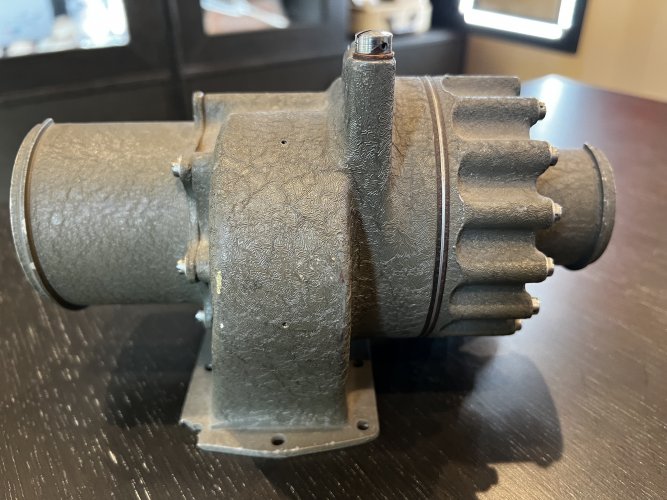
- Exterior housing (wrinkle-finish paint)
- Inlet view across the wheel
- Handwritten tag close-up
- Comparison image: Johnson flight-log page (for letterform discussion)
Happy to provide more dimensions, weights, or higher-res macros of the stampings and bearing cartridge if helpful. Appreciate any leads, corrections, or handwriting exemplars you’re willing to share!