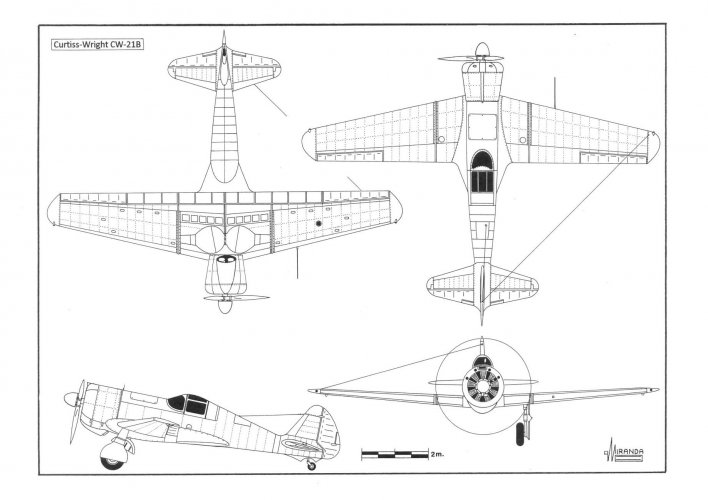
Curtiss-Wright CW-21B Demon
On April 17, 1940, the Netherlands Air Defence Command purchased twenty-four modified CW-21s.
The Netherlands surrendered on May 14, before the new fighters could be delivered and these aircraft were diverted to the Netherlands East Indies.
In December 1941, the fighter strength of the Royal Netherlands East Indies Army (ML-KNIL) consisted of twenty Hawk 75 A-7 of Squadron 1-VI.G. IV, thirty-six Brewster B-339 D Buffalo of the 1-VI.G.V., 2-VI. G.V. and 3-VI.G. V and twenty-four Curtiss CW-21B Demon of the 2-VI.G. IV.
The 'Java Panic Fighter' was the Curtiss CW-21B Demon, which differed from the Chinese version in the flush-retracting undercarriage and armament. It was powered by a 1,000 hp Wright Cyclone R-1820-G5 engine and armed with four 7.9-mm Browning M-36 machine guns. Its maximum speed was 505 km/h and its service ceiling of 10,500 meters. With a maximum weight of 2,041 kg only and a climb rate of 22.9 m/sec, the Demon would have been able to overcome any Japanese fighter in combat... would it had been used according to the A.V.G. tactics (diving down, zooming away and back to altitude). But its pilots made the mistake of getting involved in dogfights at medium altitude without having numerical superiority.
The Demon was not designed for this type of combat: it lacked structural strength, armour and self-sealing fuel tanks, its hydraulic system was not duplicated, and a single impact was enough to prevent the deployment of the undercarriage and flaps, a defect that caused the destruction of 25 per cent of the aircraft in crash landings. Another 37 per cent was shot down by impacts to the pilot or fuel tanks, which would not have occurred in other better-protected Curtiss models such as the H-75 or the P-40.
Dutch pilots were good but lacked experience in combat when they faced two elite squadrons (the 64th Sentai and the Tainan Kokutai) in which Veterans of Khalkin Gol, Philippines and China flew. Other factors that decreased the effectiveness of the Demon were the deficient Dutch raid warning organization and erroneous tactics of the ML-KNIL that split into small units the scarce available fighters, being systematically overcome in number by the attackers.
On 3 February 1942, the Demon entered in combat for the first time during a raid carried out by aircraft of the IJN against the Soerabaja, Maospati and Singosari airfields. The attackers were thirty-seven Mitsubishi G4M bombers of 21st Kanoya Kokutai and twenty-seven G4M of the Takao Kokutai, based more than 1,000 km away in Kendari-Celebes. The escort fighters were sixteen Mitsubishi A6M2 Model 21 Zero-Sen (535 kph) of the 251st Tainan Kokutai and twelve more Zeros from the 3rd Kaohsiung Kokutai, from Balikpapan-Borneo.
The large formation of Japanese aircraft was intercepted over Madura Island by twelve Demons based in Perak, eight Curtiss H-75 of Singosari and four Curtiss P-40E of the 17th USAAC Pursuit Squadron based on Ngoro-Blimbing. The Tainan Zeros shot down three Demons and damaged six more (four of which were destroyed in crash landings) and the 3rd Kokutai fighters shot down other two. In this battle the Allies also lost three Curtiss H-75 and three Curtiss P-40, the Japanese lost three Zeros and other twenty aircraft more, by battle damage, during the return flight.
The following day the IJN repeated the attack using forty G4M bombers from the 4th Kokutai and twenty-seven Zeros from the Tainan Air Group. They were intercepted by 4 Demons, two H-75 and seven P-40, the Japanese lost two Zeros and the Allies one Demon, one P-40 and the two H-75. On 19 February, seven Demons based in Bandoeng faced for the first time the IJA aircraft that, coming from Sumatra, attacked Semplak airfield. The attackers were nine Kawasaki-Ki.48-II bombers of the 90th Sentai escorted by twenty-eight Nakajima Ki.43-Ia fighters of the 59th Sentai. One Demon suffered battle damage and was destroyed in a crash landing.
On the same day, another group of five Ki.48-II of the 75th Sentai, escorted by nineteen Ki.43-Ia of the 64th Sentai attacked RAF and ML-KNIL installations in Buitenzorg and Andir bases, destroying another Demon in the ground. On 23 February, the Buffaloes went into combat with the Tainan Zeros, resulting massacred.
The following day seven British Hurricanes Mk. IIb of the 232nd RAF Squadron and four Demons intercepted a strafing raid of the IJA over Lembang, carried out by twenty-seven Ki.43 fighters of the 59th and 64th Sentais from Sumatra. One Demon was shot down in combat, another by the Dutch antiaircraft artillery, and one in crash landing and one more destroyed in Andir by the Ki.48-II of the 90th Sentai.
On March 1, fifty Ki.48-II bombers of the IJA 27th Air Group, that were attacking Bandoeng escorted by Ki.43 fighters of the 59th and 64th Sentais, were intercepted by four Hurricanes and four Demons, one of which was shot down. The next day, four Curtiss Hawk, four Buffaloes and two Demons entered combat against Nakajima fighters from 64th Sentai, with one of the Demons being shot down.
On day 3, the last three Demons in flying condition carried out a strafing mission against the Kalidjati airfield, destroying a Type 97 bomber. After the surrender of Java, two Demons were captured by the Japanese and sent to the Tachikawa Test Centre to study the secrets of its construction. Sumatra surrendered on 28 March.
Paint scheme: Dark Olive Drab 31/Light Olive Drab 35 upper surfaces, natural metal under surfaces, Orange/Black national marking triangles in wing undersurfaces and fuselage sides, White serials.
Curtiss-Wright CW-21 B technical data
Wingspan: 10.66 m, length: 8.28 m, height: 2.71 m, wing area: 16.19 sq. m, max weight: 2,041 kg, maximum speed: 536 km/h, range: 1,014 km, service ceiling: 10,450 m, power plant: one 1,000 hp Wright Cyclone R-1820-G5 air-cooled radial engine.