Could Starlite have saved the Shuttle?

My initial question was would Starlite have been effective enough to prevent the occurence of condensation to prevent the build up of ice on the ET.
Oh, that way.

No, I don't believe that any insulation would prevent the external tank from icing up. Liquid hydrogen is too cold, and Florida is too humid. The insulation will get cold enough to freeze moisture out of the air.


Preventing the Challenger disaster is easy as people have stated either monolithic SRBs or LRBs but with LRBs depending on placement(Parallel vs Staged)could make the icing foam strike problem worse LRBs right in front of the wings leading edge.
Agreed. Not sure it would be easy to make a monolithic SRB, those are much large than any other SRMs the US has made to my knowledge.

Saving Columbia would require either a very different safety culture at NASA, or leading edges strong enough to survive an ice impact without suffering a thermal breach.
 
NASA has recently moved to fuel and go for Space-X launches maybe they should have done that for the Shuttle
 
As I said, around 1997 we found a commercially-available surface coating that duplicated Starlite's performance in our torch tests. I got a small quantity and passed it along to one of our missile programs that was having thermal heating problems but I never heard anything back from them. If I can find my old notes I'll post the info here.
Speaking of Starlite though, here's something that I don't think anyone else has published. On Maurice's first visit here, I took him to my house where he became very interested in one of our stray rescue dogs. This one had a large "thing" on his back, and Maurice had a close look at it, then told me a story. When she was younger, his daughter had a pet rabbit. It was one of those breeds that has black fur. It got old and sick with cancer, which the vet said was so diffuse as to be inoperable, so they knew it was going to die soon. For some reason Maurice decided to feed it the Starlite powder that he used to mix with polypropylene and other things to make heat-resistant panels. He put it in the rabbit's food and after a while the rabbit began to get better. (Remember, this is Maurice telling me something; I have no way to verify it.) They took the rabbit back to the vet, who took some biopsies of the cancerous areas and looked at them under the microscope, where Maurice said the vet found some "very interesting" things. The tumor or tumors had consolidated and developed encasing walls, so they could be excised. The rabbit's fur, which had gone at least partly white from the illness as well as age, grew back in all-black again, and the rabbit lived for another few years. Maurice wondered if the "thing" on our dog's back might be cancer, and I think he saw it as an opportunity to do another experiment. But it turned out to be just a large scar from some previous injury. I know this all sounds crazy but it was part of the Starlite mystique at the time, 30 years ago. Anyway it's a story that I'd almost forgotten about myself, and I'm glad to preserve it here. If anyone knows Maurice's family, it should be easy to check with his daughter and see if she can confirm or debunk it. I've only met her the one time she came to St Louis and I can't even recall her name.

As long as I'm sharing old experiences, let me cover one more. On that same first trip Maurice brought the test piece that he'd used in many demonstrations already. It looked like an oversized charcoal briquette with a thin layer of Starlite smeared on one side. I couldn't get permission to do any flame testing in our Company facilities because of uncertainties about what kinds of potentially harmful vapors might be released (since obviously there was no MSDS and Maurice refused to tell us what his material was made of) but I knew the head of the chemistry department at a local university, so we went there and did a simple test. We put it in a frame of some sort and set a propane torch or bunsen burner or something to impinge on that coated surface for several minutes. Then as soon as that was turned off, Maurice took the piece and laid it face down on my hand. Now, the "Tomorrow's World" video that I'd seen showed this being done with an egg, and the presenter said "it only just feels warm" so that's what I was expecting. But it was quite a bit "warmer" than I thought it would be, not something I could hold for more than a couple of seconds, but not hot enough to leave a blister either. So that's my one and only personal experience touching a Starlite coated surface immediately after it was removed from a torch.

One more, and then I'll stop. For that first visit we assembled a room full of tech guys for Maurice to talk to. He gave a nice long chat about Starlite and even passed around some samples. It was taped, and somewhere I think I still have the 2 VHS tapes of that day. I've actually never watched them, I had been there myself so I knew what had happened. But it would be interesting now to go through them and maybe generate a transcript.
 
When she was younger, his daughter had a pet rabbit. It was one of those breeds that has black fur. It got old and sick with cancer, which the vet said was so diffuse as to be inoperable, so they knew it was going to die soon. For some reason Maurice decided to feed it the Starlite powder that he used to mix with polypropylene and other things to make heat-resistant panels. He put it in the rabbit's food and after a while the rabbit began to get better. (Remember, this is Maurice telling me something; I have no way to verify it.) They took the rabbit back to the vet, who took some biopsies of the cancerous areas and looked at them under the microscope, where Maurice said the vet found some "very interesting" things. The tumor or tumors had consolidated and developed encasing walls, so they could be excised.
LMAO, what.
Did it also turn lead into gold? Increase your mileage by 1000% when added to a tank of gas? Cure male pattern baldness?

Look, I get that you met him in person and thought highly of the guy, but...come on. That's some absolute snake oil salesman BS. Which just reinforces what I've thought about this whole thing since I first heard of it: Starlite might have been an interesting material, but Maurice Ward was an absolute crank.
 
LMAO, what.
Did it also turn lead into gold? Increase your mileage by 1000% when added to a tank of gas? Cure male pattern baldness?

Look, I get that you met him in person and thought highly of the guy, but...come on. That's some absolute snake oil salesman BS. Which just reinforces what I've thought about this whole thing since I first heard of it: Starlite might have been an interesting material, but Maurice Ward was an absolute crank.
Never said I put any stock into his theory about medical uses. Just reported what he told me.

Crank? In personal ways, yes, but you have to remember that he believed that he had invented something that could change the world, and it's undeniable that on multiple occasions people at the companies that he tried to work with tried to steal his invention. That's just a fact. I know of 3 such cases myself and I believe there were others. So his obsession with secrecy and control had legitimate roots. When you have to treat something like this as a trade secret because patenting it would reveal the method of protection and open the door to tweaking by competitors, you really don't have any choice but to do as he did, particularly when dealing with corporations having huge technical and legal teams on staff.
 
I remember my readings of 30 years ago about him... he told a story, that some con man (or was it a lawyer ? better call Saul !) discretely scratched some starlite sample; to get some scraps under his nails. To the point he didn't even shook his hand when leaving. Ward then joyfully said "I saw it coming, and the sample I passed him wasn't starlite."
 
Oh, that way.

No, I don't believe that any insulation would prevent the external tank from icing up. Liquid hydrogen is too cold, and Florida is too humid. The insulation will get cold enough to freeze moisture out of the air.
Ah, It did prevent it. There was no acreage ice on the ET. Liquid hydrogen requires insulation because liquid air would form on any metal tank surfaces and in the process of accumulating and running off would cause a huge heat leak into the liquid hydrogen. Bare metal liquid oxygen just forms water ice, which actually becomes an insulator. On most launch vehicles, the ice just sheds at engine start and lift off. But the shuttle, with its impact sensitive thermal protection system, required insulation (foam) on LOX tanks and plumbing and extra insulation of the liquid hydrogen areas to prevent ice formation. Frost was only allowed to form. After tanking, a team of engineers and techs would go out to the pad and inspect the vehicle for ice formation.
 
Ah, It did prevent it. There was no acreage ice on the ET. Liquid hydrogen requires insulation because liquid air would form on any metal tank surfaces and in the process of accumulating and running off would cause a huge heat leak into the liquid hydrogen. Bare metal liquid oxygen just forms water ice, which actually becomes an insulator. On most launch vehicles, the ice just sheds at engine start and lift off. But the shuttle, with its impact sensitive thermal protection system, required insulation (foam) on LOX tanks and plumbing and extra insulation of the liquid hydrogen areas to prevent ice formation. Frost was only allowed to form. After tanking, a team of engineers and techs would go out to the pad and inspect the vehicle for ice formation.
So where did the ice that shattered Columbia's LE come from?
 
It was foam not ice.

Yeah, foam. Relatively low density, but at high velocity. Essentially it came off of the tank and stopped in midair, and then the orbiter ran into it.
 
Last edited:
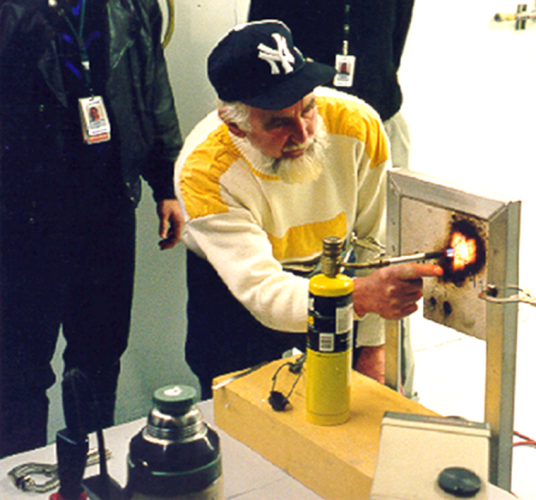
All this talk about Starlite reminded me of something genuinely weird that Maurice claimed, and that I put very little stock in, about what he called the "cold flame" that Starlite produced. According to him, as a propane torch flame impacted and spread out over the surface of a Starlite-coated piece, you could put a piece of paper into the outer fringes of that flame and it wouldn't be scorched, or you could put your finger there and it wouldn't get burned. He was making so many outrageous claims that I just discounted this one. But our BAe friend (Colin Birtwistle, who I believe later went to Lockheed for JSF but I'm not 100% sure of that) said that they had actually done that test, and that although nobody wanted to be the first to stick their finger in that edge of flame, once the first person did it the others were lined up to have a go. And I have a photo in my old stack showing Maurice doing the same thing at one of our other sites, where our own people followed up and reported that it was true. As far as I know, nobody at the time was able to come up with a plausible mechanism for such a thing. Clearly the "flame" wasn't actually that; it was glowing, and contiguous with the actual flame, but color and temperature go together in a flame so what people were seeing couldn't have been a true flame or it would have instantly ignited paper or blistered skin. Odd, to say the least.

Building on that supposed phenomenon, Maurice believed that something about Starlite produced a "signal" that interfered with fire itself, and that if he could only find the right shape for the piece, he'd be able to put out a fire from a distance. That seemed pretty farfetched. It's definitely possible to put out a flame from a distance with the right kind of sound waves, and there's been some work showing that electromagnetic waves have that ability to some limited extent. I still can't quite believe Maurice was on the right track there, though, although in fairness he did say that some of his Starlite formulations were electrically conductive and so...???

Anyway here's the photo of Maurice putting his finger in the edge of the flame wash from a propane torch. To those who say that it's not really in the flame itself, I would reply that if the lights had been off the glow would have been clearer. It was enough to mightily impress our Mesa people, just as it had the BAe folks before. :)

1767538799628.png
 
Last edited:
All this talk about Starlite reminded me of something genuinely weird that Maurice claimed, and that I put very little stock in, about what he called the "cold flame" that Starlite produced. According to him, as a propane torch flame impacted and spread out over the surface of a Starlite-coated piece, you could put a piece of paper into the outer fringes of that flame and it wouldn't be scorched, or you could put your finger there and it wouldn't get burned. He was making so many outrageous claims that I just discounted this one. But our BAe friend (Colin Birtwistle, who I believe later went to Lockheed for JSF but I'm not 100% sure of that) said that they had actually done that test, and that although nobody wanted to be the first to stick their finger in that edge of flame, once the first person did it the others were lined up to have a go. And I have a photo in my old stack showing Maurice doing the same thing at one of our other sites, where our own people followed up and reported that it was true. As far as I know, nobody at the time was able to come up with a plausible mechanism for such a thing. Clearly the "flame" wasn't actually that; it was glowing, and contiguous with the actual flame, but color and temperature go together in a flame so what people were seeing couldn't have been a true flame or it would have instantly ignited paper or blistered skin. Odd, to say the least.

Building on that supposed phenomenon, Maurice believed that something about Starlite produced a "signal" that interfered with fire itself, and that if he could only find the right shape for the piece, he'd be able to put out a fire from a distance. That seemed pretty farfetched. It's definitely possible to put out a flame from a distance with the right kind of sound waves, and there's been some work showing that electromagnetic waves have that ability to some limited extent. I still can't quite believe Maurice was on the right track there, though, although in fairness he did say that some of his Starlite formulations were electrically conductive and so...???

Anyway here's the photo of Maurice putting his finger in the edge of the flame wash from a propane torch. To those who say that it's not really in the flame itself, I would reply that if the lights had been off the glow would have been clearer. It was enough to mightily impress our Mesa people, just as it had the BAe folks before. :)

View attachment 797353
That may actually be a MAPP gas cylinder rather than propane, and if it is, the flame is quite a bit hotter. It would be the "old" original MAPP gas, not the modern MAP-Pro stuff.
 
All this talk about Starlite reminded me of something genuinely weird that Maurice claimed, and that I put very little stock in, about what he called the "cold flame" that Starlite produced. According to him, as a propane torch flame impacted and spread out over the surface of a Starlite-coated piece, you could put a piece of paper into the outer fringes of that flame and it wouldn't be scorched, or you could put your finger there and it wouldn't get burned. He was making so many outrageous claims that I just discounted this one. But our BAe friend (Colin Birtwistle, who I believe later went to Lockheed for JSF but I'm not 100% sure of that) said that they had actually done that test, and that although nobody wanted to be the first to stick their finger in that edge of flame, once the first person did it the others were lined up to have a go. And I have a photo in my old stack showing Maurice doing the same thing at one of our other sites, where our own people followed up and reported that it was true. As far as I know, nobody at the time was able to come up with a plausible mechanism for such a thing. Clearly the "flame" wasn't actually that; it was glowing, and contiguous with the actual flame, but color and temperature go together in a flame so what people were seeing couldn't have been a true flame or it would have instantly ignited paper or blistered skin. Odd, to say the least.

Building on that supposed phenomenon, Maurice believed that something about Starlite produced a "signal" that interfered with fire itself, and that if he could only find the right shape for the piece, he'd be able to put out a fire from a distance. That seemed pretty farfetched. It's definitely possible to put out a flame from a distance with the right kind of sound waves, and there's been some work showing that electromagnetic waves have that ability to some limited extent. I still can't quite believe Maurice was on the right track there, though, although in fairness he did say that some of his Starlite formulations were electrically conductive and so...???

Anyway here's the photo of Maurice putting his finger in the edge of the flame wash from a propane torch. To those who say that it's not really in the flame itself, I would reply that if the lights had been off the glow would have been clearer. It was enough to mightily impress our Mesa people, just as it had the BAe folks before. :)
Now that's what I call "having skin in the game". :eek::eek::eek::eek::eek:
 
Back
Top Bottom