American Flying Saucers
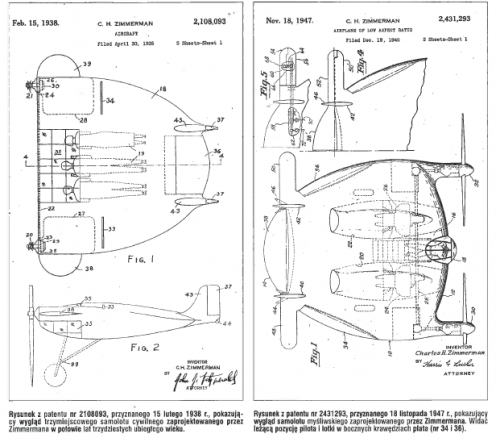
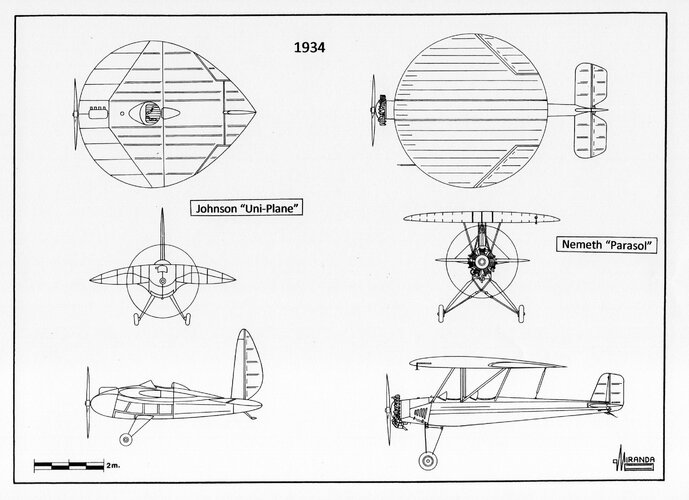
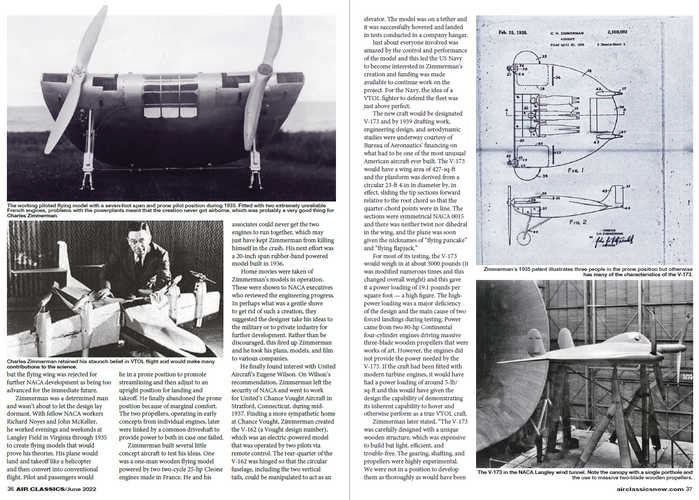
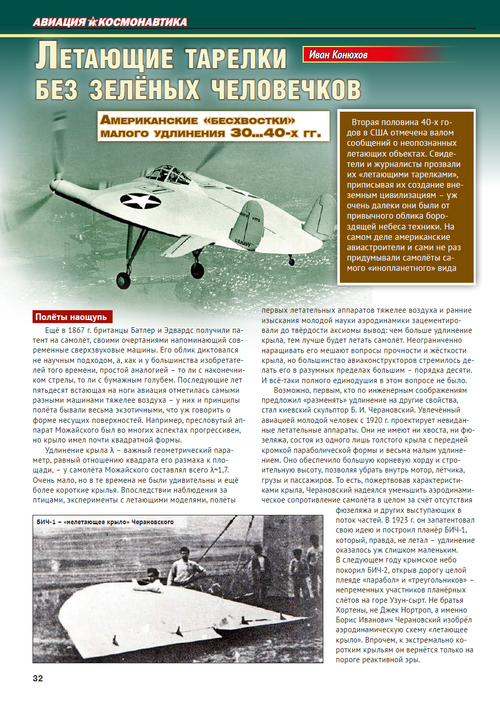
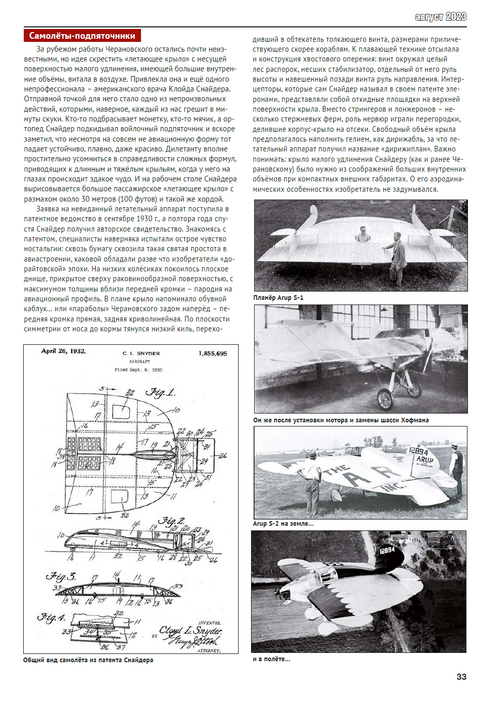
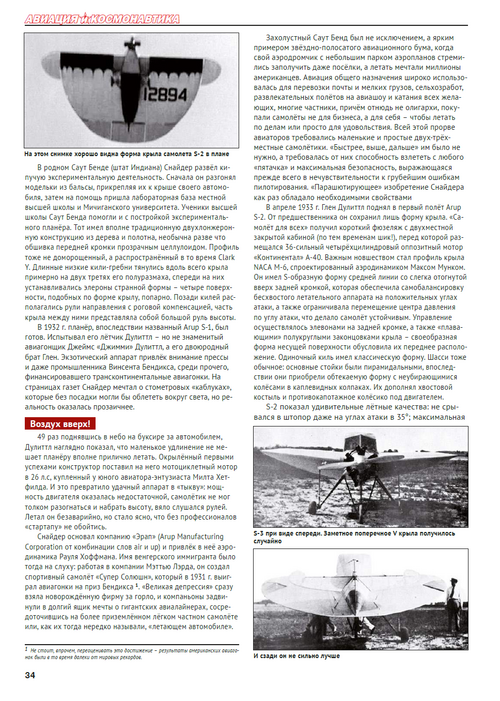
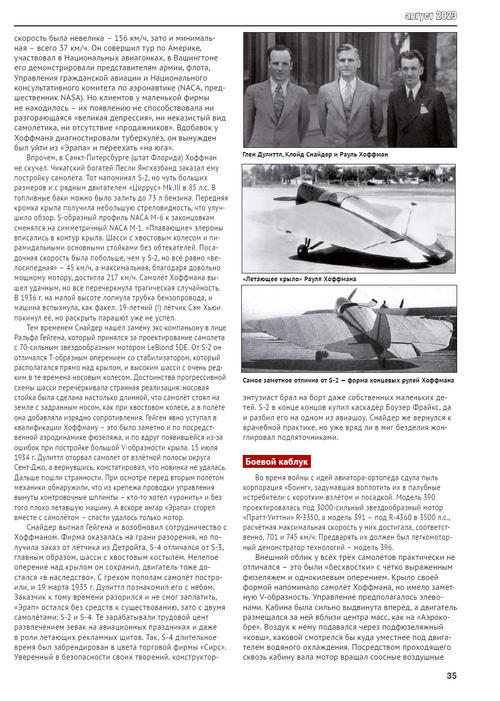
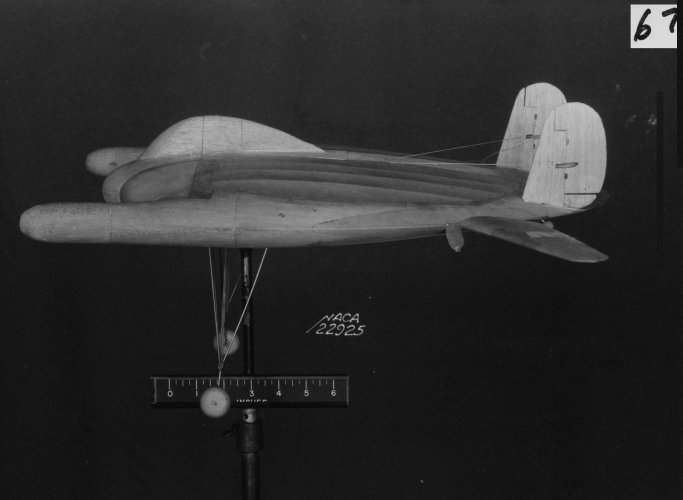
Between 1932 and 1935 the aerodynamicist Charles H. Zimmerman tested several types of low aspect ratio wings (with semicircular wingtips and Clark Y airfoils) in the NACA-Langley wind-tunnel, searching a solution to the
Air Flivver problem of stall/spin accidents.
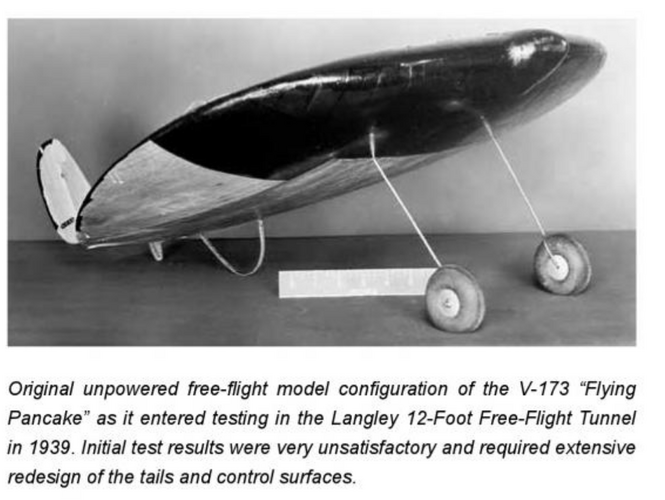
The development of a controlled vortex flow allows the low aspect ratio wing to avoid stalling at exceedingly high angle-of-attack and low speed. Zimmerman progressively reduced the center section in the wing of some scale models until it reached zero, with the wingtips forming a circular planform wing.
Their NACA report nº 539:
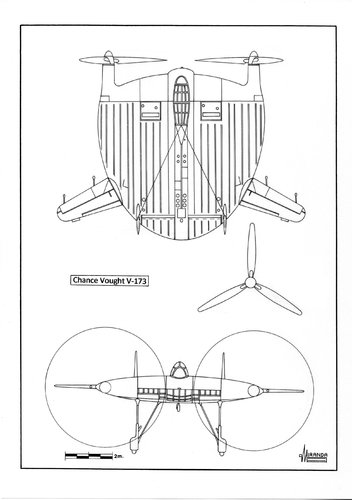
Aerodynamic Characteristics of Several Airfoils of Low Aspect Ratio (1935) became the basis for the V-173
Zimmer Skimmer design of 1939, with U.S. Navy financing and Chance Vought Aircraft Division-Stratford workmanship.
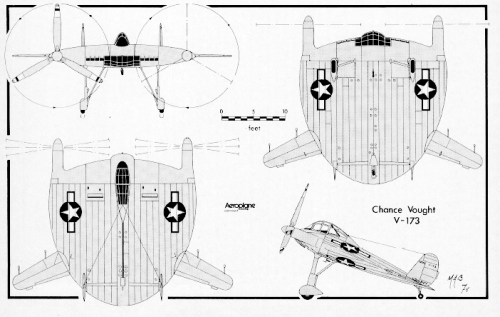
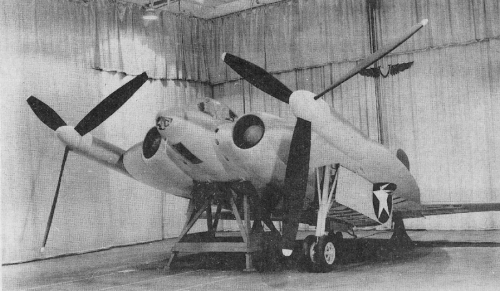
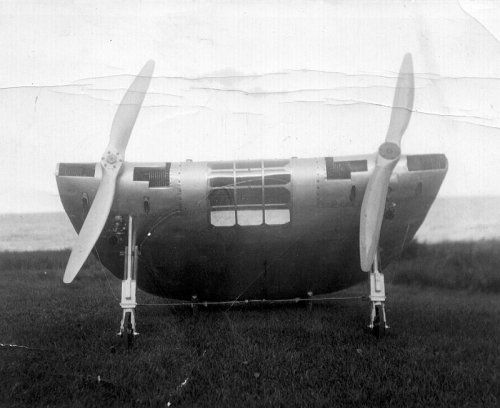
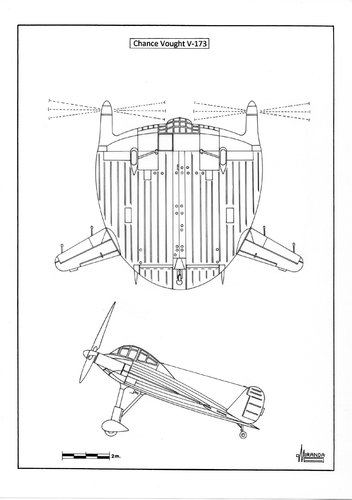
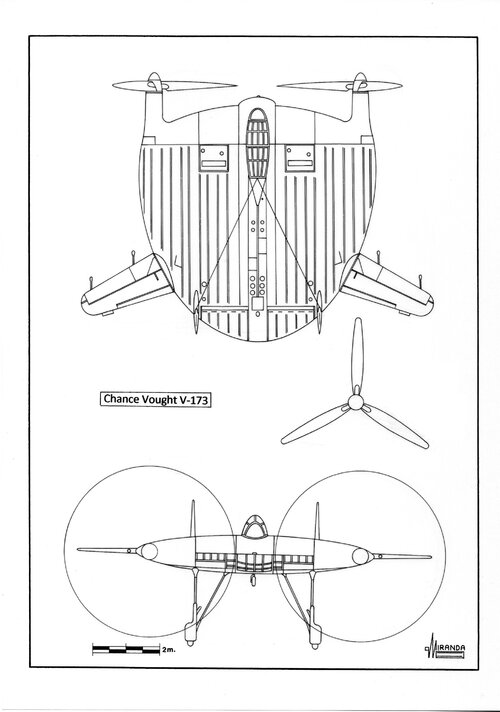
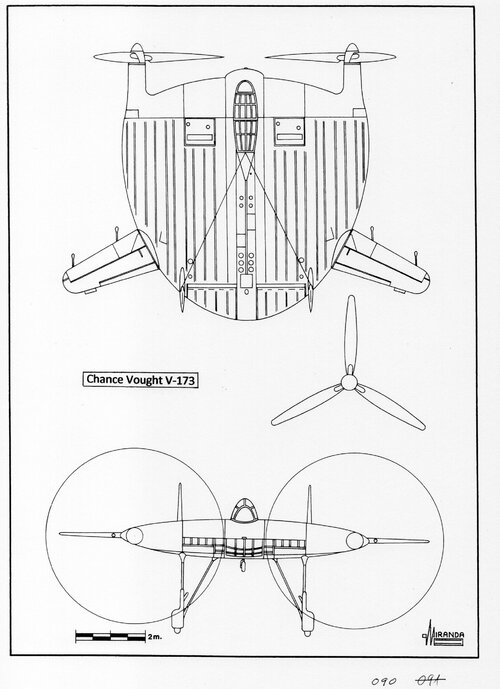
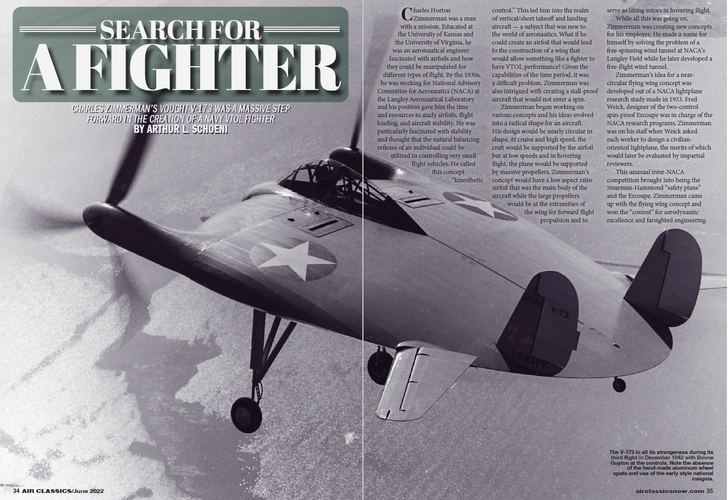
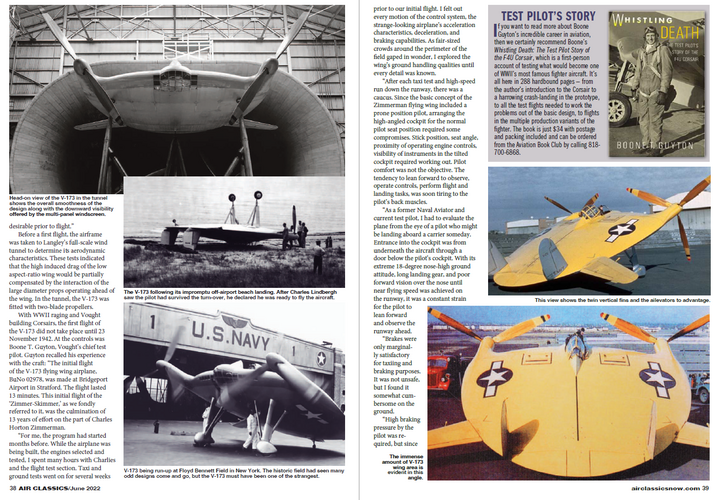
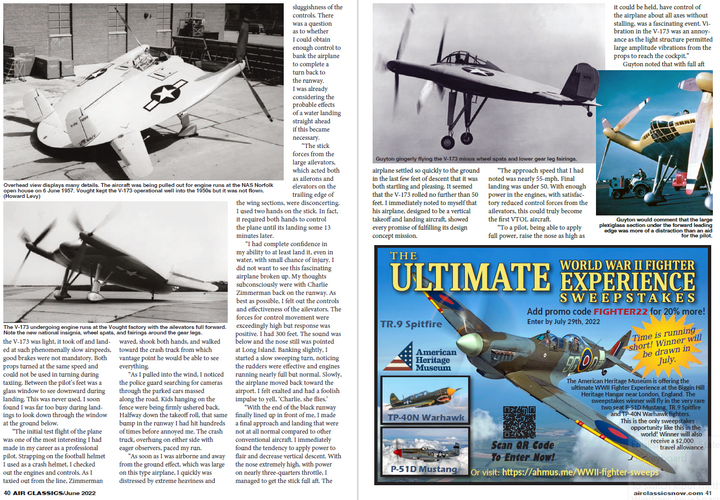
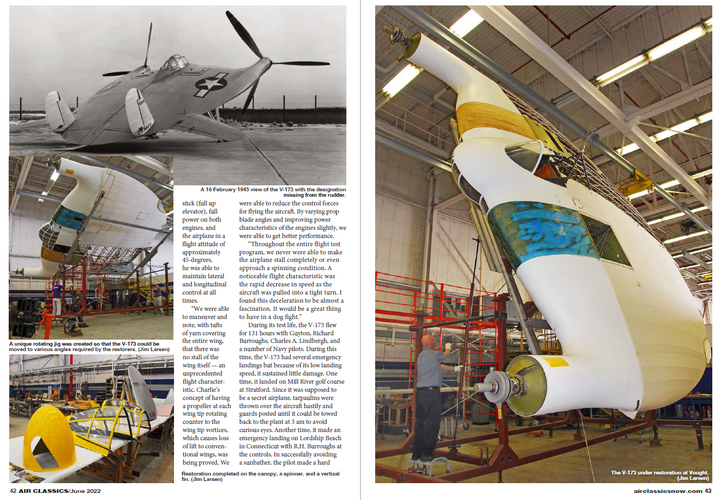
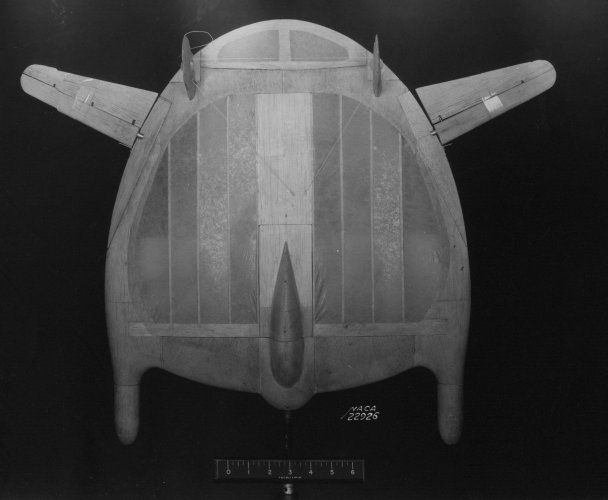
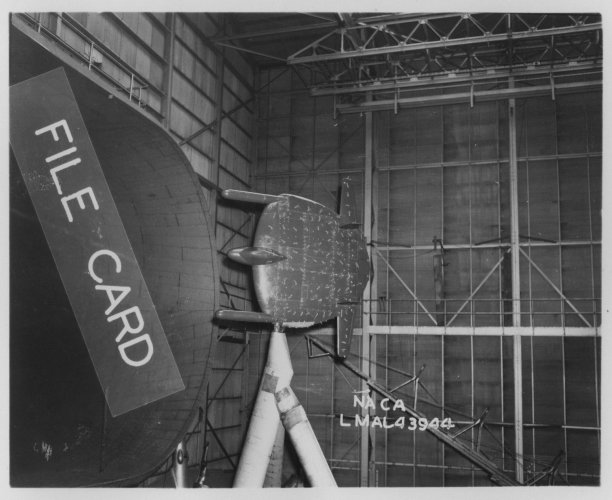
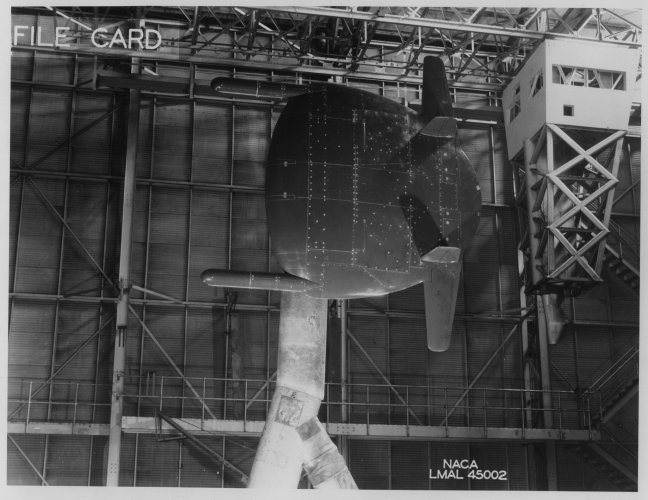
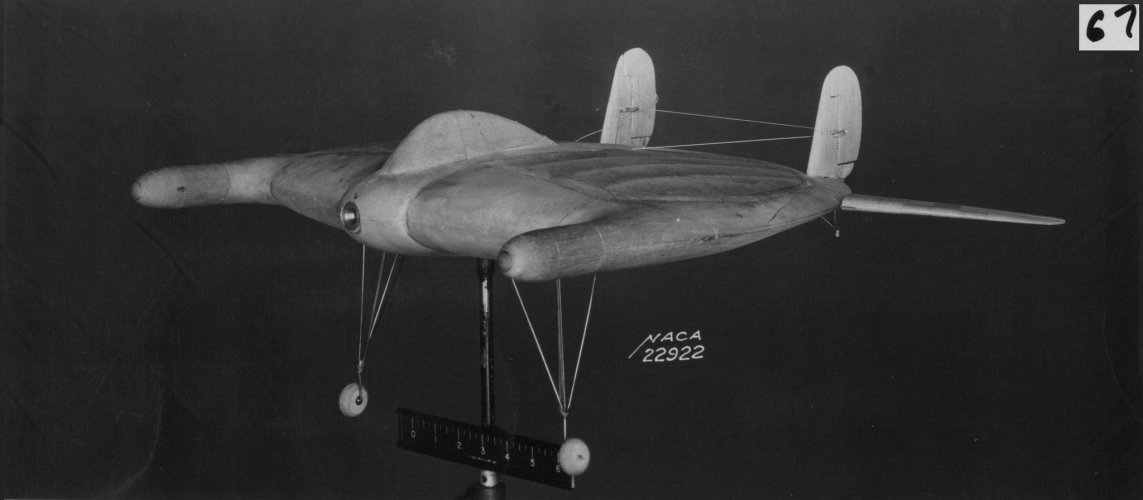
The prototype Bu Aer no. 02978 was constructed with wood framework, plywood/fabric covering and powered by two 80 hp. Continental C-75 engines driving 16 foot 6 in three-bladed, variable pitch propellers, rotating in the opposite direction. These large propellers demanded a long fixed landing gear gave the V-173 a 22.15 degrees nose-high ground angle. Most of the airframe was the wing, which had an aspect ratio of 1:275, with semi-elliptical leading edge and trailing edge joined at a straight quarter-chord line.
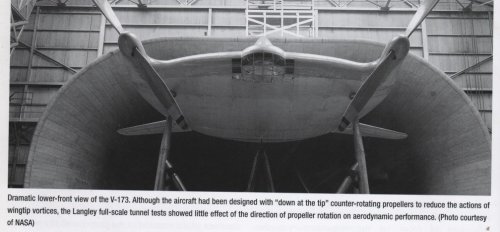
The plane was test flown at Stratford on November 23, 1942 performing a take-off run of only 200 ft. at 29 mph, controlled flight at a 45 degrees angle-of-attack and landing in 20 ft. and 15 mph. The propellers were fitted in the wingtips, retaining the high-pressure air below the wing, actively cancelling the drag tip vortex, and providing uniform airflow over the entire wing, for exceptional ‘parachute lift’ effect.
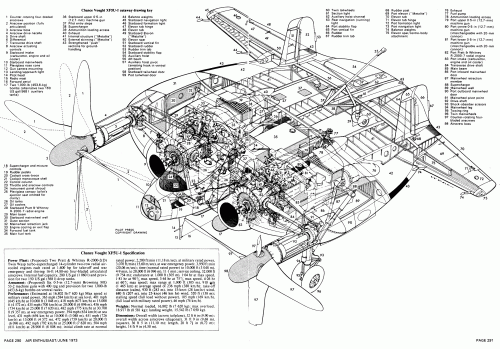
Engine power was delivered to the propellers via a complex set of shafts with right angle gear drives, and a power cross shaft with over-running clutches, that ran behind the cockpit, connecting the engines gearboxes to ensure both propellers turned in a single engine scenario.
Each horizontal stabilizer acted as both aileron and elevator (
ailevator).
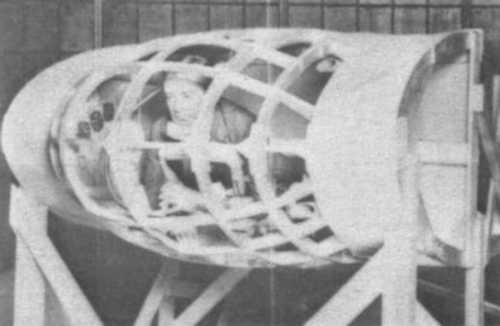
Originally the pilot was lying in prone position, to promote streamlining, with glazed panels in the lower leading edge but this was changed to an upright seat because of his marginal comfort.
Chance Vought V-173 technical data
Wingspan: 23 ft. 4 in. (7.11 m), ailevators span: 34 ft. 9 in. (10.6 m), length: 26 ft. 8 in. (8.13 m), height: 12 ft. 11 in. (3.94 m), wing area: 427 sq. ft (39.67 sq. m) max weight: 3,050 lb., max speed: 138 mph, power plant: two 80 hp Continental C-75 fan-cooled engines driving three-bladed airscrews via extension shaft.
Following the defeat in the Battle of Britain, the Germans increased his offensive against the shipping convoys in the North Atlantic. The
Luftwaffe used long-range bombers Focke-Wulf Fw 200 C-1 of the I./KG40 based on Bordeaux-Merignac, these aircraft operated out of the range of the shore-based RAF
Beaufighters. As a result of enemy air action, the Allies lost 32 merchant ships for the last quarter of 1940 and 88 ships for the first quarter of 1941.
With the loss of the HMS
Glorious and the HMS
Courageous, the Royal Navy did not have enough aircraft carriers to escort all the convoys and Winston Churchill pressed for an interim solution. In spring 1941, thirty-five merchant ships were to be converted to ‘Catapult Aircraft Merchantman’ (CAM Ships) with the installation of a rocket catapult de 70 ft in the forward deck, to launch surplus
Hurricanes. These
Hurricat /
Catafighters were standard Mk. I fighters, modified with catapult gear as
Sea Hurricane Mk.IA.
From November 1941 to July 1943, only eight catapult launches were made from CAM Ships, with six enemy aircraft shot down and the loss of one pilot.
The major drawback of the
Hurricat system was that, once the interception was completed, the fighter had to be ditched and the pilot would be picked up by the mother ship or by the nearest escort vessel. The average time to pick him up was between four and six minutes. For artic operations, the survivability was improved with the fitment of one Type K single-man dinghy. The CAM system was dropped when some merchant ships were converted in small escort carriers (MAC ships) and a new type of fighter, fitted with catapult spools and arrester hook, was developed as
Sea Hurricane Mk.IB, for MAC operation.
By the end of October 1941 the British Admiralty decided to reinforce the defenses of Singapore by sending to the Indian Ocean the powerful
Force Z formed by the aircraft carrier HMS
Indomitable, the 44,500 tons battleship HMS
Prince of Wales, the 38,000 tons battlecruise HMS
Repulse and four destroyers. Unfortunately, the
Indomitable was damaged in Kingston-Jamaica and the Royal Navy decided not to replace it with the HMS
Hermes based at Ceylon because its speed was only 25 knots and the objective of the
Force Z was the destruction of the Japanese battlecruisers that exceeded the speed of 30 knots, using the advantage of radar during night battles.
On December 10, the British vessels were steaming off Malaya in an attempt to intercept the Japanese invasion fleet heading for Patani, Kota Bharu and Kuantang on the east coast of Malaya. Near 130 nautical miles at the north of Singapore the
Force Z was attacked during 140 minutes by 112 airplanes of the Imperial Japanese Navy based at Saigon: 34 Mitsubishi G3M Model 21 bombers of the 753rd Kokutai, 52 G3M Model 22 torpedo planes of the 701st Kokutai and 26 Mitsubishi G4M torpedo planes of the 751st Kokutai managed to sink the two capital ships before the fighters Brewster B-339E of the 453 Sqn RAAF based at Sembawang-Singapore arrived over the battle area. The story would have been different if the 25 aircraft of the HMS
Hermes could have intervened.
By the end of 1941, the U.S. Navy had just entered a war in which the German and Japanese bombers had demonstrated great efficiency in destroying all kinds of Allied ships. It was necessary to protect the few warships that had survived the Pearl Harbor disaster against airstrikes, but the Pacific Fleet only had three aircraft carriers and the MAC ships were too slow to be used in combat operations.
The battleships and battlecruisers used to transport small reconnaissance floatplanes Curtiss SOC-3 and Vought OS2U-1 that were launched from steam catapults and could be recovered after each mission, but a fighter fitted with floats would have been an easy prey for the Mitsubishi
Zero-Sen.
The U.S. Navy needed an air-superiority fighter with extreme short-take-off-and-landing (STOL) capabilities, slow-flight performance, and hovering ability, able to operate from the rear decks of the warships, but this airplane did not exist until the BAE
Sea Harrier entered service in April 1980.
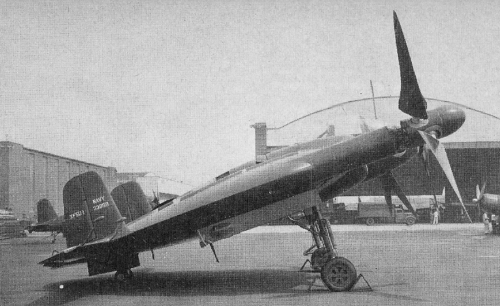
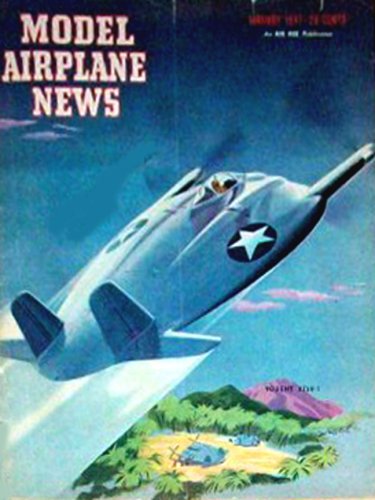
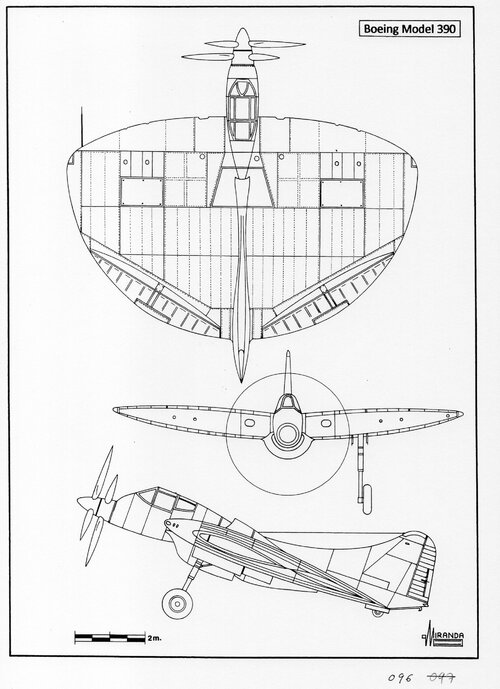
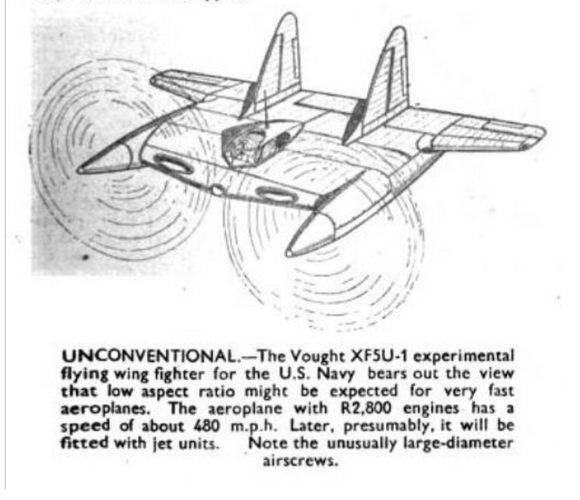
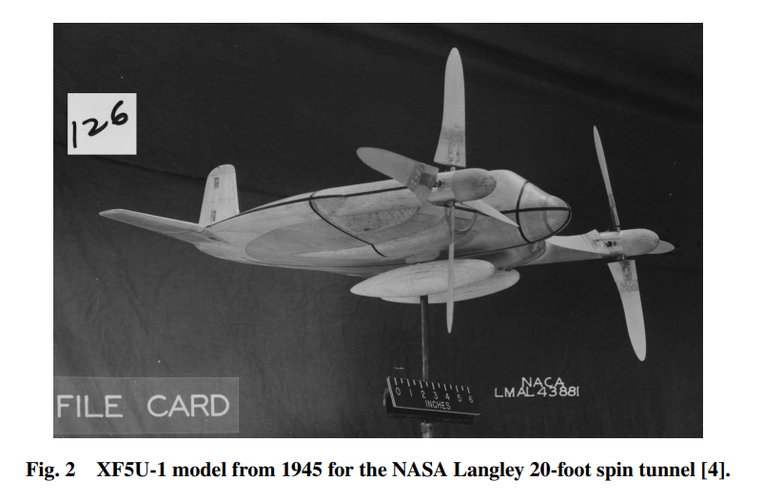
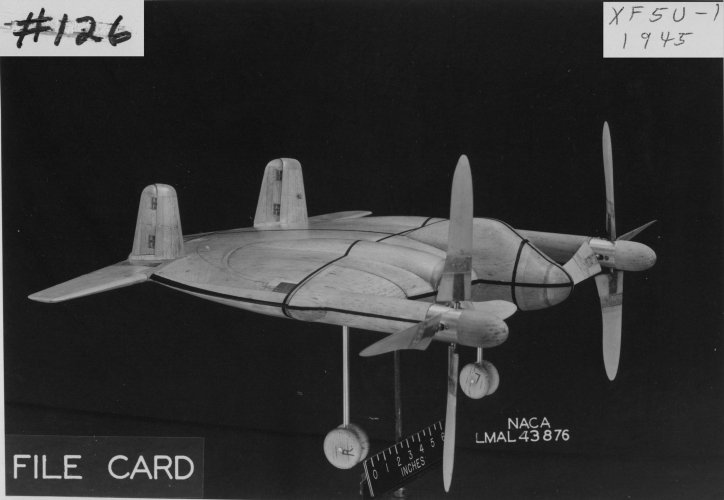
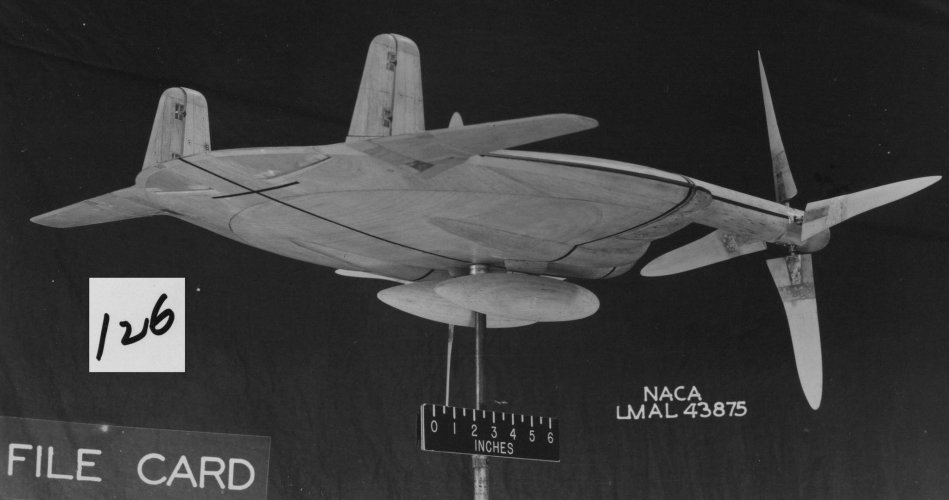
On January 19, 1942 Vought-Sikorsky submitted to the U.S. Navy the VS-315 proposal for a 425 mph STOL fighter. In February, the Navy requested a 1/3 scale wind-tunnel model, the VS-315 receiving the official designation XF5U-1 on September 10, 1942 and the wooden mock-up VS-313 was finished in June 1943.
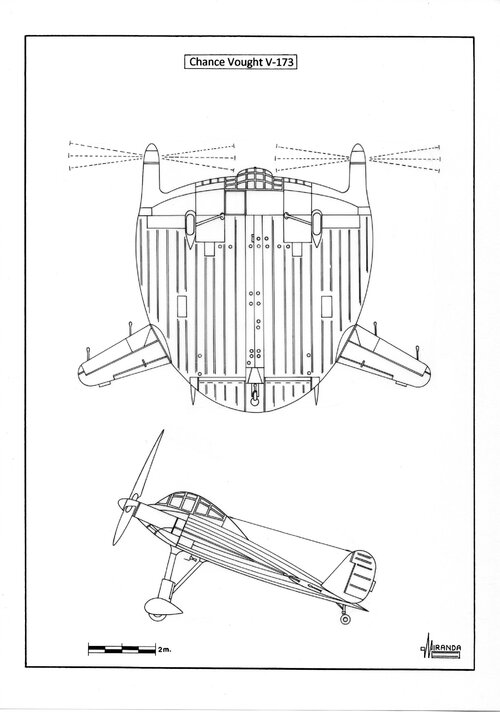
The projected naval fighter had a lightweight aluminum structure with
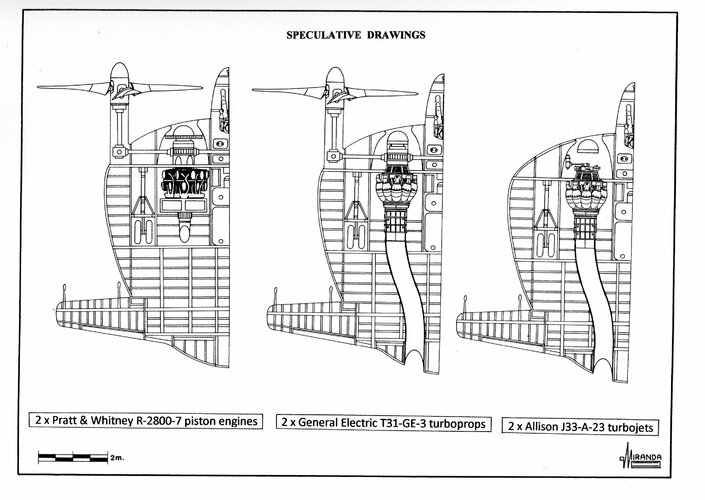
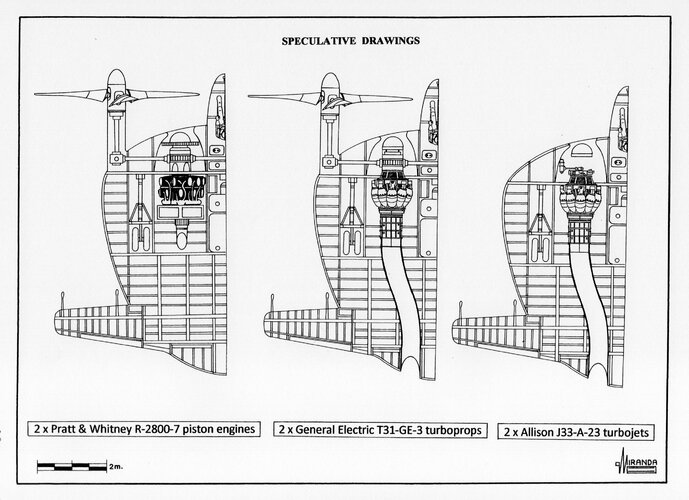
Metalite (balsa/aluminum sandwich) skin, 20 times as much power that the V-173 and increased top speed/landing speed ratio from a typical 4:1 to 10:1. Using two Pratt & Whitney R-2800-7 radial engines, rated at 1,350 hp. each, was expected a landing speed of 40 mph, a top speed of 425 mph. and a zero-roll take-off with a 25-knot headwind.
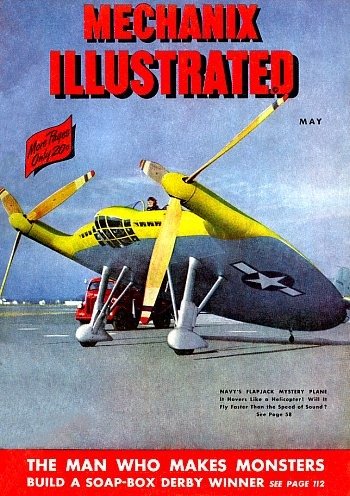
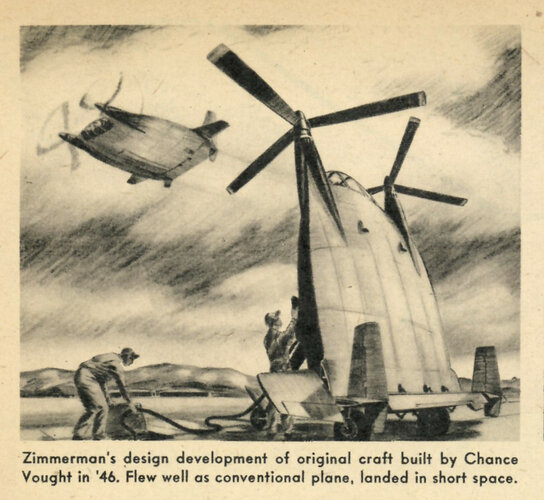
Powered by two 1,600 hp. P&W R-2000-2(D) turbo-supercharged engines with water injection, it was expected to reach 20 to 460 mph and 0 to 550 mph using two General Electric T31-GE-3 turboprops with 2,300 shp+600 lbf residual thrust and greater power-to-weight ratio. The proposed turbine-powered model was designated VS-341. With sufficient power, both rotors could generate more lift than weight for vertical take-off and landing operation, just keeping up with the warship forward speed. Powered by two turboprops, the airplane would hover motionless hanging under its rotors like a helicopter.
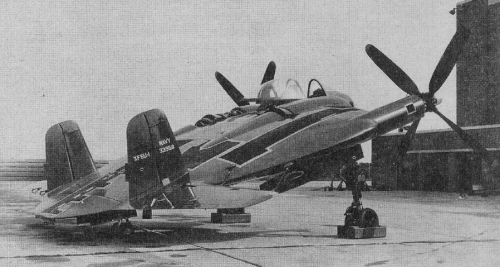
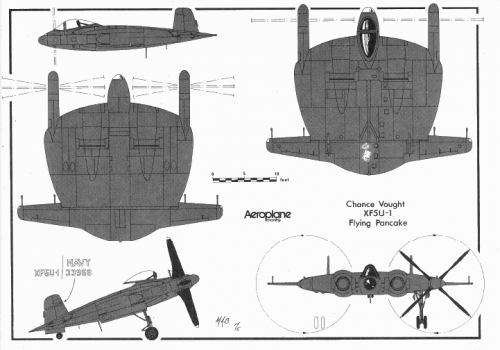
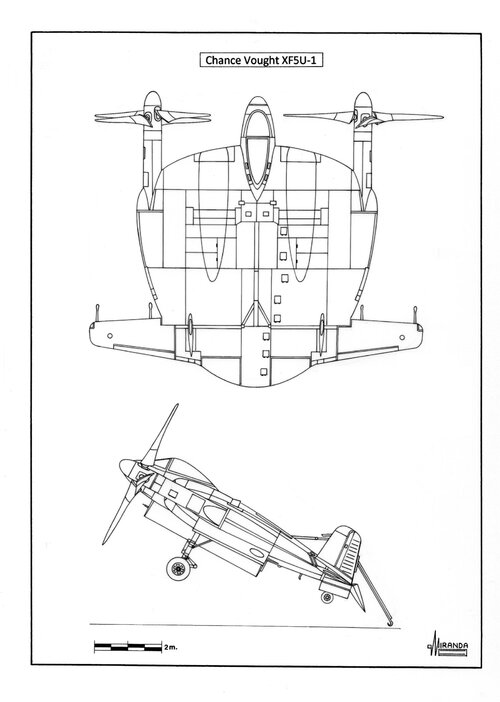
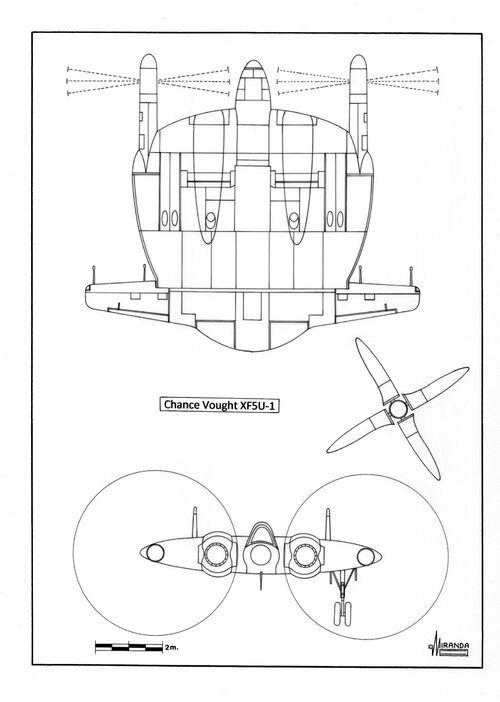
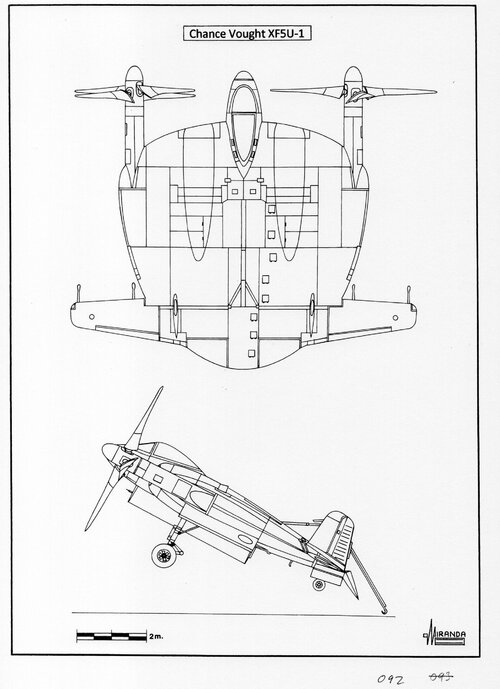
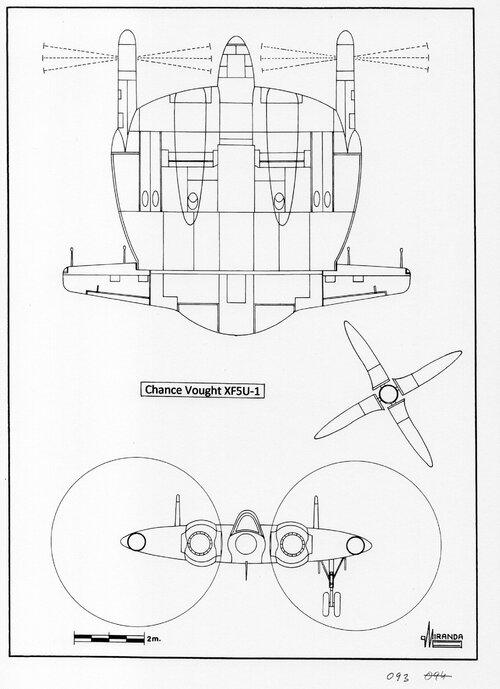
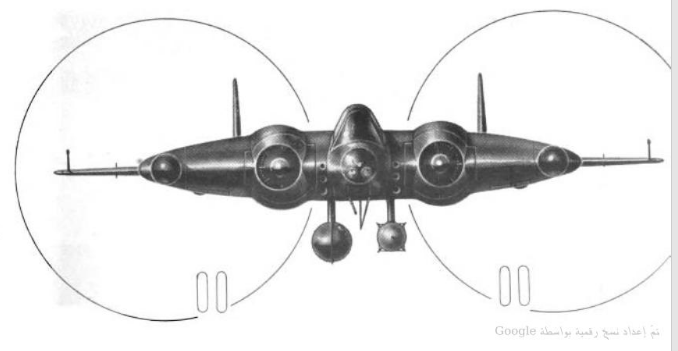
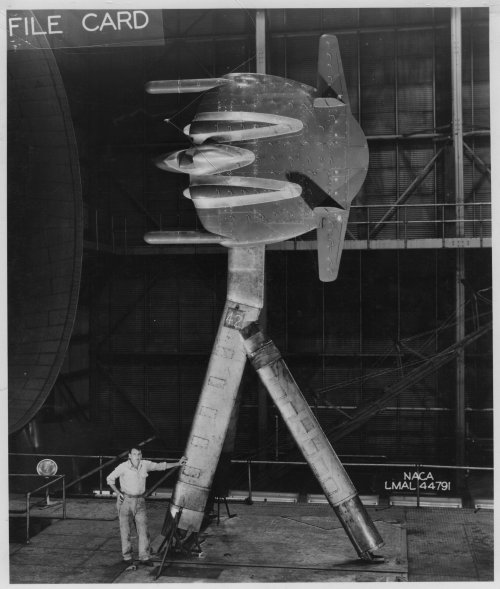
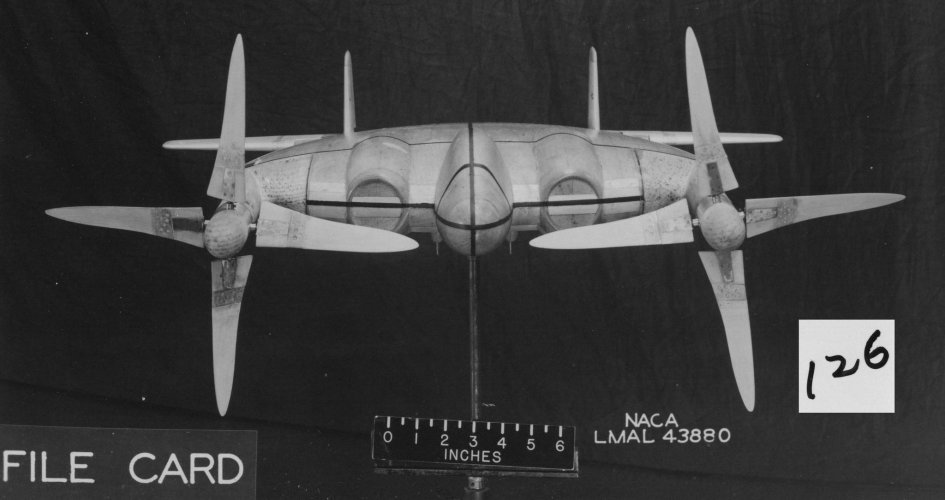
On July 15, 1944, the Navy signed a contract for two prototypes: one for static testing (Bu Aer nº 33959) and one (Bu Aer nº 33958) for flight evaluation. The XF5U-1 was completed on June 25, 1945 with retractable landing gear, catapult bridle hooks and arresting hook for carrier operation. Their R-2000-7 engines were buried into the wing, two circular air intakes with cooling fans were placed in the wing leading edge and four air exit flaps were opened on both upper and lower wing surfaces.
A pair of Hamilton Standard
Hydromatic propellers from two F4U-4
Corsair fighters were installed, but the vibration tests performed on June 29, 1945 showed excessive mechanical vibration between the engine-propeller shafting, gear boxes, and airframe structure.
It was necessary to develop a new type of propellers, with articulated blades, like those used on helicopters. Each rotor consisted of two pair of wooden blades, one mounted ahead the other, that could flap fore and aft to alleviate the vibration at a high angle-of-attack, but the articulated rotors were not available until 1947.
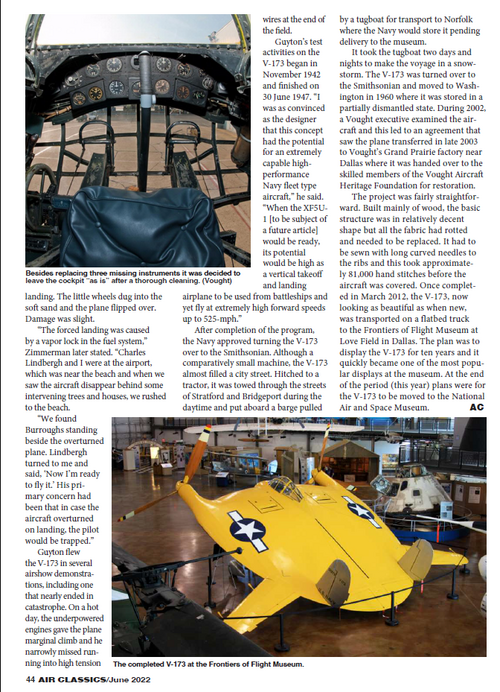
The airplane was taxi tested on February 3, 1947 at Stratford, Connecticut, but, again, showed destructive cyclic forces and heavy loads that had not been acceptable with conventional rigid airscrews. Full flight tests were scheduled for December 1948 at Edwards AFB, but the development of the two-speed gearboxes delayed the program and the U.S. Navy suddenly cancelled the contract on March 17, 1947, with orders to destroy the prototype.
Chance Vought XF5U-1 technical data
Ailevators span: 32.5 ft. (9.9 m), width at the prop tips: 36.3 ft. (11.06 m), length: 28.6 ft. (8.7 m), height: 14.8 ft. (4.5 m), wing area: 475 sq. ft (42.7 sq. m) max weight: 18,917 lb. (8,569 kg), estimated max speed: 504 mph (811 kph), estimated range: 910 miles (1,464 km), estimated initial climb rate: 3,950 ft/min (1,204 m/min), estimated service ceiling: 32,000 ft. (9,756 m), estimated take-off run: 710 ft (216 m), nose-high ground angle: 18.7 degrees, proposed armament: six 0.50 cal Colt-Browning heavy machine guns of four 20 mm cannons.
The Dark Side
The official explanation of the Navy was that they could already operate jet fighters from its 98 aircraft carriers. But the irrational decision to destroy all traces of the XF5U is only comparable to the destruction of all Northrop's flying wings produced and, in both cases, there were powerful political reasons.
Year 1947 was incredibly special. Just five days before the cancellation of the program, the doctrine to contain the Soviet expansion was announced to Congress by President Harry S. Truman.
The Cold War had started.
In May 22, the President signed an Act of Congress that implement the
Truman Doctrine.
On June 4, the first
Mogul balloon was launched, five days later the U.S. attaché in Moscow informed the War Department that the Soviets had begun the serial construction of the Horten Ho VIII flying wing bomber.
In June 26, the U.S. newspapers first began using the term
flying saucer.
The
Roswell incident occurred on July 8.
In July 26, the President signed the National Security Act (NSA 47) creating the Central Intelligence Agency (CIA) and the National Security Council (NSC).
The first North American F-86 swept wing fighter was flown on October 1, thirteen days later the Bell X-1 experimental rocket plane flew faster than the speed of sound, but it was a record that was kept secret.
In December 30, the Soviet swept wing fighter MiG-15 makes its first flight.
During the invasion of Japan ‘Operation Olympic’, planned for May 1946, the Allies expected to suffer a high number of causalities by the suicide jet bombers of second generation Kawanishi
Baika (740 kph-460 mph) and Kugisho
Ohka 43 (596 kph-370 mph).
The U.S. Navy needed fast interceptors to protect the invasion fleet, but the high fuel consumption, low power at take-off and poor reliability of early jet engines did not make them attractive for use in carrier-borne planes.
On May 28, 1945, the Navy approved a production contract for 100 North American FJ-1
Fury jet fighters. The XFJ-1 prototype was flown on September 11, 1946 powered by one General Electric GE-2 (TG-180) axial flow turbojet rated at 1,730 kgp (3,820 lbf) thrust. The first production FJ-1, with 4,000 lbf Allison J-35 axial flow turbojet, was delivered in October 1947 but only 30 airplanes were built.
On March 10, 1948 one FJ-1 made the first carrier landing in the U.S.S
Boxer (CV-21). Five months later the
Fury entered service with the VF-5A (VF-51) naval squadron for a jet familiarization program. In May 1949, the VF-51 started an operational training trip aboard the U.S.S.
Princeton (CV-37), the results were not good, one of the aircraft was destroyed and the rest were damaged.
The disastrous evaluation led to a quick retirement from active service by July 1949. The Essex-class carrier deck was 862 feet long and the
Fury had a take-off run of 840 ft.
The U.S. Navy concluded that slower acceleration by jets during the take-off was not recommended and catapult departures became standard practice.
Vought also offered its VS-340 model in the fall 1944 competition; the design proposal was accepted, and the Navy ordered three prototypes under the denomination XF6U-1
Pirate. The first prototype was flown on October 2, 1946, underpowered by one Westinghouse 24C axial turbojet with 3,000 lbf static thrust, and 30 production aircraft were ordered in February 1947.
The
Pirate development was slow, the first production airplane was flown on July 29, 1949 powered by one J 34-WE-30 axial turbojet, rated at 4,224 lbf, with afterburner and excessive fuel consumption rate. The aircraft was entirely inadequate for carrier operation, because its low performance and 0.3:1 thrust-to-weight ratio.
The introduction to squadron service of the McDonnell FH-1
Phantom on August 11, 1947 could have solved the problem. The FH-1 was a very safe airplane, powered by two J 34-WE-30 turbojets, with 370 ft take-off run and 360 ft took-off run. The
Phantom could fly at low speed for carrier operation but had a top speed of 485 mph only, against the 647 mph of the MiG-15 Soviet fighter. All the 62 airplanes produced were taken out of service in 1949.
The Soviet Union started the first major crisis of the Cold War with the
Berlin Blockade on June 24, 1948.
Confronted with the Chinese revolution, the 1948 presidential election and the end of American atomic monopoly in 1949, the Truman administration moved to escalate its containment doctrine and quadrupled its spending on defense.
On July 29, 1948, the President approved construction of five supercarriers, with 68,250-ton displacement and 1,090 ft (330 m) length, able to carry a group of large nuclear bombers, the most effective weapon of the day, and a new type of swept wing fighters of the F-86 class.
The construction of the USS
United States (CVA-58) started on April 19, 1949 with an estimated cost of US $ 189 million, but the USAAF managed to cancel the entire program in favor of the B-36 intercontinental bomber, at the cost of US $ 5.76 million for each plane.
With this operation, the Strategic Air Command kept its monopoly on nuclear weapons delivery until the approval by the Congress of the new USS
Forrestal (CVA-59) in April 1950.
During that time, the US Navy was forced to operate with the
Essex and
Midway-class carriers, straight wing fighters and Lockheed P2V-3C
Neptune medium bombers.
After the failure of the
Pirate and trying to keep alive its 15 years of work project, Zimmerman proposed to Vought an increased performance version of the XF5U, (labelled as
Jet Skimmer in the specialized literature) powered by two Allison J33-A-23 turbojets, rated at 5,400 lbf with water injection. Those huge centrifugal engines, with 50.5 in (128.3 cm) of diameter could not be installed in any naval fighter in service, but they could be buried into the wing/body of the XF5U.
Doubling the power of the F-80C
Shooting Star fighter and flying without the extra drag and weight of rotors and gearing, the new plane might have been a 20 per cent faster than the XF5U, but still inferior to the MiG-15 top speed, because the drag penalty induced by their wingtip vortex.
The
Jet Skimmer would have retained some of the STOL of the XF5U capability thanks to the special design of its exceptionally low aspect ratio wing. Fitted with the original landing gear and tail hook equipment it might have been able to operate from any escort carrier, but Vought preferred to continue with the development of the V-346
Cutlass, a decision that the Navy would soon regret after the loss of 78 airplanes in accidents.