The original blog referenced in the above article.

 
ABL is exiting the commercial launch market in favour of the defense market.

ABL Space Systems, a six-year-old launch startup, announced it is exiting the commercial launch market to focus on missile defense programs for the Pentagon. The move comes after a string of setbacks and mounting challenges in gaining traction against dominant players like SpaceX and Rocket Lab.
 
RFA have first UK vertical launch licence:

RFA received its launch licence!!

We are thrilled to announce that we have been awarded our Spaceflight Operator Licence by the @UK_CAA! This historic licence makes us the first European company to receive regulatory approval for orbital rocket launches from mainland Europe

The licence is not limited in time and covers a wide range of orbits and trajectories. All three key regulatory authorisations required for an RFA ONE test flight in 2025 from @SaxaVordSpaceport have now been granted

What a vote of confidence from @UK_CAA and @spacegovuk, thank you!

Read more in our press release ➡️


RFA receives launch licence from the UK
First licence for vertical orbital launches from European mainland
January 16, 2025

Augsburg, Germany – January 16th, 2025. Rocket Factory Augsburg (RFA), a European leader in developing flexible and low-cost launch services, proudly announces that it has officially received its spaceflight operator licence from the UK Civil Aviation Authority (CAA). In combination with the spaceport licence and the range control licence from SaxaVord Spaceport, all three critical regulatory licences required for a test flight in 2025 from Scotland are therefore granted.

The spaceflight operator licence, also called launch licence, is of historic significance: RFA is the first company in Europe to receive such a licence for vertical launches of a privately developed orbital rocket. With this, RFA now has regulatory approval from the United Kingdom´s Civil Aviation Authority (CAA) to launch into space from Scotland. The licence is not limited in time and covers a wide range of orbits and trajectories. It validates RFA’s commitment to meeting stringent safety and operational standards, reinforcing the company’s readiness to execute its first test flight in 2025. Obtaining this historic approval demonstrates the trust that the CAA and UK have in RFA’s technology, team and philosophy.

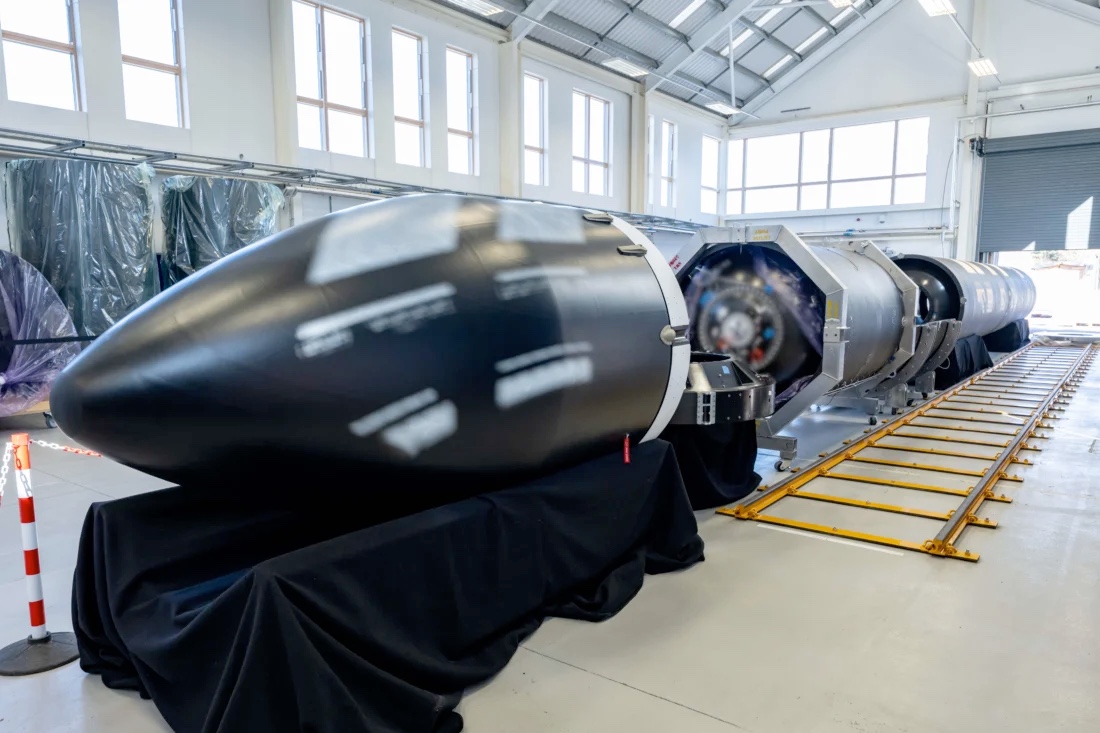
With this regulatory green light in place, RFA is now shifting its focus to the final technical preparations for the first test flight. The company has already completed major development milestones, including the successful flight qualification of the RFA ONE’s second stage, its advanced Redshift orbital transfer vehicle (OTV), and its payload fairing system. The remaining efforts are centred on building the rocket´s first stage with nine Helix staged-combustion engines, and conducting a full hot fire test on the launch pad at SaxaVord Spaceport, Scotland.

“This is a groundbreaking moment for RFA and for Europe’s space industry,” said Jörn Spurmann, Co-founder and Chief Commercial Officer of RFA. “Securing the first-ever launch licence outside ESA’s established site in Kourou is not just a regulatory milestone – it’s a powerful endorsement of our technical excellence and a turning point for European space innovation. This license marks Europe’s bold step toward independent, competitive, and sustainable space access. By enabling cost-effective and flexible launches from European main land, we are laying the foundation for a new era of space exploration and commercialization, ensuring Europe remains at the forefront of the global space race. Together with the CAA and our partners, we are driving the future of accessible and reliable spaceflight, unlocking opportunities that will shape industries and inspire generations.”

Rob Bishton, CEO of the UK Civil Aviation Authority, said: “This is a new era for aerospace and granting the first vertical launch licence from UK soil builds towards a historic milestone for the nation. This licence is the culmination of extensive hard work behind the scenes to put appropriate safety and environmental measures in place before launch. Through effective licensing and regulation we are enabling the expanding space sector to reach new heights.”

Matt Archer, UK Space Agency Director of Launch, ISAM, and Space Sustainability said: “This licence approval is a landmark moment, as it signals the start of vertical rocket launches from European soil. The achievement, driven by effective collaboration between RFA, SaxaVord Spaceport, the regulator and government partners, highlights the growing strength of the UK’s launch capabilities and our international relationships. What’s more, ambitious companies like RFA are creating high-skilled jobs, catalysing investment, and inspiring the next generation to see their future in space.”
As Europe strives for greater autonomy and flexibility in space access, the RFA spaceflight operator license highlights the importance of developing privately driven, innovative solutions to meet the rapidly growing demand for satellite launches. The upcoming test flight of RFA ONE will position RFA as a key player in Europe’s spaceflight ambitions, providing a reliable and affordable launch service for small satellites, right from European mainland.

+++END+++
 
 
Based on picture, should be Airbus's S250 bus, also used for French CO3D and Angolan Angeo-1 satellites.
Given the masses the launch could well be from British territory, RFA in saxavord or others...
 
Orbex come out of this looking pretty bad as regards their decision to abruptly abandon Sutherland. No matter how much they try and spin it.

 
I imagine this is an effort to try and save jobs there by the government once Virgin Orbit went bust. Being as other launch companies seem to prefer other sites in the UK.

 
UK government press release.

UK space sector bolstered with government reforms to boost growth and cut red tape

UK Space Agency to join the Department for Science, Innovation and Technology by April 2026, helping to streamline support for the UK’s growing space industry.

UK Space Agency to join the Department for Science, Innovation and Technology by April 2026, helping to streamline support for the UK’s growing space industry.

Move is part of the government’s Plan for Change to cut red tape and make Whitehall more agile and efficient.

Over 60 new industry-led recommendations published today show how smarter regulation can unlock major opportunities – from tackling space junk to building and repairing satellites in orbit.

People and businesses across the UK will benefit from new changes that will see the UK Space Agency become part of the Department for Science, Innovation and Technology (DSIT) – cutting duplication, reducing bureaucracy, and putting public accountability at the heart of decision-making.

In a major step to boost support for the UK’s space sector, the change will bring together the people who shape space policy and those who deliver it. This will cut any duplication that exists and ensure decisions are made with clear ministerial oversight.

Taking place by April 2026, the new unit will keep the UK Space Agency (UKSA) name and brand and will be staffed by experts from both organisations. This will drive up efficiency in line with the government’s Plan for Change, cutting red tape and making Whitehall more agile.

Today also sees the publication of over 60 recommendations from industry leaders on how to improve regulation for space missions, including Rendezvous and Proximity Operations (RPO) – where spacecraft work together in orbit. These missions are key to unlocking a future market worth £2.7 billion by 2031 (according to the UKspace IOSM Priorities Paper), and the UK is well placed to lead the way. It is a prime example of the joined-up working that will benefit from the merge of UKSA into DSIT.

With the right support, UK space firms could capture a quarter of the global market for in-orbit servicing, assembly and manufacturing. This will help to clean up space, extend the life of satellites, and build new infrastructure above Earth.

Every Arms Length Body across government is being reviewed with a view to rooting out unnecessary bureaucracy and duplication, and to put public accountability first. Ministers have already announced that NHS England, the largest quango in the world, will be abolished as part of this process.

Space Minister Sir Chris Bryant said:

You don’t need to be a rocket scientist to see the importance of space to the British economy. This is a sector that pulls investment into the UK, and supports tens of thousands of skilled jobs right across the country, while nearly a fifth of our GDP is dependent on satellites. The aims for growth and security at the heart of our Plan for Change can’t be met without a vibrant space sector.

Bringing things in house means we can bring much greater integration and focus to everything we are doing while maintaining the scientific expertise and the immense ambition of the sector.

UK Space Agency CEO Dr Paul Bate said:

I strongly welcome this improved approach to achieving the government’s space ambitions. Having a single unit with a golden thread through strategy, policy and delivery will make it faster and easier to translate the nation’s space goals into reality.

In coming together, the UK Space Agency and space policy colleagues are building on the firm foundations of economic growth and capability development laid in recent years, including cutting-edge missions, major national programmes, and the regulations that enable UK launch and leadership in space sustainability.

We will continue to deliver, while reducing duplication and ensuring we work even more closely with Ministers to support the UK space sector, and the country.

The UK Space Agency was founded in 2010 and currently operates as an executive agency of DSIT. It catalysed investment and revenue of at least £2.2 billion for the UK space sector in 2024/2025. DSIT and the Agency will continue to work closely together over the coming months to support the UK space sector and ensure a smooth transition to the new arrangements. Further practical details on the merger will be announced in due course.

This RPO Sandbox report has been delivered by 3 firms with leading expertise in the field: Astroscale, ClearSpace and D-Orbit, working in collaboration with the Civil Aviation Authority, the UK Space Agency and DSIT. Publishing the Stage 1 Report on the Regulatory Sandbox for Rendezvous and Proximity Operations (RPO) delivers a key recommendation from the Space Regulatory Review and further demonstrates the strength of the sandbox model to support wider innovation, taking advantage of these safe spaces for establishing ‘what works’ for regulating cutting-edge new technologies.

By tackling bottlenecks and uncertainties that UK firms in this field and beyond currently face, and ensuring regulation keeps up with the fast pace of innovation in this area, we will help encourage investment in nascent space activities like space junk removal, in-orbit refuelling and repair services that are expected to be highly lucrative in the decades ahead.

By stress-testing the regulatory framework for novel space missions, the report’s recommendations provide important clarity for the UK’s space industry, their clients and investors, which ultimately encourages the growth of and investment in British space businesses working on RPO missions. This work is supported by the Regulatory Innovation Office’s (RIO) mission to reform regulation across emerging technologies.

Delivery on these recommendations is already underway, as is Stage 2 of the Sandbox, which will examine issues unique to RPO missions in greater detail. The Stage 1 report sets a model for future sandboxes to follow. Its findings will support the delivery of the UK’s first ever active debris removal mission, planned to launch by 2028 to prove the tech needed to safely remove defunct satellites from orbit. This is technology that will protect the safe, secure and sustainable access to space upon which the UK’s economy and national security depend.

Nick Shave, Managing Director, Astroscale UK:

Astroscale UK is proud to have jointly led the industry delivery of Stage 1 of the RPO Regulatory Sandbox. Rendezvous and Proximity Operations are the foundation of all in-orbit servicing, from life-extension and refuelling to active debris removal – and with the right regulatory framework, the UK can be a global leader in this transformative sector.

The recommendations in this report tackle the real bottlenecks industry faces today, providing clarity, proportionality and the confidence investors need. We look forward to working with government, regulators, and our fellow innovators to turn these proposals into action, ensuring the UK captures the economic and sustainability opportunities of a truly serviceable space sector.

Rory Holmes, ClearSpace COO and UK Managing Director, said:

Together with partners, ClearSpace has been at the forefront of delivering Stage 1 of the RPO Regulatory Sandbox, an important step towards a safe, sustainable, and commercially dynamic space sector. This stage has been pivotal in fostering collaboration between government, regulators, insurers, and operators, enabling stakeholders to address knowledge gaps and reduce uncertainty around licensing in-orbit servicing missions in the UK.

Through the RPO Operators Consortium, we have contributed to comprehensive recommendations on safety, sustainability, security, and liability measures to strengthen the UK’s regulatory framework and benefit all satellite operators. By establishing a clear, transparent, proportionate, and predictable approach, these proposals position the UK to become a global leader in this strategically vital domain. We remain committed to turning this framework into action, supporting its implementation, and advancing the vision of secure, resilient, and sustainable space operations.

D-Orbit’s UK Legal Counsel, Lauren Payne, said:

Stage 1 successfully highlighted a range of challenges associated with the licensing of RPO missions under the current regulatory framework, allowing key stakeholders in licensing to work through these real-life challenges in a focussed, neutral forum. For Stage 2 we will build on the work in Stage 1 and zero in on implementation, where we hope to translate these issues into a better regulatory environment for RPO operators, customers, and regulators.

Colin Macleod, Head of the Space Regulator at the UK Civil Aviation Authority, said:

The regulatory sandbox on RPO allows us to work with industry and government on cutting edge ideas in a fast-paced, collaborative and safe environment.

RPO is vital for sustainable space but operating satellites at thousands of miles per hour in close proximity brings big challenges. Getting this right unlocks new ways of operating in space, helping the UK space sector grow while operating safely and responsibly.

Notes to editors

There are no immediate changes to UK Space Agency grants or contracts, and businesses and researchers currently working with the UK Space Agency do not need to take any action.

The Stage 1 Report of the Regulatory Sandbox for Rendezvous and Proximity Operations (RPO) has been funded by DSIT and developed in collaboration with the sector, the Civil Aviation Authority, and the UK Space Agency. While government bodies were actively involved in the process, the recommendations and problem statements are independent and originate from the sector – they do not represent government policy. DSIT is committing to explore the recommendations further as part of ongoing regulatory reform efforts.

Publishing this report fulfils a recommendation from the Space Regulatory Review; and its delivery is supported by the Regulatory Innovation Office (RIO), whose mission is to unlock innovation by removing regulatory barriers to emerging technologies reaching the market.

The Regulatory Innovation Office is an office within DSIT established to drive reforms to the regulatory system that will support the rapid introduction of our most impactful technologies.

DSIT media enquiries

Email [email protected]

Monday to Friday, 8:30am to 6pm 020 7215 3000

 
Interesting development Flyaway. Cutting red tape will surely help with the development of the British space industry so that what happened to REL never happens again.
 
UK government press release.

UK space sector bolstered with government reforms to boost growth and cut red tape
...out of breath from laughing too hard...I may need an ambulance with that one.

Never mind--I stopped laughing hearing this:
"Moreover, criminal law carries expressive power. "Treating environmental harm not merely as a regulatory issue but also as a criminal act conveys a strong message about societal values and priorities....The UK therefore has an opportunity to take on a leadership role by adopting its own legislation, they write, noting that a bill to criminalize ecocide was introduced in 2023 but has not moved forward."

But Greens don't want to be sued by ranchers losses I bet.
https://phys.org/news/2025-08-wolves-livestock-deaths-minimally.html

I see the poor have one more enemy

If the UK wants spaceflight--kick this Unabomber talk to the curb--and the politicians who talk this garbage.
 
Last edited:
'We've known it's been coming for a while': Inside the decision to eliminate the UK Space Agency

But insiders who discussed the situation with Space.com said questions around UKSA's merit had been heard in government circles since around 2020.

"It was around COVID when the [Department of Business, Energy and Industrial Strategy, or BEIS] responsible for UKSA at that time started making an argument that the space agency had become isolated and no longer understood the needs for space across all other government departments," a source who had worked at UKSA during the first decade of its existence told Space.com under the condition of anonymity. "It was perceived that the agency had become a bit of a show pony, a cheerleader for the concept of space rather than thinking about what do we actually need from space for environment, transport, defense etc."


Therefore, over 80% of UKSA's budget has been placed into ESA. The perception in the government was that UKSA was acting more in line with ESA's wishes than with the U.K. government's needs, the source added.

"The government started to argue that the policy team in UKSA was too narrow and too focused on what ESA wanted," they told Space.com. "It was too focused on not questioning where ESA wanted to go as an organization and was largely driven by the forward vision of ESA."


"Currently, in the UK, it's all very disjointed," the source said. "You have to talk to lots of different people and different government interfaces."

"I don't think it's a bad thing because DSIT is the department that is giving the space agency all its money anyway," the other source added. "The space agency will maintain its brand but will be reporting to the head of DSIT and not asking money directly from the government."


"It's hard to see how it will work in practice and how will our international partners know how to interact with the U.K.," the source said. "The jury is out whether this could be the right solution. I think that for the next 12 months, things might slow down, and priorities might become less clear as there will be lots of changes on the inside of the government."

 
Last edited:

Startup Spaceflux secures key role in UK civil/defense space tracking effort​

WASHINGTON — With three contracts over the past three months, UK startup Spaceflux is now positioned as a major provider of space monitoring data to Britain’s National Space Operations Centre (NSpOC) jointly run by the Defence Ministry and the UK Space Agency.
 
From green fields to rocket fuel: Inside the UK’s newest space hub

In the middle of rolling green fields in a quiet corner of Buckinghamshire sits something you might not expect - the UK’s newest space hub.

The brand new Westcott Space Hub is a £20 million facility that aims to bring together science expertise and companies to create 300 new jobs and grow the UK's space industry.

The companies on the site work with cutting-edge technology.

In one old bunker, scientists are working out how to turn water into rocket fuel. The small device they are using splits the water up into hydrogen and oxygen to create a fuel capable of propelling high-powered engines.

The idea is to make a fuel that is safer and less toxic than the current typical rocket fuel, Dan Staab, Chief Scientist at URA Thrusters, says.

"At the moment, lots of satellites have toxic fuel that's very difficult to handle and very expensive. You need hazmat suits. It's a huge cost just to get it ready for launch to fuel it. And if you could replace that with just clean water, that's a huge cost saving and you don't have any danger for people who are exposed to it."


UK-based rocket builder Orbex has signed a letter of intent to sell its business to European space logistics startup The Exploration Company.


Orbex was founded in 2015 and is developing a small launch vehicle called Prime. The company also began work on a larger, medium-lift launch vehicle called Proxima in December 2024.


On 21 January, Orbex published a brief press release stating that a letter of intent had been signed and that negotiations had begun. The company added that all details about the transaction remain confidential at this stage. A statement from Orbex CEO Phil Chambers suggests that the company’s financial position factored into its decision to pursue a buyer.


“Our Series D fundraising could have led us in many directions,” said Chambers. “We believe this opportunity plays to the strengths of both businesses, and we look forward to sharing more when the time is right.”


In her own statement, The Exploration Company’s CEO Hélène Huby described the two businesses as “complementary.”


“Orbex and TEC are complementary. We are working closely with the UK government to ensure that our combined business reinforces the UK’s launcher roadmap. We will be respecting the confidentiality of this process and will share more in due course.”


The Exploration Company is building a reusable space capsule that will initially ferry cargo to the International Space Station. The company is developing, under a CNES-financed project, a high-thrust reusable rocket engine called Typhoon. Since its founding in 2021, the company has raised €225 million.
 
Thing running not Good for Orbex Space
Orbex’s Danish subsidiary, Orbital Express Launch ApS, is set to file for bankruptcy,
with its facilities officially closing on 20 January and approximately 90 employees losing their jobs.
This is serious because Orbital Express Launch ApS build the Engines for Orbex rocket.


To make matter worst
 
That is not good Michel Van, it will be a shame if Orbex goes under if the parent company goes. Any thoughts about potential takeovers?
 
We left the other nations high & dry after we abruptly pulled out of this ESA space mission. It was to be the first of its kind mission.

European nations agree 30% boost in three-year space budget [Nov. 27]

The new space budget excludes the UK-led TRUTHS mission to provide a satellite-based climate observatory, after Britain pulled out of the project for budget reasons, officials said.

Growth and security at the forefront in UK funding boost for European Space Agency [Nov. 27]

*Earth Observation totals include previous commitments to the TRUTHS mission which have now been reallocated to other elements.
 
This is why New Space has worried me…the tech-bros talk garbage about how they’ll be on the Moon tomorrow—and it gives anti-space dullards in power cover to do more damage…Elon will do all this, so why should—blah, blah.
 
According to the new Saxavord website, there will be 600 seats to watch launches.

A maximum of 600 viewer passes will be granted. These will be offered to local residents first – detailed arrangements will be made public nearer to test flight/launch days – with the remainder made more widely available.

 
Orbex are now dead in the water.

Orbex Fails After Planned Purchase Falls Through​

The UK-based services provider Orbex has entered insolvency proceedings after a planned takeover by European space logistics startup The Exploration Company fell through.

Blow As Orbex Set To Appoint Administrators [Feb 11]

The UK home-grown orbital launch services company and space rocket manufacturer, Orbex, is in the process of appointing administrators after fundraising, merger and acquisition opportunities all concluded unsuccessfully.

Orbex has filed a notice of intention to appointment Administrators and will continue trading while all options for the future of the company are explored, including potential sale of all or parts of its business or assets. The notice provides short-term protection and allows the business time to secure as positive an outcome as possible for its creditors, employees and wider stakeholders.

The funding required for Orbex to remain a viable business was sought from a variety of public and private investors during its Series D funding round, which has ultimately failed. Several merger and acquisition opportunities have also been explored, with none resulting in a favourable outcome.

Phil Chambers, CEO of Orbex, said: “Disappointing doesn’t come close to describing how we feel about this moment. We have been successfully developing a sustainable, world-class sovereign space launch capability for the UK and were on the cusp of our first test flights later this year.

“It is no secret that designing and building space rockets to enable a launch service is a capital-intensive, highly advanced process with a long development cycle that creates a ‘scale-up’ funding gap. Institutional support is a crucial to bridge this gap and we have worked tirelessly to try to find both funding or rescue solutions.

“What is most disappointing is that we have brought hundreds of skilled jobs to Scotland; we have been at the vanguard of the UK’s space ambitions; we have led the way in driving good news about the UK’s space sector. Yet all of this progress now risks being undone – and it is real people who will feel the consequences.”

The first test launches of Orbex’s microlauncher Prime were due to take place later this year. Orbex already has commercial launch commitments from several satellite customers for Prime, which is one of the most advanced, low-carbon microlaunchers in the world.
 
Last edited:

Similar threads

Back
Top Bottom