Following the success of the Stukas during the Battle of France, General Marshall decided to reintroduce the dive-bomber concept to the USAAC.
In October 1940, an order was placed for 78 ex-Navy dive Douglas SBD-3A dive bombers.
On December 7, 1941, these aircraft equipped three squadrons of the 27th Light Bombardment Group, under the denomination A-24-DE Banshee.
The Type saw combat in the Dutch East Indies suffering heavy casualties against the Japanese Mitsubishi Zeros. The failure was attributed to poor crew training and the absence of escort fighters.
On September 6, 1941, the USAAF issued a requirement calling for a single seat Close Support Army Cooperation Airplane capable of defending itself from enemy fighters thanks to its speed and the use of armor instead of the rear gunner.
Kaiser-Fleetwings proposed the XA-39 project (MX-300) powered by one R-2800-27 radial engine rated at 2,000 hp and armed with two 37-mm cannons, four 0.5-in heavy machine guns, 6 x 500-pound bombs or 2 x 1,600-pound in the bomb bay and 2 x 1,000-pound bombs in underwing racks.
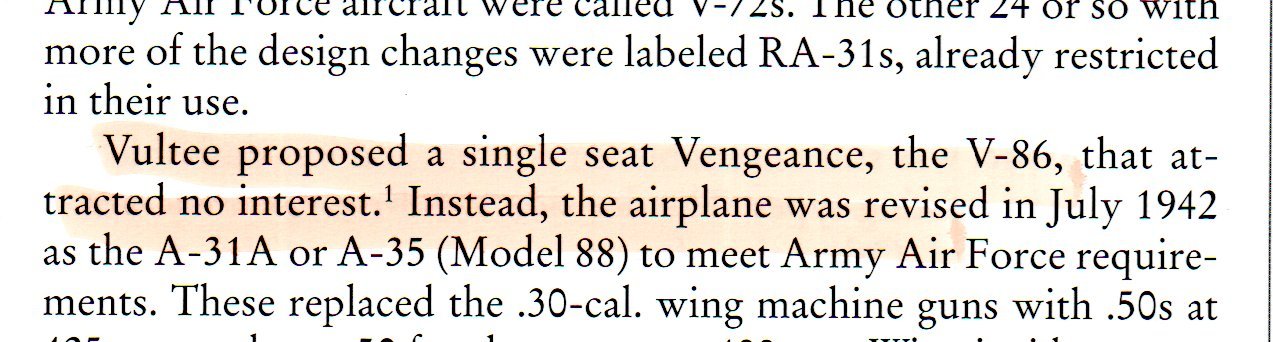
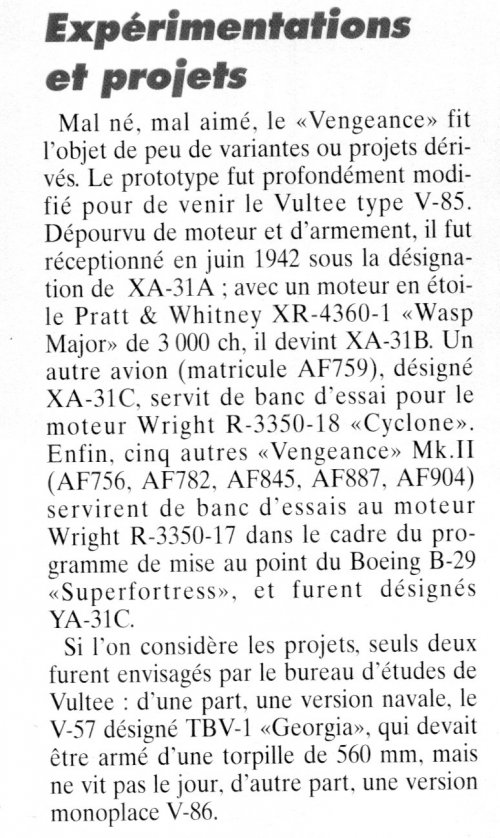
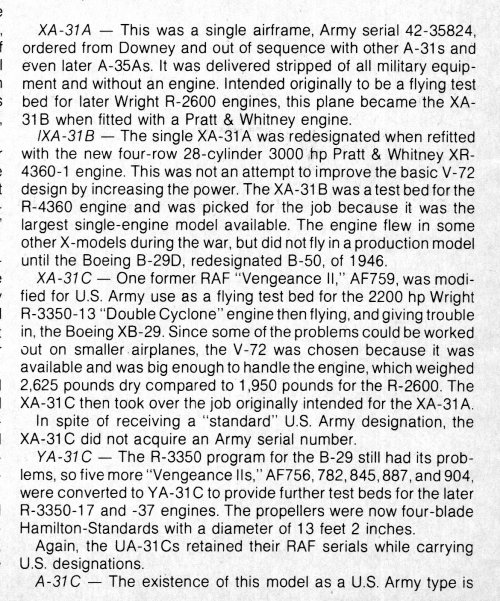
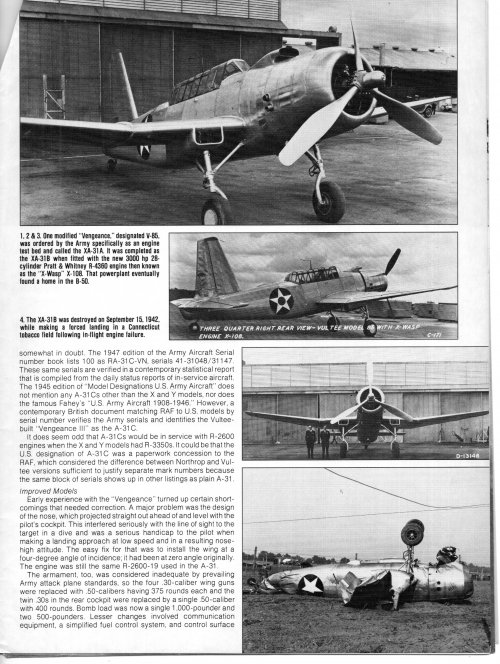
Vultee proposed a single seat version of the A-31 Vengeance named XA-34 (V-86).
Brewster proposed a single seat variant of the XSB2A-1 Buccaneer dive bomber.
In May 1942, the mockup was presented to USAAF officers armed with eight forward firing 0.5-in machine guns and 3,000-pound maximum bombs load.
The armament was later increased to four 20-mm guns and six 0.5-in heavy machine guns in the first prototype (c/n 42-13568) and to four 37-mm anti-tank guns in the second prototype XA-32 A (c/n 42-13569).
The Kaiser-Fleetwings proposal did not progress beyond mockup and was cancelled before any prototypes were ordered.
On October 30, 1941, USAAF ordered two Vultee XA-34 prototypes and two other prototypes Brewster XA-32.
Brewster promised a maximum speed of 560 km/h, with R-4360 engine, and the start of mass production in April 1943 but the c/n 42-13568 was flown on May 22, 1943, fitted with a completely new tailfin and split dive flaps and powered by one P&W R-2800-37 rated at 2,100 hp only.
During flight tests, it was shown that the power of the single engine was insufficient to obtain the promised performance powering an aircraft as large as a Grumman TBM Avenger and as heavy as a Douglas A-20 Havoc.
Ailerons and rudder vibration during a dive proved dangerous.
The exhaust pipes configuration produced dangerous concentrations of carbon monoxide and excessive heat inside the cockpit, blinding the pilot during night flights.
By 1943, USAAF was already utilizing North American A-36A Invader dive bombers and Republic P-47 Thunderbolt low level attack bombers, Vultee XA-34 contract was amended to change the role to low level attack, under the denomination XA-41 but the Brewster XA-32 project was considered unsuitable for combat and cancelled in November 1944.
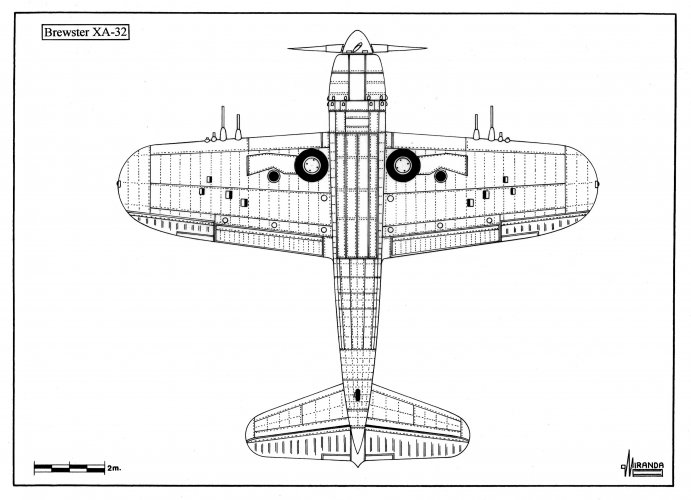
Brewster XA-32 technical data
Wingspan: 13.75 m, length: 12.37 m, height: 3.87 m, wing area: 38.25 sq. m, max weight: 9,060 kg, max speed: 500 km/h, range: 800 km, range with underwing drop tanks: 1,500 km, service ceiling: 7,900 m, climb rate: 535 m/min, power plant: one Pratt& Whitney R-2800-37, 18-cylinder, radial, air-cooled engine rated at 2,100 driving a four blade cuffed propeller with 4,130-mm of diameter, wing mounted armament: four 20-mm cannons and four 0.5-in heavy machine guns, bomb load: 2 x 454 kg in underwing racks 1 x 454 kg in the bomb bay fitted with a parallelogram device that made it possible to drop the bomb outside the propeller arc in a dive.
Painting scheme 1943 (42-13568)
Olive Drab (FS 30118) upper surfaces, Neutral Grey (FS 36173) under surfaces and white star roundels in four positions.
Painting scheme 1943 (42-13569)
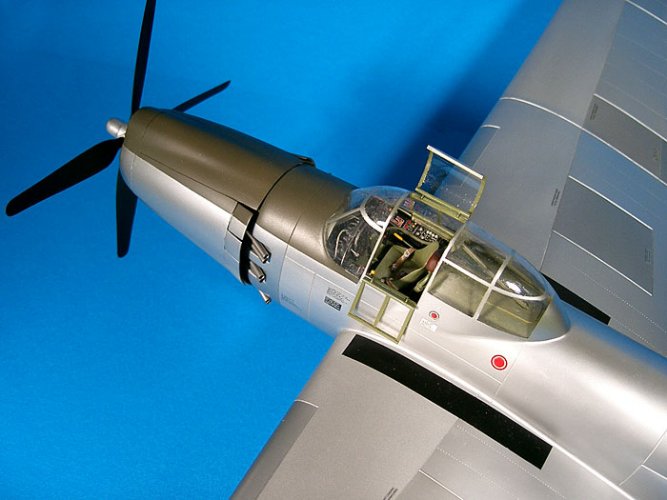
Olive Drab (FS 30118) upper surfaces, Neutral Grey (FS 36173) under surfaces, star & bars insignias in four positions, yellow serials and yellow propeller hub with German Kullerschnauze-style red spiral.
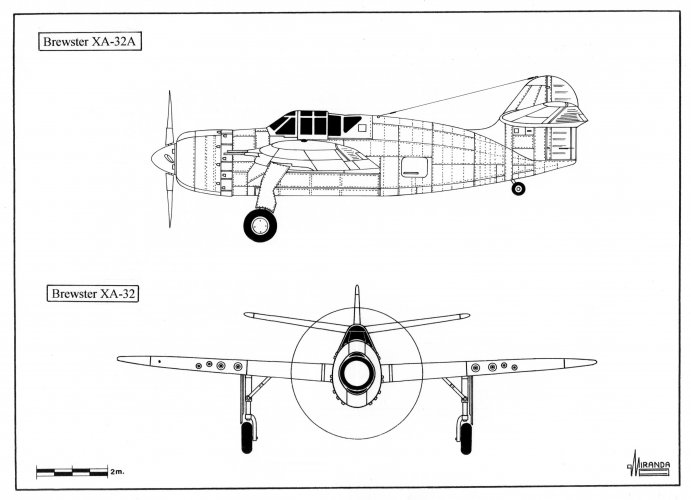
Brewster XA-32 A technical data
Wingspan: 13.75 m, length: 12.37 m, height: 3.87 m, wing area: 38.25 sq. m, max weight: 8965 kg, max speed: 500 km/h, range: 800 km, range with underwing drop tanks: 1,500 km, service ceiling: 7,900 m, climb rate: 535 m/min, power plant: one Pratt& Whitney R-2800-37, 18-cylinder, radial, air-cooled engine rated at 2,100 driving a four blade cuffed propeller with 4,130-mm of diameter, wing mounted armament: four 37-mm cannons, bomb load: 2 x 454 kg in underwing racks 1 x 454 kg in the bomb bay fitted with a parallelogram device that made it possible to drop the bomb outside the propeller arc in a dive.
Painting scheme 1944 (modified 42-13569)
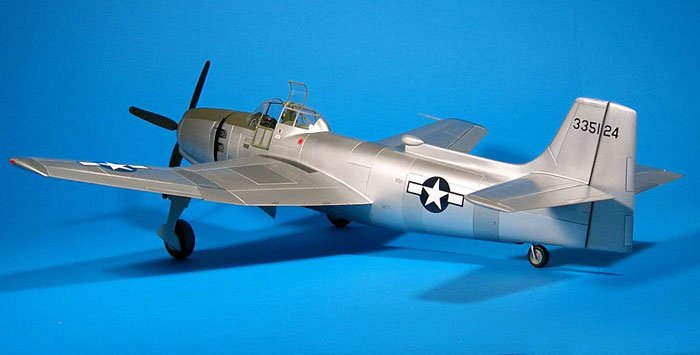
Natural metal overall with star & bars insignias in four positions.
In October 1940, an order was placed for 78 ex-Navy dive Douglas SBD-3A dive bombers.
On December 7, 1941, these aircraft equipped three squadrons of the 27th Light Bombardment Group, under the denomination A-24-DE Banshee.
The Type saw combat in the Dutch East Indies suffering heavy casualties against the Japanese Mitsubishi Zeros. The failure was attributed to poor crew training and the absence of escort fighters.
On September 6, 1941, the USAAF issued a requirement calling for a single seat Close Support Army Cooperation Airplane capable of defending itself from enemy fighters thanks to its speed and the use of armor instead of the rear gunner.
Kaiser-Fleetwings proposed the XA-39 project (MX-300) powered by one R-2800-27 radial engine rated at 2,000 hp and armed with two 37-mm cannons, four 0.5-in heavy machine guns, 6 x 500-pound bombs or 2 x 1,600-pound in the bomb bay and 2 x 1,000-pound bombs in underwing racks.
Vultee proposed a single seat version of the A-31 Vengeance named XA-34 (V-86).
Brewster proposed a single seat variant of the XSB2A-1 Buccaneer dive bomber.
In May 1942, the mockup was presented to USAAF officers armed with eight forward firing 0.5-in machine guns and 3,000-pound maximum bombs load.
The armament was later increased to four 20-mm guns and six 0.5-in heavy machine guns in the first prototype (c/n 42-13568) and to four 37-mm anti-tank guns in the second prototype XA-32 A (c/n 42-13569).
The Kaiser-Fleetwings proposal did not progress beyond mockup and was cancelled before any prototypes were ordered.
On October 30, 1941, USAAF ordered two Vultee XA-34 prototypes and two other prototypes Brewster XA-32.
Brewster promised a maximum speed of 560 km/h, with R-4360 engine, and the start of mass production in April 1943 but the c/n 42-13568 was flown on May 22, 1943, fitted with a completely new tailfin and split dive flaps and powered by one P&W R-2800-37 rated at 2,100 hp only.
During flight tests, it was shown that the power of the single engine was insufficient to obtain the promised performance powering an aircraft as large as a Grumman TBM Avenger and as heavy as a Douglas A-20 Havoc.
Ailerons and rudder vibration during a dive proved dangerous.
The exhaust pipes configuration produced dangerous concentrations of carbon monoxide and excessive heat inside the cockpit, blinding the pilot during night flights.
By 1943, USAAF was already utilizing North American A-36A Invader dive bombers and Republic P-47 Thunderbolt low level attack bombers, Vultee XA-34 contract was amended to change the role to low level attack, under the denomination XA-41 but the Brewster XA-32 project was considered unsuitable for combat and cancelled in November 1944.
Brewster XA-32 technical data
Wingspan: 13.75 m, length: 12.37 m, height: 3.87 m, wing area: 38.25 sq. m, max weight: 9,060 kg, max speed: 500 km/h, range: 800 km, range with underwing drop tanks: 1,500 km, service ceiling: 7,900 m, climb rate: 535 m/min, power plant: one Pratt& Whitney R-2800-37, 18-cylinder, radial, air-cooled engine rated at 2,100 driving a four blade cuffed propeller with 4,130-mm of diameter, wing mounted armament: four 20-mm cannons and four 0.5-in heavy machine guns, bomb load: 2 x 454 kg in underwing racks 1 x 454 kg in the bomb bay fitted with a parallelogram device that made it possible to drop the bomb outside the propeller arc in a dive.
Painting scheme 1943 (42-13568)
Olive Drab (FS 30118) upper surfaces, Neutral Grey (FS 36173) under surfaces and white star roundels in four positions.
Painting scheme 1943 (42-13569)
Olive Drab (FS 30118) upper surfaces, Neutral Grey (FS 36173) under surfaces, star & bars insignias in four positions, yellow serials and yellow propeller hub with German Kullerschnauze-style red spiral.
Brewster XA-32 A technical data
Wingspan: 13.75 m, length: 12.37 m, height: 3.87 m, wing area: 38.25 sq. m, max weight: 8965 kg, max speed: 500 km/h, range: 800 km, range with underwing drop tanks: 1,500 km, service ceiling: 7,900 m, climb rate: 535 m/min, power plant: one Pratt& Whitney R-2800-37, 18-cylinder, radial, air-cooled engine rated at 2,100 driving a four blade cuffed propeller with 4,130-mm of diameter, wing mounted armament: four 37-mm cannons, bomb load: 2 x 454 kg in underwing racks 1 x 454 kg in the bomb bay fitted with a parallelogram device that made it possible to drop the bomb outside the propeller arc in a dive.
Painting scheme 1944 (modified 42-13569)
Natural metal overall with star & bars insignias in four positions.






![42-13569 XA-32A LEFT FRONT VIEW WRIGHT FIELD 15Aug1944 [A-28701 AC]a.gif](/data/attachments/350/350543-5861ae1d72506898138455334151a805.jpg)
![42-13569 XA-32A LEFT SIDE VIEW WRIGHT FIELD 15Aug1944 [173471 USAF]a.gif](/data/attachments/350/350544-d60fc9c6fd68cd234ea7fc891c0eda67.jpg)
![42-13569 XA-32A LEFT FRONT VIEW 09Aug1945 [28701 AC]a.gif](/data/attachments/350/350545-c5f2a2b059707cee3fb63b8fea349da4.jpg)