
You are using an out of date browser. It may not display this or other websites correctly.
You should upgrade or use an alternative browser.
You should upgrade or use an alternative browser.
Boom Supersonic Overture M1.8 SST
Lots of interesting stuff on the engine they're building for it.
I'd posted that video yesterday.
djfawcett
With Enough Power, Anything Will Fly
- Joined
- 16 December 2012
- Messages
- 323
- Reaction score
- 567
Lets put this into perspective, they are going to build a good based natural gas turbine for power generation to be used as the back-up system for the data centers. They plan to make billions, and then use the money to build an SST, that supposedly will flying by 2030. This is not being optimistic, this is more in the category of "Merlin and fairy dust time".
I really wanted to see them successful in developing their aircraft. But the path they are choosing pretty much defines what the investment community is believing ......... maybe a chance at a power generation system, but huge odds against building an SST, and for sure never by 2030. Sorry for those that want to believe. I was in that group until they laid off or fired almost all of the engineering staff other than those required to develop the power turbine, and several aero folks. From what I am seeing, their actions seem more like a desperate reach, rather than a planned course of aircraft development. But time will tell.
I really wanted to see them successful in developing their aircraft. But the path they are choosing pretty much defines what the investment community is believing ......... maybe a chance at a power generation system, but huge odds against building an SST, and for sure never by 2030. Sorry for those that want to believe. I was in that group until they laid off or fired almost all of the engineering staff other than those required to develop the power turbine, and several aero folks. From what I am seeing, their actions seem more like a desperate reach, rather than a planned course of aircraft development. But time will tell.

- Joined
- 3 June 2011
- Messages
- 20,986
- Reaction score
- 19,254
When they said the weight of the engine was 14klbs (heavier than even a GE4) I started to wonder if the engine they were showing was for the powerplant, not the aircraft.Lets put this into perspective, they are going to build a good based natural gas turbine for power generation to be used as the back-up system for the data centers. They plan to make billions, and then use the money to build an SST, that supposedly will flying by 2030. This is not being optimistic, this is more in the category of "Merlin and fairy dust time".
I really wanted to see them successful in developing their aircraft. But the path they are choosing pretty much defines what the investment community is believing ......... maybe a chance at a power generation system, but huge odds against building an SST, and for sure never by 2030. Sorry for those that want to believe. I was in that group until they laid off or fired almost all of the engineering staff other than those required to develop the power turbine, and several aero folks. From what I am seeing, their actions seem more like a desperate reach, rather than a planned course of aircraft development. But time will tell.

- Joined
- 19 February 2007
- Messages
- 1,644
- Reaction score
- 3,484
As an observation, Boom had no other choice than to develop and build their own engine, lacking any other option to power their aircraft. So, it is an existential (survival) pivot for the company if the final goal is to build the airplane.
The ground powerplant unit versions are intended (as I read it) as primary power sources for data centers which would be electrical power grid independent. It is expected that it will take four years for the power generation version of the Symphony engine to become operational. Current order-to-delivery lead times for existing ground powerplants from GE and Pratt are said to exceed five years.
If successful, Boom would then be able to power their aircraft design - and - control that powerplant; being "the only game in town". As a monopoly, they could then block the development of any other aircraft in this class by denying engines. Or, they could pivot further and become a pure play engine OEM, dropping their airplane ambitions.
But for now, the data center bubble will pay the freight.
The ground powerplant unit versions are intended (as I read it) as primary power sources for data centers which would be electrical power grid independent. It is expected that it will take four years for the power generation version of the Symphony engine to become operational. Current order-to-delivery lead times for existing ground powerplants from GE and Pratt are said to exceed five years.
If successful, Boom would then be able to power their aircraft design - and - control that powerplant; being "the only game in town". As a monopoly, they could then block the development of any other aircraft in this class by denying engines. Or, they could pivot further and become a pure play engine OEM, dropping their airplane ambitions.
But for now, the data center bubble will pay the freight.
djfawcett
With Enough Power, Anything Will Fly
- Joined
- 16 December 2012
- Messages
- 323
- Reaction score
- 567
What needs to be understood is that the GE and Pratt time is do to demand and support equipment, not from lacking a turbine. Boom does not have a turbine anywhere near a working production model. And what about the support equipment? Have you seen any reference to that? The generation system is far, far beyond putting a turbine mounted on a stand with a generator attached. Furthermore, if Boom by some miracle is successful in developing both a ground power station/supersonic aircraft turbine, and a successful SST (miracles do happen), do you really think the majors players are going to sit back and ignore the market? Not hardy, a successful SST means there is a market and the major OEM will start following suit. But again, Boom would need one heck of a miracle.It is expected that it will take four years for the power generation version of the Symphony engine to become operational. Current order-to-delivery lead times for existing ground powerplants from GE and Pratt are said to exceed five years.
"As an observation, Boom had no other choice than to develop and build their own engine, lacking any other option to power their aircraft. So, it is an existential (survival) pivot for the company if the final goal is to build the airplane."
The above quote only proves my point concerning investors. Every engine manufacturer capable of producing an SST engine (less Russia and China) gives boom a very slim chance of being successful. In simple terms, the major engine boys are not interested in investing in a long shot. And that is and will carry through to the general investment community for the airframe and ultimate production.
Last edited:
Scott Kenny
ACCESS: USAP
- Joined
- 15 May 2023
- Messages
- 19,668
- Reaction score
- 28,152
Industrial or marine engines are always heavier than the equivalent aviation engine. Usually the casing being thicker.When they said the weight of the engine was 14klbs (heavier than even a GE4) I started to wonder if the engine they were showing was for the powerplant, not the aircraft.
- Joined
- 3 June 2011
- Messages
- 20,986
- Reaction score
- 19,254
That one chunk was 3,000lbs finished and looked way beefier than anything you'd typically see on an aircraft engine.Industrial or marine engines are always heavier than the equivalent aviation engine. Usually the casing being thicker.
- Joined
- 27 May 2008
- Messages
- 1,247
- Reaction score
- 2,787
The bit of Boom I struggle with is that he tell everyone Concorde failed because it was uneconomical and lessons have been learnt. So how is Booms offering with less range, less pax, less speed, and higher fuel prices is it going to have better economic’s ?
Also four engines? No competition of engine supplier selection to drive down the operating and O/H costs? Appreciate Concorde had the same but an engine monopoly is not an approach that improves operating economics.
Also four engines? No competition of engine supplier selection to drive down the operating and O/H costs? Appreciate Concorde had the same but an engine monopoly is not an approach that improves operating economics.
- Joined
- 3 June 2011
- Messages
- 20,986
- Reaction score
- 19,254
The bit of Boom I struggle with is that he tell everyone Concorde failed because it was uneconomical and lessons have been learnt. So how is Booms offering with less range, less pax, less speed, and higher fuel prices is it going to have better economic’s ?
Also four engines? No competition of engine supplier selection to drive down the operating and O/H costs? Appreciate Concorde had the same but an engine monopoly is not an approach that improves operating economics.
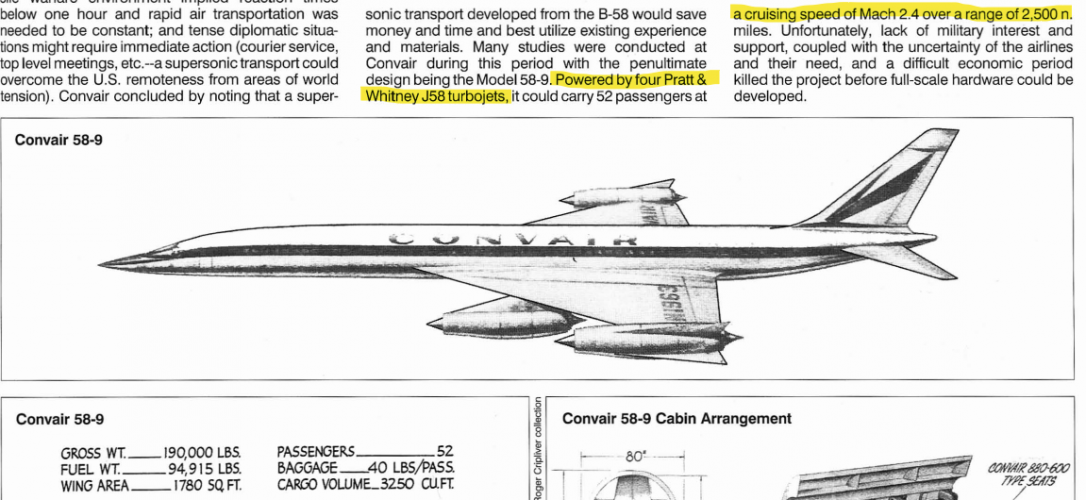
Almost 70 years ago:
Their chance of being successful at the power turbine is minuscule. Nobody but a fool will rely on an untested/very low hours turbine to provide safe access to power to billion of dollars of on-line equipments. (picture yourself has a patient under surgery aware that Boom built the safe power pack - that would be enough for me to away run with my guts open!).
I think they are just dragging their huge capital to make it last for a fun and long ride. Nothing that we see from one video to the other is fairly new. No breakthrough. Everything is low key conservative.
Heck, their entire facility is built under a roof that won't stand strong winds. Anything approaching a tornodo goes there and they will spend their last company’s money in PR lamanting that they though against the odds and blablabla... Before unplugging the feed.
But don't take me wrong, I still have an immense respect for what they did and ran for.
I think they are just dragging their huge capital to make it last for a fun and long ride. Nothing that we see from one video to the other is fairly new. No breakthrough. Everything is low key conservative.
Heck, their entire facility is built under a roof that won't stand strong winds. Anything approaching a tornodo goes there and they will spend their last company’s money in PR lamanting that they though against the odds and blablabla... Before unplugging the feed.
But don't take me wrong, I still have an immense respect for what they did and ran for.
Last edited:
- Joined
- 3 June 2011
- Messages
- 20,986
- Reaction score
- 19,254
Interestingly enough, SpaceX is also getting into the turbine power generation business, albeit I think they're just trying to help eliminate the turbine blade bottleneck.Their chance of being successful at the power turbine is minuscule. Nobody but a fool will rely on an untested/very low hours turbine to provide safe access to power to billion of dollars of on-line equipments. (picture yourself has a patient under surgery aware that Boom built the safe power pack - that would be enough for me to away run with my guts open!).
I think they are just dragging their huge capital to make it last for a fun and long ride. Nothing that we see from one video to the other is fairly new. No breakthrough. Everything is low key conservative.
Heck, their entire facility is built under a roof that won't stand strong winds. Anything approaching a tornodo goes there and they will spend their last company’s money in PR lamating that they though against the odds and blablabla... Before unplugging the feed.
But don't take me wrong, I still have an immense respect for what they did and ran for.
https://marketwise.com/investing/spacex-gas-turbine-parts-ai-data-centers/
Before anybody pooh-poohs the idea, don't forget they make all the turbine blades for their rocket engines.
- Joined
- 15 January 2021
- Messages
- 657
- Reaction score
- 2,905
A couple of observations from the video:
1. It appears there is a lot of GE influence in the team. The compressor is made of blisks (bladed disks) vs IBRs (P&W nomenclature - Integrally Bladed Rotors). Also, the fixed compressor stator airfoils are cantilever mounted to the outer case with the inner tips rubbing directly against the rotating spacers between each blisk stage, while P&W ties the inner end of the airfoils together with an inner shroud that has an inner honeycomb layer rubbing against knife edge seals protruding from the compressor spacers.
2. 3D printed HPT blades. Fast to produce the desired internal cooling passage geometry, doubtful if they can operate at full temperature, even for the 500 hour limited life. If they run the core with ambient inlet temperature, they may be able to validate the HPC aero at much lower rotor speeds and TIT, but you need a heated inlet to simulate the low rotor exit conditions and run the core to full rotor speed and temperature.
3. The HPT blade profile is a relatively low reaction, high impulse design (not a lot of airflow turning). High impulse means more expansion thru the HPT 1st stage vanes, lowering the temperature thru the 1st blades. Most newer engines have more airflow turning / higher reaction HPT blades to get higher work per stage while maintaining HPT efficiency. The Boom engine may not need that level of work per stage.
4. “We’re really a drug dealer, not an aerospace company”. Unintentional truth? Wouldn’t be the first time that happened…
1. It appears there is a lot of GE influence in the team. The compressor is made of blisks (bladed disks) vs IBRs (P&W nomenclature - Integrally Bladed Rotors). Also, the fixed compressor stator airfoils are cantilever mounted to the outer case with the inner tips rubbing directly against the rotating spacers between each blisk stage, while P&W ties the inner end of the airfoils together with an inner shroud that has an inner honeycomb layer rubbing against knife edge seals protruding from the compressor spacers.
2. 3D printed HPT blades. Fast to produce the desired internal cooling passage geometry, doubtful if they can operate at full temperature, even for the 500 hour limited life. If they run the core with ambient inlet temperature, they may be able to validate the HPC aero at much lower rotor speeds and TIT, but you need a heated inlet to simulate the low rotor exit conditions and run the core to full rotor speed and temperature.
3. The HPT blade profile is a relatively low reaction, high impulse design (not a lot of airflow turning). High impulse means more expansion thru the HPT 1st stage vanes, lowering the temperature thru the 1st blades. Most newer engines have more airflow turning / higher reaction HPT blades to get higher work per stage while maintaining HPT efficiency. The Boom engine may not need that level of work per stage.
4. “We’re really a drug dealer, not an aerospace company”. Unintentional truth? Wouldn’t be the first time that happened…
A couple of observations from the video:
3. The HPT blade profile is a relatively low reaction, high impulse design (not a lot of airflow turning). High impulse means more expansion thru the HPT 1st stage vanes, lowering the temperature thru the 1st blades. Most newer engines have more airflow turning / higher reaction HPT blades to get higher work per stage while maintaining HPT efficiency. The Boom engine may not need that level of work per stage.
Look at the one key press CFD. Their range of solution is probably of linear pattern, hence with simplified/constricted assumptions.
@Archibald : Concorde was fully booked most of the time. It is hence dubious that the first Supersonic airliner, 20 years after the last flight of the former, will not enjoy the same success.
Scott Kenny
ACCESS: USAP
- Joined
- 15 May 2023
- Messages
- 19,668
- Reaction score
- 28,152
Transatlantic is viable.I think the all important question is whether their plane make any economic sense on two key airways
a) East coast to Europe, transatlantic
and b) Los Angeles to Tokyo, transpacific.
Transpacific is a very different discussion. it's more than twice the distance non-stop, and if you stop in Hawaii you lose the speed advantage.
I was under the impression that Concorde actually flew about half to 3/4 full. Which is why Boom is looking at ~80pax, not the ~100-120 that Concorde carried.@Archibald : Concorde was fully booked most of the time. It is hence dubious that the first Supersonic airliner, 20 years after the last flight of the former, will not enjoy the same success.
@Scott Kenny : I understand that at the price range seats were sold, that 3/4th would be enough of a testimony regarding its success (in lieu of popularity*). I wrote earlier how even Corporates turned away from Concorde as bookings were hard to secure due to Diplomats and high Public figures long term mass reservations,
- Joined
- 23 August 2011
- Messages
- 2,566
- Reaction score
- 8,460
@Scott Kenny : I understand that at the price range seats were sold, that 3/4th would be enough of a testimony regarding its success (in lieu of popularity*). I wrote earlier how even Corporates turned away from Concorde as bookings were hard to secure due to Diplomats and high Public figures long term mass reservations,
Wasn't there a real difference between British Airways and Air France's operations as well. BA's were reportedly far more successful.
Odds at some startup becoming a engine manufacturers ,startup that is kinda trying to make a supersonic passenger plane but now decided to make the engine first and then again changed tack into power generation turbines, is near zero.
Unless we are looking at a replay of the SpaceX story. Near zero...but not zero.Odds at some startup becoming a engine manufacturers ,startup that is kinda trying to make a supersonic passenger plane but now decided to make the engine first and then again changed tack into power generation turbines, is near zero.

- Joined
- 9 March 2021
- Messages
- 172
- Reaction score
- 758
Wonder if we'll ever know how much cash United Airlines handed over to these guys in 2021.
https://www.cnbc.com/2021/06/03/uni...-airplanes-from-start-up-boom-supersonic.html
They "will begin production of the Overture in 2023 and conduct its first flight in 2026".
Looks like North Carolina taxpayer's have contributed $107M to date.
https://www.newsobserver.com/news/business/article315113958.html
A pig in a poke, for sure.
https://www.cnbc.com/2021/06/03/uni...-airplanes-from-start-up-boom-supersonic.html
They "will begin production of the Overture in 2023 and conduct its first flight in 2026".
Looks like North Carolina taxpayer's have contributed $107M to date.
https://www.newsobserver.com/news/business/article315113958.html
A pig in a poke, for sure.

The transpacific route (LA-Tokyo, no stop at Hawai) was said in studies to be the must for the commercial success of the US SST, and when the program ended, it wasn't really sure it could do it at the state it was, or only just.I think the all important question is whether their plane make any economic sense on two key airways
a) East coast to Europe, transatlantic
and b) Los Angeles to Tokyo, transpacific.
It was a matter of supersonic L/D ratio. Most 1960s SST with "classic delta wing" ended at 7 (Concorde, L-2000, 2707-300) but non-stop transpacific needs 9 - 10.The transpacific route (LA-Tokyo, no stop at Hawai) was said in studies to be the must for the commercial success of the US SST, and when the program ended, it wasn't really sure they could do it, or only just.
NASA SCAT-15F shape, cranked arrow wing, was L/D = 9 but its stall characteristics were atrocious, 1960s analog FBW could not tame it.
In 1968 during the shift from 2707-200 to 2707-300 Boeing considered a SCAT-15F shape but decided against it. So the 2707-300 ended with a "classic delta" L/D of 7 - and could not go non-stop transpacific.
Post 1971 NASA SST designs were all based on SCAT-15F, incrementally refined arrow wing; now tamed by digital FBW, a legacy of Neil Armstrong Lunar Module computer; first flown in 1972 on a Crusader. Which passed it to the F-18 in 1978.
The Americans fundamentally got the SST economic case right : 250 pax at Mach 2.7, the latter allowing three transatlantic rotations per day; as a crossing took 2 hours rather than Concorde 3 hours and 130 pax.
But it was beyond technological state of the art: titanium airframe, supersonic L/D, FBW, transpacific were a bridge too far. Plus takeoff noise and sonic boom.
By the way... https://primary.jwwb.nl/public/o/e/f/temp-irhbxbxyapuxvspkirmh/e4ahay/1avril1964scienceetvie.jpg
See my post here -- https://www.secretprojects.co.uk/th...sst-program-1960-1971.483/page-42#post-941200
Last edited:
Yep. And given that Boom stuff reuse more or less the same shape as the 2707-300, wonder how they could reach an L/D of 9.It was a matter of supersonic L/D ratio. Most 1960s SST ended at 7 (Concorde, L-2000, 2707-300) but non-stop transpacific needs 9 - 10.
NASA SCAT-15F shape was 9 but its stall characteristics were atrocious, 1960s analog FBW could not tame it.
In 1968 during the shift from 2707-200 to 2707-300 Boeing considered a SCAT-15F shape but decided against it. So the 2707-300 ended with a L/D of 7 and could not go non-stop transpacific.
Post 1971 NASA SST designs were all based on SCAT-15F, incrementally refined and tamed by digital FBW, a legacy of Armstrong Lunar Module first flown in 1972 on a Crusader. Which passed it to the F-18 in 1978.
Or maybe their idea of going slower changes the math ? Or their engine will be super super fuel efficient...? No idea.
LA-Tokyo was probably more of a thing in the 1980s. Now the key city pairs would be San Francisco to Singapore (or Shanghai).The transpacific route (LA-Tokyo, no stop at Hawai) was said in studies to be the must for the commercial success of the US SST, and when the program ended, it wasn't really sure it could do it at the state it was, or only just.
~6,000km range is the optimal IMHO. That would allow the following Pacific route:
San Francisco/Los Angeles <-> Anchorage (fuel stop) <-> Tokyo/Seoul <-> Singapore.
New York, Washington DC, and Chicago to Anchorage would be possible if overland supersonic flight could be allowed while flying over the great Canadian wilderness to Alaska. That would improve the market immensely.6,000km is also the right distance for:
- New York/Washington DC <-> London/Paris
- Dubai <-> Singapore
- London/Paris <-> Dubai (with the right supersonic routing over the Adriatic, Mediterranean, Sinai and Saudi deserts, Persian Gulf etc)
So with 6,000km range you could even have a supersonic round the world route!
New York/Washington DC <-> London/Paris <-> Dubai <-> Singapore <-> Tokyo/Seoul <-> Anchorage (fuel stop) <-> New York/Washington DC
Increasing range beyond 6,000km doesn't open up many more big city pairs except for Shanghai <-> San Francisco/New York/Washington DC (with the fuel stop in Anchorage) which requires +1,000km (i.e. 7,000km range). Everything else has too much overland flight. Eliminating the fuel stop in Anchorage is also hard as San Francisco <-> Tokyo nonstop is 8,300km and San Francisco <-> Shanghai non-stop is almost 10,000km... just too far.
Last edited:

Kiltonge
Greetings Earthling
- Joined
- 24 January 2013
- Messages
- 889
- Reaction score
- 2,057
I was under the impression that Concorde actually flew about half to 3/4 full. Which is why Boom is looking at ~80pax, not the ~100-120 that Concorde carried.
This might seem odd, but it used to be that airlines didn't want 100% load factors. Averaging 70-85% was optimal because it avoided bumping (premium) pax due to overbooking and could absorb unexpected peaks. Yields per pax were adequate to cover costs despite the empty seats.
The change to chasing 100% came in the 2000s, driven by the low-cost carriers and the big airlines slashing yields to compete.
Similar threads
-

-

-
-

-
 AFRL Low-Cost Attritable Aircraft Technology (LCAAT) Program
- Started by Triton
- Replies: 179