
You are using an out of date browser. It may not display this or other websites correctly.
You should upgrade or use an alternative browser.
You should upgrade or use an alternative browser.
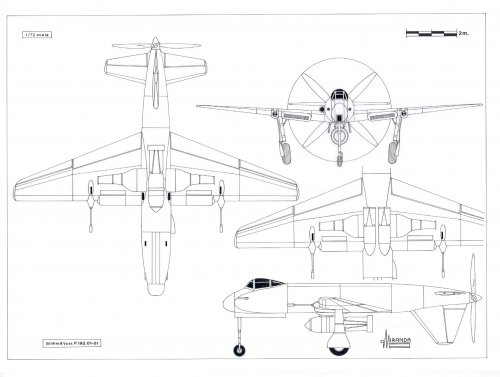
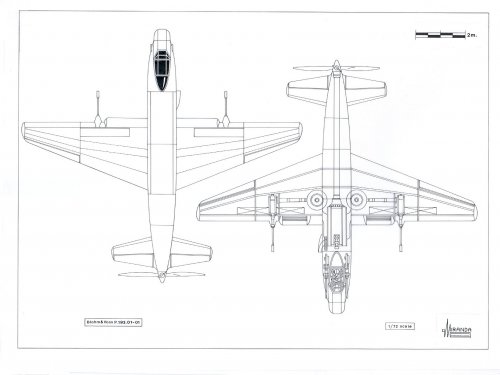
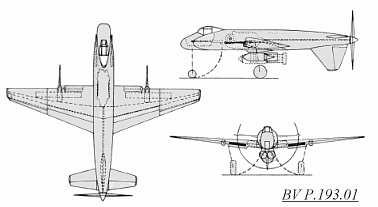
Blohm & Voss P.193.01.01
- Thread starter Justo Miranda
- Start date

- Joined
- 28 October 2006
- Messages
- 1,004
- Reaction score
- 139
This is a favourite of mine.
I've never done a proper profile set for this. It must have slipped below the radar.
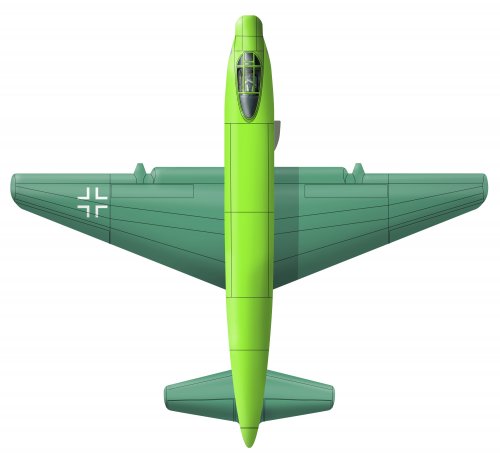
I did do a profile of it when I very first started, but it was more for camouflage ideas than anything else.
Maybe this is the kick up the tail section I need.
;D
I've never done a proper profile set for this. It must have slipped below the radar.
I did do a profile of it when I very first started, but it was more for camouflage ideas than anything else.
Maybe this is the kick up the tail section I need.
;D

- Joined
- 13 August 2007
- Messages
- 9,837
- Reaction score
- 16,308
wundervoll art work Justo
it's sad this "bug" was never build, you know Görings dislike of Push propellors (this not a aircraft) and modern landing gear (This is too american)
Also other Blohm & Voss proposal gave Goring fits of raving madness...
it's sad this "bug" was never build, you know Görings dislike of Push propellors (this not a aircraft) and modern landing gear (This is too american)
Also other Blohm & Voss proposal gave Goring fits of raving madness...
- Joined
- 28 October 2006
- Messages
- 1,004
- Reaction score
- 139
Wurger said:Peter,
please remind the Bv P.180!
Thanks Wurger. Will get back on it.
;D
Nimitz Zhang
ACCESS: Restricted
- Joined
- 15 July 2019
- Messages
- 16
- Reaction score
- 6
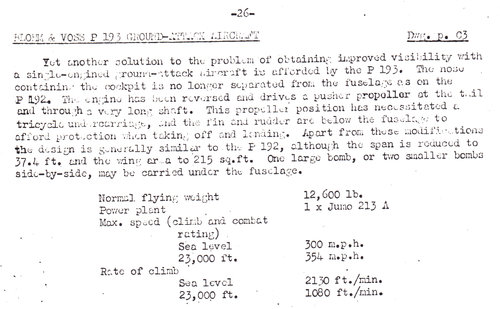
Anyone have specifications on its weight? And can any creative mind think of how hardpoints can be added to support rockets pods (RA55), SC 50, and SC 250 bombs of the like to more properly support the ground troops?
The central hardpoint can only carry one bomb and no hardpoints can be added due to the awkward landing gear position taking up most of the wing.
The central hardpoint can only carry one bomb and no hardpoints can be added due to the awkward landing gear position taking up most of the wing.

- Joined
- 11 June 2014
- Messages
- 1,617
- Reaction score
- 3,340
Anyone have specifications on its weight? And can any creative mind think of how hardpoints can be added to support rockets pods (RA55), SC 50, and SC 250 bombs of the like to more properly support the ground troops?
The central hardpoint can only carry one bomb and no hardpoints can be added due to the awkward landing gear position taking up most of the wing.
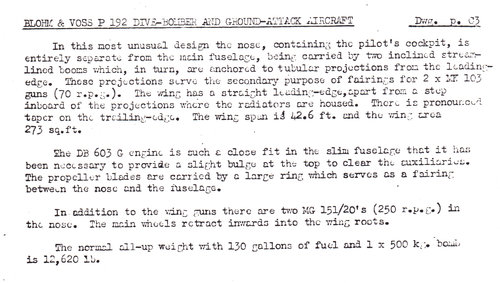
From German Aircraft: New and Projected Types, January 1946:
- Joined
- 11 June 2014
- Messages
- 1,617
- Reaction score
- 3,340
Dan, you regularly surprise with your document sources. Don you also have the same for the P 192?
Yes (see below). I might have the original German documents somewhere but it's quicker to use these.
- Joined
- 11 June 2014
- Messages
- 1,617
- Reaction score
- 3,340
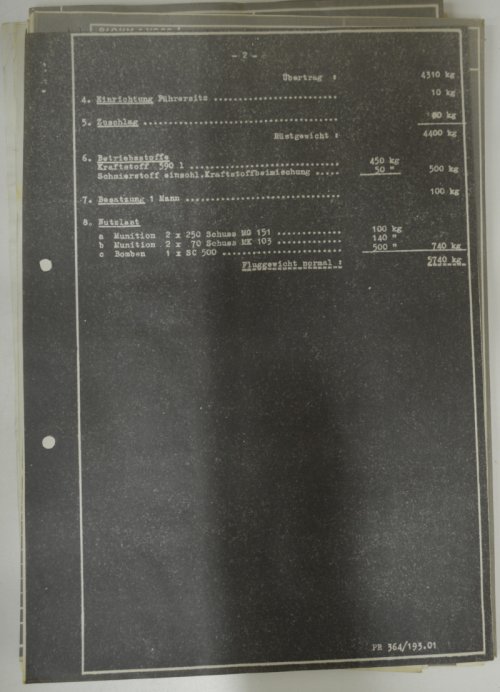
Dan, thank you. This is the first (semi)original document I have seen.
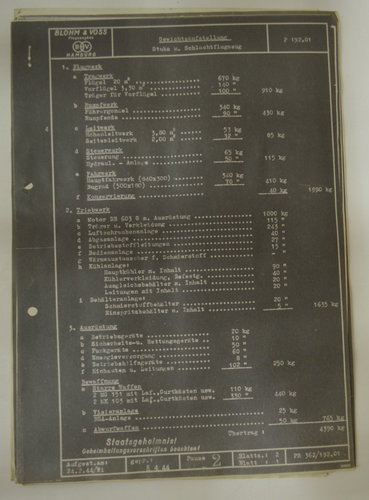
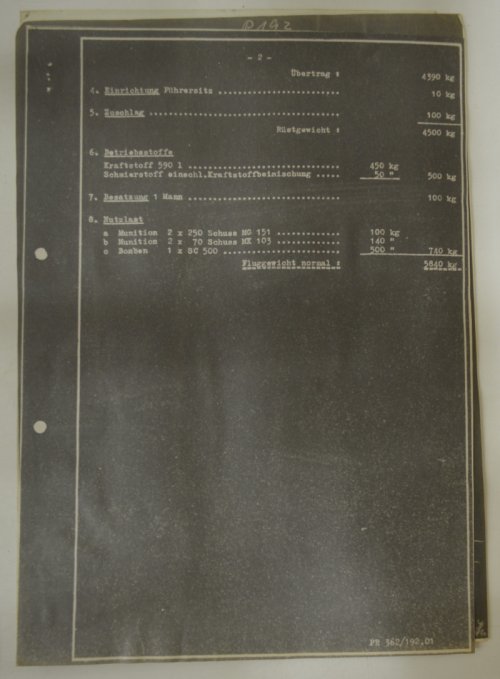
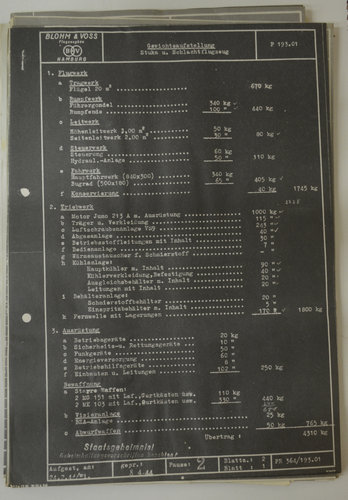
Found the original German versions.
P 192.01
P 193.01
Last edited:

Wasp
ACCESS: Restricted
- Joined
- 11 January 2010
- Messages
- 30
- Reaction score
- 14
Curious that both only count 50kg for Abwurfwaffen. Far from the usually envisioned SC1000 or 2x500. Just a typo, two times?
Or are they only referring to the ETC and not the variable payload itself? Could be also for the Guns, since it says Gurtkästen but not necessarily means the munition in them? Just a guess.
- Joined
- 11 June 2014
- Messages
- 1,617
- Reaction score
- 3,340
Curious that both only count 50kg for Abwurfwaffen. Far from the usually envisioned SC1000 or 2x500. Just a typo, two times?
Or are they only referring to the ETC and not the variable payload itself? Could be also for the Guns, since it says Gurtkästen but not necessarily means the munition in them? Just a guess.
There was a second page to each description which, for some reason, I neglected to upload as part of the original post six years ago. I've now added those second pages (see above).
Wasp
ACCESS: Restricted
- Joined
- 11 January 2010
- Messages
- 30
- Reaction score
- 14
Thank you. Then it is as I assumed the weights of the installation/cases only and the actual munition/bombs added on the second page.There was a second page to each description which, for some reason, I neglected to upload as part of the original post six years ago. I've now added those second pages (see above).
Thx for clearing this up.
Another detail, that caught my eye is the Propeller of the P 193 stated as VS9. Isn't the VS9 only a 3 bladed prop (according to some sources, the 4-bladed version using the same blade shape presumed to be the VS19), though on most post-war drawings it is shown as 4-bladed prop.
Maybe a misinterpretation of the equal lengths lines on the original drawing assumed as a symetrical 4-blade prop and not simply drawn to show the diameter of the full circle (I guess especially interesting for its rear prop design)?
Although not named on the P 192 sheet, the weight is exactly the same. So here also a 3-bladed design?

Wurst
ACCESS: Restricted
- Joined
- 19 September 2019
- Messages
- 35
- Reaction score
- 164
The air intake for the Jumo 213 seems to be on the wrong side in Justo's drawing. Or am I mistaken?
Definitely an interesting plane. I'm currently building the Micro Mir kit with a few improvements. I'll post a picture once it's painted.
Definitely an interesting plane. I'm currently building the Micro Mir kit with a few improvements. I'll post a picture once it's painted.
Wurst
ACCESS: Restricted
- Joined
- 19 September 2019
- Messages
- 35
- Reaction score
- 164
Here is my kit review of the Mikro Mir kit.

https://www.kitreviewsonline.de/blohm-voss-bv-p-193-in-172-von-mikromir-72-033/
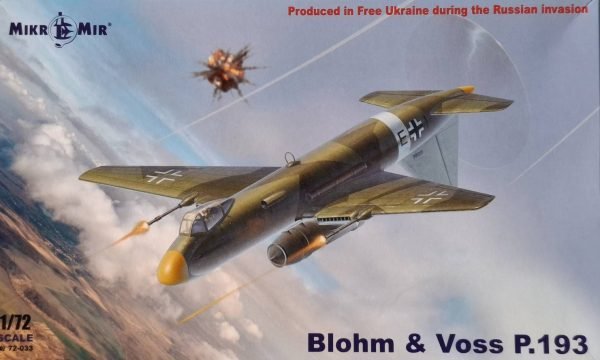
https://www.kitreviewsonline.de/blohm-voss-bv-p-193-in-172-von-mikromir-72-033/

blackkite
Don't laugh, don't cry, don't even curse, but.....
- Joined
- 31 May 2007
- Messages
- 9,421
- Reaction score
- 9,281
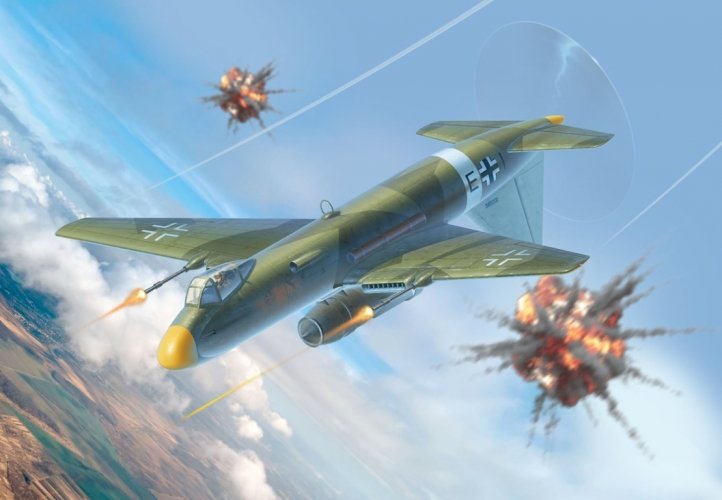
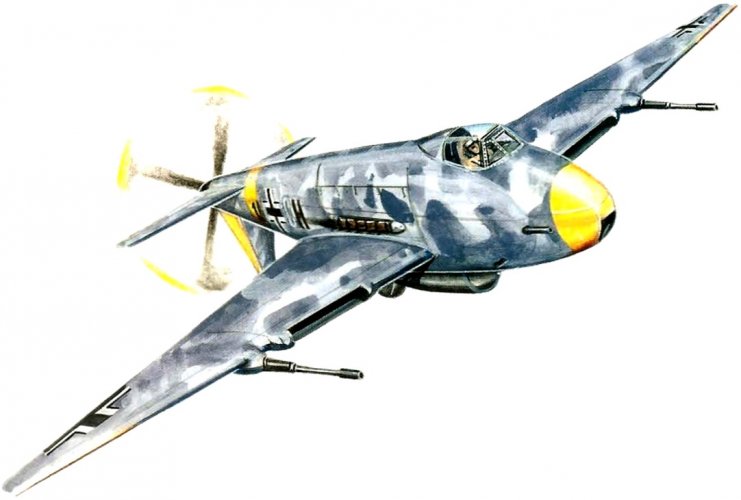
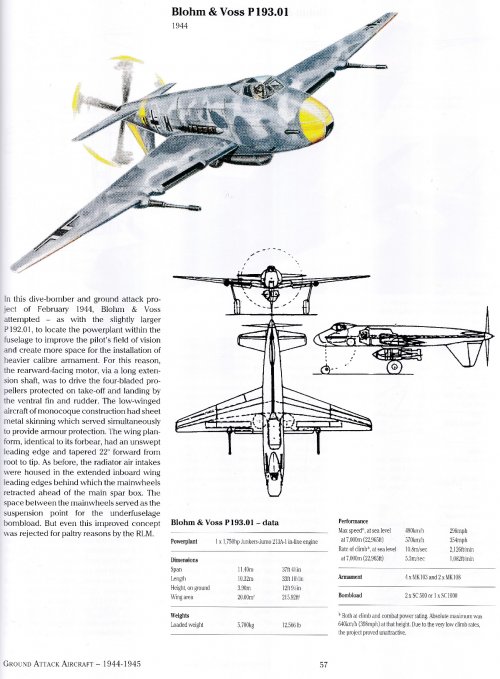
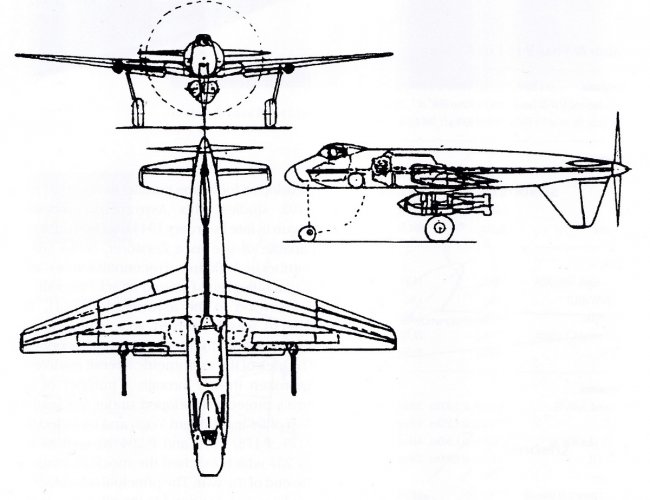
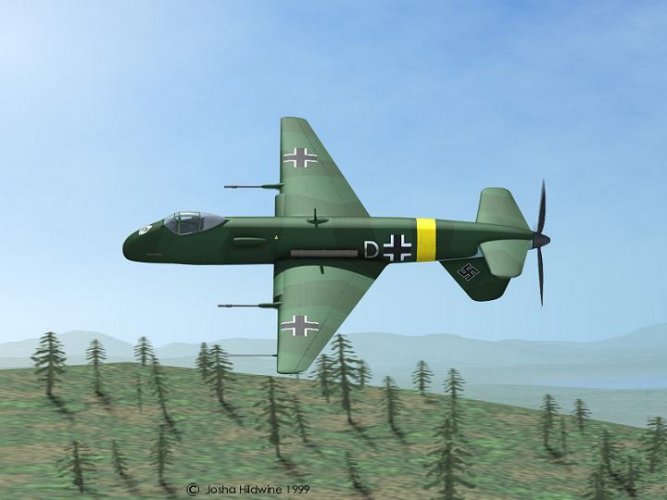
Blohm & Voss P193 assault aircraft
"In this dive bomber and ground attack aircraft design from February 1944, Blohm & Voss attempted, as with the slightly larger P192.01, to mount the powerplant within the fuselage to improve the pilot's field of view and free up more space for heavier armament. For this reason, the rear-facing engine was to drive a four-bladed propeller via a long shaft. The low-wing monocoque design featured a metal skin that also served as armor protection for the forward fuselage, including the cockpit and engine. The wing, identical to its predecessor, had a soft leading edge and tapered forward from root to tip. The radiator intakes were still located in the extended leading edges of the wing, behind which the main wheels retracted forward of the main spar. The space between the main wheels served as a hardpoint under the bomber's fuselage. But even this improved concept was rejected by the RLM. Placing large radiators in the wings for a battlefield aircraft is very original.
Engine – 1x1750 hp Junkers Jumo 213A-1
Dimensions: 11.4x10.32x3.9 m.
Wing area – 20 sq.m.
Net weight – 5700 kg.
Maximum speed – at sea level – 480 km/h, at 7000 m – 570 km/h.
Rate of climb -10.8 m/s at sea level, 5.5 m/s – at 7000 m, without armament at an altitude of 640 km/h.
Armament: 4xMK103 and 2xMK108, 2xSC500 or 1xSC1000 bombs."
Attachments
Last edited:
blackkite
Don't laugh, don't cry, don't even curse, but.....
- Joined
- 31 May 2007
- Messages
- 9,421
- Reaction score
- 9,281
blackkite
Don't laugh, don't cry, don't even curse, but.....
- Joined
- 31 May 2007
- Messages
- 9,421
- Reaction score
- 9,281
Attachments
Similar threads
-

-

-
-
-
 Blohm & Voss outboard tail projects (origins and descendants)
- Started by negoshi8or
- Replies: 50