blackkite
Don't laugh, don't cry, don't even curse, but.....
- Joined
- 31 May 2007
- Messages
- 9,515
- Reaction score
- 9,661
Hi! Blohm & Voss P 192
https://www.facebook.com/photo?fbid=752523764453091&set=pcb.25528512120082672https://war-book.ru/blohm-und-voss-p-192-shturmovik/
Blohm & Voss P192 assault aircraft
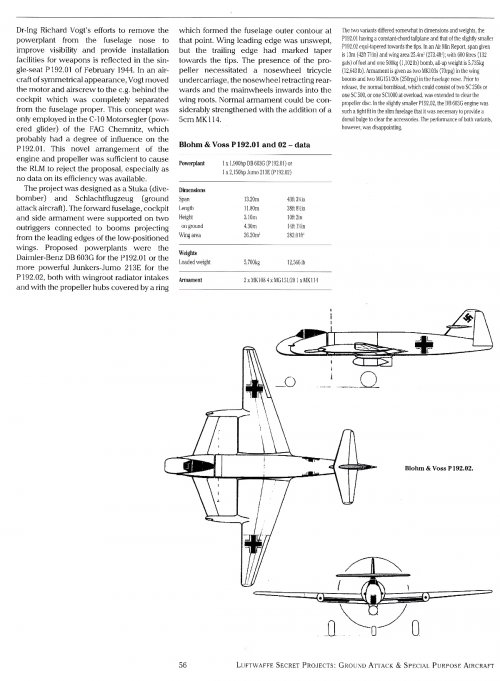
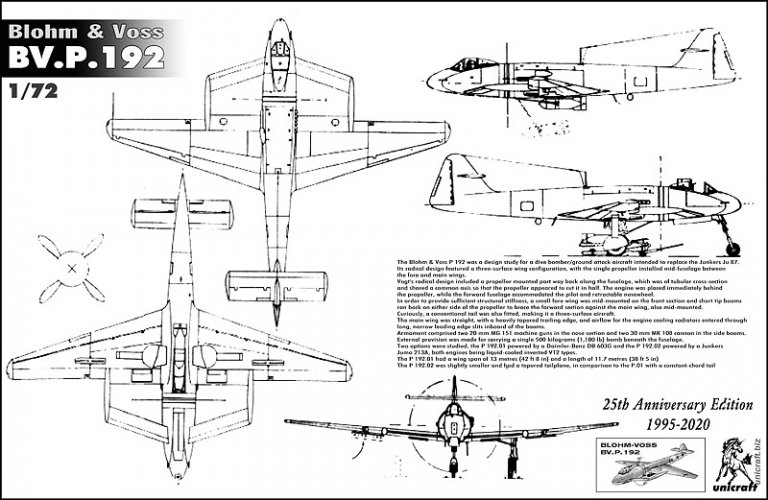
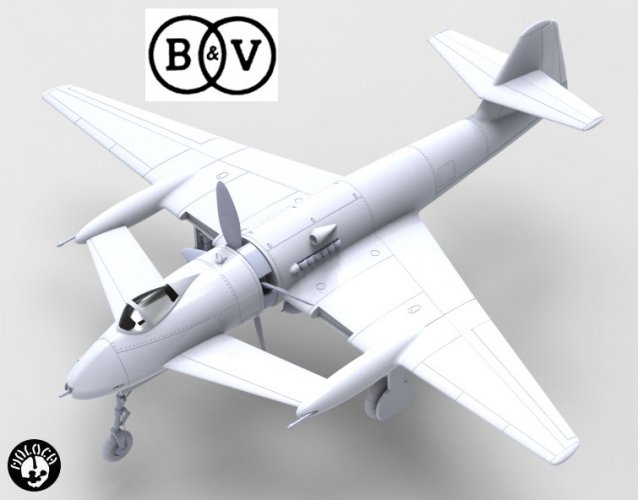
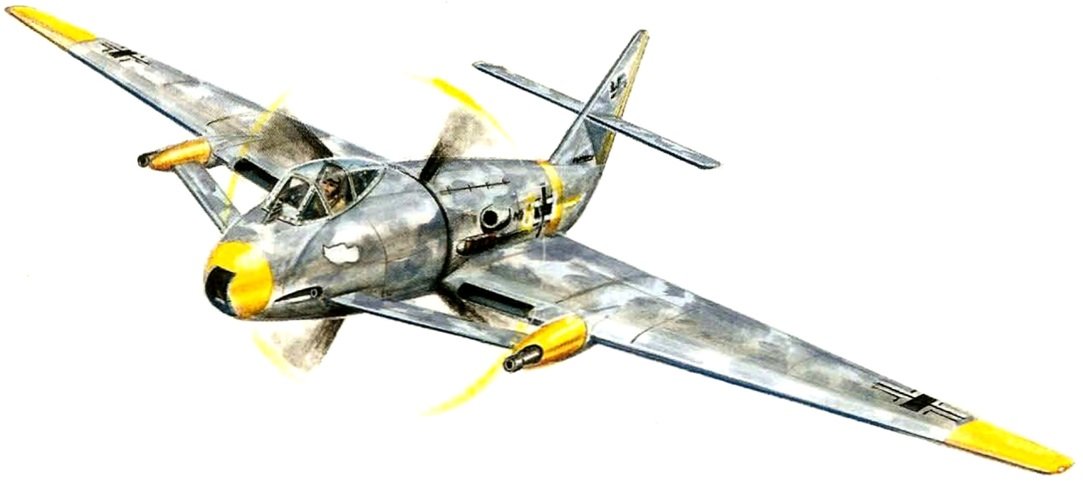
"Dr. Richard Vogt's efforts to remove the powerplant from the forward fuselage to improve visibility and provide weapons mounting options were reflected in the single-seat P192.01, a design dated February 1944. In an aircraft with a symmetrical appearance, Vogt relocated the engine and propeller behind the cockpit, which was completely separate from the fuselage itself. This concept had only been used in the FAG Chemnitz C-10 Motorsegler (motorized glider), which likely had some influence on the P192.01. This new engine and propeller arrangement was sufficient to force the RLM to reject the proposal, especially since there was no data on its effectiveness.
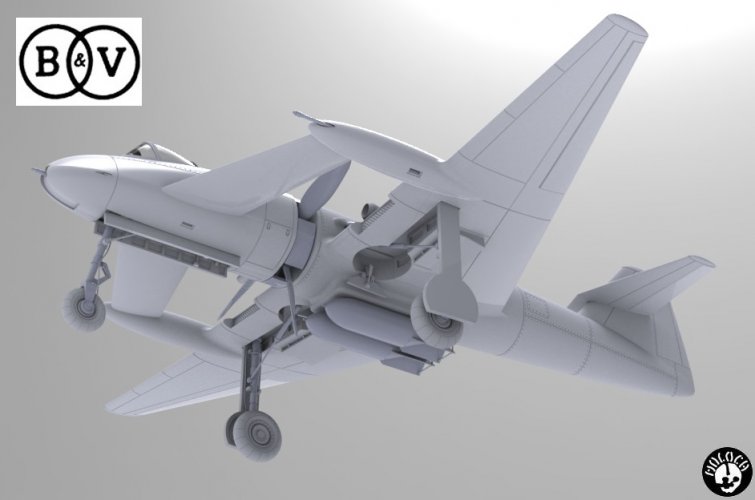
The design was developed as a Stuka (dive bomber) and Schlachtnugzeug (attack aircraft). The forward fuselage, cockpit, and onboard weapons were supported by two outriggers connected to booms protruding from the leading edges of the low-wings. The proposed powerplants were to be the Daimler-Benz DB603G for the P192.01 or the more powerful Junkers-Jumo 213E for the P192.02. Both the air intakes and radiator were located in the wing, and the propeller hubs were enclosed in a ring, which formed the outer contour of the fuselage at this point. The wing's leading edge was not swept, but the trailing edge had a noticeable reverse taper. This propeller necessitated a tricycle landing gear with a nosewheel, with the nosewheel retracting rearward and the main wheels retracting into the wing roots. The conventional armament could be significantly enhanced by adding the 5cm MK114.
Engines: 1x1900 hp BD603G (P192.01) or 1x2150 hp Jumo213E (P192.02)
Dimensions: 13.2x11.8x3.1 m, above ground – 4.3 m.
Wing area: – 26.2 sq.m.
Curb weight – 5700 kg.
Maximum speed – about 600 km/h."
Armament: 2xMK108, 4xMG151/20, 1x5-cm MK114 or 500-kg bomb, in the P192.02 modification – 1000 kg of bombs.
https://www.facebook.com/photo?fbid=752523764453091&set=pcb.25528512120082672https://war-book.ru/blohm-und-voss-p-192-shturmovik/
Blohm & Voss P192 assault aircraft
"Dr. Richard Vogt's efforts to remove the powerplant from the forward fuselage to improve visibility and provide weapons mounting options were reflected in the single-seat P192.01, a design dated February 1944. In an aircraft with a symmetrical appearance, Vogt relocated the engine and propeller behind the cockpit, which was completely separate from the fuselage itself. This concept had only been used in the FAG Chemnitz C-10 Motorsegler (motorized glider), which likely had some influence on the P192.01. This new engine and propeller arrangement was sufficient to force the RLM to reject the proposal, especially since there was no data on its effectiveness.
The design was developed as a Stuka (dive bomber) and Schlachtnugzeug (attack aircraft). The forward fuselage, cockpit, and onboard weapons were supported by two outriggers connected to booms protruding from the leading edges of the low-wings. The proposed powerplants were to be the Daimler-Benz DB603G for the P192.01 or the more powerful Junkers-Jumo 213E for the P192.02. Both the air intakes and radiator were located in the wing, and the propeller hubs were enclosed in a ring, which formed the outer contour of the fuselage at this point. The wing's leading edge was not swept, but the trailing edge had a noticeable reverse taper. This propeller necessitated a tricycle landing gear with a nosewheel, with the nosewheel retracting rearward and the main wheels retracting into the wing roots. The conventional armament could be significantly enhanced by adding the 5cm MK114.
Engines: 1x1900 hp BD603G (P192.01) or 1x2150 hp Jumo213E (P192.02)
Dimensions: 13.2x11.8x3.1 m, above ground – 4.3 m.
Wing area: – 26.2 sq.m.
Curb weight – 5700 kg.
Maximum speed – about 600 km/h."
Armament: 2xMK108, 4xMG151/20, 1x5-cm MK114 or 500-kg bomb, in the P192.02 modification – 1000 kg of bombs.
Attachments
Last edited: