The Republic XP-69 was cancelled May 25, 1943, the McDonnell XP-67 on September 13, 1944, the General Motors P-75 and the Lockheed XP-58 were dropped in October 1944.
The failure of the H-2470, V-3420 and R-2160 monster engines managed to prevent the entry into service of the long-range escort fighter that the USAAF desperately needed early 1945.
But the problem of long-range escort fighters appeared intractable.
On July 14, 1943, a Bell YP-59A jet fighter had set a new altitude record flying at 47,600 feet. To take advantage of the publicity, the firm Bell proposed to the USAF Air Materiel Command (AMC) the construction of the Stratospher Fighter D-16, a high-altitude fighter based on the YP-59A, but at that time the USAF was only interested in obtaining a long-range escort fighter.
To adapt the D-16 concept to the conditions of the MX-511 specification, calling for a long-range escort fighter, Bell redesigned the Stratospher Fighter to increase its fuel capacity. The new aircraft, designated Bell Model 40, was based on the same formula as the YP-59 but was a larger 116 per cent a 220 per cent heavier and could carry internally 4,352 liters of fuel and another 500 liters in underwings drop tanks.
Experience gained in Europe with Eighth Air Force Mustangs showed that the best tactic for defending bomber formations was to attack enemy interceptors with ‘hit and run’ attacks while they were ascending and before they reached the flight level of the bomber stream.
It was also shown that during high-altitude fighting between Mosquito bombers and Messerschmitt Bf 109 fighters, tactical conditions are reversed above 8,000 meters and the larger aircraft can maneuver better than the small one. During the Cold War the turning radius of the gigantic Convair B-36 bomber at 50,000 feet was 23,000 feet and three minutes, while the turning radius of the MiG-15A jet fighter flying at the same altitude was 30,000 feet and six minutes.
Based on these concepts, Bell determined that it was feasible to use the Model 40 as a long-range escort fighter without the aircraft risking mid-altitude dogfight against the nimble Japanese fighters. The Model 40 could perform hit-and-run attacks against enemy fighters ascending toward the bombers, taking advantage of the altitude and outmaneuvering those that managed to get into attack position over the bomber stream in high-altitude dogfights.
The new fighter was proposed to the AMC on April 3, 1943.
On March 11, the USAF awarded a contract for two prototypes and one static tests airframe, under the denomination XP-83.
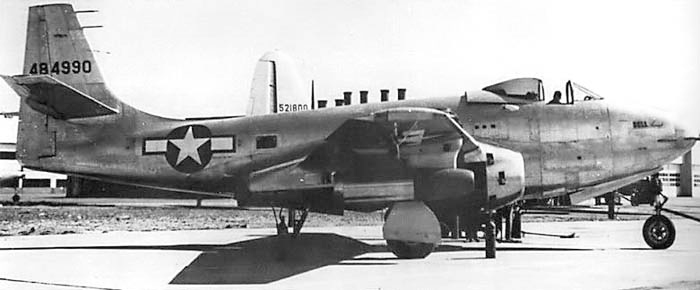
The mockup was inspected on June 5, 1944, and the first prototype (44-84990) was flown on February 5, 1945, underpowered by two General Electric 1-40 centrifugal turbojets each rated at 1,688 kg thrust.
The airplane showed yaw instability and was heavier than expected.
Bell feared that the advance of American troops across the Pacific would make the use of long-range escort fighters unnecessary and, to gain time in the construction of the prototype, he used some existing parts in the flaps and landing gear instead of designing more suitable systems, as a result the prototype suffered an increase in weight of 906 kg over the original design.
These shortcomings were expected to be corrected during the construction of the second prototype, but only six days before the first prototype made its first flight, the U.S. Marines secured the island of Iwo Jima located 800 miles of Tokyo. The first landing strip was completed in March and the P-51D fighters of the 15th FG and 21st FG moved to Iwo Jima. On April 7, 1945, these Mustangs made their first mission in Japan, and their presence forced the Japanese to withdraw the twin-engine heavy fighters Ki.45, Ki.46 and J1N1 from combat, significantly reducing pressure on the Superfortress.
In the fighting over Japan, the Mustang pilots encountered fierce resistance from the conventional fighters of the IJA and IJN, but they did not observe any high-altitude interceptor models or any enemy jet fighters.
After receiving these reassuring reports, the USAF lost interest in XP-83 although it continued evaluation programs for the first prototype and downgraded the construction of the second prototype that made its first flight seventy days after the end of Second World War.
The evaluation program started on May 11, 1945, during these trials XP-83-01 showed directional stability adequate for flying but not for spin recovery or combat aerobatics and the AMC recommended a larger tailfin increased in 18-in.
The lack of power meant a long takeoff run because its initial ground acceleration was slow, throttles had to be manipulated gingerly to avoid flame outs, and the pilots were forced to fly very long and flats landings.
The exhaust heat from the closely mounted turbojets tended to warp the Alclad tail.
This configuration had the advantage that no asymmetric forces were exerted if one turbojet failed or it was voluntarily turned off by the pilot to increase range, but it generated too much drag compared to other jet fighter designs with wing-mounted engines. Data from NACA wind tunnel showed that a redesigned windshield and canopy would increase by 11 km/h the top speed.
The airframe was built entirely in light alloys Alclad 24 ST and 75 ST.
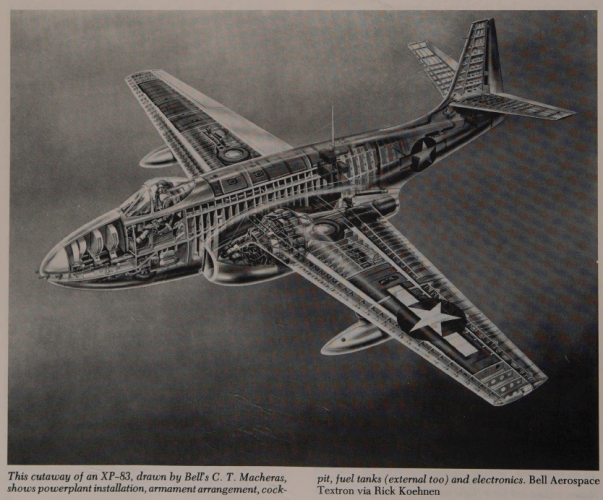
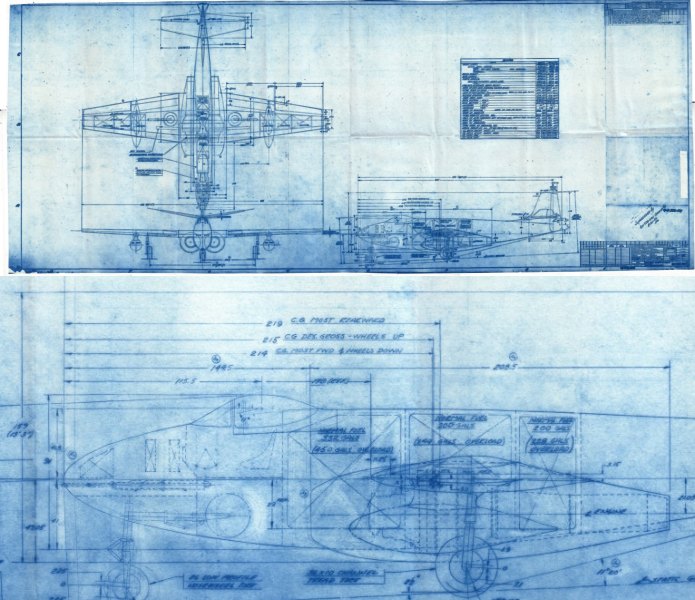
The fuselage housed six 0.5-in machine guns, the nose undercarriage leg, the cockpit (pressurized to 3,000 m ceiling) with the canopy fixed to a sliding section of the upper fuselage that was ejectable in emergency, three fuel tanks containing 332, 200 and 200 U.S. gallons (450, 244 and 228 in overload), electronic equipment that included a rear warning radar with yagi antenna mounted in the tailfin and reflex gunsight type A-1.
The wings were fitted with electrically actuated Fowler flaps, General Electric hydraulically boosted ailerons, electrically actuated undercarriage main members, three internal fuel tanks with 123 liters each and two underwing racks with 251 liters drop tanks.
Phase II evaluation tests to determine the aircraft performance began on June 9, 1945.
The program included mockup combat with propeller and jet fighters, the XP-83-01 was found outclassed in performance, diving speed and maneuverability by the P-47, P-38 and P-80 production fighters. Its roll rate was slightly less than the P-80 and the critical Mach number was 0.735 compared to 0.75 for the Grumman Hellcat.
Performance was relatively poor but overall behavior of the aircraft was satisfactory, and it was decided not to repeat the tests with the second prototype (44-94991).
During the Battle of Okinawa (Operation Iceberg) it was shown that the P-47 N-5-RE Thunderbolt lacked sufficient range to support the amphibious invasion operating from bases located in Cauayan-Luzon 1,278 km away.
The USAF considered using a ground attack version of the XP-83 to support the invasion of Kyushu Island, operating from Iwo Jima and Okinawa bases and it was decided to use the second prototype for ground attack weapons tests.
Trials were conducted by the AMC Armament Laboratory at Wright Field: the nose was lengthened by 32-in to accommodate six 15.2-mm T17E3 heavy machine guns or four 20-mm cannons or two 37-mm anti-tank cannons or a strafing battery of twenty 0.5-in machine guns and the wing racks were modified to carry bombs of 454 kg.
The XP-83-02 was fitted with a slightly different canopy with a very sloping windscreen.
The XP-83-01 was used by the AMC Power Plant Laboratory as a ramjet testbed to try to resolve synchronization problems experienced by the F-51D. It was hoped that a flight engineer would be able to control the ignition parameters and regulate the operation of the two turbojets mounted under the plane's wings until a synchronized thrust was obtained so that the prototype could fly powered only by the ramjets.
An engineering station was installed behind the pilot seat with access through a ventral hatch and two red and silver experimental ramjets Marquardt XRJ-30-MA with 21-in diameter were mounted under each wing that were photographed by means of two 16-mm cameras mounted under the wing tips.
During the test flight, on September 4, 1947, the engineer was unable to control the operation of the starboard ramjet because the vibration had caused a fuel leak that caused the wing fire and blew up the ramjet. Both crew members were forced to bail out at an altitude of 2,000 feet.
The project XP-83 was cancelled on January 30, 1947.
Bell XP-83-01 technical data
Wingspan: 16.15 m, length: 13.67 m, height: 4.67 m, wing area: 40.04 sq. m, max weight: 10,973 kg, max speed: 840 km/h, service ceiling: 13,715 m, rate of climb: 1,722 m/min, range: 3,300 km, power plant: two General Electric 1-40 centrifugal turbojets each rated at 1,688 kg thrust, armament: six nose mounted 0.5-in machine guns, electronic equipment: radio AN/ARC-3 with external wire antenna, IFF SCR-695A, tail radar AN/APS 13 with yagi antenna mounted in the tailfin and AN/APN-1 radio altimeter with two inverted ‘T’ dipoles placed under the port wing.
Bell XP-83-02 technical data
Wingspan: 16.15 m, length: 14.48 m, height: 5.13 m, wing area: 40.04 sq. m, max weight: 12,485 kg, max speed: 852 km/h, service ceiling: 12,200 m, range: 3,540 km, power plant: two General Electric J33-GE-5 centrifugal turbojets each rated at 1,812 kg thrust, armament: six 15.2-mm T17E3 heavy machine guns or four 20-mm cannons or two 37-mm anti-tank cannons or a strafing battery of twenty 0.5-in machine guns and the wing racks were modified to carry bombs of 454 kg, electronic equipment: radio SCR-522 with external wire antenna, IFF SCR-695A, tail radar AN/APS 13 with yagi antenna mounted in the tailfin and AN/APN-1 radio altimeter with two inverted ‘T’ dipoles placed under the port wing.
Painting scheme: natural metal with black anti-glare panel and wing walks.




![f83-2.jpg[img]](/proxy.php?image=http%3A%2F%2Fwww.airwar.ru%2Fimage%2Fidop%2Ffighter%2Ff83%2Ff83-2.jpg%5Bimg%5D&hash=738b741c2d28523498f64128e0255141)