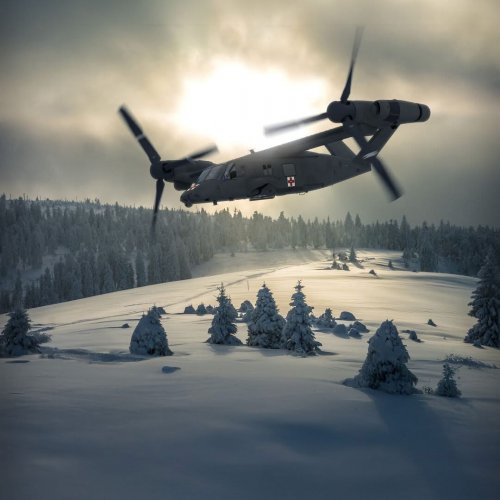
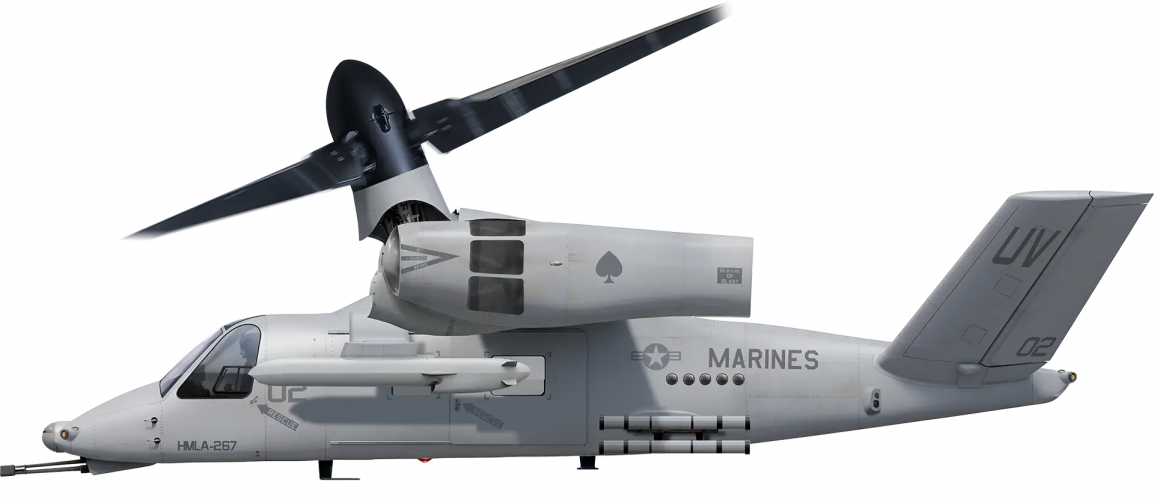
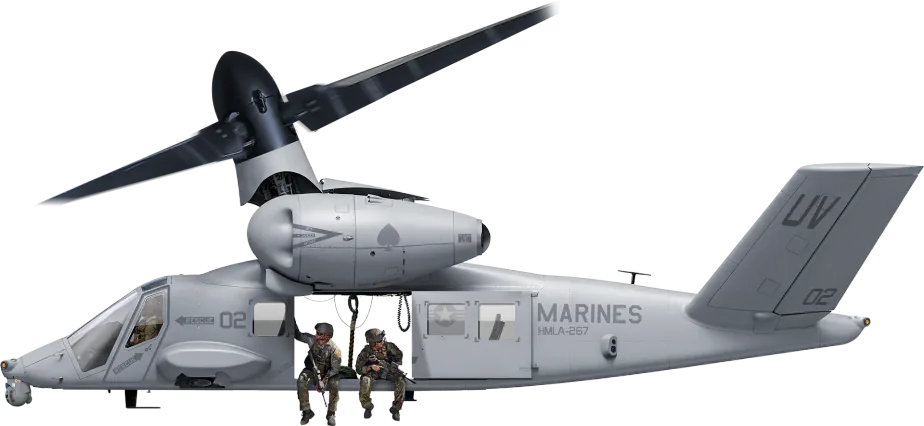
Bell MV-75 Cheyenne II (aka V-280 Valor)

Strictly speaking... is this true? That I can think of, Bell currently produces 0 commercial helicopters per year in the U.S. until the 525 gets certified, unless we are throwing in Mirabel-produced aircraft from up in Canada. But Robinson, Airbus, and Leonardo all build aircraft in the U.S. too, don't they? Heck, even small players like MD and Enstrom produce more commercial helicopters in the U.S. these days.
How much domestic content by percentage is your Chevy, Ford or Jeep required to have in order meet your criteria for US built? Final assembly for Bell commercial helicopters is in Canada and Japan, however rotors and gearboxes are manufactured in the US. These are the high dollar limited life components in helicopters that generate revenue. Helicopters are very much like inkjet printers. It’s not the cost of the printer that makes the profit, it’s the ink cartridges.

My expectation of someone questioning the accuracy of my post was the reason for addition of the wording ‘by revenue dollars’.

For more details, just ask Google

“By revenue, Bell Textron (a subsidiary of Textron Inc.) is the largest dedicated manufacturer of commercial and civil helicopters headquartered in the United States, pulling in billions annually (with total Bell segment revenues reaching roughly $4.3 billion). While corporate giants like Lockheed Martin (parent of Sikorsky) and The Boeing Companyhave larger overall corporate revenues from massive defense contracts, their rotary divisions focus overwhelmingly on military fleets rather than the commercial market. [1, 2, 3, 4, 5]”
 
Last edited:
How much domestic content by percentage is your Chevy, Ford or Jeep required to have in order meet your criteria for US built? Final assembly for Bell commercial helicopters is in Canada and Japan, however rotors and gearboxes are manufactured in the US. These are the high dollar limited life components in helicopters that generate revenue. Helicopters are very much like inkjet printers. It’s not the cost of the printer that makes the profit, it’s the ink cartridges.

My expectation of someone questioning the accuracy of my post was the reason for addition of the wording ‘by revenue dollars’.

For more details, just ask Google

“By revenue, Bell Textron (a subsidiary of Textron Inc.) is the largest dedicated manufacturer of commercial and civil helicopters headquartered in the United States, pulling in billions annually (with total Bell segment revenues reaching roughly $4.3 billion). While corporate giants like Lockheed Martin (parent of Sikorsky) and The Boeing Companyhave larger overall corporate revenues from massive defense contracts, their rotary divisions focus overwhelmingly on military fleets rather than the commercial market. [1, 2, 3, 4, 5]”
Very true, and all well made points. I am definitely not trying to be adversarial. I just know I have often picked up the vibe from folks at Heli-Expo over the years that Bell is the only "American" manufacturer of big helicopters in the commercial space, discounting Airbus, Leonardo, etc., meanwhile every Bell commercial model is listed as a product of Canadian origin and has Canada on the serial number plate because in the eyes of the regulators and customs officers, the substantial transformation in the manufacturing process happens up in Canada.

I know this caught more than a few operators off guard last year when buying used aircraft overseas. Once a tariff framework agreement was struck with the EU, a used H125 or A109 was tariff free, but a used 407 or 505 was subject to a 35% tariff because it was a product of Canada. Created a bit of an unfortunate dynamic... incentivizing US imports of aircraft produced largely with EU-produced major components and where the profits ultimately accrue to an EU corporation, while penalizing the aircraft built with US gearboxes, blades, etc.
 
t
Very true, and all well made points. I am definitely not trying to be adversarial. I just know I have often picked up the vibe from folks at Heli-Expo over the years that Bell is the only "American" manufacturer of big helicopters in the commercial space, discounting Airbus, Leonardo, etc., meanwhile every Bell commercial model is listed as a product of Canadian origin and has Canada on the serial number plate because in the eyes of the regulators and customs officers, the substantial transformation in the manufacturing process happens up in Canada.

I know this caught more than a few operators off guard last year when buying used aircraft overseas. Once a tariff framework agreement was struck with the EU, a used H125 or A109 was tariff free, but a used 407 or 505 was subject to a 35% tariff because it was a product of Canada. Created a bit of an unfortunate dynamic... incentivizing US imports of aircraft produced largely with EU-produced major components and where the profits ultimately accrue to an EU corporation, while penalizing the aircraft built with US gearboxes, blades, etc.

Also all true. From a technology and product development perspective, the majority of Bell new commercial helicopter engineering is performed in the US. This is not the case for Airbus or Leonardo. The engineers working in Canada for Bell and in the US for Airbus and Leonardo are excellent. Just that all companies tend to keep engineering development close to home.
 
I will hypothesize that Boeing and Sikorsky pretty much felt like owned U.S. Army Aviation. Army Aviation had retired the last Bell product and Bell was seen as a USMC Company. They no doubt felt they were in the driver's seat as the U.S. Army was never going to do tilt rotors. Both companies have retired flag officers paid to keep the company informed of what was going on at the Aviation HQ and the Pentagon. It would not surprise me if they rationalized that they could negotiate how much MOSA was inclusive in the contract. Anyway the sloopy contract was likely a product of this perception by the SB>1 team thinking it was a foregone conclusion that they would be awarded the contract.

The team no doubt low balled the proposal expecting to recoup the cost delta with contract award and future corrections as the aircraft was built.

https://www.captiongenerator.com/v/2284390/hitler-reacts-to-the-bell-v-280-winning-flraa.
 
Interesting enough I was looking for online / PDf download of our RN Fleet Air Arm Maritime Aviation Transformation booklet (which I obtained earlier this year at International Military Helicopter).

First search was this

https://www.navylookout.com/maritim...n-the-royal-navys-plan-for-a-hybrid-air-wing/


Future Crewed Maritime System caught my eye


I know further down the line (or sooner) our participation in MV-75 is a given due to the 2020 agreement with the US Army, so that an MV-75 conceivably operate off our QE class carriers in future albeit under RAF operational use / Joint Aviation Command.

At a rough guess here are my potential FMS customers for the Cheyenne II based on presentations I have seen at likes of International Military Helicopter , or talking to people at likes of Farnborough (?) and odd press release.

- UK
- RoK
- Netherlands
- Canada
- Italy
- Australia

cheers
 

Attachments

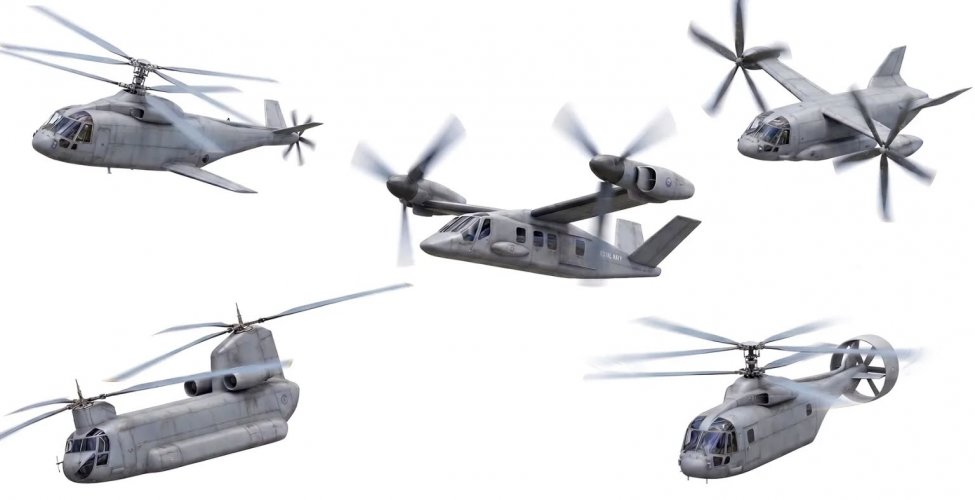
  • FCMAS.jpg
    FCMAS.jpg
    64.7 KB · Views: 250
Last edited by a moderator:
That looks as tall (or taller) as a CH-53K.
 
Last edited by a moderator:
I dub the one in the upper right-hand corner, "The Fat Boy".
 
Last edited by a moderator:
At a rough guess here are my potential FMS customers for the Cheyenne II based on presentations I have seen at likes of International Military Helicopter , or talking to people at likes of Farnborough (?) and odd press release.

- UK
- RoK
- Netherlands
- Canada
- Italy
- Australia

cheers
This is consistent with my supposition that nations who have maritime and overseas requirements are likely to find VTOL capability like MV-75 over longer distances a compelling case .
 
Last edited by a moderator:
Future Crewed Maritime System caught my eye
View attachment 822844
I'm still not sold on tilt-rotors as a naval helicopter replacement.

I think that a compound helicopter would be much better for shipboard use for ASW and maybe AEW. Despite the sheer height of most coaxial setups.

I did have one odd thought after that, however: Compound Kaman intermeshing helo type. Since that would still have excellent hover characteristics and speed. Might get a bit interesting in terms of the gearing/transmission, however. @yasotay what do you think about that idea?


I know further down the line (or sooner) our participation in MV-75 is a given due to the 2020 agreement with the US Army, so that an MV-75 conceivably operate off our QE class carriers in future albeit under RAF operational use / Joint Aviation Command.
I know the RAF is going to complain about needing lots more pilots, since MV75s only hold a single squad/UK section instead of a full platoon like the Chinooks do. So a total of 3-4x more helo drivers than they have now.


This is consistent with my supposition that nations who have maritime and overseas requirements are likely to find VTOL capability like MV-75 over longer distances a compelling case .
And are just waiting for the US to pay for all the development.
 
I'm still not sold on tilt-rotors as a naval helicopter replacement.
I think there is the potential for two distinct missions. I am not a naval expert so I could be off base here. I believe there used to be an outer and inner ASW and SW capability in most major naval fleets with a carrier based "outer" mission done by the likes of the S-3 Viking from the fleet. Large fleets of shore based aircraft and declining budgets rationalized the redundancy of the mission that put paid the S-3. Now even the shore based fleets are in short supply and usable airfields might become difficult, politically or kinetically. So this is a potential mission set that an aircraft like MV-75 might be worth consideration for. It (like the CMV-22) would also have potential for other missions (SOF insert/extract, disaster support, etc.)
Certainly for the inner mission that still appears to have a need to hover in one location for more extended periods a tilt rotor is suboptimal and a efficient hovering platform would still seem best for this mission.
I think that a compound helicopter would be much better for shipboard use for ASW and maybe AEW. Despite the sheer height of most coaxial setups.
The coaxial compounds to date would not fit into most of the hanger decks of NATO frigates and destroyers I believe. In fairness neither would any currently planned tilt rotor. I also would doubt that the Admirals would design the ship around the helicopter. The compelling case would have to be how much ocean the would the aircraft be expected to cover in a given operation. Speed and range can become a factor if you expect to have to do hover at or beyond 160 kilometers from the ship.
I did have one odd thought after that, however: Compound Kaman intermeshing helo type. Since that would still have excellent hover characteristics and speed. Might get a bit interesting in terms of the gearing/transmission, however. @yasotay what do you think about that idea?
I am not sure that the Kaman rotor system would do well at high speeds. Great design for hovering and sling loads at < 222 kph really. Although some of the old Dorman Intermeshing concepts might be okay.
I know the RAF is going to complain about needing lots more pilots, since MV75s only hold a single squad/UK section instead of a full platoon like the Chinooks do. So a total of 3-4x more helo drivers than they have now.
The bus is brilliant at what it does and will remain a mainstay for years to come. But it is not necessarily optimal for all missions. In operations with higher levels of risk would you want to risk loosing an entire platoon with the loss of one aircraft? Where with three (faster) aircraft a loss of one might not compromise a mission.
And are just waiting for the US to pay for all the development.
Well yeah! That is pretty universal I think. Pretty much everybody waits for the host nation to do the expensive stuff.
 
I think there is the potential for two distinct missions. I am not a naval expert so I could be off base here. I believe there used to be an outer and inner ASW and SW capability in most major naval fleets
Huh, fair point. Though I was imagining outer ASW getting picked up by the drones. IIRC the folded V247 is half the width of the V280, much like how an AH1 is half the width of a UH1.


I also would doubt that the Admirals would design the ship around the helicopter.
IIRC the FFG-7 hangars were designed around the SH60. Plus Spruance/Tico.


I am not sure that the Kaman rotor system would do well at high speeds. Great design for hovering and sling loads at < 222 kph really. Although some of the old Dorman Intermeshing concepts might be okay.
Thank you.


The bus is brilliant at what it does and will remain a mainstay for years to come. But it is not necessarily optimal for all missions. In operations with higher levels of risk would you want to risk loosing an entire platoon with the loss of one aircraft? Where with three (faster) aircraft a loss of one might not compromise a mission.
Exactly the argument that UKArmy and RAF will be having. And IIRC the argument that happened inside the US Army and inside the USMC as well.
 
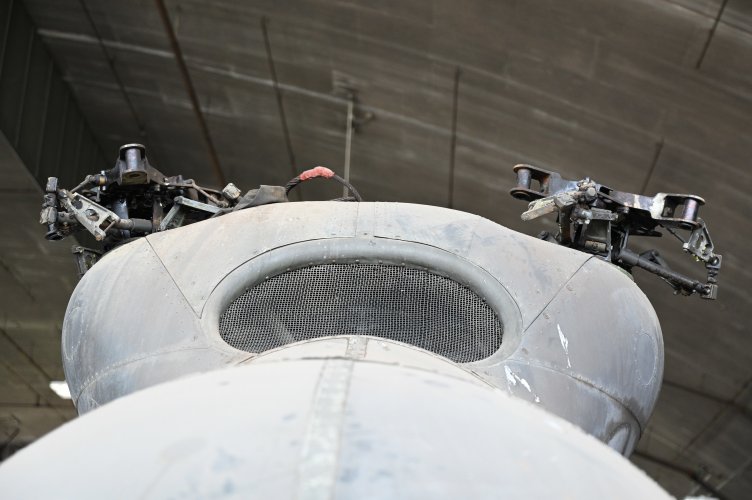
I don't think I've ever seen that one before! Interesting setup. Doesn't look like the standard cyclic/collective, but doesn't look like the Kaman servoflap-controlled setup, either.


https://media.defense.gov/2024/Jan/18/2003377976/1200/1200/0/230720-F-IO108-004.JPG
(sorry, had to link, uploads didn't want to play nice for some weird reason. Also, Forum does NOT like GIMP-native file types)
 

Attachments

  • 230720-F-IO108-004 - Kellett XR-8 rotor heads.jpeg
    230720-F-IO108-004 - Kellett XR-8 rotor heads.jpeg
    3.4 MB · Views: 139
Last edited:
There are likely more aerodynamically savvy who can support/debunk my notion of suitability for higher speed flight with an articulated intermeshing rotor systems, but since this is the MV-75 thread, it ought to be done elsewhere.
 

Attachments

  • MV-75-USMC.png
    MV-75-USMC.png
    593.2 KB · Views: 117
  • V-280-USMC.png
    V-280-USMC.png
    204.4 KB · Views: 112
https://simpleflying.com/mv75-cheyenne-uh60-black-hawk-replacement-missions/

Nothing overly new here, but there are some "numbers" that might intrigue.
Some of the numbers I found intriguing were stated in the FY 2027 budget REQUEST.

"Fiscal Year 2027 budget documents said that "the FY 2027 budget request initiates delivery of MV-75 prototype aircraft, continues to build and integrate remaining developmental prototype and Limited User Test aircraft, continues production planning, and initiates MV-75 prototype testing required to verify weapon system performance in preparation of a user assessment." The documents show MV-75 Fiscal 2025 funding at $1.0 billion, Fiscal 2026 funding at $1.2 billion, and Fiscal 2027 funding at $2.1 billion."

Thanks to the inability of the US congress to pass a budget, and the multiple continuing resolutions freezing any year to year program funding, Bell has received a fraction of the 2025 and 2026 funding stated.
 
Thanks to the inability of the US congress to pass a budget, and the multiple continuing resolutions freezing any year to year program funding, Bell has received a fraction of the 2025 and 2026 funding stated.

All Congress do anymore is beg they supporters for donos, eat hot chip and lie
 
Unlike the USAF and USN where aircraft are primary weapon systems, the U.S. Army considers aircraft to be supporting systems. Very expensive supporting systems. When the budget gets lean (relatively) the aviation branch gets the pinch. So while MV-75 as one of the "new" Big Five is to get a very large budget, the other platforms are, at least for the foreseeable future, in what amounts to a caretaker status. Of course if (when) the United States manages to get into another ground war...
 
On the plus side, I guess MV-75 will have great loiter time if some of them end up getting turned into EW and drone control/launch platforms. Just keep orbiting the battlefield for hours.
 
The delicate flight characteristics of tilt-rotor flight and insueing vulnerability to even small arms fire during flight especially during horizontal to vertical transition would seem to argue for the Apache in close ops.

Cheyenne II's limited ability for close in, below the tree line, loiter also argues for the Apache.

Proximity matters for EW & even ALE (futureISR) launch let alone SPEAR3/JAGM/Hellfire II/Spike.
 
The delicate flight characteristics of tilt-rotor flight and insueing vulnerability to even small arms fire during flight especially during horizontal to vertical transition would seem to argue for the Apache in close ops.

Cheyenne II's limited ability for close in, below the tree line, loiter also argues for the Apache.

Proximity matters for EW & even ALE (futureISR) launch let alone SPEAR3/JAGM/Hellfire II/Spike.
While I doubt MV-75 will ever transition to an attack platform in the traditional sense providing close in support, I could see some missions like electronic sensing and launching some versions of LE becoming mission sets. Also the extended ranges being tossed about from the likes of Anduril and other weapon companies do not need proximity to the front lines. These too might be viable missions for MV-75. I would agree that providing support to ground maneuver forces, in close proximity to the threat systems is probably not a mission for the platform. Apache will indeed remain the primay platform for that if killer drones and FPV do not assume the role.
 
The delicate flight characteristics of tilt-rotor flight and insueing vulnerability to even small arms fire during flight especially during horizontal to vertical transition would seem to argue for the Apache in close ops.

Cheyenne II's limited ability for close in, below the tree line, loiter also argues for the Apache.

Proximity matters for EW & even ALE (futureISR) launch let alone SPEAR3/JAGM/Hellfire II/Spike.
Based on what information by a reputable source do you conclude that the MV-75 has "delicate flight characteristics" and "insueing vulnerability to even small arms fire during flight especially during horizontal to vertical transition"?

The MV-75 is much smaller than the V-22 and the V-280 demonstrator has proven maneuverability equal or better to the Blackhawk. Will it be as agile as an Apache? Of course not, it is like comparing an F-16 to a C-130.

Will the MV-75 be as survivable as an Apache? Based on V-22 proven survivability to intense ground fire, I would not be surprised. Larger airframes allow for greater separation of redundant systems like hydraulics. Having two engines widely spaced apart reduces potential loss of both engines from ground fire including shoulder launched missiles. Tiltrotor range and ability to refuel inflight supports getting home after loss of fuel. Finally, speed is life when it is time to get the hell out of Dodge (>270 knots versus 160 knots).

https://www.hurlburt.af.mil/News/Features/Display/Article/495545/cv-22-crews-save-lives/
 
While I doubt MV-75 will ever transition to an attack platform in the traditional sense providing close in support, I could see some missions like electronic sensing and launching some versions of LE becoming mission sets. Also the extended ranges being tossed about from the likes of Anduril and other weapon companies do not need proximity to the front lines. These too might be viable missions for MV-75. I would agree that providing support to ground maneuver forces, in close proximity to the threat systems is probably not a mission for the platform. Apache will indeed remain the primay platform for that if killer drones and FPV do not assume the role.
The number of drones often needed to destroy one vehicle is an example of how much they fall short literally. Western armies just doesnt have the equipment, vehicles, or personal to, maintain operate, replace etc to deploy the swarms of garbage. Even if a single operator can control hundreds, there is no means to field the full support infrastructure especially during fast, mobile maneuver warfare.
 
Based on what information by a reputable source do you conclude that the MV-75 has "delicate flight characteristics" and "insueing vulnerability to even small arms fire during flight especially during horizontal to vertical transition"?
If a tiltrotor craft loses the entire rotation of one prop, regardless of distributed power, the craft flips over and... This has been known for decades.
Likewise, in extemis transition under fire is not conducive to natural pilot reaction, Pilots often have to mix fixed wing piloting reactions w/conflicting rotorcraft piloting instinctual reactions. Understand when that when the v-22 ingresses troops it hovers at longer distances forcing disgorged dismounts to walk drastic distances so the 22 an avoid groundfire potentials.
Downwash is horrendous and thus not complementary to low hover.
The MV-75 is much smaller than the V-22 and the V-280 demonstrator has proven maneuverability equal or better to the Blackhawk. Will it be as agile as an Apache? Of course not, it is like comparing an F-16 to a C-130.
Famously the Chinook is faster than the Apache and am not sure how much a tiltrotor can really manuver. Speed can transmit as the appearance of higher maneuver ability, for those who belive that. Tiltrotors have speed & range, and an inability to operate in urban enviroments due to dowwash and landing zone diameter. Most future ops will need to occur in urban areas where a MH-6 best operates not a V-22.
Based on V-22 proven survivability to intense ground fire, I would not be surprised.
That is an amazingly surprising statement.
Larger airframes allow for greater separation of redundant systems like hydraulics. Having two engines widely spaced apart reduces potential loss of both engines from ground fire including shoulder launched missiles. Tiltrotor range and ability to refuel inflight supports getting home after loss of fuel. Finally, speed is life when it is time to get the hell out of Dodge (>270 knots versus 160 knots).

https://www.hurlburt.af.mil/News/Features/Display/Article/495545/cv-22-crews-save-lives/
 
Back
Top Bottom