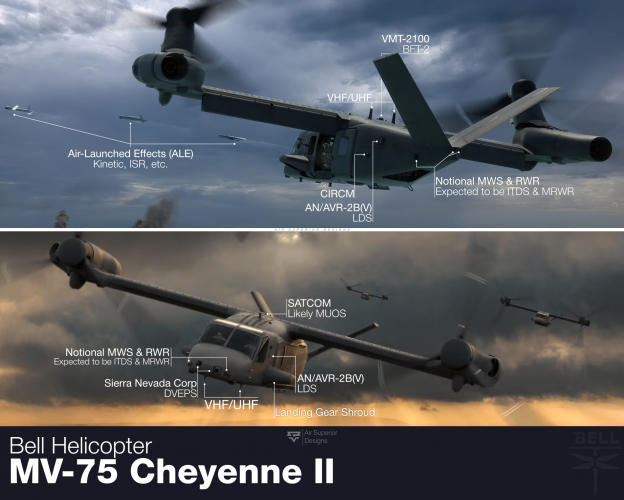
Bell MV-75 Cheyenne II (aka V-280 Valor)

And yet statistically the V-22 has a mishap rate that is completely average amongst the DOD’s rotorcraft inventory, and lower than many types in the Marine Corps inventory - so your assertions here clearly miss the mark at a fundamental level if you want to invoke “statistics”.

As for being a solution to a non-existent problem, ask military leadership and troops if lack of range and speed are a “non-existent” problem that they don’t need solved.

There have been 12 V-22 mishaps since the type entered service, with a total of 32 fatalities. Contrary to your assertions, the majority of these mishaps have been - as is the case with most aircraft - due to pilot/crew error.

The anti-V-22 crusades that folks will go through gymnastic to embark on really get baffling after a while… this is a thread about the MV-75 Cheyenne II, feel free to go discuss the V-22 mishap rate in an Osprey thread if so eager to poorly regurgitate half truths that the press love to harp on…
Only 400 Ospreys, vs. 5000+ Black Hawks.
People forget just how troubled the V22 development was. During 15 years of development, it killed 30 men on test flights and was grounded several times before it was deployed. Of the 20 hull lossess incidents involving crashes. Also about 32 total have been disposed of written up as losses. Because it's composite fuselage which is essentially flammable and impossible to fix under heavy damage.
During those long 15 years, it was a running gag just how troubled the Osprey was, and everybody kinda thought it would go the way of the Comanche and Crusader, decade after people thought it would end up on chopping block like the Expeditionary fighting vehicle. It was so jacked up, it missed the invasion of both Iraq and Afghanistan. 4 lethal accidents in span 2 years,

When a supposedly advantageous piece of equipment is withheld from 2 largest wars recent memory....Iraq offered too much dust and enemy insurgent small arms fire for it's purpose soldier insertion. And Afghanistan' mountainous terrain offered too much wind shear to keep it stable for high altitude operations they wanted. Tiltrotors have not folded over to civilian applications because they are unstable and dangerous; the AW609 wont be FAA certified til late 2020s and idea any pilots and future civil aviation providers is sketchy. Accident's due "Pilot Error" what error's is really the difficulty of controlling an aircraft that's very prone to instability.

 
Only 400 Ospreys, vs. 5000+ Black Hawks.
People forget just how troubled the V22 development was. During 15 years of development, it killed 30 men on test flights and was grounded several times before it was deployed. Of the 20 hull lossess incidents involving crashes. Also about 32 total have been disposed of written up as losses. Because it's composite fuselage which is essentially flammable and impossible to fix under heavy damage.
During those long 15 years, it was a running gag just how troubled the Osprey was, and everybody kinda thought it would go the way of the Comanche and Crusader, decade after people thought it would end up on chopping block like the Expeditionary fighting vehicle. It was so jacked up, it missed the invasion of both Iraq and Afghanistan. 4 lethal accidents in span 2 years,

When a supposedly advantageous piece of equipment is withheld from 2 largest wars recent memory....Iraq offered too much dust and enemy insurgent small arms fire for it's purpose soldier insertion. And Afghanistan' mountainous terrain offered too much wind shear to keep it stable for high altitude operations they wanted. Tiltrotors have not folded over to civilian applications because they are unstable and dangerous; the AW609 wont be FAA certified til late 2020s and idea any pilots and future civil aviation providers is sketchy. Accident's due "Pilot Error" what error's is really the difficulty of controlling an aircraft that's very prone to instability.
Again - you display a misunderstanding of the statistics. They are adjusted to mishap per total flight hours, it doesn’t care if the installed fleet is 20 aircraft or 2,000 - this specifically serves to normalize for fleet size.

Source on 32 having been written off/disposed as losses? Would be keen to see those details.

People don’t forget how troubled the V-22’s development was… it’s mentioned literally every time the aircraft makes news. The discussion of its past usually receives more coverage than actual discussion of its present.

As sad as the mishaps during development were, this is why we have flight test - and when you have a flight crew that exceeds the maximum allowable descent rate for the aircraft by a sizable margin because they missed their initial point to begin their descent… why should the aircraft somehow be held to blame for a crew sadly vastly departing from the permitted flight envelope and sadly resulting in 19 Marines losing their lives. Do we blame aircraft that crash due to being over-G’d or over-sped for resultant mishaps or is that a unique phenomenon for the Osprey?

As for the 4 lethal accidents in 2 years, you’ve got two that were clear cut crew error (Norway, Australia - investigation reports on those mishaps are publicly available). You’ve got another that, while ultimately experiencing a catastrophic gearbox failure, can absolutely be chalked up to a crew decision to ignore massive warnings from the aircraft that the gearbox was making chips and fly on for 40+ minutes until the failure finally occurred (the aircraft literally warned them there was an issue, they pressed on). In California, there was a mishap attributed to hard clutch engagement. So 3 of your 4 had significant (or total) crew involvement, and the 4th had solely technical causes. Hell, over the same period I’m pretty sure we lost more F-35s to mechanical failures. Let’s go crucify it next too

Wasn’t deployed for Iraq and Afghanistan? I’m sorry, but this is just factually incorrect on a massive level.

While the Osprey was not in service at the start of those wars, it did deploy to both Iraq and Afghanistan after entering service in 2007 - in the case of Iraq, they rushed it to deployment that very same year.


Iraq:
Afghanistan:
  • The V-22 was later deployed to Afghanistan, with VMM-261 conducting the first MV-22 combat deployment there in 2009.
  • It went on to support Operation Enduring Freedom in combat and logistics roles.
  • Heck, an Osprey even flew Bin Laden’s body out the carrier after Operation Neptune Spear

Fair criticism is fair criticism, but ground it in facts and real data, not claims that are easily disproven by even cursory research.
 
Last edited:
Only 400 Ospreys, vs. 5000+ Black Hawks.
People forget just how troubled the V22 development was. During 15 years of development, it killed 30 men on test flights.
And that's how you can tell they don't have an honest argument. One aircraft crashes with its pilot onboard. Another crashes with 30 people onboard. So you count the people, not the crashes, so it makes it sound like the second aircraft has more problems than it does.
 
Only 400 Ospreys, vs. 5000+ Black Hawks.
People forget just how troubled the V22 development was. During 15 years of development, it killed 30 men on test flights and was grounded several times before it was deployed. Of the 20 hull lossess incidents involving crashes. Also about 32 total have been disposed of written up as losses. Because it's composite fuselage which is essentially flammable and impossible to fix under heavy damage.
During those long 15 years, it was a running gag just how troubled the Osprey was, and everybody kinda thought it would go the way of the Comanche and Crusader, decade after people thought it would end up on chopping block like the Expeditionary fighting vehicle. It was so jacked up, it missed the invasion of both Iraq and Afghanistan. 4 lethal accidents in span 2 years,

When a supposedly advantageous piece of equipment is withheld from 2 largest wars recent memory....Iraq offered too much dust and enemy insurgent small arms fire for it's purpose soldier insertion. And Afghanistan' mountainous terrain offered too much wind shear to keep it stable for high altitude operations they wanted. Tiltrotors have not folded over to civilian applications because they are unstable and dangerous; the AW609 wont be FAA certified til late 2020s and idea any pilots and future civil aviation providers is sketchy. Accident's due "Pilot Error" what error's is really the difficulty of controlling an aircraft that's very prone to instability.
Your argument is fallacious due the number of inaccuracies presented.
@HaveVoid has addressed most of those.
I think you also overstate the number of H-60 built. It is indeed a very successful combat helicopter, but then so is/was the H-1. Like the H-1 before it the H-60 is not believed to meet mission parameters happening now and into the future. In fairness the H-60 is not going away anytime soon. The General in charge of Aviation made a point of stressing that H-60 will remain in the U.S. Army fleet for some time. MV-75 will likely go to units (101st Division already specified) that have long range missions that H-60 cannot do without stringing refuel stations out over distances. Something the enemy might take note of I think.

I look forward to your arguments if you can support them with viable data. Otherwise, please know you are only taking up space.
 
Last edited:
People forget just how troubled the V22 development was. During 15 years of development, it killed 30 men on test flights and was grounded several times before it was deployed.
Why did you neglect to include the fact that it went through the turmoils of the Peace Dividend, was slashed at multiple times by the likes of Dick Cheney and yet still birthed a capability unmatched anywhere else.
 
I think you also overstate the number of H-60 built.

Sikorsky announced the 5000th "Hawk" delivery back in 2023. That includes all the S-70s, I believe, or at least all the H-60s. (There might be some differences between those two counts)

 
@TomS - Thank for the correction. I was only considering the H-60 fleet for the U.S. Army. 5,000 is relevant to the argument.
 
Even if you only count the Army H60s...

In the last 10 years it has kill over 35 people which the V22 has in 20 FOR JUST THE ARMY.

Which is a closer Apples to Apples comparison.

An even closer one be the S65 Stallion type, with a similar role and build number of 500 ish. THAT one has killed over 100 people in noncombat crashes in any 20 year period of its long production history. Some in just single crashes. Hell in 2005 a CH53E kill all 31 people in it in Iraq when the pilots got confused.


Helicopters are 50000 parts flying in close formation as an afront to God and aerodynamics. If one breaks...

All the types be fucking booted if the lost rate was "UNSUSTAINABLE" as the V22 is called by unknowledgeable haters.

But we been using them none stop since what, the mid 1940s? I think 35 people in 20 years is very Sustainable compare to any other helicopter. Even the 95 kill in total since the V22 first flight 36 years ago is down right insanely low in comparison to every other type out there.

I feel the MV75 Cheyenne be just fine.
 
I think the MV-75 will be a success at the primary roles it's intended for but there are still tasks where modern H-60 variants are more economical/suitable. I hope the Army isn't going to pretend that "yeah, we're going to completely replace the H-60 with these."
 

Over twenty years ago, Sikorsky's management made a decision to attempt re-develop the ABC configuration into something workable instead of invest in tiltrotor technology. Sikorsky has dabbled in tiltrotors on the side, off and on over the years, both in trade/design studies and wind tunnel work. However, they felt that if the Army was going to choose a tiltrotor, they'd go with Bell, so there was little point in pursuing that path.

Maybe it wouldn't have mattered in the end, but committing to the ABC path and the billion+ dollars of private capital expended on it for no return was a critical decision. More so as it's clear the DoD is willing to wind down purchases of H-60 platforms.
 
I think the MV-75 will be a success at the primary roles it's intended for but there are still tasks where modern H-60 variants are more economical/suitable. I hope the Army isn't going to pretend that "yeah, we're going to completely replace the H-60 with these."
I don't expect the USN to replace their H-60s with MV75s. Dipping sonar for ASW or hauling sling loads is better done by a helicopter than a tiltrotor.

The USMC might replace their H-1s with MV75s if Bell can figure out a gunship version as well as the standard transport version.
 
Well, even if replacing uh60 1:1 is a goal, that won't be reached anytime soon. Back at the height of the cold war in the 1980s, fewer than 150 uh60s were made per year. That got steadily reduced and today the production rate is like 25, mostly for export. So first the production pipeline would need to be expanded, which happens gradually. And then money would be have to found for large annual purchases. Which doesn't seem likely. I don't see more than a 100 per year made for the DoD, ever. (unless there's an actual war with China) Even at a 100 per year, it'd literally take something like 25 years (with the ramp up) to replace just the army's UH60s. And the navy might want to replace some of their helicopters as well (maybe part of their Knight Hawk fleet that doesn't need a lot of hover?) Given the planned entry into service date, that might meant UH60s would stick around until 2055 or so. But frankly, I don't see even a 100 being procured per year, so in reality I think we're looking at even longer shelf life for UH60 and, possibly, simply a new, different design replacing part of the UH60 fleet. MV75 is gonna be great, but it won't necessarily be the one size fits all solution for all the DoD needs when it comes to UH60 replacement.
 
So what would be the definitive UH-60 replacement? Another helicopter on the scale of the UH-60?
 
So what would be the definitive UH-60 replacement? Another helicopter on the scale of the UH-60?
Knowing the DoD and their love for futuristic buzzwords expect something like a "tranformative, unmanned, multidomain solution networked across the entire battlefield for maximum situational awareness and capability" or something like that, throw some space BS in as well and you got yourself a DoD press brief about the future procurement of [insert a given system]
 

Some interesting information.

If memory serves the U.S. Army has said that MV-75 would not completely replace UH-60. As was just pointed out above even if built at wartime levels and pace (whatever that means now) it would be likely over a decade to replace all of the UH-60.
 
Even if the US Army halts procurement of any new UH-60s, foreign military sales and sales of the S-70 will likely continue for decades.

With life extension programs, the US Armys huge existing fleet of UH-60s will continue flying for decades, slowly decreasing from attrition due to accidents.

Finally, when Sikorsky decides it’s no longer profitable to continue production. The US Army will likely procure a small number of additional air frames before the lights are turned off.

If Sikorsky is lucky, they will continue production of the UH-60 in various models for longer than Bell produces the H-1/412. But my money is on the Bell still being in production after the UH-60 production ceases.
 
Prior to the 'America First' actions by the current administration, I would have predicted a strong foreign military market for the Cheyenne II. Bell selected to team with many foreign suppliers to facilitate foreign military sales. Following the events of the past year however, foreign military sales appear a lot less promising. This is not a political statement, just my perspective of the situation.
 
The F-35 went through thanks to the shear force of its unique cost-performance, despite a similar stalemate. The MV-75 will follow due course.

The saddest thing is for the French combatants that would have to look at one more military marvel unable to touch it.
 
Hopefully the Army has been more purposeful about designing the MV-75 for exportability from the outset and establishing the formal policy and technology transfer guidelines to actually allow successful FMS sales.

A lack of suitable national disclosure policy for the F-22A posed a challenge for hypothetical exports of that platform, for example. Obviously the V-22 logged a single export of the MV-22 variant to the JGSDF, however I have heard the story several times that another country was very interested in purchasing CV-22Bs,, and got as far as the Pricing and Availability stage with DOD where they were presented with a bill for over $1 Billion USD in NRE to develop an exportable version. As you can imagine, there are not many operators who can absorb a $1B hit to their purchase of what would probably have only ever been a small fleet of aircraft to provide an exquisite CSAF/SOF capability.

Obviously the Army is an FMS machine - UH-60, AH-64, CH-47, etc. - hopefully MV-75 will follow, although I share CTR’s concerns that current tensions between the U.S. and its NATO allies make major purchases of U.S. equipment way less palatable and likely than in years past. Maybe the countries in question will take the longer view and hope for rekindled friendship on the timescale that such FMS programs take to flesh out.
 
Last edited:
A lack of suitable national disclosure policy for the F-22A obviously saw that type’s export fortunes effectively dashed entirely
There is a tiny bit differences between the basically one of its type bleeding edge super fighter that was the F22 in the late 90s to 2010 and the MV75 which is noted to use much off the shelf kit from other designs.

Sorry but I absolutely HATE when people bring up the F22s lack of expect in comparison to other design, like sure it wasn't the brightest long term idea, but at the time it made extreme amount of sense since it took over a decade for anything to come close to that thing to even appear. It was fairly unique in that regard and it needs to be remembered as such. Like even the F15 was limited for a few years before the Soviets made the MIG29/SU27s as a counter making the F15 seen needed elsewhere.


Especially comparing to the MV75 which is completely different in all the way. It has no first of it kinda ability the F22 Stealth, it role can be cover well by current designs like the MV22 or other copters, all its gear is basically stock with only the transimision being unique to it. All the other stuff like Avonics and like can be found on other Bell designs...

The only reason why it will not see expect is due to lack of interest and politics being their lovable useless selfs over an outright banned due to be an EXTREMELY HIGH END CAPABILITY GAP.
 

MV-75 is a truck. To be sure an expensive truck, but unless I am mistaken other than the SOF varient there is not going to be cutting edge sensors and such on the U.S. Army version. With the hype about MOSA giving the ability to rapidly integrate new software and hardware I would be surprised if MV-75 is not available by the middle of the next decade to foreign countries. The article goes to lengths to talk about modularity. I expect that the "base model" will be an aircraft ready to integrate local equipment.
 
Fair play, Firefinder, but I was not invoking the F-22's extreme capability gap with respect to other platforms and trying to draw an equivalence to the MV-75, I was simply seeking to highlight that when a service has not defined National Disclosure Policy with respect to a system, technology, etc. - then it simply cannot be licensed for export by the manufacturer. Full stop. The reference to the F-22 was solely as an example of a well-known platform that did not have approved disclosure policy according to colleagues of mine who worked in the export control field at Lockheed a while back.

If that work isn't done at the front end, it often results in a delay while the Policy is sorted out. What is FMS-only, what can be sold DCS, what is the exportable version with the exportable software, etc.

Again, not at all seeking to equate the MV-75 with the F-22 from a technological overmatch standpoint - simply trying to highlight the importance of thinking about export early in a program's life cycle so that there are more options down the line. That is all.
 
If memory serves the U.S. Army has said that MV-75 would not completely replace UH-60. As was just pointed out above even if built at wartime levels and pace (whatever that means now) it would be likely over a decade to replace all of the UH-60.
I'd expect Europe to be the last holdout of the UH-60s for Active Army.

Pacific-deployed or West Coast units getting the MV-75s first (well, after the 101st gets enough to develop doctrine with), then maybe SOAR so they can add all their High Speed Extra Drag stuff to it, then Europe, then National Guard.


If the Cheyenne 2 can crack the export market then that would be good news for Bell.
I think it will. Especially if it can be acquired for less than an Osprey. The UK might be arm-twistable for buying a squadron or so, as would France (as much as they don't generally like buying US, it's either the MV-75 or the AW609 if they decide they must have a tilt-rotor).

MV-75 and AW609 competing in NGRC as the Tilt-rotor examples, and the Airbus compound helo.
 
Pacific-deployed or West Coast units getting the MV-75s first (well, after the 101st gets enough to develop doctrine with), then maybe SOAR so they can add all their High Speed Extra Drag stuff to it, then Europe, then National Guard.
Never underestimate the political clout of the National Guard. There is a big chunk of money that comes with a battalion of rotorcraft. Not to mention bragging rights. National Guard won't be in the top three to get MV-75, but I would put money of them being in the top six.
 

Army Eyes Drone Tankers To Refuel Its New MV-75 Cheyenne II Tiltrotors​

Having a swarm of UAS tankers like the MQ-25 running AAR routes in/around the SCS would be a massive capability boost. I really hope they follow through with this vision. The Navy/Marines have proven the capability exists and works (even if still in testing).
 
A lack of suitable national disclosure policy for the F-22A posed a challenge for hypothetical exports of that platform, for example.
The Obey Amendment outright banning export was a rather greater challenge.
 
Never underestimate the political clout of the National Guard. There is a big chunk of money that comes with a battalion of rotorcraft. Not to mention bragging rights. National Guard won't be in the top three to get MV-75, but I would put money of them being in the top six.
Okay, fair point.

I could see Alaska and/or Hawaii NG getting MV-75s ahead of even regular Army units on the US West Coast.
 
While a CTOL like MQ-25 would be a immediate solution, it remains a fixed airfield aircraft if operated by the U.S. Army. As has been demonstrated innumerable times in the last few years, those facilities require significant resources to repel missiles and drones. I am more inclined to consider UH-60 or CH-47, perhaps in an unmanned role as a more practical method. Not to mention there is no "new" aircraft that require more operators and maintainers.
It does make me happy to see the U.S. Army is finally expanding its view of the world.
 
I doubt that it should be a rotary winged aircraft. Range dictates a platform able to fly at speed and farther than anything any UH-60 or CH-47 can do.
Then the US Army has been operating liaison and Intelligence aircraft for decades. I see more that kind of platform being used for that application (ex. a Q400). If not an Hercule.
 
Back
Top Bottom